Saturday, March 17, 2018

Announcing The Great Hammer-Amicus Blogathon


They said it couldn’t be done (and by “they,” I mean me). First there was the Golblumathon in 2014, followed by the Nature’s Fury Blogathon in 2016. Although my second blogathon was a big success, at least by my middling standards, I was reluctant to do a follow-up, and lapsed into semi-blogathon retirement. That is, until the great and powerful Gill Jacob of Realweegiemidget Reviews suggested teaming up, and how could I say no? One of my dream projects was hosting a Hammer blogathon, and Ms. Jacob raised the bar by suggesting we include Amicus as well. So, there you have it. Two amazing production companies, one blogathon. It’s like the old Reese’s Peanut Butter Cups commercial – it’s two taste treats in one!


Not sure what to write about? In addition to reviews, we’d love to see posts about Hammer heroines, Amicus Anthologies, a retrospective of a group of works, director/actor profiles, etc… The subjects are practically endless. Participants may submit a link to a written post, YouTube video, or podcast. And remember, Hammer and Amicus were much more than horror, with sci-fi, comedies, suspense, mysteries, drama. We encourage you to dig deep into the Hammer and Amicus catalogs. The more obscure, the better.


You might ask, “Hey, Barry and Gill, I’m not very familiar with Hammer and Amicus. Do you have some examples of some of their movies?” We’re glad you asked. Here are just a few examples of titles from each respective production company:


Hammer: Horror of Dracula (1958), The Curse of Frankenstein (1957), The Abominable Snowman (1957), Cash on Demand (1961), The Vampire Lovers (1970), The Curse of the Werewolf (1961), The Hound of the Baskervilles (1959), The Devil Rides Out (1968), Scream of Fear (1961), Rasputin: The Mad Monk (1966), and many more!


Amicus: Tales from the Crypt (1972), Scream and Scream Again (1970), The Skull (1965), Daleks – Invasion Earth: 2150 A.D. (1966), Torture Garden (1967), The House That Dripped Blood (1971), The Land that Time Forgot (1975), and the list goes on…


What: The Great Hammer-Amicus Blogathon


Who: Hosted by Gill Jacob and Yours, Truly (Barry P.)


Where: Realweegiemidget Reviews and Cinematic Catharsis


When: June 1-3


How: Please read the rules below, and send me your post request (review, podcast, etc…) via email (barry_cinematic@yahoo.com), Twitter (@barry_cinematic), or by commenting below. You may also contact Gill by commenting on her post, or through her blog’s Contact Me page. (Be sure to include your preferred name, along with your blog’s title).


Here are the rules…


1.     You may review ANY Hammer or Amicus film or TV show. Hammer and Amicus-related book reviews are fine.

2.     We will allow just one duplicate for each topic, movie, book or TV show.

3.     When responding, with your choice, be sure to add your Twitter handle or a link to your Facebook page so we can promote your post.

4.     A full list of blogs, podcasters and review choices will be posted on a separate page and updated regularly.

5.     Only original, never-before-published posts will be accepted.

6.     Send your link to your post/podcast/video to Gill and me during one of the days of the blogathon.

7.     Note: we will be publishing all the links on both blogs, with daily updates on June 1st, 2nd and 3rd.

8.     Please also note: Gill and I have already claimed the following the titles below. As a result, we will only accept one more review for each of these films (first come, first served).


Barry at Cinematic Catharsis – Hammer: Twins of Evil (1971); Amicus: Dr. Terror's House of Horrors (1965)


Gill at Realweegiemidget Reviews – Hammer: Children of the Moon (1980); Amicus: Asylum (1972)


(Remember, you don't have to choose one post from Hammer and one from Amicus You may do as many or as little as you like from each.)


One more thing:


If you plan to participate, or just want to show your support, please grab one of the following banners to display on your blog:


We can’t wait to see your submissions. Be creative, and above all, have fun!

Tuesday, March 13, 2018

The Hand


(1981) Written and directed by Oliver Stone; Based on the novel The Lizard’s Tail by Marc Brandel; Starring: Michael Caine, Andrea Marcovicci, Annie McEnroe, Bruce McGill; Available on  DVD

Rating: **½

“The film has a weird schizophrenia to it because… part of it is psychological inside of Michael Caine, and part of it is outside Michael Caine, as if there is an objective manifestation of his rage – call it ‘The Hand’” – Oliver Stone (from DVD commentary)

I’m excited to contribute to The Marvelous Michael CaineBlogathon, celebrating the work of one of cinema’s hardest-working and most esteemed actors on the occasion of his 85th birthday. Many thanks to blogathon host Gill Jacob from RealWeegieMidget Reviews for the invite, and for suggesting the film for today’s review, director/writer Oliver Stone’s psychological thriller, The Hand. Two things immediately sprung to mind: a memorable segment from the 1965 Amicus horror film Dr. Terror’s House of Horrors, in which Michael Gough’s hand takes revenge, and this little comic gem from the brilliant show SCTV…

  
But let’s get back to the movie at hand (Sorry!)… When someone like Mr. Caine has worked so long in show business, it’s a foregone conclusion that not everything is going to be Oscar material, and that’s okay. One thing we can count on is that Michael Caine, ever the consummate professional, will always give his best performance, whether he’s battling killer bees, or in this case, grappling with the loss of an errant hand.


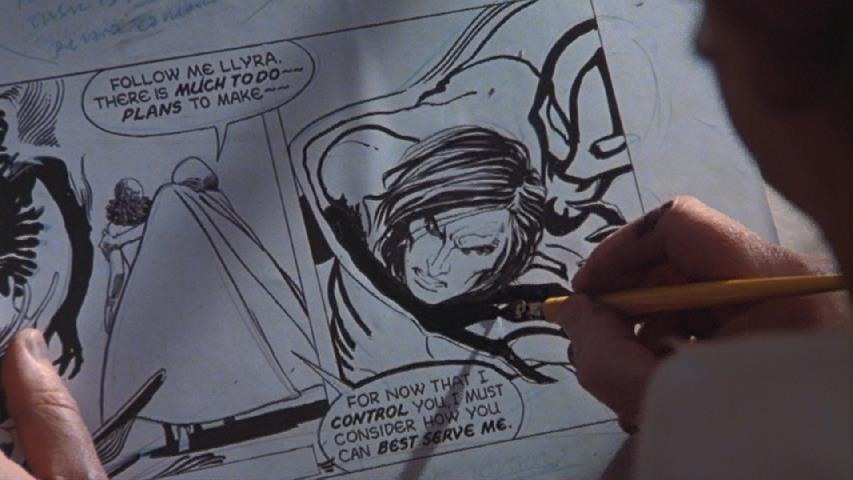
Jonathan Lansdale is a successful cartoonist, renowned for creating “Mandro,” a Conan the Barbarian-like comic strip.* One not-so-successful aspect of his life, however, is his crumbling marriage. In an early scene, he bickers with his wife Anne (Andrea Marcovicci) after she plans to rent an apartment in New York City, and their argument escalates in the car. The ensuing sequence illustrates, in spectacularly bloody fashion, why it’s not such a bright idea to stick your hand out the window of a moving car. She narrowly averts a head-on collision, but brushes a work truck, resulting in the loss of his hand, with said appendage flying away into the countryside. Jonathan begins the slow process of recovery, gradually becoming resigned to the fact that things will never be the same again. He’s fitted with a prosthetic hand, stronger than his original appendage, but without the same level of dexterity. Thus, begins his slow spiral into bitterness, isolation and insanity, as he contends with the loss of his livelihood. As his frustration and paranoia escalate, the people who cross him end up dead.** But is it Jonathan, or his lost hand?

* Fun Fact: It’s no mere coincidence that Mandro resembles Conan the Barbarian. The cartoonist who did the actual artwork for the movie is none other than Barry Windsor-Smith, who illustrated Marvel Comics’ Conan the Barbarian.

* Bonus Fun fact: Watch for a director cameo as a homeless person who becomes Lansdale’s first victim.


Caine does a fine job, as always, despite some questionable material. He captures his character’s sense of loss* and anguish as everything that belonged to him is stripped away. We also feel his exasperation as he attempts and fails to return to his art, and is relegated to teaching the art of cartooning to a class of apathetic college students. Ultimately, the problem with Jonathan is he’s a selfish, unyielding creep. He’s not likeable to begin with, so we can understand why his wife is searching for other outlets. He has an affair with Stella (Annie McEnroe), a young co-ed, but can’t tolerate learning that Anne is doing the same thing with her yoga instructor.

* According to Stone, the role was difficult on Caine, who felt emotionally drained by his character’s mental disarray.


The Hand aims for psychological suspense along the lines of Hitchcock or early Polanski (Stone said he was trying to emulate Repulsion) but misses the mark. Most of the film’s attempts at ambiguity seem too obvious and ham-handed (Egads, another pun). There are far too many shots of a fake-looking crawling hand. In some shots, which required more dexterity from the title appendage, Stone resorted to a “ninja shot,” with an actor’s real hand protruding from a black sleeve to create the illusion that it was disembodied. To his credit, Stone owns up to the film’s shortcomings in his DVD commentary. As a young director (this was his second film), Stone tried to balance the demands of the studio to present a shock-laden horror flick versus a subtle psychological thriller (a scene where a giant hand smashes through a plate glass window stretches credulity to the breaking point). He also acknowledges problems with some “less than inspired makeup” and poor lighting of scenes. While many of the effects are unconvincing, there are a couple of notable exceptions: while Jonathan is in the shower, one of the faucet knobs turns into a hand, and in a restaurant scene, a shellfish appears to come alive on a plate.


The Hand works best when it’s trying to get inside Jonathan’s fractured mind. The story is full of Freudian themes, including castration anxiety, and a battle between the id and ego, as exemplified by a climactic scene where Jonathan grapples with himself. Critics weren’t kind to The Hand upon its release. While it doesn’t quite deserve its reputation as an abject failure, it’s difficult to overlook its many faults. It’s a curiosity that doesn’t quite work, but you’ve got to hand it to Stone and Caine for the valiant attempt (Once again, I apologize for the puns. I’ll go now).

Saturday, March 10, 2018

Journey to the Beginning of Time


(1955) Directed by Karel Zeman; Written by: J.A. Novotný and Karel Zeman; Starring: Vladimír Bejval, Petr Herrman, Zdenek Hustak and Josef Lukás; Available on DVD (PAL, Region 0)

Rating: ****

“I made Journey to the Beginning of Time because I wanted to show the scale of nature, because I love it so much. It hurts me that the sense of romance is inevitably disappearing from our lives. The beauty of nature knows no equal.” – Karel Zeman (from DVD featurette, “Why the Film Was Made”)

Thanks to Ruth of Silver Screenings and Rich from Wide Screen World (https://widescreenworld.blogspot.ca/) for hosting the Time Travel Blogathon, a survey of cinematic excursions through time. Despite a multitude of obligations and projects, I realized there was no time like the present to discuss another fine offering from the brilliant filmmaker Karel Zeman, Journey to the Beginning of Time.  


I was a latecomer to the world of Karel Zeman, not having seen my first title from the Czech director/effects pioneer until a year ago, with The Fabulous World of Jules Verne (1958).* I was instantly hooked, and felt compelled to see more. Unfortunately, because Zeman hasn’t enjoyed the same name recognition as Ray Harryhausen, finding his movies can be a little tricky. Thanks to my local video store (may they never go out of business), I was able to find another title, albeit in the PAL format. Zeman acknowledged being heavily influenced by the works of Verne and French illustrator Gustave Doré, which provided the inspiration for his films. Journey to the Beginning of Time is no exception, with its obvious inclusion of Verne’s themes. The novel Journey to the Center of the Earth serves as the template, as the film’s protagonists attempt to duplicate the exploits of the fictional voyage. Zeman and crew brought their story to life through a combination of studio sets, and filming on location in Northern Bohemia in the Czech Republic, along with the river Waag in Slovakia.

* Please check out my review here. 

 
Four pre-teen boys, Peter (the leader and journal-keeper), Georgie, Jack and Tony set off on a voyage of discovery, through various prehistoric eras. The seed of their journey germinates after the kids wander around a natural history museum, lamenting the fact that they’re unable to view the ancient creatures as they existed, other than bones on display. Thus, the film builds on the premise: If they did it in the book, why can’t we? The intrepid young explorers travel through time in a boat.* The filmmakers aren’t interested in the mechanics of time travel,** only what the characters discover when they get there (Take that, modern era and time travel paradoxes! We’re voyaging through prehistory, and there’s nothing you can do about it.).

* Random Musing: I can’t help but wonder if Zeman influenced Sid and Marty Krofft to create Land of the Lost, which appeared two decades later.

** Fun fact: According to producer Karel Hutecka, the original concept for the film was a trip to the moon, but Zeman insisted on keeping the adventure on earth.


Some might be irked by Journey to the Beginning of Time’s deliberate pacing, but it’s more of a travelogue, as opposed to an action-packed, effects-laden thrill fest. The adventure is all about experiencing the discoveries that reside around the bend, as our intrepid explorers encounter strange beasts and lands from a bygone era. One refreshing aspect about Zeman’s film, compared to countless movies with similar content (King Kong, The Land Unknown, etc...), is the lack of trigger-happy characters. In most of these flicks the first impulse of the characters is to shoot the poor beasts. Our heroes, however, don’t possess the same blood-lust.* While we’re on the same track, I’m happy to report no one meets an untimely (and grisly) demise, although I was surprised Georgie, with his tendency to wander off from the group, wasn’t eaten by one of the many prehistoric beasts. This is probably for the best, since such a scene would have likely traumatized many of the intended audience members. While there are a few potentially life-threatening incidents, it’s all about the experience. After the kids have a close scrape with a giant, frightening bird Phorusrhacos, Peter speculates that this prehistoric bird formed the real-life basis for such mythical creatures as dragons and basilisks when people first found the remains of the bird.

* Peter commented, “Georgie wished we had a rifle, but it was better we hadn’t. We were on a scientific mission, not a safari. We just had to let nature be, and observe.”


Zeman and crew pull out all the stops, using all the tools in the toolbox to make the ancient flora and fauna come to life. Their effects work provides a distinctive look, with a unique blend of stop motion effects, paper cutout animation, puppetry and full-size mock ups. Instead of having the characters simply point to something off-screen, Zeman takes pains to integrate the characters into the footage. At once quaint and innovative, the effects style resembles book illustrations that have sprung from their two-dimensional boundaries. Zeman’s pastiche of techniques differs from Ray Harryhausen’s effects, but both approaches are admirable, and deserve to occupy the same pantheon.

 
This fanciful trip through various prehistoric eras (the journey begins and ends with a trilobite, representing 500 million years of evolution) is an informative primer on some of the many creatures that inhabited the various prehistoric eras. Starting with the ice age, we’re treated to scenes with a wooly mammoth and sabre toothed cats. As the voyage continues, we gradually make our way through stranger eras with more unusual creatures. There are some inaccuracies here and there (in one scene, the kids encounter a Brontosaurus – scientists are still debating whether this was a distinct species), but nitpicks aside, Journey to the Beginning of Time would be an excellent teaching tool, and an ideal departure point for a more detailed discussion of prehistoric earth. Much like The Fabulous World of Jules Verne, one could accuse the film of not having much of a plot, but the setting is the thing. There’s a childlike sense of wonder and naiveté to everything, which recalls the time of a kid’s life when everything still seems possible. It’s a delightful trip through time. Just don’t ask how they got there.

* In one scene, while admiring a particularly odd-looking species, Uintatherium, Peter explains to his cohorts (yeah, he’s the resident know-it-all) how scientific naming conventions employ Latin and Greek roots.