The Fly (1958) Directed by Kurt Neumann; Written by
James Clavell; Based on the short story by George
Langelaan; Starring: Al “David” Hedison, Patricia Owens, Vincent Price,
Herbert Marshall, Kathleen Freeman and Charles Herbert; Available on DVD and
Blu-ray
Rating: ****

The Fly (1986) Directed by David Cronenberg; Written
by Charles Edward Pogue and David Cronenberg; Based on the short story by
George Langelaan; Starring: Jeff Goldblum, Geena Davis and John Getz; Available
on DVD and Blu-ray
Rating: ****
“He was like an explorer in a wild country that no one
had ever been before. He was searching for the truth. He almost found a great
truth, but for one instant, he was careless.” – François Delambre (Vincent
Price)
“I'm an insect who dreamt he was a man and loved it.
But now the dream is over... and the insect is awake.” – Seth Brundle (Jeff
Goldblum)

The
Fly
(1958/1986) is part of a long tradition of the venerable science fiction
cautionary tales, depicting an intrepid researcher delving into mysteries we
were not meant to know. Essentially, it’s a contemporary re-telling of the myth
about Icarus, who flew too close to the sun, and paid the consequences for his
hubris. Distilled to their central theme, both films are about a brilliant
scientist who developed a revolutionary invention that will transport matter
from one place to another, rendering most other forms of transportation
obsolete. There’s just one catch, however.
In their zeal to forge ahead with their discovery, they neglect to
notice a fly in the ointment, or in this case, a fly in the teleportation
device. Man and fly are combined, with the scientist progressively losing his
humanity in the process. Oddly enough, both films are set in Canada, with the
1958 version, directed by Kurt Neumann,* set in Montréal, and the 1986 remake,
directed by David Cronenberg,** in Toronto (Cronenberg’s preferred city for
movie-making). While the 1958 film was considered a low budget production,***
filmed in only 18 days, The 1986 version**** was more moderately budgeted.
* Not-So-Fun Fact: Neumann passed away, just prior to
the 1958 film’s release.
** Fun Fact #1: Robert Bierman was originally set to
direct the remake because the producers’ original choice, David Cronenberg, was
attached to Total Recall for Dino De
Laurentiis. Due to a family tragedy, Bierman bowed out of the project, while
Cronenberg left Total Recall because
of creative differences with De Laurentis, and the rest is cinematic history.
*** Fun Fact #2: The original film’s budget of roughly
$400,000 was less than half the cost of Cronenberg’s salary for the remake.
**** Fun Fact #3: The iconic quote and tagline, “Be
afraid. Be very afraid” was based on producer Mel Brooks’ (Yes, that Mel Brooks) comments, after viewing
the dailies from a scene, which Cronenberg subsequently incorporated into the
script.

Aside from transplanting the proceedings from France
to Canada, Neumann’s version is the most faithful to Langelaan’s 1957 short
story (which originally appeared in Playboy
magazine). The 1958 movie plays like a mystery, utilizing a flashback approach
to gradually uncover why Helene Delambre (Patricia Owens) killed her husband,
Andre (Al “David” Hedison).* Cronenberg’s film uses the source material as a
departure point, rather than a template, letting the events unfold in
chronological succession. Outside of the science-gone-wrong story, it depicts a
love triangle between Dr. Seth Brundle (Jeff Goldblum),** Veronica (Geena
Davis), and her ex-boyfriend Stathis (John Getz). Both films share a common
thread, underscoring the complicated dynamics of love and loss. The tragic
elements work so well in the 1958 and 1986 versions, because we’re invested in
the likeable protagonists. Andre is an absent-minded genius, who’s also a
loving father and husband, while Seth Brundle is a brilliant, socially awkward
goofball who somehow makes the word “cheeseburger” sound inviting. Sadly, the
outcome for both is the same, although no matter how many times we may have
seen these movies, we always wish for a different outcome.
* Fun Fact #4: Before relative newcomer Hedison
accepted the role, it was offered to Rick Jason and Michael Rennie, who both
turned it down.
** Fun Fact #5: The character’s last name comes from
Formula 1 driver Martin Brundle. As a racing enthusiast, Cronenberg commented
that he often based character names after personalities in the sport.
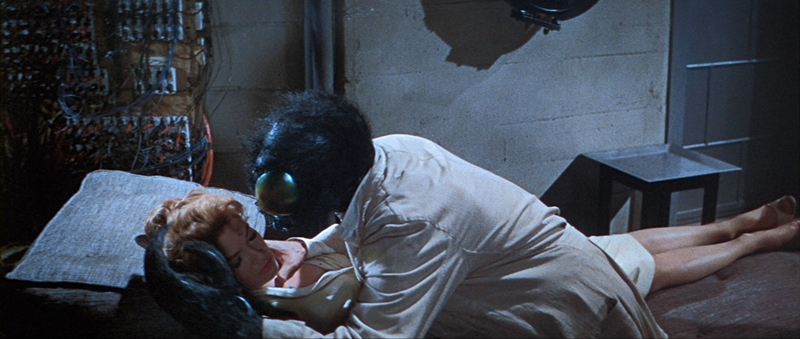
As in the original story, Andre’s post-accident body now features a fly’s head and front limb, while somewhere, buzzing about the Delambre family estate, is a fly with a human head and forearm. Although the prospect of switching heads with a common housefly is certainly unsettling, it’s not too difficult to imagine why the same approach would be considered too unsophisticated for ‘80s audiences, weaned on the realism of gritty ‘70s flicks. If you also factor in the numerous technological advances and leaps in genetic research, it becomes clear that the same story wouldn’t exactly fly (pardon the terrible pun). Instead, Cronenberg envisioned a fusion of man and insect: not two separate creatures but one being, which is the sum of its parts. Cronenberg also introduced a modicum of ambiguity to Brundle’s transformation, suggesting that not everything is necessarily bad. Initially, Brundle emerges from the transport pod seemingly unscathed. Teleporting himself could be equated to a drug, which increases his strength, agility and virility. It’s only later, as his body undergoes a metamorphosis, that the downside becomes apparent. On the other hand, the 1958 version leaves no wiggle room for debate – there’s no question that mixing a man and a fly is a terrible thing. As both movies also prove, the quest for knowledge is fraught with peril for animals as well. When Andre attempts to transport the family cat Dandelo,* it fails to reintegrate, instead becoming a string of atoms floating in space. Brundle’s poor baboon** test subject fares even worse, when he reintegrates, albeit with messy results.
* Fun Fact #6: In the original story, the unfortunate
scientist not only takes on the aspects of a fly’s anatomy, but sports some
feline facial features, due to a previous failed experiment with his family
cat, Dandelo.
** Fun Fact #7: Typhoon, the baboon took a liking to
script supervisor Gillian Richardson, becoming visibly (ahem) aroused whenever
she walked on the set.

It’s unfair to compare one visual approach versus the
other, since they’re the product of different eras and aesthetics. Andre’s
basement lab is a mass of flickering lights, neon tubes, and big dials,
surrounding two teleportation chambers* that resemble phone booths. Cronenberg’s
version features a much more industrial look, typified by the teleport pods.**
Instead of a house with a lab, Brundle lives in a warehouse fashioned into a
laboratory, with living space an incidental necessity. Likewise, the makeup
effects reflect two different decades. The idea of a man walking around with an
enormous fly head undoubtedly would have seemed more than a bit silly to
today’s jaded audiences, and would be more likely to elicit laughter rather
than chills. Ben Nye’s makeup is quite respectable for the time, and at the
very least, loads of fun to watch today. The opening scene remains quite
effective, with the shot of Andre’s body slumped over a hydraulic press, with a
profuse amount of blood running down the sides of the device – pretty strong
stuff by 1958 standards. Cronenberg interprets the source material in a
completely different way. After the fly is incorporated into Seth Brundle’s
body, he undergoes a gruesome (realized in appropriately icky detail by Chris
Walas and his team), often-painful transformation that appears to be a disease
at first. His body becomes something else, neither fly nor human, but
Brundlefly, a grotesque hybrid. His condition works as a metaphor for a
terminal degenerative illness*** – he’s powerless to stop the process, once the
DNA from both organisms has fused. His medicine cabinet becomes a collection of
discarded body parts, which he glibly refers to as the “Brundle Museum of
Natural History.”
* Some have likened the graphic progression of
Brundle’s condition to the AIDS epidemic of the 1980s. While this is certainly
a valid observation, Cronenberg’s intent, in his words, was to depict, “…the
inevitability of deterioration and death.”
** Fun Fact #8: Perhaps fortunately, the computing power required for teleportation is far beyond the capacity for current technology. According to a study by the University of Leicester, transferring a human would need 2.6 x 1042 bits of information (I’m not a math wiz, but that’s an enormous number). And that’s not counting the monumental amount of energy required to teleport a human. In short, it’s not very likely we’ll see such a device in our lifetime.
*** Fun Fact #9: The unique look of the teleportation pods was inspired by an unusual source, the cylinder head of Cronenberg’s Ducati motorcycle.

Another profound difference between the two films is how the protagonists convey information to the other characters. After the accident occurs, Andre loses the ability to speak, requiring Hedison as Andre, to pantomime throughout the remainder of the film. It’s a credit to Hedison that he’s able to convey so much emotion with movement. Cronenberg, however, didn’t want his main character rendered mute so early in the story, thus limiting Brundle’s ability to communicate with the other characters, and by extension the audience. For Cronenberg, it was crucial that Brundle was able to articulate the changes he was enduring.

The 1958 version of The Fly has a naïve, retro charm, requiring a healthy suspension of disbelief for maximum enjoyment. The image of a man with a fly head and leg remains one of the most memorable images from 1950s science fiction cinema, entrenched firmly in our pop culture consciousness. The 1986 version belongs to its own sub-genre best described simply as “Cronenberg,” reflecting his medical background, and fascination with “the flesh.” Brundle’s changes occur on a microcellular level, changing his genetic code, not simply grafting parts of a fly onto a human body (and vice-versa). The ’58 and ’86 films are so wildly divergent, there’s room for both. Each scratches a certain itch. The original is, at heart, an old-fashioned Saturday matinee monster movie for the kid in all of us, and what it does, it does very well. Cronenberg takes a more mature approach to the material for his version, exploring the deleterious effects of disease and toxic relationships. Which one is best depends on the eye of the beholder.
Sources for this article: Blu-ray commentary by David Hedison and David Del Valle; “Teleportation: Will It Ever Be a Possibility?” by Dave Hall, The Guardian (June 2018); Blu-ray commentary by David Cronenberg; Documentary, Fear of the Flesh: The Making of the Fly