Showing posts with label Anime. Show all posts

Monday, September 1, 2025

Animated August Quick Picks and Pans


Harvie Krumpet Poster

Harvie Krumpet (2003) Writer/director Adam Elliot’s stop-motion-animated short film introduces us to the bittersweet world of Harvie Krumpet, a Polish immigrant with Tourette’s Syndrome living in Australia (Geoffrey Rush provides the droll narration). Like many of Elliot’s other films, it’s a celebration of the outsider and their uniquely skewed perspective. Despite his struggles connecting with others, Harvie manages to carve his own niche in society. This brief but affecting portrait pushes all the right buttons, and is well worth a look (or two or three). 

Rating: ****. Available on Blu-ray (included in The Adam Elliot Collection), DVD, Kanopy and Tubi


The Tune Poster

The Tune (1992) Bill Plympton’s musical film celebrates the creative process as it intersects and clashes with commercialism. When he experiences the songwriter’s version of writer’s block, Del journeys to the musical town of Flooby Nooby to find inspiration and learn to sing from the heart. Plympton’s unique hand-drawn animation, takes the viewer in unexpected directions, with byzantine gags that build on each other. Will Del find his inspiration in time to please his demanding boss, and win the woman of his dreams? Watch and find out. 

Rating: ****. Available on Blu-ray, DVD and Tubi 

Blood Tea and Red String Poster

Blood Tea and Red String (2006) Christiane Cegavske’s exquisitely detailed stop-motion-animated film plays like a waking dream, skirting the barriers of consciousness. A group of birdlike people clash with mice over a life-size doll, while a frog shaman works his special brand of conjuring. Blood Tea and Red String uses fairy tale tropes to tell its unique story about infatuation, greed and togetherness.   

Rating: ***½. Available on

Phantom Boy Poster

Phantom Boy (2015) Alex, an 11-year-old boy undergoing chemotherapy, becomes an unlikely partner for an injured police detective when he discovers the ability to leave his body. When a super criminal vows to take control of New York City, Alex scours the streets for clues that might break the case. Jean-Loup Felicioli and Alain Gagnol’s French-animated feature is about summoning your inner strength, even when you feel powerless. 

Rating: ***½. Available on Blu-ray, DVD and Kanopy


Hana and Alice Poster

The Murder Case of Hana and Alice (2015) After her parents’ divorce, Tetsuko Arisugawa (“Alice”) moves to a small town with her mother. As the new kid at her middle school, she arrives to a mystery, under the watchful eye of a shut-in former student, Hana. Shunji Iwai’s gentle tale of friendship separates myth from reality, as Alice contends with bullying classmates and reticent locals to learn the truth about a classmate’s alleged death.   

Rating: ***½. Available on Blu-ray, DVD and Tubi 

Bubble Bath Poster

Bubble Bath (aka: Habfürdö) (1980) In this fun, if slight, Hungarian musical oddity, Zsolt gets cold feet over his impending marriage to Klára, taking refuge in his friend Anna’s apartment. Complications ensue when Klára pays Anna a visit, and memories and feelings are brought to the surface. Will Zsolt marry the capricious Klára or run off with amiable Anna? Looking a bit like a lost sequel to Yellow Submarine, Bubble Bath features silly songs and hallucinogenic animation that makes me wonder what kind of substances they were smuggling behind the Iron Curtain during that time.   

Rating: ***. Available on Blu-ray and Tubi


Wednesday, January 25, 2023

Japan-uary XII Quick Picks and Pans

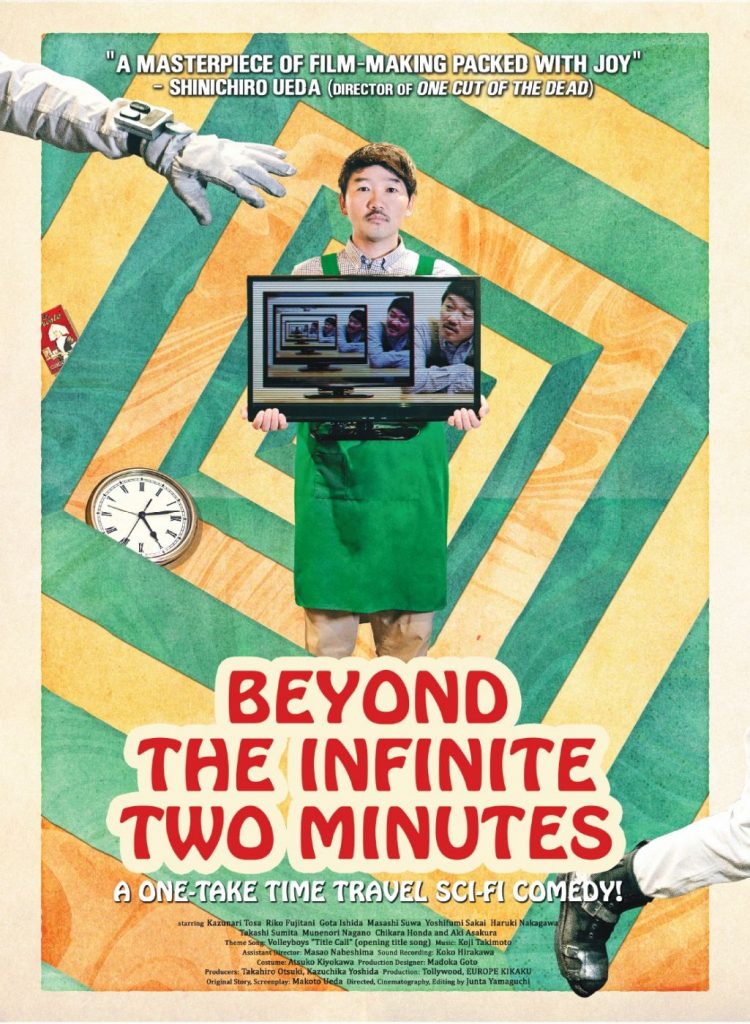
Beyond the Infinite Two Minutes Poster

Beyond the Infinite Two Minutes (2020) In this clever sci-fi/comedy, Kato (Kazunari Tosa), a coffee shop owner, inadvertently discovers the means to see events two minutes in the future via his home computer. Soon, his friends and plucky co-worker attempt to   delve further into the mysteries of accidental time travel. But as they continue to monkey around with the new experience, events begin to cascade, and they’re sucked into a loop of correlation and causality, replete with paradoxes. Director Junta Yamaguchi confines the action to one building, but this limitation never seems restrictive or redundant, in a story that milks the concept for all its worth.   

Rating: ****. Available on Blu-ray, DVD, Amazon Prime and Tubi


The Legend of the Stardust Brothers Poster

The Legend of the Stardust Brothers (1985) Writer/director Macoto Tezuka’s lively musical/comedy ponders the ephemeral nature of fame and the fickleness of fandom. Rival musicians Shingo (Shingo Kubota) and Kan (Kan Takagi) strike a Faustian bargain with a shadowy producer to become the manufactured pop duo, the Stardust Brothers. Their chaotic rise and fall is told through a string of music videos. The results are an inspired combination of The Monkees, Get Crazy, and Phantom of the Paradise (in case you missed the copious references, the film is dedicated to Winslow Leach). It’s at once a pastiche of music star movies and a self-aware parody of pop music, but even that description is selling it short. You almost need a license to appreciate this much fun. 

Rating: ****. Available on Blu-ray, DVD and Tubi


Passing Fancy Poster

Passing Fancy (1933) In this charming silent comedy/drama from Yasujirō Ozu, middle-aged layabout Kihachi (Takeshi Sakamoto) helps Harue (Nobuko Fushimi) a young woman down on her luck get a job at a local tavern. Although Kihachi is smitten by her charms, it’s clear that Harue prefers his younger, cynical companion Jiro (Den Ôhinata).  Passing Fancy features nuanced performances by its talented cast, including Tomio Aoki as Kihachi’s crafty son Tomio, and Chôko Iida as the cheery but world-weary tavern owner Otome. It’s a bittersweet study of humanity during trying times, as only Ozu can present it.   

Rating: ****. Available on DVD (part of the Eclipse Silent Ozu collection)

The Ghost of Yotsuya Poster

The Ghost of Yotsuya (1959) Iemon (Shigeru Amachi) is a brash rōnin, who lusts after Oiwa (Katsuko Wakasugi), the daughter of a nobleman. After he’s denied Oiwa’s hand in marriage, Iemon kills her father in a fit of rage. It all goes downhill from there, when he murders Oiwa so he can marry another woman. Iomen soon discovers, however, that what goes around comes around when Oiwa’s bloody ghost exacts her terrible revenge. Director Nobuo Nakagawa‘s (Jigoku) Edo-period supernatural film provides ample thrills, with oodles of atmosphere and genuinely chilling imagery. 

Rating: ****. Available on DVD (Region 2)

Black Cat Mansion Poster

Black Cat Mansion (1958) In another excellent horror fantasy from director Nobuo Nakagawa (based on a novel by Sotoo Tachibana), Yoriko (Yuriko Ejima), a woman suffering from tuberculosis, is brought to her ancestral mansion to convalesce. She starts experiencing a number of disturbing occurrences, including a strange old woman who seems committed to her destruction. Things are complicated by her husband (and physician), Dr. Kuzumi (Toshio Hosokawa), who thinks it’s all in her imagination. In a flashback, we learn the mansion is the site of an old curse, targeted against the cruel samurai who once lived there. There are some nice creepy moments, as a cat spirit takes revenge on the samurai’s descendents (including Yoriko), although the film’s conclusion is a bit too abrupt. 

Rating: ***½. Available on DVD (Region 2)


Nightmare Detective Poster

Nightmare Detective (2006) Kyoichi (Ryûhei Matsuda) is a deeply troubled man with the ability to enter people’s dreams. He reluctantly assists Keiko (Hitomi), a young police detective, to help solve a case involving people who have suddenly been driven to suicide. The deaths are linked to a mysterious phone message by someone named “O.” In her quest for the truth, Keiko enters a dangerous game of cat and mouse with the suspect, in the twisted world of her dreams. Director/co-writer Shin'ya Tsukamoto’s supernatural horror film drags a bit in the middle, but the slow build-up leads to an energetic finale.   

Rating: ***½. Available on DVD

Bright Future Poster
Bright Future (2002) Yuji (Joe Odagiri) and Mamoru (Tadanobu Asano) are factory workers/friends with a relationship not unlike George and Lenny from Of Mice and Men. Emotionally stilted Yuji is unable to pick up on social cues, while his friend guides him through the complexities of human interaction. One day, Mamoru is arrested for the vicious murder of their employer, leaving his pet jellyfish to Yuji. The venomous jellyfish serves as a metaphor for Yuji’s emancipation from his codependence – like the creature, he’s suddenly out in the world on his own, opening himself to harm and harming others. Writer/director Kiyoshi Kurosawa’s film works best as a character study with poetic flourishes, rather than a linear narrative with a redemptive character arc.  

Rating: ***½. Available on DVD

Ocean Waves Poster

Ocean Waves (1993) Tadanobu Asano’s coming-of-age drama (based on a novel by Saeko Himuro) follows two high school friends, Taku and Yutaka who gradually drift apart over a new girl in town, Rikako. While the film takes pains to illustrate Rikako’s fractured home life, it does little to engender much sympathy for her character, who comes across as shamelessly manipulative and self-centered. It’s also hard to feel sorry for Taku, who continues to go along with her schemes. This Studio Ghibli television production is a step down from its theatrical releases, lacking the meticulous attention to detail and enjoyable characters we’ve come to expect from the animation house. It might be worth a look if you’re a Ghibli completist, but compared to the studio’s best, it rings hollow. 

Rating: ***. Available on Blu-ray and DVD


Killer Car Poster

Killer Car (aka: Ju-on Car) (2008) A more accurate title for this derivative horror flick would probably be Cursed Minivan, but that doesn’t quite have the same ring to it. A group of 20-somethings take a road trip to a secluded waterfall in a second-hand Nissan Elgrand. Unfortunately for the new owner and his passengers, the vehicle once belonged to a serial killer (established in an unnecessarily grisly prelude), and one of the victims now haunts the car. None of it makes a lot of sense, but Killer Car’s worst flaw is that the ensuing attacks seem completely pointless (why would the victim’s ghost attack innocent people instead of the man responsible for her death?). There’s a quick nod to The Texas Chainsaw Massacre, but that’s about the extent of what passes for inspiration in this movie. 

Rating: *½. Available on Tubi  


Monday, January 31, 2022

Japan-uary XI Quick Picks and Pans

The Night is Short, Walk On Girl Poster

The Night is Short. Walk On, Girl (2017) Masaaki Yuasa’s delightful animated film (based on the novel by Tomihiko Morimi) is a surefire cure for what ails you. Over the course of one night, we follow the exploits of unflappable coed Kōhai (meaning “Junior”), as she enters a drinking competition with a group of retirees, foils a middle-aged pervert, and searches for a cherished lost book from her childhood. Throughout the night, she’s pursued by Senpai (an upperclassmen), who hopes to win her affections. The film’s style is as colorful and fanciful as its ebullient protagonist, possessing an irresistible energy. Don’t look for any profound messages, except perhaps to refute George Bernard Shaw’s proclamation that youth was wasted on the young. It’s nothing more or less than a celebration of the joys of being alive – something we could all use right now. 

Rating: ****. Available on Blu-ray and DVD 

Wool 100% Poster

Wool 100% (2006) Writer/director Mai Tominaga’s modern fairy tale concerns two elderly sisters, Ume and Kame (played by Kyōko Kishida and Kazuko Yoshiyuki, respectively) who live alone in a big house, filled with junk. Ume and Kame collect more junk on their daily rounds, meticulously cataloguing their discoveries in scrapbooks. Their life takes an odd turn when a strange young girl (Ayu Kitaura) with a compulsion for knitting red yarn appears in their home. Tominaga’s often whimsical, visually playful film (complemented by a wonderfully eclectic score) examines the prisons we construct for ourselves, through the comfort and trap of ritual. 

Rating: ****. Available on DVD.

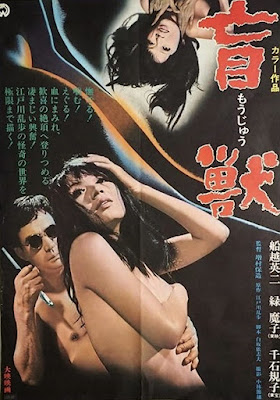
Blind Beast Poster

Blind Beast (1969) With the help of his mother (Noriko Sengoku), blind sculptor Michio (Eiji Funakoshi) kidnaps an artist’s model Aki (Mako Midori), so he can create his latest form of expression. As Aki descends into Michio’s world, she begins to come around to his way of thinking, where pleasure and pain are intertwined. It’s frequently difficult to watch, but more difficult to look away from this twisted tale of obsession by director Yasuzô Masumura’s (Giants and Toys, Black Test Car), based on a story by Rampo Edogawa. One of the highlights is Michio’s studio, populated with oversized sculptures, representing various parts of the human anatomy. The unforgettable conclusion is at once inevitable and tragic.    

Rating: ***½. Available on Blu-ray and DVD

Intimidation Poster

Intimidation (1960) Two childhood friends, Matakichi and Kyosuke (Kô Nishimura and Nobuio Kaneko), work for the same bank, but their careers have followed divergent paths. While the clever, sweet-talking Kyosuke has followed an upward trajectory, with a promotion to assistant director, his meek colleague has languished as a lowly clerk (much to the ire of his sister, who was dumped by Kyosuke). All is not as rosy as it seems for Kyosuke, who owes a small fortune from fraudulent loans (he must pay a would-be blackmailer 3 million yen, or suffer the consequences). This briskly paced neo-noir from director Koreyoshi Kurahara packs a lot in 65 minutes, with excellent performances by the leads, and a series of surprising plot twists. 

Rating: ***½. Available on DVD (part of the Criterion Eclipse Series The Warped World of Koreyoshi Kurahara)

Seance Poster

Séance (2000) Director/co-writer Kiyushi Kurosawa’s (no relation to Akira) slow-burn supernatural thriller (based on Mark McShane’s novel, Séance on a Wet Afternoon) creeps under your skin, with its meditation on the nature of guilt. Kôji Yakusho and Jun Fubuki play emotionally distant married couple Sato and Junko. When a little girl disappears, Junko views this as a perfect opportunity to apply her clairvoyant skills. When their plans go awry, Sato and Junko conspire to retain a semblance of normalcy, but the truth gnaws away at their conscience. Séance is a sobering look at the darkest depths of the human soul, painfully illustrating the disastrous consequences of compromising responsibility for selfishness.   

Rating: ***½. Available on DVD

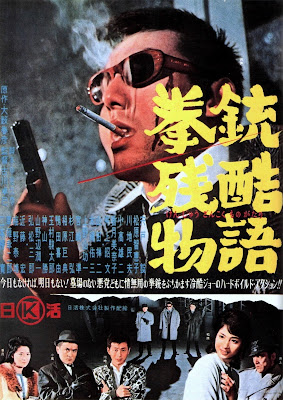
Cruel Gun Story Poster

Cruel Gun Story (1964) Takumi Furukawa’s fast-paced noir thriller features Jô Shisido as Joji Togawa, a career criminal freshly sprung from prison. Against his better judgment, he accepts a challenge to lead a small team to rob an armored car carrying 120 million yen. When he’s betrayed by the mob boss who hired him, he plots his revenge. Joji approaches his work with ice-cold precision, but has a soft spot for his disabled sister. Shisido is perfect as a criminal with a strict code of honor, maintaining his integrity in a world typified by double crosses and other dirty dealings. 

Rating: ***½. Available on DVD (part of the Criterion Eclipse series Nikkatsu Noir)

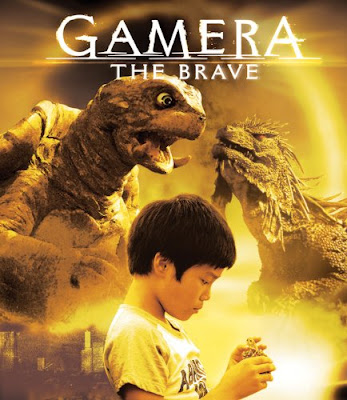
Gamera the Brave Poster

Gamera the Brave (2005) The latest Gamera flick to date might irritate some hardcore fans accustomed to the exceptional ‘90s trilogy, but I enjoyed this intentionally lower-key, kid-friendly outing. Instead of picking up where the trilogy left off, it’s a reboot of sorts harkening back, in spirit, to the original series of films with the giant turtle, when he was the friend of all children. A young boy, Toru (Ryô Tomioka) discovers an egg sitting atop a glowing red crystal, and takes it home (you can probably guess the rest). This version of Gamera is a smaller, gentler (And dare I say, cuter?) version of the eponymous kaiju hero. It’s somewhat of a letdown that he fights a rather generic enemy, but the human characters (particularly Toru’s father, Kousuke) are fairly well fleshed out. While it’s not exactly the sequel most of us wanted, it’s diverting enough.           

Rating: ***. Available on Blu-ray, DVD and Amazon Prime

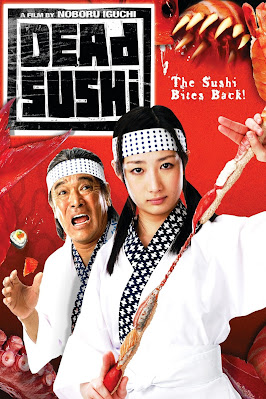
Dead Sushi Poster

Dead Sushi (2012) Keiko (Rina Takeda), a budding young sushi chef, runs away from home after she tires of her father’s criticism. She takes a job as a server at an inn, which is hosting a company retreat. Unbeknownst to Keiko, the deposed company founder, seeking revenge against his former teammates, turns his experimental serum on their sushi, with deadly consequences. Writer/director Noboru Iguchi keeps everything suitably over the top (if you’re familiar with some of his other work, including Machine Girl and Robogeisha, then you likely know what you’re in for). Expect lots of tasteless sight gags (with an occasionally clever joke thrown in, for good measure) and a surprising amount of heart. You might never look at sashimi the same way again. 

Rating: ***. Available on Blu-ray, DVD and Tubi

Monster Seafood Wars Poster

Monster Seafood Wars (2020) A young biochemist develops a substance that will make animals grow to gargantuan proportions, resulting in an ordinary octopus, squid and crab transforming into kaiju. While they threaten the population of Japan, they have an unintended side effect – they’re also delicious. Writer/director Minoru Kawasaki’s (The Calamari Wrestler, Executive Koala) applies his signature goofy, no-budget approach to his kaiju tale. It’s a couple of notches below his best, but it’s not without its moments. It never takes itself too seriously, gently poking fun at tokusatsu movies, while embracing them. The pacing, however is inconsistent, and the story (which is probably a bit too deadpan for its own good) could have used a few more jokes. 

Rating: **½. Available on Blu-ray, DVD and Amazon Prime


Monday, February 1, 2021

Japan-uary X Quick Picks and Pans


Ugetsu Poster

Ugetsu (aka: Ugetsu monogatari) (1953) Director Kenji Mizoguchi’s Feudal-era yurei (ghost) story resonates with the viewer long after it’s over. Genjurô (Masayuki Mori), a poor pottery maker dreams of making a fortune selling his wares in the big city. After evading roving samurai and thieves, he leaves his wife and young son behind, with his business partner in tow. Genjurô’s pottery catches the eye of a widowed noblewoman, Lady Wakasa (Machiko Kyô), and becomes smitten by her formidable charms. He soon finds a taste for his newly gained prosperity, but (as these stories often go) he learns that she may not be all she seems. Mizoguchi relies on the strength of its performances in place of special effects to convey this sad tale of greed, loyalty and loss.

Rating: ****. Available on Blu-ray, DVD and Kanopy

Tokyo Drifter Poster

 
Tokyo Drifter (1966) Seijun Suzuki’s ultra-stylish crime drama is a bold exercise in transforming a familiar story into something brand new. “Phoenix Tetsu” Hondo (Tetsuya Watari) is a former Yakuza enforcer working for his old boss’ company. He gets in hot water when he foils the plans of rival boss Otsuka (Eimei Esumi) to sabotage his employer. Deciding enough’s enough, he sets out on his own, and now both sides want him dead. Hondo discovers an unlikely friend in former rival, Tatsuzo, The Viper (Tamio Kawaji). Tokyo Drifter continually surprises with its unconventional main character (How many times have you heard a protagonist sing his own theme song?), expressionistic flourishes, and eye for stunning visuals. And thanks to Criterion’s recent transfer, the colors simply pop.

Rating: ****. Available on Blu-ray and DVD 

Departures Poster

Departures (2008) Daigo Kobayashi (Masahiro Motoki), a professional cellist, finds himself unemployed after his orchestra goes broke, and is forced to move home and find a new occupation. He answers an ad for a job opening, unaware that “departures” refers to preparing the dead for burial, rather than a travel agency. Kobayashi reluctantly accepts the position, at the urging of his new boss Ikuei Sasaki (Tsutomu Yamazaki), but struggles with self-doubt, public scorn and his wife Mika’s (Ryôko Hirosue) disapproval. Eventually, however, he begins to appreciate the work on its own terms, treating the deceased and their families with dignity. Yôjirô Takita’s thoughtful film (enhanced by Joe Hisaishi’s affecting music score) takes its time introducing us to an elaborate funeral ritual that seems to be largely unknown in Western culture. It’s not only a poignant commentary about how society keeps death at arm’s length, but also finding yourself and your calling.  

Rating: ****. Available on DVD and Tubi 

Black Test Car Poster

Black Test Car (1962) Yasuzô Masumura’s neo-noir plunges us into the high-risk world of industrial espionage between two competing car firms, Tiger Motors and Yamoto. Jirô Tamiya stars as up-and-coming executive Yutaka Asahina, who’s been tasked by his employer (Tiger) to spy on their competitor. Asahina and his team using any means necessary (including intimidation, blackmail, and sexual favors) to extract information about Yamoto’s new sports car design. In the process, he learns the true cost of climbing the corporate ladder. Black Test Car provides a scathing, deeply cynical glimpse into human nature, viewing business competition as a Darwinian struggle.  

Rating: ***½. Available on Blu-ray and DVD


Vital Poster

Vital (2004) Writer/director Shin'ya Tsukamoto’s (Tetsuo: The Iron Man) meditative film about the fickle properties of memory and mourning will likely haunt you for days. A young man awakens from a coma after suffering a fatal car crash that claimed the life of his girlfriend. Along with his recovery comes the renewed desire to attend medical school. In a cruel (or fortuitous, depending on your point of view) twist of fate, the cadaver on his dissecting table is his former girlfriend Ryôko (Nami Tsukamoto). What would have been the twist ending from a less skilled filmmaker becomes merely a beginning for Hiroshi’s self-discovery, as his memories gradually return. The unrelentingly morbid themes and convincing (but never exploitive) makeup effects make this a difficult but engrossing watch.

Rating: ***½. Available on Kanopy

The Vampire Doll Poster

The Vampire Doll (1970) A man (Atsuo Nakamura) returns from business abroad to discover that his girlfriend Yûko (Yukiko Kobayashi) has died. He soon discovers, however, that she might not be quite as dead as he’s been led to believe. After he goes missing, his sister Keiko and her boyfriend Hiroshi (Kayo Matsuo and Akira Nakao, respectively) investigate the strange goings on at Yûko’s secluded ancestral home. The first in a trilogy of vampire films from director Michio Yamamoto (followed by Lake of Dracula and Evil of Dracula), moves at a leisurely pace, but makes up for any deficits with a macabre, brooding tone and set designs that wouldn’t be out of place in a Hammer production.* While it may be the weakest of the trilogy, it’s well worth seeing for oodles of gothic atmosphere and some genuinely creepy moments.

* Fun Fact: A Toho/Hammer co-production, Nessie (about the elusive cryptid), was planned in the mid-70s, but sadly never reached fruition.

Rating: ***½. Available on Blu-ray and Amazon Prime 

Junkers Come Here Poster

Junkers Come Here (1995) This pleasant albeit slight anime film chronicles the adventures of 11-year-old Hiromi and her talking schnauzer Junkers. The film contains some charming scenes between the girl and her dog, while juggling some serious themes about absentee parents and divorce. The film never quite strikes the right balance between the more fantastical elements (Junkers grants Hiromi three wishes), and the reality of Hiromi’s life. Ultimately, Junkers Come Here glosses over the more unsavory aspects of Hiromi being stuck in a tug-of-war between her emotionally neglectful parents, leading to a (Spoiler Alert!) climactic sort-of reconciliation between the parents that rings hollow. It’s not quite at the level of Studio Ghibli story-wise or artistically, but it’s a pleasant enough film (if you don’t think too long about the implications of the trite ending) for most of its running time, and should at least spark some discussion from families that may watch this together.

Rating: ***. Available on DVD and Tubi

Kidan - Piece of Darkness Poster

Kidan: Piece of Darkness (2016) Most anthology horror movies are a mixed bag, and this one is no exception. But even if not all 10 stories (confined to a brisk running time of 100 minutes) are winners, you don’t have to wait very long for the next segment to come along. Some favorite stories include: a shadowy visitor that terrifies a middle-aged woman; a schoolteacher who’s tormented by his former lover; and a young woman who inadvertently finds a novel way of getting rid of excess baggage. Although Kidan relies on some tired tropes (Creepy long-haired woman? Check.), there’s enough to recommend this for a few well-placed thrills.

Rating: ***. Available on Amazon Prime

Terra Formars Poster

Terra Formars (2016) Takashi Miike’s live-action adaptation of the popular manga/anime show is entertaining in spots, but mostly exhausting. In the year 2499, Mars has been terraformed, but the cockroaches that were brought from Earth have mutated and evolved into powerful (and deadly) humanoid creatures. A group of convicted criminals are sent to the red planet to rid the landscape of the creatures, opening the door for human colonization. The non-stop pace doesn’t leave time for strong characterizations or a lot of dialogue beyond the expository variety. While there are few surprises, one fun conceit is that each of the human crew has been modified with insect DNA (yep, one has inherited the properties of the Japanese Giant “Murder” hornet) to combat the bipedal bugs. There’s some good effects work, but the action is far too repetitive, and the film’s gaping plot holes are never addressed (i.e., If they were supposed to be expendable, why were they given the means to return to Earth?). It may be worth a look, if you’re in an undemanding mood.   

Rating: **½. Available on Blu-ray, DVD and Tubi

Nezulla the Rat Monster Poster

Nezulla: The Rat Monster (2002) In their efforts to create soldiers resistant to biochemical warfare, U.S. Army scientists accidentally unleash a hideous rat creature, along with a deadly virus. A crack team of “American” soldiers and one Japanese officer are sent in to destroy the monster and obtain a sample to create an antivirus. There’s a fine line between low budget and cheap, which this movie crosses. Most of the action is confined to an abandoned industrial building, and the barely mobile titular creature fails to evoke anything beyond sympathy for the poor schmoe who had to wear the costume. Skip it.

Rating: **. Available on DVD

Wednesday, January 27, 2021

Summer Days with Coo (aka: Kappa no Kû to Natsuyasumi)


Summer Days with Coo Poster

(2007) Written and directed by Keiichi Hara; Story by Yuichi Watanabe and Masao Kogure; Based on the stories "Kappa Daisawagi" and "Kappa’s Surprise Journey," by Masao Kogure; Starring: Kazato Tomizawa, Takahiro Yokokawa, Naoki Tanaka, Naomi Nishida, Tamaki Matsumoto and Natsuki Uematsu

Available on Blu-ray and DVD

Rating: ****

“For anime, the topic of family… That topic is not very appropriate for anime, that’s what many people think. But I’m more interested in that than in fantasy or science fiction. I want to depict the family, human beings, human drama (ningen drama).”

– Keiichi Hara (from 2011 interview with Nippon Connection TV)

Many thanks to Gill of Realweegiemidget Reviews and Rebecca of Taking Up Room for hosting the Home Sweet Home Blogathon, focusing on all things related to home and family. Be sure to check out all the excellent contributions. Today’s selection focuses on a rather unique addition to one family…

Kôichi and Coo

Anyone who follows this blog probably already knows about my fondness for everything yokai (mythical creatures that reside throughout Japan). There have been many depictions of yokai in Japanese popular culture over the centuries, but perhaps none have appeared as extensively as the elusive water sprite known as kappa.*/** Descriptions vary somewhat, but some constant features include a bipedal, vaguely human shape, with a beaklike mouth, a dish on top of their head (which must continually remain wet for the creature to keep its strength up), and a turtle shell on their back. Some notable depictions in film include 1968’s Big Monster War (aka: Yôkai Daisensô) and its 2005 remake, The Great Yokai War (aka: Yôkai Daisensô), along with the more adult-oriented, Underwater Love (2011). Writer/director Keiichi Hara’s fantasy family drama Summer Days with Coo, was based on two stories by children’s author Masao Kogure.

 * Fun Fact: The town of Tono, located in Iwate Prefecture, is generally regarded as the capital for Japan’s famous water sprite, with statues and tourist attractions dedicated to kappa.

 ** Another Fun Fact: For more about kappa and their numerous yokai brethren, I highly recommend the book Yokai Attack! The Japanese Monster Survival Guide, by Hiroko Yoda and Matt Alt.


Kôichi and stone

Kôichi Uehara is an ordinary grade-school boy whose life take an extraordinary turn when he finds an unusual stone by a river that runs through his neighborhood. Trapped inside the large rock is a shriveled, almost reptilian creature. After taking his prize home, he runs the stone underwater to clean it off, inadvertently reviving the creature. Kôichi names him “Coo,” after the first sound he makes. Kôichi’s parents soon conclude that the creature is a young kappa,* and the family members conspire to keep the kappa secret from the outside world. But a secret this big can only be kept so long. Much to their dismay, Coo becomes a reluctant star, creating a media circus around the Uehara household.

Fun Fact #3: Summer Days with Coo is like a class in Kappa 101, delving into many aspects of these fascinating yokai, including a fondness for sumo-style wrestling, eating cucumbers, and their flatulent nature (yes, it’s a kappa thing).

Coo Wrestling

At its core, the film illustrates how everyone fits into the family unit, no matter how disparate the separate elements might seem. One of the more surprising things (at least for anyone accustomed to more formulaic fare) is how readily the parents accept the surprise addition. In most lesser stories there would be contrived friction between the family members, but they are truly a team when they meet adversity. Among the most believable aspect is the initial resistance from Kôichi’s little sister Hitomi. Unlike the rest of her family, she takes an instant dislike to Coo, viewing him as an interloper who’s only there to steal her thunder. Her animosity comes to a head when Coo is given her old baby chair to sit at the dinner table, which looks an awful lot (at least to a preschooler) like replacement. When Coo finally does win her over, it’s a hard-fought battle, with a small but meaningful gesture of kindness. The family dog Ossan (meaning “Old Man”),* completes the family, fitting into the greater scheme of things, guiding Coo with wisdom from his world-weary canine perspective.

* One caveat: The brief flashback scene concerning Ossan’s former abusive owner was difficult for me to watch, and I suspect many may find this disturbing. Although the scene provides context for Ossan’s worldview, it seems to downplay the behavior of the abuser, which might warrant further discussion if watching with more impressionable family members.

Kôichi and Sayoko

 Our emotions are earned rather than manipulated, because we gradually get to know the characters on their own terms. As he’s introduced to us, Kôichi isn’t especially likable, but as we spend more time with him, we get to understand his perspective, and come to like him as his character experiences growth. For more than half the film’s duration, Kôichi is aloof with fellow classmate Sayoko, keeping her at arm’s length, but they have more in common than he initially realizes. Both are loners, introspective and sensitive. Sayoko seems to understand Coo more than he does. It takes him a while to catch on that they’re two of a kind, and that Coo, himself, is a loner. His fellow kappa have vanished, and he’s lost in a world where his kind are regarded as myth.

Coo and Father's Arm

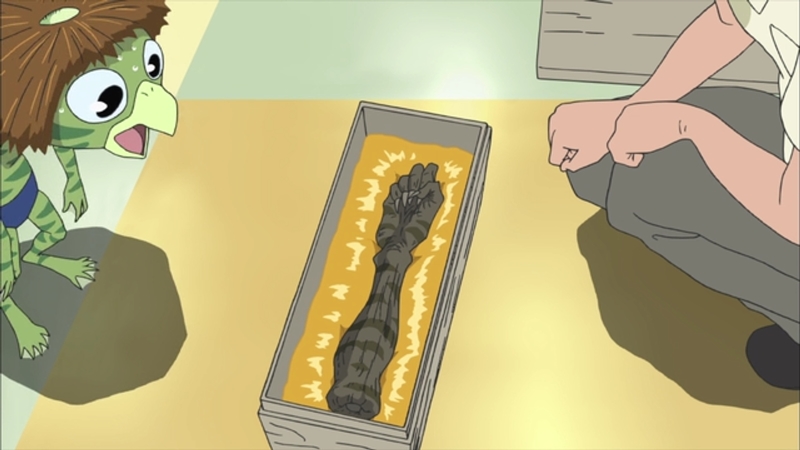
Summer Days with Coo is all about contrasts, including cruelty versus kindness, life versus death, and selfishness versus selflessness. The kindness of Kôichi’s parents is contrasted with the cruelty of the boys that mercilessly taunt Kôichi and Sayoko. Eventually, Kôichi finds a way to confront the bullies’ ringleader, recalling Coo’s admonition (during one of their wrestling matches) that “Strength alone isn’t good.” The film proves repeatedly how Coo’s inherent distrust in humanity instilled by his father is well-founded. In the opening scene, set hundreds of years ago in the Edo period, he witnesses his father’s murder at the hands of a paranoid samurai. When he appears on a television program, an historian (a direct descendent of the samurai) displays his father’s severed arm as a treasured heirloom, which only serves to reinforce Coo’s trauma of witnessing his father’s unwarranted death. The historian’s denial that the arm has any connection with Coo’s past is a grim reminder that history is told by the victors, rather than the vanquished. Another recurring theme is life out of balance. Recalling words his father once told him, Coo observes how humans have taken the natural world from the kappa, “…But in return they lose their souls.” Coo fears losing his way in the world and his identity.


Coo and Uehara Family

Director Keiichi Hara has created something truly special with Summer Days with Coo, tugging at our heartstrings without resorting to saccharine levels of sentimentality. His film reminds us the world may be cruel at times, but there are wondrous things as well. Unlike some popular (particularly American) animated films aimed at families, it doesn’t sugarcoat the more unsavory aspects of life, presenting serious topics in a frank manner. At a length of 138 minutes, it takes its time allowing us to know the characters, but doesn’t waste a moment. It’s time well spent, as we become invested in the Uehara family and Coo. Summer Days with Coo stresses the importance of unconditional love, preserving our traditions, and gratitude to those who have shown us kindness, but above all, being true to yourself.


Sources for this article: Yokai Attack! The Japanese Monster Survival Guide, by Hiroko Yoda and Matt Alt; 2011 Keiichi Hara interview with Nippon Connection TV; “On the Hunt for Tono's Mythical Water Trolls,” by Louise George Kittaka, The Japan Times, July 26, 2014 

Sunday, January 10, 2021

Perfect Blue


Perfect Blue Poster

(1997) Directed by Satoshi Kon; Written by Sadayuki Murai; Based on the novel Perfect Blue: Complete Metamorphosis, by Yoshikazu Takeuchi; Starring: Junko Iwao, Rica Matsumoto, Shinpachi Tsuji and Masaaki Ôkura; Available on Blu-ray and DVD

Rating: ****

“I don’t think that it’s too confusing or difficult to understand. Actually, we originally planned to make it easier for the audience to understand what was going on, and then we decided to keep them guessing a little, to draw their own conclusions using their own imaginations. In the end, I think we were right in keeping the audience guessing and leaving them to use their imaginations rather than spelling everything out for them.” – Satoshi Kon

“But maybe she is more like me than myself. My other self that I buried deep within my heart. What if that other personality suddenly started acting on its own?” – Mima Kirigoe (Junko Iwao)

Note: This is an expanded version of a capsule review from August, 2018. 

Perfect Blue - CHAM

Although Satoshi Kon’s career was cut tragically short, he left behind a body of work that inscribed an indelible mark on the anime world. His films engaged the brain as well as the eyes, with characters that appeared fully fleshed out, and stories that frequently questioned reality. His debut feature, Perfect Blue, is no exception, with its mind-bending exploration of the dark side of fame and the perils of living under the constant scrutiny of the public eye.

Perfect Blue - Mima's Room

In the opening scene, we’re introduced to Mimarin “Mima” Kirigoe, part of the pop trio, CHAM. It’s Mima’s final concert before she embarks on her acting career, joining the cast of a popular psychological crime drama Double Bind. As we soon learn, it’s not so easy to leave her pop idol past behind. Her recent career decisions, including a revealing magazine photo spread, don’t sit well with some of her more ardent fans, as well as her skeptical agent, Rumi. The line between the fictional world of her television show and real life blurs when people involved with the production end up brutally murdered, and her life begins to spiral out of control.

Perfect Blue

Perfect Blue plays with the theme of identity, particularly the persona fabricated by fans versus the real person. The notion that Mima could stray from her wholesome stage persona is too much for one obsessive fan to bear. At first, she’s flattered to learn about “Mima’s Room,” a website devoted to her. Things get creepy in a hurry, however, when she finds whoever is responsible for the site seems to know more about Mima than she knows about herself. She discovers the minutiae of her daily life chronicled in detail, from her thoughts about a recent flubbed performance, to which foot she uses first to step off a commuter train, or what’s her favorite brand of milk. The superfan, Me-Mania, the mastermind behind “Mima’s Room,” takes it upon himself to manufacture her online identity. He views her post-CHAM work as tarnished, endeavoring to preserve an idealized, virginal image. It’s interesting to note that he’s depicted as a socially awkward individual with pronounced facial deformities, implying that these aspects contribute to his antisocial activities. In light of his actions, however, his physical appearance seems to be an unnecessary exaggeration. On the other hand, his appearance serves to deceive the audience about the extent to which he’s impacted Mima, or how far he would go to maintain an illusion. Satoshi Kon plays coy with the degree that Me-Mania intrudes on Mima’s life outside the online world, leading us to speculate if he could also be behind the killings.

Perfect Blue - Mima

A common thread in Perfect Blue (and much of Satoshi Kon’s work) is the ambiguity of the characters. As we’re puzzling over who’s doing what, we encounter some red herrings to keep us off the trail. Instead of being in control of her own destiny, Mima is a pawn in a larger game, with someone else manipulating the events in her life. But her unstable actions are just enough to consider the possibility that she’s suffered a mental schism, and split into two different Mimas, shifting between someone who’s non-threatening and one who could plausibly be complicit in the murders. Her character’s line from the show, “Who are you?” becomes two-fold, reflecting the ambivalence of her TV show character, but also one of personal identity. Are we truly seeing what we’re seeing, or is it a manufactured reality created by Mima’s brain? As a manifestation of her inner struggles, she’s taunted by another Mima, an idealized version of herself, locked in time from her pop idol days. As the new Mima attempts to break free of the bonds of her former self, she’s trapped in a perpetual cycle of doubt and self-loathing.

Rumi and Mima

 The other key player in this drama is Mima’s agent, Rumi. Much like Me-Mania, it’s questionable whether she has her client’s best interests in mind. As a former pop idol herself, she identifies with Mima’s struggles, but secretly envies Mima’s efforts to go beyond CHAM. She’s personally invested in ensuring Mima isn’t exploited, going head-to-head with the show’s producer about her character in the show. Against her wishes, Mima agrees to do a scene in which her character is raped in a strip bar. When shooting commences, it almost seems worse for Rumi, watching the violent scene unfold on a studio monitor.

Perfect Blue - Mima

Perfect Blue underscores the unrealistic expectations for people thrust in the public eye. Celebrities are expected to stay in their lane with regard to their artistic endeavors, adhering to the specific expectations (no matter how realistic or unrealistic) of fans. If they stray too far, they suffer the consequences. Perfect Blue will continue to enthrall and challenge viewers for many years to come, inviting repeat viewings. While it might be somewhat easier to piece the events together, Mima’s distorted perceptions of reality keep an air of ambiguity about the story, and we can walk away with a slightly different interpretation every time.