Showing posts with label Biopics. Show all posts

Wednesday, September 27, 2023

American Splendor

American Splendor Poster

(2003) Directed by Shari Springer Berman and Robert Pulcini; Written by Harvey Pekar, Joyce Brabner and Shari Springer Berman; Starring: Paul Giamatti, Shari Springer Berman, Harvey Pekar, Hope Davis, Joyce Brabner, Shari Springer Berman, Judah Friedlander, Toby Radloff, Earl Billings and James Urbaniak; Available on Blu-ray and DVD 

Rating: ****½  

“Okay, this guy here, he’s our man. All grown up and going nowhere. Always a pretty scholarly cat. He never got much of a formal education. For the most part, he’s lived in shit neighborhoods, held shit jobs, and is now knee-deep in a disastrous second marriage. So, if you’re the kind of person looking for romance or escapism or some fantasy figure to save the day, guess what? You got the wrong movie.” – Harvey Pekar

The Real Harvey Pekar

Life is messy. It can’t be contained in the panels of a comic book page, depicted in two dimensions, or condensed into thought bubbles. Between its many ups and downs, there’s a bunch of monotonous stuff in the middle. There’s no swift resolution to our conflicts like a 30-minute sitcom episode, nor is there a superhero descending from the skies to set things right. Underground comic writer Harvey Pekar instinctively understood this when he set out to write American Splendor, chronicling his everyday exploits as an ordinary file clerk, working in a Cleveland veterans’ hospital. Sure, it didn’t have quite the pizzazz of Batman, Fantastic Four, or some other fantasy-oriented comic, but it possessed something that none of those comics had – relatability. Directors Shari Springer Berman and Robert Pulcini set out to show us the story behind the story about Pekar’s life. The result is part fiction, part fact, narrated by Mr. Pekar himself (who also appears with many of the real-life people who became the subject of his comics).

Paul Giamatti as Harvey Pekar

Paul Giamatti, in the unexpected role of a lifetime, plays Harvey Pekar, full-time file clerk at Cleveland Veterans Hospital, part-time comic book writer and jazz critic. While Pekar appeared to be a misanthropic curmudgeon to most of the world, Giamatti’s insightful, sympathetic performance proves his character to be much more. Beneath Pekar’s gruff exterior is an intelligent, multi-faceted individual – angry yet sensitive, caustic yet vulnerable. His holistic approach captures Pekar’s specific gait, mannerisms, and facial expressions, conveying a perennial mixture of disgust and resigned world-weariness. Giamatti brings a surprising amount of pathos to the role, especially when the film delves into Pekar’s struggle with illness (which was chronicled in Pekar and Brabner’s graphic novel, Our Cancer Year).

Harvey, Joyce and Toby

American Splendor introduces us to the colorful people in Pekar’s life (some of whom are co-workers) who became characters in his stories. In the early ‘60s, he meets the cartoonist Robert Crumb, who was just getting starting off with his underground comics. As portrayed by James Urbaniak, Crumb (who later illustrated some of Pekar’s stories) is a socially awkward, straw-hat-wearing eccentric, who connects with Pekar over a shared love of obscure vintage jazz records. Pekar meets his match with his soulmate and third wife, Joyce Brabner (played by Hope Davis), who shares his gloomy outlook (“I find most American cities to be depressing in the same way.”) yet somehow manages to be his ray of sunshine. With a fondness for pop psychology, she diagnoses everyone in her husband’s life, starting with Pekar’s co-worker and self-professed nerd, Toby Radloff.* Judah Friedlander’s spot-on impersonation of Radloff is at once hilarious and poignant, as an optimistic counterpoint to Pekar’s cynicism. Earl Billings is also excellent, in a small but substantive role as another co-worker, the literate and paranoid Mr. Boats. Pekar’s wife and co-workers could be played exclusively for laughs, but that would be far too reductive. Instead, they come across as real people, not caricatures, who in their own unique ways make Pekar’s wife worth living. 

* Fun Fact #1: Besides his appearances on MTV, some die-hard horror fans might remember him as the titular character from Troma’s direct-to-video wonders, Killer Nerd (1991) and Bride of Killer Nerd (1992).

Harvey's Monologue

Shari Springer Berman and Robert Pulcini’s inventive storytelling continually blurs the line between the real and comic worlds. Pekar becomes immersed in a live-action comic book as he delivers a monologue about finding, much to his surprise, that there were three other men who shared his name in Cleveland alone. In contrast to the filmed autobiographical sequences,* the segments with the real-life Pekar and company were shot on video, creating a reality that somehow seems less real than the dramatized footage.   

* Fun Fact #2: According to co-director Robert Pulcini, the film stock was flashed (a process which reduces the contrast and color saturation) to produce a grainy, washed-out appearance. Later in the movie, when Pekar is given a clean bill of health, Pulcini stopped flashing the film stock, imparting more clarity and color to the image.

American Splendor Comic

Pekar’s excessively low tolerance for nonsense seemed to be at odds with his brief dalliance as an unlikely TV mini-celebrity in the 1980s, with his multiple appearances on Late Night with David Letterman.* His grumpy, cantankerous nature quickly becomes comic gold for Letterman, as the perfect foil for the talk show host’s barbs. Although Pekar knows he’s being exploited (much to the chagrin of Brabner), he considers it an equitable trade for getting publicity for his comic. His new-found fame reaches a pinnacle when he and Brabner fly to Los Angeles to watch a play about their life in Cleveland,** but exploitation proves to have its limits for Pekar. During his final guest appearance with Letterman, he strays from his usual subject matter, ranting about NBC and its connection to parent company, General Electric. 

* Fun Fact #3: The animal handler waiting in the wings in NBC’s Green Room was played by the then-current (2003) director of the Columbus Zoo, a position formerly held by frequent Letterman guest, Jack Hanna. The filmmakers also considered Tony Randall and John Waters for the role. 

** Fun Fact #4: In the play within a movie, SNL alumnus Molly Shannon plays Brabner.

Comic Panel - "Now there's a reliable disappointment."

Harvey Pekar’s underground success demonstrated how the seemingly mundane goings-on of an ordinary working-class schmoe could still captivate. Anyone who’s had to work to earn a living could understand the appeal of American Splendor. For those who have a burning passion but can’t afford to quit their day jobs, this movie is for you. Pekar is a superhero for the rest of us, extolling the virtues of getting through the day, no matter how soul-crushing or tedious it might be.


Sunday, May 22, 2022

The Right Stuff


The Right Stuff Poster

(1983) Written and directed by Philip Kaufman; Based on the book The Right Stuff by Tom Wolfe; Starring: Sam Shepard, Scott Glenn, Ed Harris, Barbara Hershey, Dennis Quaid, Fred Ward, Veronica Cartwright, Lance Henriksen, Harry Shearer and Jeff Goldblum; Available on Blu-ray and DVD

Rating: *****

“I wanted to make a film about – where the main character was something called ‘The Right Stuff.’ It was a quality that was mysterious, that manifested itself in every scene of the film. It was sort of a spirit…” – Philip Kaufman (from 2020 interview at Cinémathèque – Paris)

First of all, a big thanks to Rebecca from Taking Up Room for hosting the Aviation in Film Blogathon, a celebration of flight and flicks. This week, I take a look at one of my unabashed favorites, The Right Stuff. While I don’t have an official top ten list of all-time favorite movies, if I did, this would certainly occupy a spot.

The Mercury 7 Astronauts

Writer/director Philip Kaufman handled the unenviable task of adapting Tom Wolfe’s captivating book (serialized in Rolling Stone magazine), which chronicled the story of the original Mercury 7 astronauts, along with the test pilots who crawled so they could run. Kaufman keeps many threads running throughout his film, and does an admirable job of avoiding them getting tangled. Much more than a stuffy chain of events, The Right Stuff focuses on some of the many unique, colorful individuals who made space flight possible. Levon Helm’s folksy narration bookends the film, evoking images of the Old West, as it relates to the unexplored frontier of space.
Sputnik

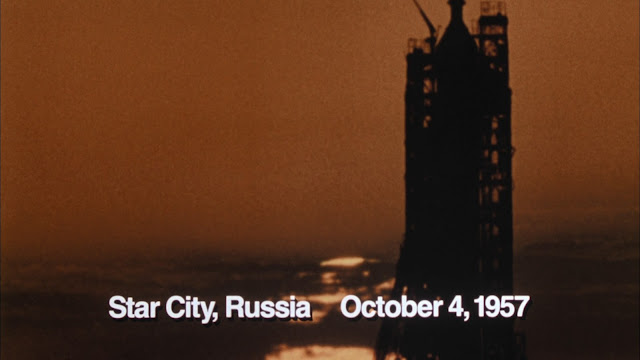
Set amidst the backdrop of the Cold War, the U.S. and U.S.S.R. were engaged in a battle for supremacy of the skies: the Space Race. Despite America’s supposed technical superiority over Russia (One NASA engineer remarks, “Our Germans are better than their Germans.”), they lag behind the achievements of the Soviets, with Sputnik and Yuri Gagarin. The desperate urgency to catch up is encapsulated by a hilarious and horrifying montage of failed rocket tests. Considering the risks and rewards involved, the freshly minted astronaut program required a new type of person.
Chuck Yeager in the X-1

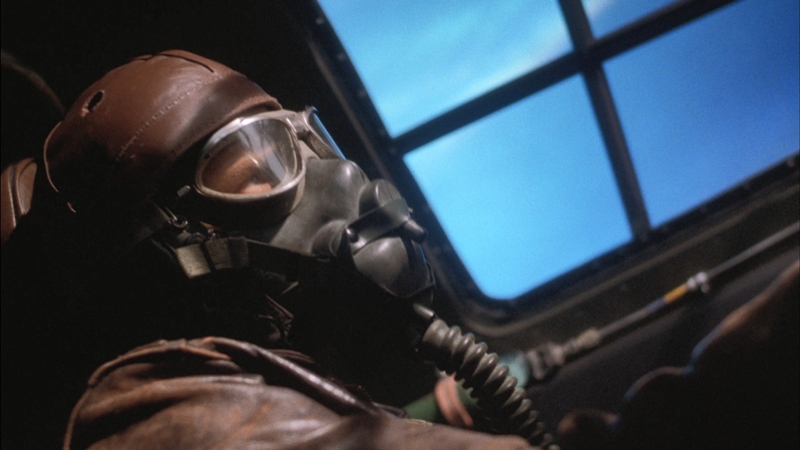
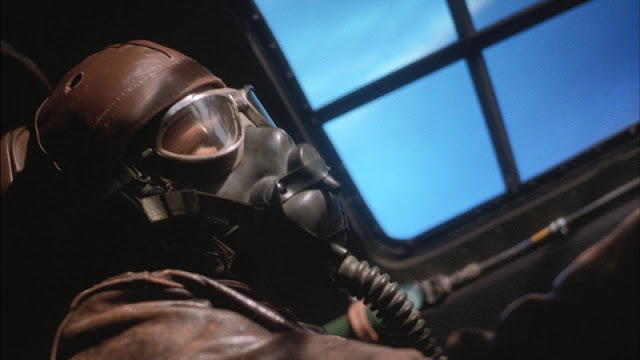
Two parallel stories run throughout the film – It’s as much about test pilot Chuck Yeager (expertly portrayed by actor/playwright Sam Shepard)*/** as it is about the Mercury 7 astronauts. Kaufman’s wife reportedly spotted Shepard in a bar, and insisting that he was perfect for the role. While Shepard was reluctant to play Yeager at first, Kaufman persisted in pursuing him until he eventually settled into the role. In retrospect, Shepard was the ideal choice. Yeager anchors the film, with his “can do” attitude and no-nonsense approach. Yeager’s laid-back, fearless persona belies the nature of his extremely hazardous profession, typified by a high pilot mortality rate (The ominous presence of a minister, played by Royal Dano, looms like a harbinger of death throughout the film). The film begins in 1947, when Yeager breaks the sound barrier in his rocket-powered Bell X-1, nicknamed “Glamorous Glennis,” after his wife (played by Barbara Hershey). While he paved the way for the astronauts, he wasn’t considered a suitable candidate, because he didn’t fit NASA’s profile, which required a college degree. Instead, he carries on as he always had, stretching the capabilities of experimental aircraft. In a climactic scene, pursuing the elusive world altitude record in a souped-up F-104 Starfighter, he briefly reaches the edge of space, before hurtling down in an uncontrolled spin. At once, the scene signifies his determination to push the boundaries, as well as a reminder that for him, space remains just out of reach.   

* Fun Fact #1: The real Chuck Yeager served as a technical consultant, and appeared in the film as a bartender at Pancho’s, a favorite hangout for test pilots at Edward’s Air Force Base. 

* Fun Fact #2: According to Kaufman, Yeager and Shepard didn’t initially hit it off (Yeager reportedly told the director, “This guy ain’t me.”), but eventually became friends during the production. On the other hand, Yeager took an instant shine to Barbara Hershey, who portrayed his wife, Glennis, referring to her by character’s name. 

** Fun Fact #3: Beeman’s Gum is featured prominently in the film, as Yeager reportedly chewed a stick during each flight. Besides being a favorite of pilots, the gum originally contained pepsin, which allegedly calmed the stomach.
 

John Glenn on TV

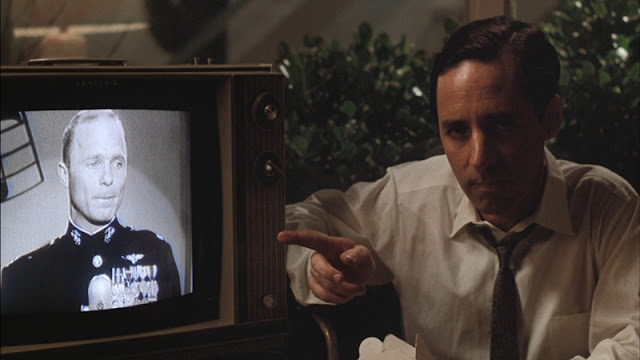
Before they ever flew into space, the Mercury 7 astronauts already enjoyed their celebrity status, to varying degrees. Scott Glenn portrays Alan Shepard who enjoys a good joke, but is nothing but serious when it comes to his profession. The late, great Fred Ward excels as gruff Virgil I. “Gus” Grissom, proving number two is the worst spot. After the fanfare and celebration following Shepard’s flight, Grissom’s ends in near disaster when the hatch on his capsule blows prematurely. Instead of a ticker tape parade or a meeting with the President, he’s treated to an inquiry by doubting NASA officials. Ed Harris’ charismatic interpretation of John Glenn* comes across as an overgrown yet amiable boy scout (part of Kaufman’s direction to Harris – smile more), giving us a hint of the astronaut who would become a politician. Gordon Cooper (Dennis Quaid) comes across as a cocky goofball, with a tendency to sleep when things are at their most tense. 

* Fun Fact #4: According to co-producer Robert Chartoff, “Ed Harris walked into the office, and we looked at him and couldn’t believe that such a person existed. He was not only a wonderful actor but looked so much like John Glenn. And of course we looked at each other and said, ‘Oh my God, this is the guy we want.’ I said to Phil (Kaufman), ‘Please, don’t let this guy get hit by a car. At least, not until after the picture is made.’” (Excerpt from Wired.com article)
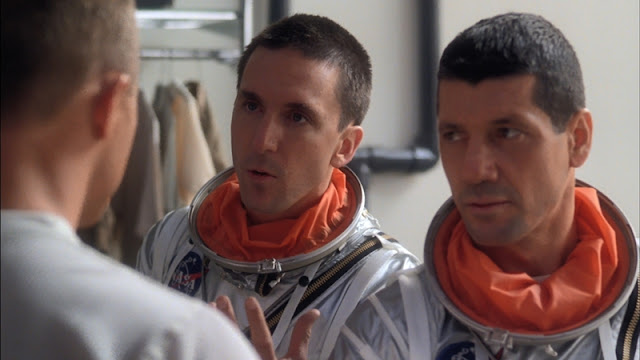
Argument Between the Astronauts

In one key scene, the pressures of being in the public eye reach a boiling point as the astronauts argue with each other about their responsibility as role models, versus how they conduct their private lives. Shepard and Glenn almost come to blows over their difference of opinion, but just as things are about to get out of hand, they find a united cause. NASA wants to send a chimp up in space, and it becomes clear to the astronauts that they’re held in the same regard. It all comes to a head when they confront the arrogant NASA engineers, who view the astronauts as nothing more than an occupant in a remote-controlled vehicle of their design (“a redundant component”). As pilots, the astronauts scrutinize the prototype capsule with skepticism (windowless, with no hatch they can open from the inside, or control in the event of a system failure). It’s a clash between the hands-on, practical approach of the astronauts (“We want a window.”) and the arrogant, book-smart engineers (“This is the way it is.”).

The NASA Recruiters

Amidst the drama, there are so many terrific comic moments. Harry Shearer and Jeff Goldblum (who largely improvised their lines), appear as two bumbling government recruiters, who court test pilots for the hazardous job. After his launch is delayed for hours, and he’s bolted into his cockpit, Alan Shepard declares that he has to urinate. Unfortunately for Shepard, no one considered this contingency for a supposed 15-minute flight, which sparks a fierce debate between the engineers and astronauts about what peeing in his spacesuit might do to his spacecraft. In an earlier scene, also with Shepard, he’s confronted by a Latino orderly with the ramifications of using a racist impression during a particularly vulnerable moment.
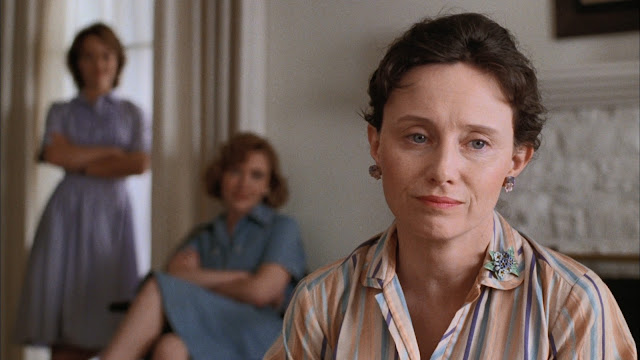
Annie Glenn

Kaufman had such a monumental task balancing Yeager’s story, with the ensemble work of the seven astronauts that it’s inevitable some of the Mercury 7, notably Scott Carpenter (Charles Frank), Wally Schirra (Lance Henriksen), and Deke Slayton (Scott Paulin) are relegated more to the background (for more on these three, I suggest checking out Wolfe’s book). While Kaufman spends significantly less time on the wives of the astronauts, the actresses’ performances shine through, speaking to the wives’ strength and resolve in the face of uncertainty. Trudy Cooper (Pamela Reed) reaches her wit’s end, following her husband Gordon from base to base, and remaining forever in his shadow. John Glenn’s wife Annie (Mary Jo Deschanel) refuses to appear on national TV with Vice President Lyndon Johnson (Donald Moffat), due to a stutter (much to the indignation of Johnson). Veronica Cartwright (as Betty Grissom) shares one of the film’s most heart-wrenching scenes with Fred Ward, sharing their anguish and bitterness about their unfair treatment by NASA officials.
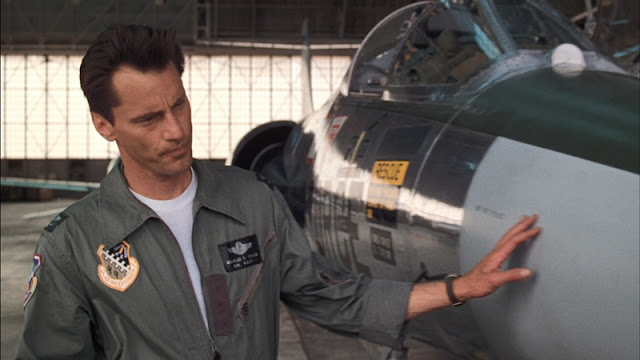
Chuck Yeager and the NF-104

So what exactly is “The Right Stuff?” It’s that indefinable quality to push the envelope,* and embrace a challenge rather than step away from it. Just because so-called experts said breaking the sound barrier couldn’t be done, didn’t mean that it was an impossible task for Yeager. It’s unwavering resolve under pressure when most individuals would give up – a reliance on wits and fearlessness. A common trait found among Yeager and the astronauts is that they’re all adrenaline junkies, driven to be the best and the fastest (Gordon Cooper asks his wife, “Who’s the best pilot you ever saw,” and subsequently answers his own question. “You’re looking at him.”) In an early scene, the NASA recruiters invite Scott Carpenter to consider joining their dangerous program, which prompts the response, “Count me in.” When John Glenn is informed that his Mercury spacecraft will be launched by the more powerful, albeit unpredictable Atlas rocket, he doesn’t hesitate to step up to the challenge.

* Not so Fun Fact: Unfortunately, during filming, Joseph Svec, a stuntman, was killed filming a parachute drop, when his chute failed to open. 


The X-1

The excellent performances are matched by the brilliance of the visuals, thanks to cinematographer Caleb Deschanel’s superb camerawork and effects supervised by Gary Gutierrez. The action sequences are kinetic and visceral, punctuated with moments of visual poetry. The sound barrier is imagined as a demon that lives in the sky. A deftly applied mixture of editing, effects and photography place us squarely in the cramped cockpit of the X-1 with Chuck Yeager. Sparks in the Australian outback are juxtaposed with mysterious “fireflies” that surround John Glenn’s capsule, Friendship 7. The most iconic shot of the film is a slow-motion sequence, depicting the Mercury 7 astronauts walking side-by-side in full gear, which has been copied and parodied in countless movies (think Monsters, Inc.).
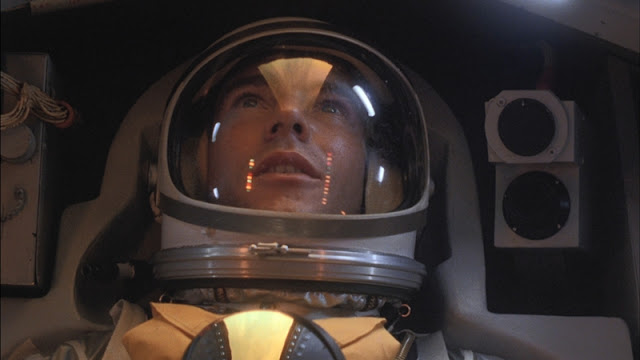
Gordon Cooper

The Right Stuff achieves the virtually impossible task of de-mythologizing the original astronauts, as it preserves the mythos surrounding them. Although Kaufman juggles so many characters,* the end results appear almost effortless. The film features uniformly exceptional ensemble work by a talented cast of (then) mostly unknowns. Bill Conti’s soaring score equally plays a vital role, lends the right amount of gravitas to the visuals. Despite a runtime of nearly three-and-a-quarter hours, it never seems too slow or too long, but just right (at least to this reviewer). It’s one of the fastest three hours you’ll ever spend. In an age when manned rocket launches have become almost passé, and no longer hold the public’s attention the way they once did, it’s important to remember the bold few who paved the way for everyone who followed. The Right Stuff is so much more than a history lesson, it’s a testament to the human spirit, as well as a grand piece of entertainment. 

* Fun Fact #5: According to Kaufman, there were 134 speaking parts. 


Sources: “Punch a Hole in the Sky: An Oral History of TheRight Stuff,” by Alex French and Howie Kahn, Wired.com; Interview with Philip Kaufman at Cinémathèque – Paris, 2020 


Saturday, May 22, 2021

The Christopher Lee Blogathon – Day 2 Recap

The Christopher Lee Blogathon

Whew! I hope you’ve had time to catch your breath, dear reader, because it’s time for Day Two of the Christopher Lee Blogathon. Today, you’ll find seven spectacular posts spanning multiple genres, from historical drama, to sword and sandal, and westerns.  

Scream of Fear

If you plan to participate but you’re not quite ready, don’t fret, we’ll post your link on Day Three (Pssst! Rumor has it there might be a Bonus fourth day, as well, if you need a bit more time). And of course, it’s never too late to join. Post a comment below, email me at barry_cinematic@yahoo.com, or reach me on Twitter (@barry_cinematic). You may also contact Gill by commenting on her post, through her blog’s Contact Me page, or on Twitter (@realweegiemidge).

The Curse of Frankenstein

In addition to today’s links, be sure to visit the Day 1 Recap, and stay tuned for Day 3!

And here we go with Day Two’s submissions…

Jinnah Poster     

Steven Thompson from Booksteve’s Library examines the controversial biopic, Jinnah (1998).

Hercules in the Haunted World Poster

Stabford Deathrage from Stabford Deathrage Shoots His Mouth Off gives us his unique take (as only Mr. Deathrage can) on Hercules in the Haunted World (1961).

Christopher Lee - Count Dooku

Rebecca Deniston from Taking Up Room proves nobody doesn’t like Christopher Lee, when she looks back at some of his more surprising film and TV appearances.

The Avengers - Never Say Die

Don’t touch that dial! Mitchell Hadley from It’s About TV looks at The Avengers episode, "Never Say Die."

How the West was Won

Caftan Woman wins us over, discussing Mr. Lee’s appearance on TV’s How the West Was Won (1978).

Return from Witch Mountain

What happens when you mix Lee with Disney? Eric Binford from Diary of a Movie Maniac lets us know in his review of Return from Witch Mountain (1978).

Alice in Wonderland Poster

Movie Rob returns to take us down the rabbit hole with Alice in Wonderland (2010)


Thursday, April 30, 2020

April Quick Picks and Pans


The Strangler (1964) This overlooked little thriller is worthy of rediscovery, thanks to Victor Buono’s gloriously unhinged performance as Leo Kroll, a man frozen in a stage of arrested development. The standard police procedural plot is nothing special, hampered by wooden acting from David McLean and Baynes Barron as obtuse cops. Buono takes the film to a different level as Kroll with his intimidating presence, sociopathic tendencies and idiosyncrasies (he targets nurses and collects dolls, which he keeps locked in a desk drawer). He’s tormented by his hospitalized, domineering mother (Ellen Corby), who teaches him to distrust women. In one of the most memorable scenes, he expresses his love to a horrified arcade prize booth worker. If you can excuse the dated psychology, it’s a compelling portrait of a profoundly disturbed individual.  

Rating: ***½. Available on DVD and Tubi


The Perfume of the Lady in Black (1974) Mimsy Farmer stars as Silvia Hacherman, a successful chemist, in director/co-writer Francesco Barilli’s (writer of Who Saw Her Die?) unconventional, slow-moving mystery. She’s confronted by many questions and few answers, as she comes face to face with a young girl who seems to know a little too much about her shady past. The film invites viewers to separate reality from delusions, with shades of Repulsion and multiple references to Alice in Wonderland, as Silvia’s sanity gradually erodes. The story moves with a deliberate pace, in a giallo seemingly devoid of murders, but stick with it as the bodies pile up in the third act. The conclusion is as baffling as it’s disturbing

Rating: ***½. Available on Blu-ray, DVD and Kanopy


The Believers (1987) Martin Sheen stars as police psychologist Cal Jamison, a recent widower, who relocates to New York. He barely gets settled before becoming embroiled in a case involving a series of ritualized child murders (linked to an extremist sect of Santeria). As he digs deeper for answers, his young son (Harley Cross) is targeted by the murderous cult, whose tendrils spread far and wide. Sheen is over the top, but there are some good supporting performances by Robert Loggia as a police lieutenant, Harris Yulin as a wealthy philanthropist, and Helen Shaver as his landlord/girlfriend (she has the honor of being in the film’s ickiest scene). Director John Schlesinger builds a modicum of suspense and paranoia, although it probably would have been wise to omit the dodgy opening scene, depicting the improbable accident (milk and coffee makers don’t mix) that killed Jamison’s wife. The film might not make you a believer (pardon the pun), but there are worse ways to spend 90 or so minutes.

Rating: ***. Available on Blu-ray, DVD and Prime Video


Burke and Hare (1972) Despite the tremendous potential of the subject matter, this movie somehow squanders its retelling of the infamous Burke and Hare murders, which occurred in Edinburgh, Scotland in the early 19th century. Vernon Sewell’s 1972 film attempts to be erotic and comic, yet fails on both counts. Ne’er do wells Burke and Hare (Derren Nesbitt and Glynn Edwards) hatch a scheme to get rich, selling bodies to an anatomical school. In order to meet the increasing demands of the school, and their greed, they resort to murder to keep the product flowing. The film suffers from lethargic pacing (spending too much time with a subplot about a local brothel, frequented by doctors and medical students), feeble attempts at comedy, and does little to evoke a sense of horror or atmosphere. The theme song by The Scaffold is kind of catchy, though.

Rating: **½. Available on Blu-ray, DVD and Kanopy

Saturday, April 18, 2020

The Vincent Price Blogathon – Day 2 Recap


Day Two of the Vincent Prince Blogathon is upon us, and we have another bumper crop of posts, with Edgar Allan Poe, creepy houses, flying mammals, gothic romance, the silly side of Mr. Price, a double dose of biopics, TV, radio drama, and Vincent singing!  

If you plan to participate but you’re not quite ready, fear not, we’ll post your link on Day Three. Post a comment below, email me at barry_cinematic@yahoo.com, or reach me on Twitter (@barry_cinematic). You may also contact Gill by commenting on her post, through her blog’s Contact Me page, or on Twitter (@realweegiemidge).

In addition to today’s links, be sure to visit the Day 1 Recap, and stay tuned for Day 3!

Reminder: The deadline to enter for a chance to win an Italian poster pair (below) for The Pit and the Pendulum (1961), courtesy of Westgate Gallery, is 11:59 p.m. (Pacific Time) on Saturday, April 18th (See the Day 1 Recap for contest details). The winner will be selected by random drawing on Sunday, April 19th, and announced on the Day 3 Recap. Good luck to all everyone who entered!

Here are the submissions for Day Two. Be sure to check out the following links and remember to tune in Sunday for Day Three.

Get your clicker ready, because it’s time for Caftan Woman to discuss Vincent’s TV appearance on Have Gun Will Travel, “The Moor’s Revenge.”

What’s that behind you? Never fear, as Sally Silverscreen from 18 Cinema Lane is our guide for the House of the Long Shadows (1983).


Shawn Hall from The Everyday Cinephile looks at Brigham Young (1940).

You’d have to be bats to miss Constance and Diana Metzinger’s review of The Bat (1959) on their blog, Silver Scenes.

Karavansara gives the 1947 radio drama The Saint a listen.

 Swing on by John V’s Eclectic Avenue, and read his review of The Pit and the Pendulum (1961).
           
Stop by The Midnite Drive-In for an eye-popping double feature of Dr. Goldfoot and the Bikini Machine (1965) & Dr. Goldfoot and the Girl Bombs (1966).

Paul Batters from Silver Screen Classics pays his respects to The Tomb of Ligeia (1964).

 Peter Fuller from Vincent Price Legacy UK explores the musical side of Mr. Price.

 Movie Rob is back to talk about Brigham Young (1940).


Vinnie Harris dares us to spend the night inside the House on Haunted Hill (1959).

Don’t sleep on Virginie Pronovost’s (of The Wonderful World of Cinema) review of Fritz Lang’s While the City Sleeps (1956).

And finally… Join me, won’t you, as I step back in time to 1844, and pay a visit to Dragonwyck (1946).

Friday, August 31, 2018

August Quick Picks and Pans – Animation Month


Loving Vincent (2017) This Polish/British co-production from writer/directors Dorota Kobiela and Hugh Welchman explores the life and death of Vincent van Gough, told through the lens of his artwork. The film’s unique look, which captures van Gough’s style, is nothing short of mesmerizing. Thanks to a painstaking process that required the animators to paint over live action footage, each scene immerses the viewer into one of the master’s works. The color sequences are bookended by black and white flashbacks that recreate the appearance of old photographs.

The filmmakers admitted to watching a lot of film noir during the movie’s production, which informed the tone of their work. The story takes place a year after Van Gough’s death, focusing on a courier tasked with delivering a letter from the late painter. It’s part biopic (as we see the artist’s troubled life in flashback), and part mystery, as we witness the perspective of Van Gough from the many people who knew him, and explore the ambiguity surrounding his death. Loving Vincent is an unforgettable visual treat, as well as a captivating, touching portrait of the ephemeral quality of genius (and how the spark of madness often resides with such prodigious talent).

Rating: ****½. Available on Blu-ray and DVD


Perfect Blue (1997) Director Satoshi Kon’s (based on the novel by Yoshikazu Takeuchi) landmark anime feature employs elements from psychological thrillers and gialli to convey the fragmented mind of its protagonist. Mima, a pop singer, retires from her music gig to become an actress, which becomes the catalyst for a series of disturbing and deadly events. Her life begins to spiral out of control, as she embarks on her career change. As her choices chip away at her wholesome image, the change is too much for some fans. A website dedicated to her seems to be reading her thoughts, and she’s stalked by a strange man who might be linked to a series of gruesome murders. She begins to question her grip on reality and her identity. It’s an unnerving depiction of mental illness that recalls Repulsion and Psycho, and a frightening commentary on the unfortunate price of fame and the perils of toxic fandom.

Rating: ****. Available on DVD


In This Corner of the World (2016) Get out your hanky for this one. Director/co-writer Sunao Katabuchi (based on the manga by Fumiyo Kono) follows Suzu, a young woman from Hiroshima stuck in an arranged marriage. The filmmakers wisely assume we know the events leading up to the conclusion of World War II, so they don’t attempt to provide a history lesson. Instead, we see how one family is affected by the war. Suzu experiences a difficult transition living away from the big city, stifled by a passionless relationship and hostile in-laws. Her life is beset by tragedy, heartbreak and hope, living under the constant threat of American bombs. The gentle, pastel-colored animation belies the horrors depicted in the film, serving as a fitting tonal contrast. Katabuchi doesn’t sugar- coat Suzu’s life, but creates a nuanced experience that’s visually entrancing and emotionally exhausting.

Rating: ****. Available on Blu-ray, DVD and Netflix


Kirikou and the Sorceress (aka: Kirikou et la Sorcière) (1998) Writer/co-director Michel Ocelot’s spirited interpretation of a West African folk tale might require some suspension of disbelief for western eyes, but it rewards with a timeless story that has many lessons to teach us. Kirikou emerges from his mother’s womb, walking, talking and ready for action, albeit in miniature form. When his village is terrorized by Karaba, an evil sorceress, he saves the village, yet remains an outcast. His persistence and ingenuity, however, prevails above all. Kids and adults can benefit from Kirikou’s gentle message that we should never judge something by appearances alone. The endlessly inquisitive Kirikou also teaches that to understand someone, you only need to live in his or her shoes.

Rating: ****. Available on DVD and Amazon Prime


Les Maîtres du Temps (aka: Time Masters) (1982) Writer/director Rene Laloux’s adaptation of Stefan Wul’s book was released in the States in a butchered (dubbed and edited) form, but it’s worth seeking out in the Eureka video edition. In this cosmic odyssey, a researcher surveying an alien planet crashes his land vehicle, leaving his young son stranded in a forest, with only an egg-shaped device to keep him company. The device is the boy’s only link to human connection, and possible rescue, from a spacecraft many light years away. Laloux’s film features colorful characters, alien vistas, and a cool twist. It’s not quite as mind-bending an experience as his earlier work, Fantastic Planet, but it’s a trip well worth taking.  

Rating: ***½. Available on DVD (Region 2)


The Phantom Tollbooth (1970) Directors Chuck Jones and Abe Levitow, working from a script by Jones and Sam Rosen (based on the kids book by Norton Juster), take us on a funky voyage through a nonsensical land. The animated feature (bookended by live action sequences) stars Butch Patrick (Eddie Munster) as Milo, a kid who’s bored with school and can’t find anything to do. When a strange tollbooth unexpectedly appears in his living room he’s whisked away to a world with various lands. He’s accompanied by Tock, a watchdog (with a clock embedded in his chest), and travels through a world where absurdity reigns supreme. The film reminds us about important life lessons, such as using your brain and taking decisive action. It suffers from a soundtrack full of mostly forgettable songs, but the colorful, Alice in Wonderland-inspired animation and fun wordplay take up most of the slack. While far from perfect, it’s diverting enough to keep kids and adults reasonably entertained.

Rating: ***. Available on DVD