Showing posts with label Historical Drama. Show all posts

Monday, April 21, 2025

Aguirre, the Wrath of God

Aguirre, the Wrath of God Poster

(1972) Written and directed by Werner Herzog; Starring: Klaus Kinski, Ruy Guerra, Helena Rojo, Del Negro, Peter Berling and Cecilia Rivera; Available on DVD 

Rating: ****½

Aguirre and Crew

“I am the great traitor. There can be no greater! Whoever even thinks about deserting will be cut into 198 pieces! And then trampled upon until you can paint the walls with him. Whoever eats one grain too many or drinks one drop of water too much will be locked up for 155 years! If I, Aguirre, want the birds to drop dead from the trees, the birds will drop dead from the trees. I am the Wrath of God! The earth I walk upon sees me and quakes! But whoever follows me and the river, will win untold riches. But whoever deserts...” – Don Lope de Aguirre (Klaus Kinski)

“… I would have spent the entire budget in three days working in the studio, and of course, there was something authentic about the jungle which can’t be fabricated. You can’t create jungle in the studio. You have to go out there, and the story takes place in the Peruvian jungle; you have to go there. There’s no alternative to that.” – Werner Herzog

Gonzalo Pizarro and Don Lope de Aguirre

The purported feuds between Werner Herzog and the volatile actor Klaus Kinski* are legendary, most likely embellished to some degree by both parties for dramatic effect. But no matter whose account you believe, Kinski was notorious for being temperamental and difficult to work with. Despite the acrimony between the two, chronicled in Herzog’s stellar documentary, MyBest Fiend (1999), they somehow managed to put aside their differences to make five films together, starting with Aguirre, the Wrath of God. The script was written in 1971 on a tour bus in two-and-a-half days.** The then 28-year-old director set out with a crew of eight to shoot his low budget epic (budgeted at $380,000) on location in the Peruvian jungle, with the cast and crew living on rafts. Keeping the production on track was no small feat for Herzog, as he contended with limited food and supplies, managing Kinski’s wild rants,*** and near tragedy.**** 

* Fun Fact #1: Herzog was 13 when he first met Kinski, who occupied the same boardinghouse in Germany. 

** Fun Fact #2: A few scenes were lost from Herzog’s first draft of the screenplay when one of the soccer players he was traveling with vomited on his typewriter, along with several pages of the script. 

*** Fun Fact: #3: According to Herzog’s account, Kinski fired his Winchester rifle at a noisy hut full of extras. Thankfully, no one was killed, but one extra lost a fingertip. 

*** Not-So-Fun Fact: Herzog’s life and career were almost cut short on Christmas Eve of 1971, when he was taken off the passenger list to Cuzco at the last moment due to a change in routes. Later that day, the same plane he was supposed to take disintegrated in mid-flight, with all aboard killed, except for one teenage girl (chronicled in Herzog’s 1999 TV documentary Wings of Hope

Treacherous Mountain Path

The opening scene on a fog-shrouded mountain (Huayna Picchu) sets the tone for the rest of the film,* as conquistadors and their slaves** traverse treacherous mountain paths, which subsequently claim several lives. Don Pedro de Ursúa (Ruy Guerra) is appointed leader on their quest to the golden city of El Dorado by Gonzalo Pizarro (Alejandro Repullés), along with his second-in command, Don Lope de Aguirre (Klaus Kinski). Accompanying them on their journey, against the better judgment of Pizarro, are Ursúa’s wife Inez de Atienza (Helena Rojo) and Aguirre’s teenage daughter Flores (Cecilia Rivera). But it doesn’t take long before Aguirre, who doesn’t agree with his superior’s leadership, conspires to displace him. Aguirre chooses Don Fernando de Guzmán (Peter Berling) as emperor for the new land they hope to discover, but he’s at best, a figurehead who will comply with Aguirre’s machinations. Aguirre’s team travels down the tumultuous Urubamba River in rafts, while fending off attacks from unseen natives on the shore.   

* Fun Fact #4: Herzog stated that most of the footage was filmed on a handheld 35 mm camera, stolen from a film school in Munich. 

** Fun Fact #5: Herzog hired 450 indigenous people from the highlands as extras.

Aguirre

Despite the behind-the-scenes drama (including a shooting spree by an enraged Kinski),* it’s easy to admire Kinski’s mesmerizing performance, as a feral, malevolent force of nature. Instead of using makeup or prosthetics to depict the disabled Aguirre, Kinski portrayed his character’s infirmity through body movement. As directed by Herzog (or Kinski’s idea, depending on which story you prefer), Aguirre scuttles like a crab or spider, in a side-to-side motion. His uneven stance suggests a twisted body, with one arm longer than the other. He matches his unpredictable motion with an equally mercurial demeanor. While surprisingly tender to his daughter, he reserves his savage energy for his men. 

* Fun Fact #6: Kinski commented in his hyperbolic autobiography on his working relationship with Herzog: “…He doesn’t have the foggiest inkling of how to make movies. He doesn’t even try to direct the actors anymore. Long ago, when I ordered him to keep his trap shut, he gave up asking me whether I’m willing to carry out his stupid and boring ideas.”

Inez de Atienza

In stark contrast to Kinski’s scene-stealing performance, Mexican actress Helena Rojo chose a more subtle approach as the beleaguered Inez de Atienza. She contends with the disgrace of her husband’s imprisonment, along with the ever-increasing madness of Aguirre with quiet dignity, although her eyes and facial expressions suggest another story. After experiencing one injustice after another, she simply walks into the jungle, clad in her finest dress, vanishing without a trace. 

Attacking the Shore

In his DVD commentary, Herzog made it clear that this was not a history lesson, but a fictionalized account (including real historical figures) about Spanish conquistadors, their plunder of the New World, and subsequent ill-fated quest for the fabled golden city, El Dorado. While he didn’t hide the fact that most of the story was fabricated, his documentary-style approach creates a “fly on the wall” experience, as if Herzog traveled back in time to 1560 to capture a forgotten piece of the past. There’s a sense of immediacy that transcends fiction, to create its own reality. While adhering to a more naturalistic approach in general, Herzog incorporated sequences that are pure poetry. In one scene that exemplifies the vanquished and their once-proud legacy, a slave laments that he was once royalty, with no one permitted to look directly upon his face. In another scene, a soldier’s loud proclamation to overthrow Aguirre is met with swift retribution. In the midst of counting to ten, he’s cut off (quite literally) with his decapitated head finishing the count. It’s a surreal scene that doesn’t reflect reality, but it’s unforgettable nevertheless. Herzog’s crowning achievement is the haunting climactic scene with Aguirre alone on his raft, his plans in tatters, surrounded by scores of monkeys (although I doubt Kinski’s simian-tossing would win any awards from the ASPCA). 

* Fun Fact #7: Herzog purchased 400 monkeys in Iquitos for the scene. The monkeys were later released in the wild, rather than sold to another buyer.   

* Fun Fact #8: For the scene where Aguirre and his men encounter the remnants of a cannibal village, Herzog adorned the village set with a real mummy, which was somehow acquired by his brother.

Aguirre with Monkey

The road to ruin is paved with imaginary gold. Aguirre, the Wrath of God illustrates how a cult of personality, fed by the empty promise of untold riches, can lead a group of people to insanity and their ultimate ruin. Aguirre’s cult almost parallels Herzog’s obsession with filming his vision, regardless of the peril and hardship involved.* But there’s a method to Herzog and Kinski’s (alleged) madness. Although historical accuracy takes a back seat to art, Herzog somehow manages to capture the veracity of the setting, purveying a fiction that’s more truthful than pure fact. 

* Fun Fact #9: Perhaps as a final insult to injury, Herzog recounted how the exposed negatives of his footage (intended for developing at a lab in Mexico City) were lost. He feared that his movie was gone, only to have the lost reels discovered on top of a pile of trash at Lima airport. 


Sources for this article: Shout Factory Blu-ray commentary by Werner Herzog; Kinski Uncut, by Klaus Kinski; Every Man for Himself and God Against All, by Werner Herzog 

Saturday, October 29, 2022

The Devilishly Delightful Donald Pleasence Blogathon – Day 2 Recap


The Devilishly Delightful Donald Pleasence Blogathon

We’re back for Day Two of the Devilishly Delightful Donald Pleasence Blogathon, hosted by Gill Jacob of Realweegiemidget Reviews and Yours Truly! Please enjoy today’s posts, covering some film and television titles that might have slipped beneath the radar.

Donald Pleasence - From Beyond the Grave

It’s not too late to join. If you plan to post tomorrow, or you’ve been delayed, enter a comment below, email me at barry_cinematic@yahoo.com, or reach me on Twitter (@barry_cinematic). You may also contact Gill by commenting on her post, through her blog’s Contact Me page, or on Twitter (@realweegiemidge).

Donald Pleasence - Prince of Darkness

Check out Day 2’s stellar submissions below, and don’t forget to read all the amazing posts from Day 1. See you tomorrow for Day 3!

Manuela Poster

Lê from Critica Retro sets sail on her review of Manuela (aka: Stowaway Girl) (1957). 

Kidnapped Poster
 

You’ll be captivated by Rachel’s (from Hamelette's Soliloquy) take on Kidnapped (1971). 


The Uncanny Poster

Eddie Harrison from Film Authority invites us to experience The Uncanny (1977). 

The Barchester Chronicles Poster

Debbie Vega from Moon in Gemini examines the miniseries The Barchester Chronicles (1982). 


Sunday, May 22, 2022

The Right Stuff


The Right Stuff Poster

(1983) Written and directed by Philip Kaufman; Based on the book The Right Stuff by Tom Wolfe; Starring: Sam Shepard, Scott Glenn, Ed Harris, Barbara Hershey, Dennis Quaid, Fred Ward, Veronica Cartwright, Lance Henriksen, Harry Shearer and Jeff Goldblum; Available on Blu-ray and DVD

Rating: *****

“I wanted to make a film about – where the main character was something called ‘The Right Stuff.’ It was a quality that was mysterious, that manifested itself in every scene of the film. It was sort of a spirit…” – Philip Kaufman (from 2020 interview at Cinémathèque – Paris)

First of all, a big thanks to Rebecca from Taking Up Room for hosting the Aviation in Film Blogathon, a celebration of flight and flicks. This week, I take a look at one of my unabashed favorites, The Right Stuff. While I don’t have an official top ten list of all-time favorite movies, if I did, this would certainly occupy a spot.

The Mercury 7 Astronauts

Writer/director Philip Kaufman handled the unenviable task of adapting Tom Wolfe’s captivating book (serialized in Rolling Stone magazine), which chronicled the story of the original Mercury 7 astronauts, along with the test pilots who crawled so they could run. Kaufman keeps many threads running throughout his film, and does an admirable job of avoiding them getting tangled. Much more than a stuffy chain of events, The Right Stuff focuses on some of the many unique, colorful individuals who made space flight possible. Levon Helm’s folksy narration bookends the film, evoking images of the Old West, as it relates to the unexplored frontier of space.

Sputnik

Set amidst the backdrop of the Cold War, the U.S. and U.S.S.R. were engaged in a battle for supremacy of the skies: the Space Race. Despite America’s supposed technical superiority over Russia (One NASA engineer remarks, “Our Germans are better than their Germans.”), they lag behind the achievements of the Soviets, with Sputnik and Yuri Gagarin. The desperate urgency to catch up is encapsulated by a hilarious and horrifying montage of failed rocket tests. Considering the risks and rewards involved, the freshly minted astronaut program required a new type of person.

Chuck Yeager in the X-1

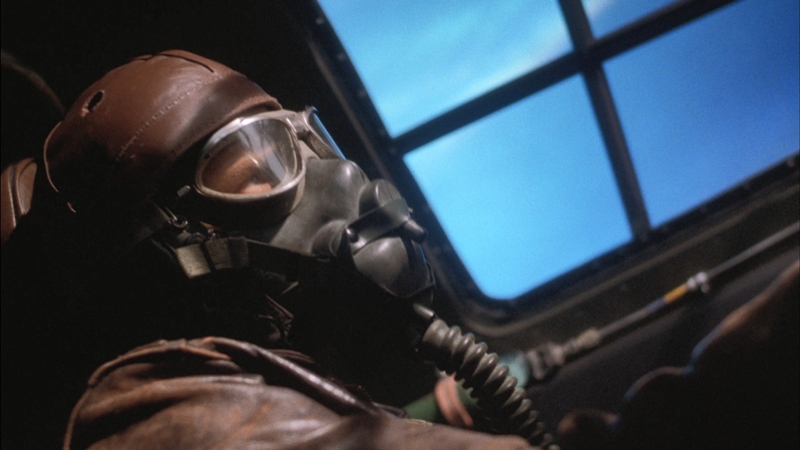
Two parallel stories run throughout the film – It’s as much about test pilot Chuck Yeager (expertly portrayed by actor/playwright Sam Shepard)*/** as it is about the Mercury 7 astronauts. Kaufman’s wife reportedly spotted Shepard in a bar, and insisting that he was perfect for the role. While Shepard was reluctant to play Yeager at first, Kaufman persisted in pursuing him until he eventually settled into the role. In retrospect, Shepard was the ideal choice. Yeager anchors the film, with his “can do” attitude and no-nonsense approach. Yeager’s laid-back, fearless persona belies the nature of his extremely hazardous profession, typified by a high pilot mortality rate (The ominous presence of a minister, played by Royal Dano, looms like a harbinger of death throughout the film). The film begins in 1947, when Yeager breaks the sound barrier in his rocket-powered Bell X-1, nicknamed “Glamorous Glennis,” after his wife (played by Barbara Hershey). While he paved the way for the astronauts, he wasn’t considered a suitable candidate, because he didn’t fit NASA’s profile, which required a college degree. Instead, he carries on as he always had, stretching the capabilities of experimental aircraft. In a climactic scene, pursuing the elusive world altitude record in a souped-up F-104 Starfighter, he briefly reaches the edge of space, before hurtling down in an uncontrolled spin. At once, the scene signifies his determination to push the boundaries, as well as a reminder that for him, space remains just out of reach.   

* Fun Fact #1: The real Chuck Yeager served as a technical consultant, and appeared in the film as a bartender at Pancho’s, a favorite hangout for test pilots at Edward’s Air Force Base. 

* Fun Fact #2: According to Kaufman, Yeager and Shepard didn’t initially hit it off (Yeager reportedly told the director, “This guy ain’t me.”), but eventually became friends during the production. On the other hand, Yeager took an instant shine to Barbara Hershey, who portrayed his wife, Glennis, referring to her by character’s name. 

** Fun Fact #3: Beeman’s Gum is featured prominently in the film, as Yeager reportedly chewed a stick during each flight. Besides being a favorite of pilots, the gum originally contained pepsin, which allegedly calmed the stomach.


John Glenn on TV

Before they ever flew into space, the Mercury 7 astronauts already enjoyed their celebrity status, to varying degrees. Scott Glenn portrays Alan Shepard who enjoys a good joke, but is nothing but serious when it comes to his profession. The late, great Fred Ward excels as gruff Virgil I. “Gus” Grissom, proving number two is the worst spot. After the fanfare and celebration following Shepard’s flight, Grissom’s ends in near disaster when the hatch on his capsule blows prematurely. Instead of a ticker tape parade or a meeting with the President, he’s treated to an inquiry by doubting NASA officials. Ed Harris’ charismatic interpretation of John Glenn* comes across as an overgrown yet amiable boy scout (part of Kaufman’s direction to Harris – smile more), giving us a hint of the astronaut who would become a politician. Gordon Cooper (Dennis Quaid) comes across as a cocky goofball, with a tendency to sleep when things are at their most tense. 

* Fun Fact #4: According to co-producer Robert Chartoff, “Ed Harris walked into the office, and we looked at him and couldn’t believe that such a person existed. He was not only a wonderful actor but looked so much like John Glenn. And of course we looked at each other and said, ‘Oh my God, this is the guy we want.’ I said to Phil (Kaufman), ‘Please, don’t let this guy get hit by a car. At least, not until after the picture is made.’” (Excerpt from Wired.com article)

Argument Between the Astronauts

In one key scene, the pressures of being in the public eye reach a boiling point as the astronauts argue with each other about their responsibility as role models, versus how they conduct their private lives. Shepard and Glenn almost come to blows over their difference of opinion, but just as things are about to get out of hand, they find a united cause. NASA wants to send a chimp up in space, and it becomes clear to the astronauts that they’re held in the same regard. It all comes to a head when they confront the arrogant NASA engineers, who view the astronauts as nothing more than an occupant in a remote-controlled vehicle of their design (“a redundant component”). As pilots, the astronauts scrutinize the prototype capsule with skepticism (windowless, with no hatch they can open from the inside, or control in the event of a system failure). It’s a clash between the hands-on, practical approach of the astronauts (“We want a window.”) and the arrogant, book-smart engineers (“This is the way it is.”).

The NASA Recruiters

Amidst the drama, there are so many terrific comic moments. Harry Shearer and Jeff Goldblum (who largely improvised their lines), appear as two bumbling government recruiters, who court test pilots for the hazardous job. After his launch is delayed for hours, and he’s bolted into his cockpit, Alan Shepard declares that he has to urinate. Unfortunately for Shepard, no one considered this contingency for a supposed 15-minute flight, which sparks a fierce debate between the engineers and astronauts about what peeing in his spacesuit might do to his spacecraft. In an earlier scene, also with Shepard, he’s confronted by a Latino orderly with the ramifications of using a racist impression during a particularly vulnerable moment.

Annie Glenn

Kaufman had such a monumental task balancing Yeager’s story, with the ensemble work of the seven astronauts that it’s inevitable some of the Mercury 7, notably Scott Carpenter (Charles Frank), Wally Schirra (Lance Henriksen), and Deke Slayton (Scott Paulin) are relegated more to the background (for more on these three, I suggest checking out Wolfe’s book). While Kaufman spends significantly less time on the wives of the astronauts, the actresses’ performances shine through, speaking to the wives’ strength and resolve in the face of uncertainty. Trudy Cooper (Pamela Reed) reaches her wit’s end, following her husband Gordon from base to base, and remaining forever in his shadow. John Glenn’s wife Annie (Mary Jo Deschanel) refuses to appear on national TV with Vice President Lyndon Johnson (Donald Moffat), due to a stutter (much to the indignation of Johnson). Veronica Cartwright (as Betty Grissom) shares one of the film’s most heart-wrenching scenes with Fred Ward, sharing their anguish and bitterness about their unfair treatment by NASA officials.

Chuck Yeager and the NF-104

So what exactly is “The Right Stuff?” It’s that indefinable quality to push the envelope,* and embrace a challenge rather than step away from it. Just because so-called experts said breaking the sound barrier couldn’t be done, didn’t mean that it was an impossible task for Yeager. It’s unwavering resolve under pressure when most individuals would give up – a reliance on wits and fearlessness. A common trait found among Yeager and the astronauts is that they’re all adrenaline junkies, driven to be the best and the fastest (Gordon Cooper asks his wife, “Who’s the best pilot you ever saw,” and subsequently answers his own question. “You’re looking at him.”) In an early scene, the NASA recruiters invite Scott Carpenter to consider joining their dangerous program, which prompts the response, “Count me in.” When John Glenn is informed that his Mercury spacecraft will be launched by the more powerful, albeit unpredictable Atlas rocket, he doesn’t hesitate to step up to the challenge.

* Not so Fun Fact: Unfortunately, during filming, Joseph Svec, a stuntman, was killed filming a parachute drop, when his chute failed to open. 


The X-1

The excellent performances are matched by the brilliance of the visuals, thanks to cinematographer Caleb Deschanel’s superb camerawork and effects supervised by Gary Gutierrez. The action sequences are kinetic and visceral, punctuated with moments of visual poetry. The sound barrier is imagined as a demon that lives in the sky. A deftly applied mixture of editing, effects and photography place us squarely in the cramped cockpit of the X-1 with Chuck Yeager. Sparks in the Australian outback are juxtaposed with mysterious “fireflies” that surround John Glenn’s capsule, Friendship 7. The most iconic shot of the film is a slow-motion sequence, depicting the Mercury 7 astronauts walking side-by-side in full gear, which has been copied and parodied in countless movies (think Monsters, Inc.).

Gordon Cooper

The Right Stuff achieves the virtually impossible task of de-mythologizing the original astronauts, as it preserves the mythos surrounding them. Although Kaufman juggles so many characters,* the end results appear almost effortless. The film features uniformly exceptional ensemble work by a talented cast of (then) mostly unknowns. Bill Conti’s soaring score equally plays a vital role, lends the right amount of gravitas to the visuals. Despite a runtime of nearly three-and-a-quarter hours, it never seems too slow or too long, but just right (at least to this reviewer). It’s one of the fastest three hours you’ll ever spend. In an age when manned rocket launches have become almost passé, and no longer hold the public’s attention the way they once did, it’s important to remember the bold few who paved the way for everyone who followed. The Right Stuff is so much more than a history lesson, it’s a testament to the human spirit, as well as a grand piece of entertainment. 

* Fun Fact #5: According to Kaufman, there were 134 speaking parts. 


Sources: “Punch a Hole in the Sky: An Oral History of TheRight Stuff,” by Alex French and Howie Kahn, Wired.com; Interview with Philip Kaufman at Cinémathèque – Paris, 2020 


Saturday, May 22, 2021

The Christopher Lee Blogathon – Day 2 Recap

The Christopher Lee Blogathon

Whew! I hope you’ve had time to catch your breath, dear reader, because it’s time for Day Two of the Christopher Lee Blogathon. Today, you’ll find seven spectacular posts spanning multiple genres, from historical drama, to sword and sandal, and westerns.  

Scream of Fear

If you plan to participate but you’re not quite ready, don’t fret, we’ll post your link on Day Three (Pssst! Rumor has it there might be a Bonus fourth day, as well, if you need a bit more time). And of course, it’s never too late to join. Post a comment below, email me at barry_cinematic@yahoo.com, or reach me on Twitter (@barry_cinematic). You may also contact Gill by commenting on her post, through her blog’s Contact Me page, or on Twitter (@realweegiemidge).

The Curse of Frankenstein

In addition to today’s links, be sure to visit the Day 1 Recap, and stay tuned for Day 3!

And here we go with Day Two’s submissions…

Jinnah Poster     

Steven Thompson from Booksteve’s Library examines the controversial biopic, Jinnah (1998).

Hercules in the Haunted World Poster

Stabford Deathrage from Stabford Deathrage Shoots His Mouth Off gives us his unique take (as only Mr. Deathrage can) on Hercules in the Haunted World (1961).

Christopher Lee - Count Dooku

Rebecca Deniston from Taking Up Room proves nobody doesn’t like Christopher Lee, when she looks back at some of his more surprising film and TV appearances.

The Avengers - Never Say Die

Don’t touch that dial! Mitchell Hadley from It’s About TV looks at The Avengers episode, "Never Say Die."

How the West was Won

Caftan Woman wins us over, discussing Mr. Lee’s appearance on TV’s How the West Was Won (1978).

Return from Witch Mountain

What happens when you mix Lee with Disney? Eric Binford from Diary of a Movie Maniac lets us know in his review of Return from Witch Mountain (1978).

Alice in Wonderland Poster

Movie Rob returns to take us down the rabbit hole with Alice in Wonderland (2010)


Friday, August 31, 2018

August Quick Picks and Pans – Animation Month


Loving Vincent (2017) This Polish/British co-production from writer/directors Dorota Kobiela and Hugh Welchman explores the life and death of Vincent van Gough, told through the lens of his artwork. The film’s unique look, which captures van Gough’s style, is nothing short of mesmerizing. Thanks to a painstaking process that required the animators to paint over live action footage, each scene immerses the viewer into one of the master’s works. The color sequences are bookended by black and white flashbacks that recreate the appearance of old photographs.

The filmmakers admitted to watching a lot of film noir during the movie’s production, which informed the tone of their work. The story takes place a year after Van Gough’s death, focusing on a courier tasked with delivering a letter from the late painter. It’s part biopic (as we see the artist’s troubled life in flashback), and part mystery, as we witness the perspective of Van Gough from the many people who knew him, and explore the ambiguity surrounding his death. Loving Vincent is an unforgettable visual treat, as well as a captivating, touching portrait of the ephemeral quality of genius (and how the spark of madness often resides with such prodigious talent).

Rating: ****½. Available on Blu-ray and DVD


Perfect Blue (1997) Director Satoshi Kon’s (based on the novel by Yoshikazu Takeuchi) landmark anime feature employs elements from psychological thrillers and gialli to convey the fragmented mind of its protagonist. Mima, a pop singer, retires from her music gig to become an actress, which becomes the catalyst for a series of disturbing and deadly events. Her life begins to spiral out of control, as she embarks on her career change. As her choices chip away at her wholesome image, the change is too much for some fans. A website dedicated to her seems to be reading her thoughts, and she’s stalked by a strange man who might be linked to a series of gruesome murders. She begins to question her grip on reality and her identity. It’s an unnerving depiction of mental illness that recalls Repulsion and Psycho, and a frightening commentary on the unfortunate price of fame and the perils of toxic fandom.

Rating: ****. Available on DVD


In This Corner of the World (2016) Get out your hanky for this one. Director/co-writer Sunao Katabuchi (based on the manga by Fumiyo Kono) follows Suzu, a young woman from Hiroshima stuck in an arranged marriage. The filmmakers wisely assume we know the events leading up to the conclusion of World War II, so they don’t attempt to provide a history lesson. Instead, we see how one family is affected by the war. Suzu experiences a difficult transition living away from the big city, stifled by a passionless relationship and hostile in-laws. Her life is beset by tragedy, heartbreak and hope, living under the constant threat of American bombs. The gentle, pastel-colored animation belies the horrors depicted in the film, serving as a fitting tonal contrast. Katabuchi doesn’t sugar- coat Suzu’s life, but creates a nuanced experience that’s visually entrancing and emotionally exhausting.

Rating: ****. Available on Blu-ray, DVD and Netflix


Kirikou and the Sorceress (aka: Kirikou et la Sorcière) (1998) Writer/co-director Michel Ocelot’s spirited interpretation of a West African folk tale might require some suspension of disbelief for western eyes, but it rewards with a timeless story that has many lessons to teach us. Kirikou emerges from his mother’s womb, walking, talking and ready for action, albeit in miniature form. When his village is terrorized by Karaba, an evil sorceress, he saves the village, yet remains an outcast. His persistence and ingenuity, however, prevails above all. Kids and adults can benefit from Kirikou’s gentle message that we should never judge something by appearances alone. The endlessly inquisitive Kirikou also teaches that to understand someone, you only need to live in his or her shoes.

Rating: ****. Available on DVD and Amazon Prime


Les Maîtres du Temps (aka: Time Masters) (1982) Writer/director Rene Laloux’s adaptation of Stefan Wul’s book was released in the States in a butchered (dubbed and edited) form, but it’s worth seeking out in the Eureka video edition. In this cosmic odyssey, a researcher surveying an alien planet crashes his land vehicle, leaving his young son stranded in a forest, with only an egg-shaped device to keep him company. The device is the boy’s only link to human connection, and possible rescue, from a spacecraft many light years away. Laloux’s film features colorful characters, alien vistas, and a cool twist. It’s not quite as mind-bending an experience as his earlier work, Fantastic Planet, but it’s a trip well worth taking.  

Rating: ***½. Available on DVD (Region 2)


The Phantom Tollbooth (1970) Directors Chuck Jones and Abe Levitow, working from a script by Jones and Sam Rosen (based on the kids book by Norton Juster), take us on a funky voyage through a nonsensical land. The animated feature (bookended by live action sequences) stars Butch Patrick (Eddie Munster) as Milo, a kid who’s bored with school and can’t find anything to do. When a strange tollbooth unexpectedly appears in his living room he’s whisked away to a world with various lands. He’s accompanied by Tock, a watchdog (with a clock embedded in his chest), and travels through a world where absurdity reigns supreme. The film reminds us about important life lessons, such as using your brain and taking decisive action. It suffers from a soundtrack full of mostly forgettable songs, but the colorful, Alice in Wonderland-inspired animation and fun wordplay take up most of the slack. While far from perfect, it’s diverting enough to keep kids and adults reasonably entertained.

Rating: ***. Available on DVD