(1962) Directed by Karel Zeman; Written by: Karel Zeman, Jirí
Brdecka and Josef Kainar; Adapted from works by Gottfried August Bürger, Rudolph
Erich Raspe and Gustave Doré; Starring: Milos Kopecký, Rudolf Jelínek, Jana
Brejchová, Karel Höger, Rudolf Hrusínský, Jan Werich, Eduard Kohout and Bohus
Záhorský; Available on Blu-ray and DVD
Rating: ****
“My one wish was to get the right idiom for my plan: to
capture the surreal world of Baron Munchausen. I wanted this romantic fantasy
to be unleashed from mundane reality, so I used imagery resembling prints from
the period. At the same time, I decided to treat color like a painter on a
canvas. I put it only where it was necessary.” – Karel Zeman (from Blu-ray
featurette, “Why Zeman Made the Film”)
A hearty thanks to Rebecca from Taking Up Room and Gill from
Realweegiemidget Reviews for hosting
the It’s in the Name of the Title Blogathon,
spotlighting movie titles that feature their respective characters’ names. I’m proud to discuss, for your consideration, Karel Zeman’s
aptly named The Fabulous Baron Munchausen (1962).
Since Rudolf Erich Raspe anonymously published his fictionalized
account of Baron Munchausen’s* adventures in 1785, the exploits of the famous
spinner of tall tales have enchanted and captivated readers. Raspe’s original
work spawned a number of spinoff books, plays, radio shows, and of course,
motion pictures. Munchausen became the subject of several silent-era films
(including Georges Méliès 1911 short, “The Hallucinations of Baron Munchausen”).
Sadly, many of the early short films are presumed lost, but arguably the most
noteworthy cinematic examples are three feature-length films, released in 1943,
1962, and 1989, respectively. The infamous 1943 German version, The
Adventures of Baron Munchausen, was made under the watchful eye of Hitler’s
propaganda minister Joseph Goebbels (intended as a morale booster). While not
overtly pushing a Nazi agenda, for many (including this reviewer) it’s
impossible to separate the movie from its notorious origins and the monstrous
regime that launched it. Terry Gilliam’s lavish, big-budget 1989 version, also
titled The Adventures of Baron Munchausen gained its reputation as a
troubled production, riddled with cost-overruns. Bookended between these
versions was Czech filmmaker Karel Zeman’s The Fabulous Baron Munchausen,
his third feature (after 1955’s Journey to the Beginning of Time and
1958’s The Fabulous World of Jules Verne (aka: Invention for
Destruction). As with his previous movies, Baron Munchausen employed
his knack for combining live action with animation.
* Fun Fact #1: Yes, Baron Munchausen was a real person. Munchausen,
the character, was based on the real-life Hieronymus Karl Friedrich von
Münchhausen, a retired German military officer, who was known for regaling
anyone who’d listen with wild stories of his exaggerated and imaginary exploits.

The opening scene finds the eponymous Baron (Milos Kopecký)
traveling to the moon, where he encounters characters from Jules Verne’s From
the Earth to the Moon, as well as (for some reason) Cyrano de Bergerac. He meets
an astronaut named Tonik (Rudolf Jelínek), and believing him to be a resident
of the Moon, decides to take him on a tour of Earth. Their first stop is Turkey,
where they meet the despotic Sultan (Rudolf Hrusínský). Much to the Sultan’s chagrin, Munchausen and
Tonik are smitten by Princess Bianca (Jana
Brejchová),* who’s being held against her will. Thus begins a nominal love
triangle, but it’s clear that Bianca only has eyes for Tonik. Although
initially peeved at the princess’ preference for Tonik, the Baron’s jealousy doesn’t
last long – after all, he only has one true love, himself. They hastily make
their escape, with the Sultan’s army nipping at their heels. They’re rescued by
a Dutch trading ship, but after they face the wrath of the vengeful Sultan’s
navy, they’re cast adrift in the open ocean, where they’re subsequently swallowed
by a giant fish. Their quixotic journey continues across the globe guided by
the Baron’s indomitable wit and boundless imagination.
* Fun Fact #2: According to film writer Michael Brooke, at
the time the film was released, Brejchová was more popular in her native Czech
Republic than her husband, renowned director Milos Forman.

As a self-taught animator,*/** Karel Zeman honed his techniques
with each project, working through the myriad challenges of his films like
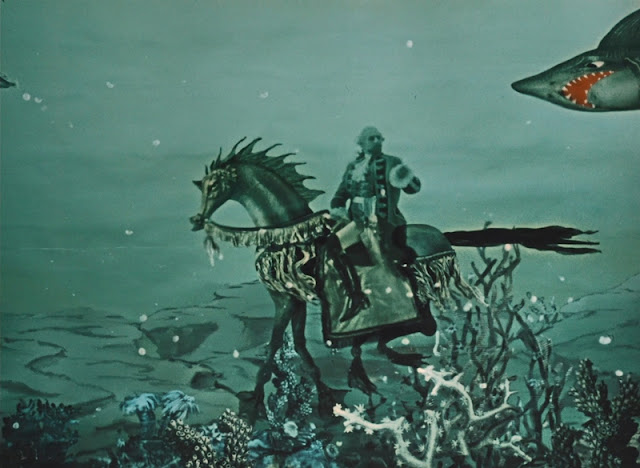
mathematical equations. Using Gustave Doré’s artwork as a template, his paper
cutout animation resembles book illustrations that leapt off the pages. His
signature blending of live action and animation creates a fairy tale look. Particularly
impressive is a tracking shot through the Sultan’s palace, arranging multiple cardboard
planes to create a three-dimensional space. He also frequently used split-screen
techniques, combining live actors with paper cutouts in the background or
foreground. The effects are delightfully old-fashioned, giving Zeman’s film a
charm that can’t be compared to modern efforts. It's not about seamless
integration of the imagery, but indicative of a different filmmaking tradition
that favors creating fanciful visuals over hyper-realism. While I’m not going
to initiate a debate about which approach is “better,” the analog, mostly
in-camera effects never fail to entrance. Created by a small team of dedicated
craftspeople, The Fabulous Baron Munchausen possesses a handmade quality
that can’t be duplicated by a bunch of people clicking away on computers.
* Fun Fact #3: Zeman learned about the mechanics of
animation by studying a “Felix the Cat” cartoon frame by frame.
** Fun Fact #4: Despite his early artistic predilections, Zeman’s
father forced him to attend business school.
Amidst the high fantasy, Karel Zeman reveals a sense of
humor worthy of a Warner Brothers cartoon. In one terrific gag, the Baron and
Tonik attempt in vain to break down some double doors in the Sultan’s palace,
only to watch Princess Bianca effortlessly open them. When Tonik innocently
steps on a rug in the Sultan’s throne room, he unwittingly triggers a swarm of
spears. And on the Dutch trading ship even the ship’s figurehead enjoys taking
a brief smoke break. Along with these playful flourishes, the film presents a satire
on the human condition. While in the presence of the mercurial Sultan, Baron
Munchausen speaks the “language of high diplomacy” (consisting of musical
harmonica sounds) as a means of communication.

In The Fabulous Baron Munchausen, Karel Zeman takes
you to imaginary places that never existed, but you somehow wish they did. His
approach to visuals is distinctly different compared to his contemporary Ray
Harryhausen, but the end results are just as mesmerizing. Zeman’s version of
Baron Munchausen argues that imagination and fantasy are more powerful than
knowledge – and in the context of the distinctly engaging visuals, who could disagree?
While Zeman left an indelible impression with his film, there’s something about
Munchausen that transcends generations and bears repeating. Who knows when or
where the next iteration of the indomitable Baron will take us, but one thing’s
for certain: you can’t keep a good fibber down.
Sources for this article: “Why Zeman Made the Film” Blu-ray
featurette; “Baron Munchausen; Facts and Fibs,” by Michael Brooke; Film
Adventurer Karel Zeman (2015 documentary)