Showing posts with label Spain. Show all posts

Tuesday, July 1, 2025

The Diabolical Dr. Z


The Diabolical Dr. Z Poster

(1966) Written and directed by Jesús Franco; Adaptation and Dialogue by Jean-Claude Carrière; Starring: Antonio Jiménez Escribano, Estella Blain, Mabel Karr, Howard Vernon, Fernando Montes, Marcelo Arroita-Jáuregui, Cris Huerta, Guy Mairesse and Jesús Franco; Available on Blu-ray and DVD.

Rating: ***½ 
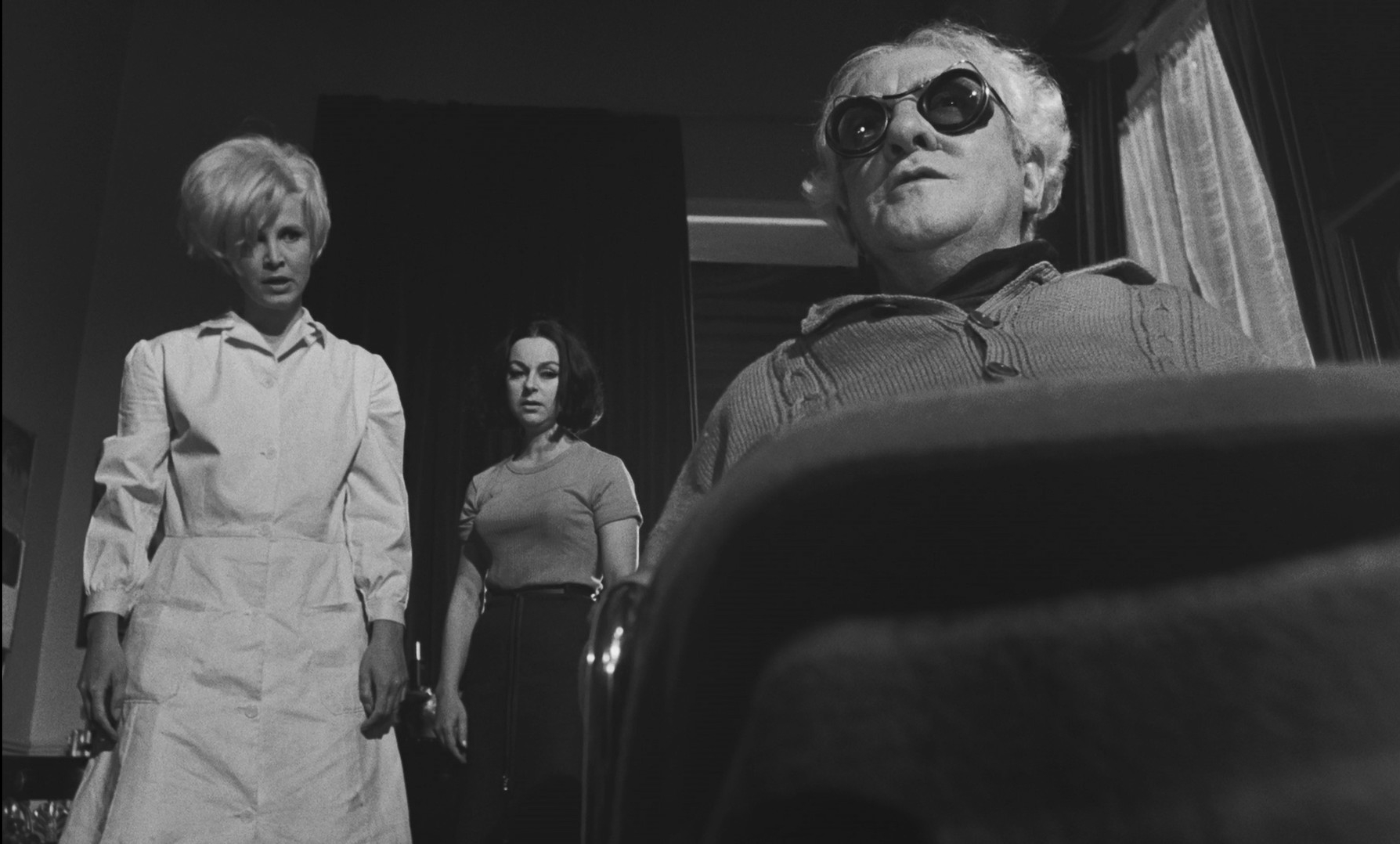
Irma and Dr. Zimmer

“I don’t think I have a definitive film. Such a thing is not possible for me. But if you’re curious about which film I would save from a fire, I should tell you Necronomicon (Succubus), Black Angel (Venus In Furs), and Miss Muerte (The Diabolical Dr. Z). They are the most sincere. They are the most close to my previous idea to do it, you know what I mean? I like the style of black cinema. I like the style of expressionisimo, and they are the most of myself. I don’t say that I love it, though, because I don’t...” – Jesús Franco (from 2009 A.V. Club interview) 

Dr. Zimmer

Jesús (“Jess”) Franco was an incredibly prolific filmmaker, credited with directing more than 200 movies (considering how many titles he directed under a pseudonym, we may never know the true count). Franco was so prolific that it’s easy to see how rumors spread about shooting more than one film at a time.* The Diabolical Dr. Z (aka: Miss Muerte) an unofficial adaptation of Cornell Woolrich’s 1940 novel, The Bride Wore Black, was itself re-made by Franco (sort of) several years later as She Killed in Ecstasy (1971). The French/Spanish co-production was filmed in and around Madrid.   

* Fun Fact #1: Although Tim Lucas perpetuated this rumor in his DVD commentary, Franco himself denied ever directing more than one film at a time, stating in an AV Club interview, “I never made two or three films together. This is impossible! I only have one head. It is impossible for me to think about two films at the same time…”

Irma, preparing to run over a hitchhiker

Set in Austria, the film takes place in the same universe as Franco’s earlier film, The Awful Dr. Orloff (1962). Dr. Zimmer (Antonio Jiménez Escribano),* who’s a disciple of the eponymous mad scientist (sharing his theories about good and evil residing in the nervous system), meets with the International Neurological Congress to present his findings. Unbeknownst to his fellow scientists, Dr. Z has already taken the step from animal to human experimentation. Presumably subscribing to the adage, “Ask for forgiveness, not permission,” Dr. Z requests clearance to use a human subject, which goes about as well as you’d expect. The subsequent shock of rejection by his peers is too much for him to take, but before he dies, he implores his daughter/assistant Irma (Mabel Karr) to continue his work. In Irma’s case, that means using her father’s experiments to take revenge against the men who discredited him. After faking her own death using a hitchhiker (Ana Castor)** as a stooge, Irma sets out to eliminate Dr. Z’s detractors. Using her father’s invention (a cool-looking but impractical device with flimsy mechanical arms), she brainwashes Miss Death (Estella Blain), an unassuming exotic dancer with freakishly long nails, to carry out her bidding.   

* Fun Fact #2: Despite being the title character, Dr. Zimmer only appears in the film’s first 12 minutes. 

** Fun Fact #3: According to film historian Tim Lucas, Castor was Franco’s first pick to play Irma.

Miss Death

Thanks to Alejandro Ulloa’s* gorgeous cinematography, The Diabolical Dr. Z is quite possibly one of the best-looking films Franco has ever made. Although Franco reportedly lamented the fact that many of his earlier films were filmed in black and white, it’s hard to imagine color enhancing the overall experience. Ulloa imbues Dr. Z with a noirish appearance, typified by long shadows, fog-drenched streets, and imposing low-angle shots. One of the film’s highlights is Miss Death’s sexy/creepy dance sequence on a spiderweb, foreshadowing her lethal mind-controlled escapades in future scenes. 

* Fun Fact #4: This film would prove to be Franco’s only collaboration with Ulloa, who would go on to lens Horror Express (1972).

Dr. Z's Lab

As with many of Jesús Franco’s films, The Diabolical Dr. Z is akin to a waking dream, with logic taking a backseat. But considering the excesses of Franco’s later efforts, Dr. Z shows surprising restraint, most likely enforced by the censors of the time (Miss Death’s revealing costume notwithstanding). Besides the film’s neo-noir leanings, Dr. Z features some excellent performances by Mabel Karr’s as the icy Irma and Estella Blain as the aforementioned Miss Death. Franco himself has a nice semi-comic turn, in the (uncredited) role of the perpetually exhausted Inspector Tanner, who constantly complains about his triplet babies keeping him awake at night. Is The Diabolical Dr. Z proof to the Franco naysayers that he could make a good movie? Well, some naysayers are going to “nay,” no matter what. Those with an open mind (Francophiles and horror fans alike), however, might be pleasantly surprised by this stylish horror thriller.   


Sources for this article: Tim Lucas DVD commentary; JessFranco (interview), by Sean O’Neal, AV Club (2009) 


Thursday, June 26, 2025

Spanish Horror Month Quick Picks and Pans

The Lorely's Grasp

The Loreley’s Grasp (1973) What if Hammer produced a movie in Spain? It might look something like The Loreley’s Grasp, from Amando de Ossorio (Tombs of the Blind Dead). Set in Germany (but filmed mostly in Spain), Loreley (Helga Liné), a legendary, centuries-old creature emerges from the lake to feast on the hearts of its victims. When an all-girls boarding school appears to be the creature’s primary target, the schoolmaster hires the experienced hunter Sigurd (Tony Kendall) to track down and destroy it. Helga Liné is appropriately enticing as the siren-like Lorely, who transforms into a hideous beast at night. The rubbery monster is nothing to write home about, but the film makes up for any deficits with heaps of gothic atmosphere. Great fun! 

Rating: ***½. Available on Blu-ray, DVD and Tubi   

Howl of the Devil

Howl of the Devil (1988) Director/co-writer Paul Naschy’s love letter to the Universal monsters of yesteryear is a twisted tale of obsession, imagination gone awry, and death. Naschy plays Hector, the psychologically unbalanced brother of a famous, deceased character actor, Alex (also played by Naschy). While Hector partakes in bizarre sex games, his nephew Adrián lives in a world of his own. He’s watched over by Hector’s comely housekeeper, Carmen (Caroline Munro), who dreams of taking Adrián away. Adrián holds imaginary conversations with several monsters (including Waldemar Daninsky, the Wolf Man, the Hunchback of Notre Dame, Frankenstein’s Monster, and the Phantom of the Opera), which naturally gives Naschy a golden opportunity to revisit these characters. While it’s hard to justify some of the plot’s sleazier elements, it’s a treat to see Naschy in his element. 

Rating: ***½. Available on Blu-ray 

The Baby's Room

The Baby’s Room (aka: Películas Para no Dormir: La habitación del Niño) (2006) In this intriguing film from director/co-writer Álex de la Iglesia, a young couple with an infant son move into an old house. Not long after they begin renovating the place, Juan and Sonia (Javier Gutiérrez and Leonor Watling) experience a number of strange occurrences, with Juan insisting there’s an intruder watching over their baby. Rather than a ghostly presence, signs point to parallel universes at work, with the house as their focal point. Although it may not quite deliver on such a fascinating premise, The Baby’s Room is worth a look. 

Rating: ***. Available on DVD (part of The Horror Anthology, Volume 1) and Tubi

Edge of the Axe

Edge of the Axe (1988) In this standard slasher from director José Ramón Larraz, an axe murderer in a creepy mask stalks women in a a small Northern California town. Mostly shot in Spain, Edge of the Axe relies on 2nd unit footage in California, to remind us where we’re supposed to be. A computer “expert” (the filmmakers apparently had no idea what late ‘80s computers were actually capable of) teams up with one of the locals to locate the killer. An escaped mental patient (or course), proves to be the culprit. Yawn. 

Rating: **. Available on Blu-ray, Prime Video and Midnight Pulp

Dracula, Prisoner of Frankenstein

Dracula, Prisoner of Frankenstein (1972) When your monster movie features Frankenstein’s creation, Dracula and the Wolfman, what can go wrong? Well, if it’s the wildly prolific Jesús (“Jess”) Franco at the helm, plenty. With the help of his homemade monster, Dr. Frankenstein revives Dracula, hoping to create an invincible vampire army to rule the world (just forget about stakes, fire and sunlight). This would-be tribute to Universal’s classic monsters somehow manages to be dull, despite the presence of three horror icons. Featuring sloth-like pacing, non-existent character development, and dollar-store makeup effects, Dracula, Prisoner of Frankenstein underwhelms from the first reel to the last. If someone told me Franco made this while someone held a gun to his head, I’d believe it. Unless you’re on a masochistic mission to see all 200+ of his movies, skip it.  

Rating: *½. Available on Blu-ray, DVD and Tubi

Black Candles

Black Candles (aka: Los Ritos Sexuales del Diablo) (1982) After she learns about her brother’s untimely death, Carol (Vanessa Hidalgo) travels to England to visit her sister-in-law Fiona (Helga Liné) in her farmhouse. All is not as it seems, as Carol stumbles onto a satanic cult, falling into Fiona’s trap. The paper-thin plot is mostly an excuse to depict one sleazy escapade after another (including a sex scene with a pig). More unpleasant than scary, Black Candles is a must-miss. 

Rating: *½. Available on Blu-ray and DVD


Friday, June 13, 2025

Horror Rises from the Tomb


Horror Rises from the Tomb Poster

(1973) Directed by Carlos Aured; Written by Paul Naschy; Starring: Paul Naschy, Emma Cohen, Vic Winner (aka: Victor Barrera), Helga Liné, Betsabé Ruiz, and María José Cantudo; Available on Blu-ray and DVD 

Rating: ***

Alaric de Marnac

“Horror fans in particular are great people. They are devoted to their favorite type of film with loyalty few other genres have. It is sad that many modern directors are exploiting and abusing this audience with bad films. They try to appeal to them by title, take their money, and leave them disappointed. In my prime, I always gave the public what I thought they wanted. I was a horror fan myself before I became an actor, director, and screenwriter, so I knew first-hand what some of their tastes were. I’d like to think I reached my goal in keeping horror fans happy and entertained. If not, at least I gave them my best effort...” – Paul Naschy (from 1992 interview) 

“The reason the producer decided to give me my first directing opportunity was not because he believed that I had some special merits, but because I promised to make the film on a very low budget” – Carlos Aured

Alaric de Marnac and Mabille De Lancré

Paul Naschy (aka: Jacinto Molina Álvarez) has often been compared to Lon Chaney, not only for the breadth of characters he portrayed, but the depth of his commitment to the craft of acting. Even if you don’t know his name, I’d wager (if you’re a horror fan like me) you’ve seen his face multiple times. Besides acting, he often worked behind the camera, directing and writing. Horror Rises from the Tomb (aka: El Espanto Surge de la Tumba), featured a script by Naschy,* and direction by rookie Carlos Aured. While the movie was set in France,** it was mainly filmed in the Lozoya valley in Naschy’s native Spain. 

* Fun Fact #1: According to Naschy’s memoir, Memorias de Un Hombre Lobo (aka: Memoirs of a Wolfman), he cranked out the screenplay in one-and-a-half days, with the aid of amphetamines. 

** Recycled Fun Fact (see my Night of the Werewolf  review): Why was this movie set in France if it was shot in Spain? Filmed depictions of supernatural events were forbidden under Franco’s Spain, but were permissible as long as the setting was outside of Spain. 

Alaric de Marnac's Head

In the film’s prologue, circa 15th century France, Alaric de Marnac* (Paul Naschy) and his lover/accomplice Mabille De Lancré (Helga Liné) are sentenced to death for the practice of witchcraft and a litany of atrocities. Before de Marnac is decapitated and Mabille is strung up on an oak tree,** he proclaims he will return for vengeance against his accusers’ descendants. Skip forward to 20th century Paris, where Hugo (also played by Naschy) and his friend Maurice (Vic Winner) discuss the legend of de Marnac. Maurice doesn’t believe the stories – until the spirit of Alaric de Marnac compels him to paint a portrait of the deceased warlock. The friends set out for the countryside to investigate, with their girlfriends in tow. After an unfortunate run-in with bandits, they eventually arrive at Hugo’s father’s house, *** conveniently located near the ancient ruins of a monastery where de Marnac and his mistress were supposedly buried. Still under the influence of de Marnac’s malevolent spirit, Maurice locates a small chest, buried in the courtyard of the monastery. Clouded by hopes of buried treasure, some villagers abscond with the chest. Instead of finding untold riches they discover de Marnac’s decapitated head inside, which begins asserting its control over anyone in its proximity (Does he have a limited range, like Wi-Fi or Bluetooth? The world may never know). Once de Marnac’s head has been restored to its proper place on his body, the warlock proceeds to drain Hugo’s girlfriend Silvie (Betsabé Ruiz) of her blood to revive Mabille. Subsequently, Maurice and his girlfriend Paula (Cristina Suriani) fall under the resurrected couple’s spell to carry out their bidding. Thus, the wheels are set in motion for the time-honored cinematic tradition of a showdown between the forces of good and evil. 

* Fun Fact #2: Alaric de Marnac was based on a real historical figure, nobleman and alleged serial killer, Gilles de Rais who terrorized 15th century France. 

** Fun Fact #3: The filmmakers chose an ancient oak tree for the scene, located within the historically significant location of Roble Gordo. According to Naschy, one of the torches used for the scene was left burning near the tree, reducing it to ashes overnight. 

*** Fun Fact #4: Hugo’s country home conveniently belonged to Naschy’s family.

Alaric de Marnac and Mabille De Lancré

Paul Naschy is in his element in the dual roles of evil personified Alaric de Marnac and everyman Hugo. Helga Liné conveys the right combination of seductive and spooky as Mabille, who’s every bit de Marnac’s equal. Together, by far, they’re the most memorable characters in the film. The other big star is the pervasive somber tone and moody lighting, making the most of the film’s meager budget. In one of the most disturbing scenes, a group of blank-eyed, reanimated dead villagers shamble into Hugo’s house.

Walking Dead

Evil meets its match when Hugo produces “Thor’s Hammers” amulet, which has been in his family’s possession for centuries. The protective talisman (ahem, deus ex machina) is the key to Alric de Marnac’s destruction. How something Nordic in origin ended up in rural France is never explained, as well as why it would have such a deleterious effect on an ancient French nobleman (What did Alaric de Marnac do to piss off the Vikings?). Outside of our dynamic satanic duo, there’s not much in the way of character development – most of them seem to exist simply as a means to propel the plot. You’ll scarcely notice the film’s deficits when you’re treated to oodles of gothic atmosphere and many of the characters (predominately women) in various states of undress.* Horror Rises from the Tomb might not be Naschy’s best or most consistent effort, but it’s a hoot to watch – and sometimes, that’s all you need. 

* Fun Fact #5: Due to content restrictions in Spain, the filmmakers shot nude scenes for the foreign export market, and re-filmed clothed scenes for the domestic version. 


Sources for this article: Essay by Mirek Lipinski;“Paul Naschy,” by Dale Pierce, Filmfax: The Magazine of Unusual Film, 1992; Memoirs of a Wolfman, by Paul Naschy (Translated by Mike Hodges)


Saturday, March 1, 2025

“Attack of the…” Month Quick Picks and Pans


Attack the Gas Station Poster

Attack the Gas Station (1999) A group of aimless Korean youths hold up a gas station for kicks, taking the employees hostage. They get more than they bargained for, however, when they inadvertently escalate a gang war. Attack the Gas Station approaches its subject with sly humor and unexpected depth, delving into the histories of the disenchanted anti-heroes. Fasten your seatbelts, and get ready for some anarchic fun. 

Rating: ***½. Available on DVD 

Attack of the Beast Creatures Poster

Attack of the Beast Creatures (1985) What do you do when you set out to make your own monster movie, but the estimate to have the monsters fabricated costs far more than the entire budget? You make your own. The results are (ahem)… well, they tried. The survivors of a doomed ocean liner in the North Atlantic, circa May 1920, end up on a seemingly uninhabited island. They soon discover deadly acid pools and a bunch of vicious little red humanoid creatures with glowing eyes and sharp teeth. Soon, they have to fight their way through a hostile forest to get back to the lifeboat. Director Michael Stanley’s no-budget made-in-Connecticut wonder is nothing, if not ambitious. It’s not good, but never fails to entertain, with bad acting, laughable effects, and unintentional humor. 

Rating: ***. Available on Blu-ray 

Gyo: Tokyo Fish Attack Poster

Gyo: Tokyo Fish Attack (2012) Takayuki Hirao’s anime adaptation of Junji Ito’s bleak manga Gyo cuts many corners, blending cell art with less effective computer-generated animation. While it’s not the best Ito adaptation, it’s far from the worst. A young woman on vacation with her friends, falls into a nightmare situation when they’re overrun by foul-smelling sea creatures with mechanical legs. She returns to an apocalyptic version of Tokyo on a quest to find her boyfriend. Gyo tries to be more “adult” with excessive fan service, which detracts from the plot. Nevertheless, the horror of Ito’s original story shines through, as humanity, paying for the sins of the fathers, is brought to the brink of extinction. 

Rating: ***. Available on DVD 

Attack of the Robots

Attack of the Robots (1966) This somewhat deceptively titled spy spoof from director Jesús Franco is surprisingly competent, if a bit generic. Eddie Constantine (Alphaville) stars as retired Interpol agent Al Pereira, who’s enlisted to foil a plot to turn people into zombie assassins (controlled by a pair of special horn-rimmed glasses). Sophie Hardy provides some sizzle as Pereira’s Interpol counterpart, Cynthia Lewis, but there’s little chemistry between the two leads. There’s also some uncomfortable “Chinese” stereotypes portrayed by Spanish actor Vicente Roca as counter-spy, Lee-Wee. Look for Franco in a cameo as a nightclub pianist.   

Rating: **½. Available on Blu-ray, DVD and Tubi 

Attack of the Giant Teacher Poster

Attack of the Giant Teacher (2019) Kenzo Miyazawa (Makoto Kojima) is a night school teacher at a career crossroads, lacking energy or enthusiasm for his job. When he learns that the school is being closed down at the end of the year, he encourages his confused students to plan one final event: an Edo-period musical. Oh, and there just happens to be an insatiably hungry alien who wants to put Earth’s residents on its dinner plate. Attack of the Giant Teacher features some surprisingly colorful characters. Unfortunately, its reach far exceeds its grasp, with dreadful CGI effects and the giant teacher vs. kaiju action implied by the title doesn’t occur until the final five minutes. It probably would have been better to scrap the tokusatsu plot in favor of focusing on the dynamic of teacher and students alone, but the film has its moments. 

Rating: **½. Available on Blu-ray, DVD and Tubi

Ski Troop Attack Poster

Ski Troop Attack (1960) Filmed in South Dakota with most of the same cast and crew as Beast from Haunted Cave (1959), Roger Corman’s cut-rate World War II “epic” runs just over an hour (including a heap of stock footage). A small ragtag bunch of American soldiers led by the gung-ho Lt. Factor (Michael Forest) attempt to destroy a bridge, deep inside enemy territory. It’s pretty standard stuff, down to the soldier who can’t wait to get back home (Guess what happens to him?). For Corman completists only. 

Rating: **. Available on Blu-ray, DVD and Tubi

Attack of the Killer Refrigerator 

Attack of the Killer Refrigerator (1990) Shot on VHS for what looks like $50 (folks, this isn’t the movie to showcase your 4K TV), this horror spoof takes place during the course of one evening in a suburban house. After partying young people scrape the ice out of a refrigerator, the (wounded?) kitchen appliance is out for revenge, picking off the residents and guests one by one – and that’s about it. The short film only runs 16 minutes, so you don’t have much time to be bored. 

Rating: *½. Available on Blu-ray


Tuesday, April 25, 2023

Spirit of ’76 Month Quick Picks and Pans


Mad Dog Morgan Poster

Mad Dog Morgan (1976) Dennis Hopper plays Daniel “Mad Dog” Morgan, an Irish immigrant turned outlaw in 1860s Australia. He roams the countryside with his trusty indigenous companion Billy (played by the always reliable David Gulpilil), robbing from the settlers. Despite a reportedly troubled production (due to a problematic Hopper), co-writer/director Philippe Mora’s outback western is a fascinating but sympathetic portrait of one of Australia’s most notorious criminals. In stark contrast to his pursuers and local lawmakers, Morgan possesses a code of honor and sense of fair play, transforming him into a cult hero of sorts. 

Rating: ***½. Available on Blu-ray, DVD and Kanopy

Who Can Kill A Child Poster

Who Can Kill a Child? (1976) Narciso Ibáñez Serrador’s Spanish horror-suspense film is a potent mixture of Lord of the Flies with Children of the Damned. English tourists Tom and Evelyn (Lewis Fiander and Prunella Ransome) decide to leave the hustle and bustle of a crowded Spanish coastal town, for the promise of peace and quiet on a nearby island. They soon discover the conspicuous absence of adults in the island village, which seems to be populated by roaming packs of sadistic children. We never learn what causes their vicious behavior (Is it a social or biological disease?), but the implication is that some sort of judgment day is at hand for the grown-ups. It’s a truly relentless, unnerving experience that will stay with you long after you’ve watched it.

One warning: The film’s only sour note (and it’s a big one) is the opening credit sequence, presenting a tasteless litany of atrocities against children (including concentration camps and famine). My recommendation: fast-forward through it. 

Rating: ***½. Available on Blu-ray and DVD

Black Magic 2 Poster

Black Magic 2 (1976) This Shaw Brothers sequel to the 1975 original promises more sex, gore and sorcery than you can shake a severed limb at. An 80-year-old practitioner of the dark arts keeps his youthful appearance by drinking the breast milk of young women under his spell. He keeps an army of zombies in his basement, who obey his every whim. When three doctors investigate the veracity of claims about him, they try to stop his reign of terror. Can they stop him, or will they join the ranks of his victims? Watch and find out. 

Rating: ***. Available on Blu-ray and DVD

Creature from Black Lake Poster

Creature from Black Lake (1976) This low-budget independent production, filmed in Louisiana, is surprisingly engaging, thanks to colorful characters and a terrifying beast.  Pahoo and Rives (Dennis Fimple and John David Carson), two grad students from Chicago, travel to bayou country in the hopes of tracking down a legendary missing link. Although the scenes with the redneck sheriff (Bill Thurman) won’t surprise anyone, it’s a notch above many of its contemporaries (I’m looking at you, Legend of Boggy Creek) thanks to better acting (featuring appearances by stalwart character actors Jack Elam and Dub Taylor) and (for once) a decent view of the enraged hominid.   

Rating: ***. Available on Blu-ray, DVD, Tubi and Amazon Prime

The Human Tornado Poster

The Human Tornado (1976) Rudy Ray Moore returns as everyone’s favorite kung fu-fighting pimp Dolemite, in his sequel to the character’s eponymous 1975 debut. Dolemite and his pals flee a trigger-happy hillbilly sheriff with an axe to grind for the glitz and glamour of Los Angeles. He runs into more trouble when he tries to rescue his pal Queen Bee (Lady Reed) from the clutches of a local kingpin. It’s cheap, with iffy acting, fake kung fu, and a scene that stops the plot cold, solely for an opportunity to showcase his routine in front of an audience. Is it good? No, but that’s not the point. The Human Tornado was made to entertain, and entertain it does, with Moore’s signature one-liners and over-the-top mayhem. 

Rating: ***. Available on Blu-ray, DVD, Amazon Prime, Kanopy, and Tubi


Death Machines Poster

Death Machines (1976) Madame Lee (Mari Honjo) manages a trio of unstoppable assassins (aka: the “Death Machines”), while the bumbling cops attempt to thwart a series of contract killings. Meanwhile, a survivor of a karate studio massacre vows revenge against the people who killed his master and left him for dead. Filled with laughable dialogue, questionable acting, and haphazard directing, Death Machines is a textbook example of a film that’s so bad it’s good. Enjoy. 

Rating: **½. Available on Blu-ray and DVD


The Town that Dreaded Sundown Poster

The Town that Dreaded Sundown (1976) This odd pseudo-documentary style thriller (and I use the term “thriller” loosely) chronicles a 1946 murder spree, by a killer with no apparent motive. The tone is wildly inconsistent, ranging from a serious police procedural to slapstick hijinks. Probably the most annoying aspect of the movie is its reliance on unnecessary narration, which either describes what already happened on screen, or provides exposition that could have been dialogue. You’ve been warned. 

Rating: **½. Available on Blu-ray and DVD

Futureworld

Futureworld (1976) This forgettable sequel to Michael Crichton’s 1973 film manages to underwhelm at every turn, lacking the novelty or suspense of its predecessor. The Delos Corporation picks up the pieces from the disaster depicted in the first film, rebuilding their resort and replacing their problematic androids with new models. In an effort to boost public relations, they invite TV reporter Tracy Ballard (Blythe Danner) and newspaper reporter Chuck Browning (Peter Fonda) to an all-access experience at the luxury theme park. All isn’t as it seems at the new, “improved” resort, as the snooping reporters discover a sinister conspiracy at work (a theme that would be beaten to death in the exasperating HBO TV series). The cut-rate Samuel Z. Arkoff production fails to impress, riding the fumes of the original (Yul Brynner revises his role as the Gunslinger, in an ill-advised dream sequence cameo). The seemingly endless scenes of Chuck and Tracy running around in the underground bowels of the resort are an apt metaphor for the film, running in circles with nowhere to go. Yawn. 

Rating: **. Available on Blu-ray, DVD and Tubi  


Monday, August 8, 2022

The Night of the Werewolf

The Night of the Werewolf Spanish Poster

(1981) Written and directed by Paul Naschy (as Jacinto Molina); Starring: Paul Naschy, Julia Saly, Silvia Aguilar, Azucena Hernández, Beatriz Elorrieta and Pilar Alcón; Available on Blu-ray (Part of the Paul Naschy Collection) and DVD (Out of Print) 

Rating: ***½ 

“The movies I was making not only reflected my spirit and personality, but was the result of a series of circumstances that surrounded the peculiar country of Spain. The Wolf Man created by the English or Americans, like Larry Talbot, had nothing to do with Spanish culture. I guess that’s why my fans are people who know my movies and have been subconsciously affected by all of this, by a very special country that has always been in conflict, which is Spain. This is reflected in my work.” – Paul Naschy (excerpted from a 2002 interview)

Werewolf

Over the course of his career, Paul Naschy* earned a well-deserved reputation as the Spanish Lon Chaney, portraying a variety of boogeymen, including Dracula, Frankenstein’s monster, the mummy, and of course, a werewolf. Arguably his best-known character was the eternally doomed Polish nobleman/lycanthrope Waldemar Daninsky (a role he played 12 times). ** The Night of the Werewolf (aka: El Retorno del Hombre Lobo) represented a return to familiar territory, blending old-fashioned Hammer-style gothic atmosphere and pools of blood, with a sprinkling of sex and nudity* for good measure. 

* Fun Fact #1: Jacinto Molina adopted the moniker “Paul Naschy,” in an effort to make his name more marketable to international audiences. According to the prolific actor/filmmaker he chose “Paul” after seeing a picture of Pope Paul VI in a newspaper, and the surname “Naschy” was based on Hungarian weightlifter, Imre Nagy. 

** Fun Fact #2: By comparison Lon Chaney Jr. only played his signature role, Lawrence Talbot (aka: The Wolf Man), five times. 

*** Fun Fact #3: According to Naschy, horror filmmakers were allowed to slip by the persnickety Spanish censors, provided all of the supernatural mayhem took place in a different country.

Erika Revives Elizabeth Bathory

In the film’s prologue, set in 16th Century Hungary, we witness a tribunal, where Countess Elizabeth Báthory (Julia Saly) and her confederates are punished for their sadistic crimes against humanity. Compared to her cohorts, Báthory receives a veritable slap on the wrist, confined to her chambers for the rest of her life, while her accomplices are sentenced to death. Most notable among the doomed, is Polish nobleman Waldemar Daninsky (Paul Naschy),* who moonlights as a werewolf (under the control of Báthory, he preyed on hundreds of villagers). But (Surprise!) death isn’t the end for Báthory and her troublesome troupe. Skip forward several centuries, when diligent archeology student Erika (Silvia Aguilar) is hot on the trail of the site that houses Báthory’s not-so-final resting place. Erika, whose ambition is only matched by her ruthlessness, strangles her mentor (Narciso Ibáñez Menta) and takes his amulet, which holds the key to bringing the evil countess back to life. Meanwhile, a wealthy collector and his lackey unwittingly bring Daninsky back to life by removing a silver cross from his chest. If Erika’s previous exploits weren’t enough to convince you of her malevolent intentions, she brings along two of her nubile colleagues, Barbara (Pilar Alcón) and Karen (Azucena Hernández), just so she can sacrifice them. Proving how cutthroat the field of archeology can be, Erika suspends Barbara’s body above Báthory’s crypt, puncturing her neck. In return for Erika’s loyalty, the newly revived Báthory bites her number one fan in the neck, adding her to the ranks of the undead. 

* Fun Fact #4: Unlike Elizabeth Báthory, don’t bother searching for Waldemar Daninsky in the history books. Naschy derived his venerable character’s name from Polish weightlifting champion Waldemar Baszanowski.

Werewolf

Since Naschy is the star of the movie, we’ll conveniently forget about all those murders that occurred several hundred years ago, so he can emerge as the nominal hero. In an early scene, he comes to Erika and her friends’ rescue when they’re ambushed and assaulted by bandits. 300 years of slumber haven’t dulled Daninsky’s impulse to settle the score with Báthory and stop her growing league of vampire minions. To reinforce Daninsky as a sympathetic character, there’s a brief poignant moment (paralleling a shot in Jean Cocteau’s Beauty and the Beast) in which the werewolf regards his reflection in a pool of water with contempt. Karen plays Beauty to Naschy’s Beast, whose unconditional love for Daninsky can set him free.

Bathory vs. Daninsky

Julia Saly seems to be having a blast as Elizabeth Báthory, and why not? Along with her vampire henchwomen, she’s a formidable opponent for Daninsky – a force of nature to be reckoned with. Compared to Báthory, goody-two-shoes Karen couldn’t be anything but bland. The closest thing to a tragic figure is Mircalla (Beatriz Elorrieta), Daninsky’s live-in caretaker. Although persecuted by the villagers as a witch (half of Mircalla’s body is horribly scarred from an attempt to burn her), she’s a force of good, protecting her benefactor and Karen from harm. She scarcely hides the fact that she’s also in love with Daninsky, but no thanks to her hideous appearance, she remains squarely entrenched in the friend zone (Yeah, so much for “It’s what’s inside that counts.”).

Vampire Attack

Despite some creaky elements, recycled from countless other monster movies, The Night of the Werewolf never fails to entertain. It’s the equivalent of cinematic comfort food, packed with the usual trappings we’ve come to expect from modern gothic horror: a tortured protagonist, a shadowy castle shrouded in fog, comely women clad in diaphanous nightgowns (carrying an unwieldly candelabra, no less). If one ignored the movie’s origins, it could almost be confused with a Hammer production (if Hammer played fast and loose with their properties). It’s an irresistible blend of trashy and sublime that hooks you in from the first reel. Who wouldn’t want to see Elizabeth Bathory and her vampire horde versus a werewolf, in a struggle for ultimate power? It’s the historical smackdown we so richly deserved, if reality hadn’t denied us.


Sources: “Paul Naschy: Interview with the Werewolf,” 2002 Blue Underground interview; Paul Naschy wiki 


Sunday, November 29, 2020

November Quick Picks and Pans


Scarlet Street poster

Scarlet Street (1945) Fritz Lang’s cynical noir drama is as bleak as they come, taking us to the darkest corners of human nature. Edward G. Robinson stars as Christopher Cross, a meek, middle-aged bank teller stuck in a loveless marriage to a domineering widow (Rosalind Ivan). His life takes a turn for the worse when he falls for a scheming young woman, Kitty March (Joan Bennett). With the urging of her abusive grifter boyfriend Johnny (Dan Duryea), Kitty takes credit for Christopher’s artwork, garnering the success he could never attain. The film is anchored by Robinson’s heartbreaking performance as a man who only wants to be loved and desired by a beautiful woman. It’s a Faustian bargain with no upside, as he sinks into a ruinous abyss, trading away his reputation at work and talent as an artist.

Rating: ****. Available on Blu-ray, DVD, Amazon Prime and Kanopy

Death of a Cyclist Poster

Death of a Cyclist (aka: Muerte de un Ciclista) (1955) This Spanish noir from writer/director Juan Antonio Bardem ponders the futility of running away from one’s guilt. Juan (Alberto Closas) is a college professor, having an affair with the dean’s wife, Maria (played with icy conviction by Lucia Bosè). When they hit and run a bicyclist (who subsequently dies from his injuries), they conspire to keep things quiet. Juan’s personal and professional life goes downhill, as the incident gnaws away at his conscience. But while Juan wrestles with the ramifications, Maria remains determined to suppress the truth. Bardem’s morality tale painfully illustrates how one terrible event can change someone’s life forever, and how culpability isn’t necessarily an inherent human trait.

Rating: ****. Available on DVD

Crystal Eyes Poster

Crystal Eyes (aka: Mirada de Cristal) (2017) This Argentinian pseudo-giallo from writer/directors Ezequiel Endelman and Leandro Montejano is a fun ’80s retro-tinged throwback, replete with big hair and neon colors. After the accidental death of a top model, several of her cohorts vie for her coveted spot. Unfortunately for them, they don’t realize that a psychopath (wearing a disturbing mannequin mask) lurks in the wings to pick them off, one by one. The filmmakers accomplish a lot on what appears to be a microscopic budget (as long as you don’t scrutinize the sketchy makeup and old creepy mansion that looks suspiciously like a dollhouse), with some nice visuals and splashes of color (recalling Argento’s Suspiria). Sure, it’s nothing you haven’t already seen before, but it’s easy to appreciate the affection for the genre in every scene.

Rating: ***. Available on Tubi

The Killer Reserved Nine Seats Poster

 The Killer Reserved Nine Seats (1974) Nine self-absorbed people are invited to an old theater and subsequently locked inside for the night with a homicidal madman. I think you can guess where it goes from there. Director/co-writer Giuseppe Bennati’s giallo is moderately entertaining with the requisite kills and sexual hijinks, as long as you don’t spend much time questioning the logic of the characters. Instead of banding together against a common antagonist, they continue to bicker and split up. Although the performances are nothing special, the true star of this thriller is the Teatro Gentile da Fabriano, built in 1884, which provides some visual flair to the proceedings.

Rating: ***. Available on DVD (PAL region 0) and Amazon Prime

The Pyjama Girl Case Poster

The Pyjama Girl Case (1978) This not-quite-a-giallo Italian murder mystery (shot in Australia) starts on a promising note, with a body discovered on the beach. Sadly, it’s all downhill from there. Ray Milland, whose agent obviously wasn’t turning down any offers at this point, is good as a retired police detective volunteering on the case, but he's not in the film nearly enough. The story chronicles the events leading up to the murder, and director/writer Flavio Mogherini doesn’t spare any of the sleazy details in the process. His movie favors wallowing in exploitive and voyeuristic sequences (a scene where a group of people ogle a nude corpse is especially off-putting), when it would have benefitted from tension and pathos.

Rating: *½. Available on Blu-ray and DVD

Monday, December 24, 2018

Acción Mutante


(1993) Directed by Álex de la Iglesia; Written by Jorge Guerricaechevarría and Álex de la Iglesia; Starring: Antonio Resines, Álex Angulo, Frédérique Feder, Juan Viadas, Saturnino García and Fernando Guillén; Available on DVD

Rating: ***½

“You can conclude that I am some sort of sadist who mistreats his actors and his crew, and that is true. No, I’d like to say that I have also suffered a lot in this movie. And if you have the opportunity to see any sequence I was also shooting, I got hurt. We all had a great and an awful time and I think that is what it means to make a movie.” – Álex de la Iglesia (from DVD making of featurette)


Who says dystopian flicks have to be all gloom and doom? Álex de la Iglesia’s ambitious, audacious feature film debut manages to address the big issues without being heavy handed or preachy. Instead of hammering the concerns home with depressing settings and gloomy characters, he’s distilled the dystopian themes into a potent, lively brew. As a tonal starting point, he blends early Peter Jackson (think Bad Taste and Dead Alive), Robocop-era Paul Verhoeven and Terry Gilliam (especially Brazil and Time Bandits), with elements from Treasure of the Sierra Madre thrown into the mix for good measure. The finished product, however, is unmistakably de la Iglesia’s.  


In the near future setting, perhaps a step or two away from our present, we’re introduced to an oligarchical society, run by big corporations and the wealthy. A militant group of disabled and deformed people, “Acción Mutante” (or “Mutant Action”), wage war against the wealthy, the beautiful, and anyone who strives for perfection. Their leader, Ramón Yarritu (Antonio Resines, in a standout comic performance), just released from a five-year prison sentence, meets up with his old gang to plan their next act of defiance (“Society treated us like shit, and now we’re gonna kick some ass!”). They target spoiled rich girl Patricia Orujo (Frédérique Feder), heiress to the Orujo Bakery fortune, for kidnapping at her wedding reception. After a botched operation, starting with a gunman hidden in a giant cake, they still manage to wreak chaos at the party and abduct their target. The gang, with Patricia in tow, escape in their rust-bucket spaceship Virgen del Carmen to the mining planet Axturias. Her father (Fernando Guillén) and new husband (Enrique San Francisco), aren’t about to take this sitting down, and pursue with their own army.


Ramón is a walking contradiction, as a fighter for the oppressed masses and a not-so-selfless seeker of personal gain. Greed gets the best of him as he imagines the perceived wealth from the ransom money, and he systematically eliminates his co-conspirators. One thing he didn’t count on was his hostage developing a strange affinity for her kidnapper (Ramon complains, “Not the Stockholm Syndrome again!”). After he removes the staples from her mouth, he wishes he’d left them in, as she launches into a diatribe of anti-establishment rhetoric (“It’s incredible how much the system can alienate you.”). By the   end of the movie, they’re reduced to bickering like an old married couple.


Acción Mutante is packed with a series of inspired gags – I don’t want to spoil the fun by detailing them here, but the common denominator among them (a common de la Iglesia trait) is that things don’t go as planned, starting with the wedding cake. After Ramón kills Alex’s (Álex Angulo) conjoined twin Juan (Juan Viadas), Alex is forced to amble about, attached to his brother’s stuffed corpse. Each situation builds on the next, leading up to a final irony-drenched scene. No exploration of the film would be complete without mentioning the awful, absurd costume design by Estíbaliz Markiegi and Lena Mossum. Some highlights are the avant-garde fashions worn by snooty party-goers, Patricia’s father’s Nazi-like uniform (including an Orujo Bakeries arm band), and a TV news reporter’s suit that resembles a bunch of rocks (to match the miners’ bar on Axturias, the setting for the climactic ransom exchange).


Álex de la Iglesia has a strong following from a dedicated group of fans, yet he remains a best-kept secret of sorts to most American audiences. He’s made arguably better, more polished films since Acción Mutante (such as with El Crimen Ferpecto – that’s not a typo, 800 Bullets and The Last Circus), but this remains a solid introduction to his movies and skewed sensibilities. Acción Mutante isn’t afraid to address some serious topics, depicting marginalized members of society fighting against inequities, class division between rich and poor, and how money (or the promise of it) corrupts. Somehow, de la Iglesia manages to inject his commentary on social ills, and we can still keep a smile on our collective faces. Warning: You might have to dig to find the film* (I found my Region 2 DVD through an independent seller on Amazon UK), but it’s well worth endeavoring to beg, borrow or steal** a copy.

* According to a 2005 interview, one reason for the disc’s relative scarcity may be that the filmmakers didn’t have the rights to the Mission Impossible theme, which figures prominently in one scene.

** The writer assumes no liability for anyone who chooses this third option.