Showing posts with label Satire. Show all posts

Sunday, May 31, 2026

Musical May Quick Picks and Pans


True Stories Poster

True Stories (1986) Writer/director David Byrne is our guide to the fictional town of Virgil, Texas, where they’re about to hold their sesquicentennial celebration. He introduces us to an assortment of Virgil’s eccentric residents, including: Kay and Earl Culver (Annie McEnroe and Spalding Gray), a husband and wife who haven’t spoken to each other in years, a pathological liar (Jo Harvey Allen), Louis Fyne (John Goodman), a good-natured bachelor who just wants a wife, and a woman so lazy she never leaves her bed (Swoosie Kurtz). The actors perform the Talking Heads songs, placing their unique spin on the material. It’s a skewed little slice of Americana, as only David Byrne can show us. 

Rating: ****. Available on Blu-ray and DVD 


Reefer Madness - The Movie Musical Poster

Reefer Madness: The Movie Musical (2005) This Showtime-produced film, based on the off-Broadway musical by Kevin Murphy and Dan Studney (who also adapted it for the feature), uses the sensationalistic 1936 anti-marijuana scare film as a launching point.  Alan Cumming (who plays multiple roles) is our guide through a world of sin and depravity, as only the devil’s lettuce can take us (allegedly). Watch as ordinary American “teen” couple Mary Lane (Kristen Bell) and Jimmy Harper (Christian Campbell) fall under the spell of the illicit substance, after Jimmy falls in with a bad crowd. The musical numbers are a lot of fun (especially the one taking place in heaven), along with the satirical lambasting of "wholesome” 1930s society. 

Rating: ****. Available on Blu-ray, DVD, Tubi and Prime Video

Lisztomania Poster

Lisztomania (1975) The same year he graced us with Tommy, writer/director Ken Russell shot this audacious oddball of a movie, suggesting composer/pianist Franz Liszt (Roger Daltrey) was the rock star of his day. It’s a delirious cocktail of bizarre imagery, sex, and music, like Russell’s greatest hits, distilled into one movie. Don’t look for historical accuracy – just let it flow through your brain as you try to make sense of it all. Paul Nicholas co-stars as Liszt’s friend/rival composer Richard Wagner (who happens to be a vampire), Ringo Starr makes a memorable cameo as the Pope. I can’t say I understood it, but I enjoyed the ride. 

Rating: ***½. Available on Blu-ray and DVD 

Alice in Wonderland Poster

Alice in Wonderland: An X-Rated Musical Fantasy (1976) Chances are, you’ve probably never seen a version of Alice in Wonderland like this before. Thanks to the filmmakers of the anything-goes ‘70s, Alice was only one of several adult parodies of beloved (aka: public domain) stories. Alice (Kristine DeBell) is at a crossroads with her frustrated boyfriend, whose advances are constantly thwarted. After another argument over sex (or lack thereof), Alice has a moment of reflection, and decides to learn what all the fuss is about. Thus begins, her trippy quest of self-discovery in Wonderland, where she meets the usual suspects, including the White Rabbit, Tweedledum and Tweedledee, and the Mad Hatter (guess what the 9-3/4 on his hat refers to). Sure, the jokes are corny, and there are too many unnecessary insert shots, but it’s hard not to appreciate the effort that went into making this a genuine musical. The songs (written by Bucky Searles and Jack Stern) are decent, with some highlights being: “Guess I Was Just Too Busy Growing Up,” “Alice Helps Humpty Dumpty Up,” and “What’s a Nice Girl Doing on a Knight Like This?”. Give it a try, if you dare. 

Rating: ***. Available on DVD 

The First Nudie Musical Poster

The First Nudie Musical (1976) A struggling independent studio owner (Stephen Nathan) experiences a flash of inspiration to save his livelihood: produce a porn musical. He secures the funding, with the catch that he needs to complete the film within two weeks, or ownership of the studio will transfer to his debtors. Despite a series of setbacks involving casting, songwriting, and working with a rookie director (played by Bruce Kimmel, who wrote and co-directed), the somehow manages to get the production off the ground. The songs are mostly forgettable, and the majority of the jokes fall flat, but it’s harmless enough. Perhaps the premise could be worked into a better movie someday.   

Rating: **½. Available on DVD, Tubi and Prime Video 

Pennies from Heaven Poster

Pennies from Heaven (1981) It’s the feel-bad musical sensation of 1981, folks. Herbert Ross’ lavish musical, set in the middle of the Great Depression, is nice to look at, but relentlessly grim from beginning to end. Steve Martin (in what could be his most unlikeable role to date) stars as Arthur Parker, a struggling music salesman prone to flights of fancy. He abandons his wife Joan (Jessica Harper), setting his sights on mild-mannered schoolteacher, Eileen (Bernadette Peters). He effectively ruins her life, as she becomes pregnant, loses her job, and is eventually forced into prostitution to make ends meet. Pennies from Heaven is an exercise in cynicism that ignores what made those ‘30s musicals special. 

Rating: **. Available on DVD


Monday, February 2, 2026

Battle Royale


Battle Royale Poster

(2000) Directed by Kinji Fukasaku; Written by Kenta Fukasaku; Based on the novel by  Koushun Takami; Starring: Tatsuya Fujiwara, Aki Maeda, Taro Yamamoto, Chiaki Kuriyama, Takashi Tsukamoto, and Takeshi Kitano; Available on Blu-ray and DVD 

Rating: ****

Horrified Students

“I had a horrible experience escaping air bombing and helping to pick up dismembered limbs of people who were killed. I realized later that I was told lies by the Japanese military government that told us we have to fight to save our country from the enemy. I felt cheated and isolated. This is what I wanted to portray in the movie.” – Kinji Fukusaku 

“Basically, the person who is outside the battlefield or someone who can calmly observe the whole situation has the most power. Below that level are the people who actually fight. That’s the nature of violence. The most frightening person is the one who is quiet and lets others be violent.” – Takeshi Kitano

Where does influence end and originality begin? Or perhaps this is the wrong question to ask. Film fans and critics alike often look for the mythical “first” movie that started it all, but that’s not as easy as it seems. The more movies I see, the more I realize it’s just one big continuum, with ideas constantly being recycled, regurgitated, and re-formed to fit the moment. Consider Battle Royale, one film that’s engendered the cinematic equivalent of the “chicken or the egg” debate since its release, and the subsequent franchises that drew upon it for inspiration (whether intended or not). The Hunger Games (2012), Ready or Not (2019), and Squid Games could arguably be considered direct descendants of Battle Royale, but Battle Royale didn’t exist in a vacuum, with the many books and films that preceded it encoded in its DNA (The Most Dangerous Game, Lord of the Flies, and The 10th Victim, to name only a few). Veteran director Kinji Fukasaku,*/** best known for his controversial Yakuza films of the ‘60s and ‘70s*** prompted more controversy with his adaptation of Koushun Takami’s 1999 novel. 

* Fun Fact #1: Fukasaku celebrated two milestones with Battle Royale: His 60th feature film and his 70th birthday. 

** Not-So-Fun fact: Sadly, Battle Royale would prove to be his last completed project. Fukasaku died of cancer only a couple of years later, while filming Battle Royale II: Requiem (which was finished by his son, Kenta). 

*** Fun Fact #2: Kinji Fukasaku is probably best-known on these shores, however, for the kitschy space epic The Green Slime (1968).

Instructional Video for Battle Royale

Set in a dystopian near-future, Japanese society has eroded to the point where unemployment has reached 15%, youth violence has run rampant, and public schools can no longer manage their students. In response to these changes, the “BR Act” was created, to keep the young people in line. In the film, a classroom of 42 middle school students (traveling under the auspices of an end-of-year field trip) are brought to a remote island.* They soon learn they’re about to embark on a three-day life-or-death competition, with the object of killing each other off, until the last boy or girl is standing. Each student is subsequently provided with supplies (including a random weapon), and sent out meet his or her fate. To discourage any thoughts of escape, each student is equipped with necklaces that will explode if they disobey or attempt to tamper with the devices. Beyond the constraints of the island and necklaces, there are no rules. 

* Fun Fact #3: The island used for filming was Hachijō-kojima, a small island that has remained uninhabited (except for a population of goats) since the late 1960s.

Mitsuko

Much like Lord of the Flies, some of the students form alliances, in the hopes that they will get through this together, but it’s merely delaying the inevitable. When “kill or be killed” is the only imperative, most of them do away with the pretense of friendship or teamwork. One such alliance is between “transfer student” Shôgo Kawada - Boy #5 (Tarô Yamamoto), who survived the game before, but at the expense of his girlfriend. He initiates a shaky truce with Shuya Nanahara - Boy #15 and Noriko Nakagawa - Girl #15 (Tatsuya Fujiwara and Aki Maeda, respectively). Kawada casts a shadow on his credibility when he continually changes his back-story (claiming at different times to be the son of a doctor, chef, and fisherman), leaving Shuya and Noriko to question his motives. While some choose to team up, others prefer to act alone. Another transfer student, Kazuo Kiriyama - Boy #6 (Masanobu Andô), operates on his own, mercilessly killing off the other students with maniacal glee. But at least everyone knows where they stand with Kiriyama. Less predictable is Mitsuko Sôma - Girl #11 (Kô Shibasaki), using every trick she knows to lull her fellow students into a false sense of security. A brief flashback to her early childhood provides a sympathetic view of an otherwise unsympathetic character, who vowed never to become a victim.

Kitano in Classroom

As disturbing as the students’ behavior may be, it pales in comparison to their teacher Kitano, played by comic actor Takeshi Kitano (aka: “Beat” Kitano). Kitano steals the show whenever he’s onscreen, with his deadpan delivery. In the opening scene, set a couple years before the government-ordained bloodbath, he’s stabbed by a student, resulting in his departure from the school. Now, bitter and estranged from his family, he returns to see his old class kill each other. Whatever status quo he’s preserving has done nothing to improve his life or set a model example for the younger generation. One nice little touch, illustrating Kitano’s amorality, is his munching on a bag of cookies (while he tracks the carnage from a control room) that was being shared by his students a only few hours earlier. One aspect that’s never fully explored is his soft spot for Noriko, who seems to fill the void (at least in his mind) of his broken relationship with his own daughter.

Shuya, Noriko and Shôgo

It would be a gross understatement to say that Battle Royale must have been a tough sell to any potential distributors (including its delay in getting a theatrical release in the States). It’s easy to see how it would be unpalatable to most audiences to depict a bunch of 9th grade kids (most of whom were played by actors in their mid to late teens) murdering each other. Battle Royale was a lightning rod for its detractors, who focused on the content rather than the subtext. The satire was lost on members of Japanese parliament who decried the film as depicting violence for violence’s sake. When it was screened for the politicians, it evoked a knee-jerk reaction without analyzing what the film was attempting to say (Illustrated by the following selected quotes from two lawmakers on opposite ends of the political spectrum: “The movie is crude and it is tasteless.”; and “This movie is anti-social. It shows distinct acts of violence that have no place on the screen.”). In the context of the film, violence isn’t an end to itself, but a symptom of one of the main underlying themes – the breakdown in communications between the older and younger generations. Although Fukasaku’s interview quote referred to one of his earlier Yakuza films, it applies to his raison d'être for Battle Royale: “… I became interested in violence itself, its contagious, chaotic purposeless character.” When friends (or at least individuals that harbored no former animosity) are forced to fight for their survival, humanity is reduced to its most primitive state, where relationships in the outside world have no meaning. The adults’ answer, meeting the students’ violence with violence, is nothing but a dead end.

Mitsuko in center, surrounded by other students

Battle Royale keeps many plates spinning as it follows the students’ individual personalities, and for the most part, it succeeds admirably. The message flew over the heads of well-intentioned, but misguided critics, politicians and concerned parents, but managed to reach audiences who appreciated its sardonic tone. The social commentary isn’t subtle, but then again that’s the point. Kinji Fukasaku’s film is at once a pitch-dark comedy, and a cautionary tale about what might happen if we ever grew accustomed to the wholesale slaughter of our fellow human beings. In its own way, Battle Royale recalls Jonathan Swift’s “A Modest Proposal,” taking a cartoonishly extreme stance, but with a wink and a heaping helping of stage blood. 


Sources for this article: “Kinji Fukasaku: An Introduction,” by Keiko McDonald, Film Criticism (Fall 1983, volume 8, issue 1); “Japanese Pols Taking Aim at ‘Battle’ Over Violence,” by Jon Herskovitz, Variety (December 4-10, 2000); “More to Him than ‘Green Slime,’” by Mark Magnier, Los Angeles Times (January 17, 2001); “A Battle Royal Over Movie Violence,” by Suvendrini Kakuchi, World Press Review (March 2001); Interview with Takeshi Kitano (included in 2014 Arrow Blu-ray) 


Monday, February 10, 2025

Attack of the Killer Tomatoes


Attack of the Killer Tomatoes Poster

(1978) Directed by John De Bello; Written by Costa Dillon, John De Bello and J. Stephen Peace; Starring: Cindy Charles, David Miller, Eric Christmas, J. Stephen Peace and Sharon Taylor; Available on Blu-ray and DVD 

Rating: ***

Woman with Shopping Cart Chased by Giant Tomato

“…People often ask me how did I come up with this idea for killer tomatoes, and I can actually remember, they used to show Saturday afternoon science fiction/horror movies on regular TV before cable, watching Attack of the Mushroom People, a wonderful Japanese film that I later determined was not a documentary… It was supposed to be a horror movie, and I thought what could actually be sillier than that – mushroom people? And for some reason tomatoes popped up first.” – Costa Dillon (co-writer/actor) (from 2003 DVD commentary) 

PR Presentation

The 1970s were the golden era of disaster and “nature strikes back” movies, making audiences afraid to visit skyscrapers, go to the beach, or enjoy a transatlantic cruise. During that tumultuous decade, virtually anything that could be exploited as a threat was depicted on the silver screen, no matter how unlikely or ridiculous. If sharks, rats, rabbits and even worms could pose a threat to humanity’s existence, then why not common household produce? Taking this loopy premise to its illogical conclusion, director/co-writer John De Bello and his partners in crime set out to produce their disaster comedy on an estimated budget of $90,000.* 

* Fun Fact #1: The helicopter crash featured in the movie was the real thing. The individuals involved in the crash thankfully walked away (and even managed some ad libs), so the filmmakers kept the scene in the film. De Bello joked that the wrecked helicopter cost more than the rest of the movie.       

The Authorities Assemble

Attack of the Killer Tomatoes is not so much a story as a string of gags. Following several unprovoked attacks on U.S. citizens, the country’s top minds assemble to assess the emerging tomato threat.* They enlist bumbling federal investigator Mason Dixon (David Miller) accompanied by his equally inept sidekick Lt. Wilbur Finletter (played by co-writer J. Stephen Peace), to help stamp out the red menace. ** They’re followed by a snooping reporter (Sharon Taylor), who’s egged on by her editor to use her feminine wiles to get a scoop. When things appear to be at their worst, the authorities discover a novel solution to combat the tomato menace: an insipid pop song*** that proves to be lethal (If this sounds familiar, the idea was recycled, either intentionally or via the collective unconscious, by Tim Burton in 1996’s Mars Attacks!). For the climactic showdown at San Diego Stadium (now Qualcomm Stadium), the filmmakers must have called everyone they knew (and probably pulled some random folks off the street), including a cameo by the famous San Diego Chicken mascot. 

* Fun Fact #2: If the scene where the government officials gather in an impossibly tiny, cramped room looks familiar, your eyes aren’t deceiving you. De Bello admitted that he copied a scene from the Marx Brothers classic, A Night at the Opera (1935). 

** Fun Fact #3: For the scenes where tomatoes needed to splat against glass, the filmmakers used boiled tomatoes. 

*** Fun Fact #4: The infectiously awful song “Puberty Love” was sung by a young Matt Cameron (listed in the credits as “Foo” Cameron), who went on to become the drummer for Soundgarden and Pearl Jam.

Attack in the Produce Aisle

The comedic elements in the movie (ranging from the merely tasteless to downright offensive) are of the “let’s throw it at the wall and see what sticks” variety, so it’s inevitably a hit-and-miss affair. While the jokes never quite rise above sophomoric, the obnoxious junior high schooler in me still finds parts of it funny (like the war cry of the angry tomatoes, which at least to my ears, sounds like an incoherent, meth-addled Porky Pig). Another inspired gag is a Japanese scientist (Paul Oya) whose voice is badly dubbed (a nod to kaiju films that played on TV in the ‘60s and ‘70s). In one of the best moments, a government spy (Gary Smith) infiltrates the tomatoes’ command center, disguised as a tomato, but makes a fatal error by asking for someone to pass the ketchup. And who can forget the earworm-worthy title song? Rest easy, because even if you don’t want it there, it’ll be firmly planted in your brain. Unsurprisingly, not all the jokes have worn well. The aforementioned Japanese scientist becomes the butt of a Pearl Harbor joke, there’s an East German female athlete who imbibes steroids, and a homophobic slur is used as a punchline. 

* Fun Fact #5: Twin Peaks fans will want to keep an eye out for a very young Dana Ashbrook in a sailboat scene. 

** Fun Fact #6: The explosions for the film were created by special effects professional Greg Auer, who lent his talents to numerous projects, including Star Wars, The Hills Have Eyes, and Carrie.

Angry Mob

Attack of the Killer Tomatoes has an undeserved reputation for being one of the “worst” movies ever made, but it’s not even close. To paraphrase Roger Ebert, the worst sin a movie can commit is to be boring. Given the “everything but the kitchen sink”* approach, this movie is far from dull (Scatterbrained, amateurish and puerile, but not boring). Some movies, such as this one can’t be labeled “good” and “bad,” but something in-between that defies categorization. Considering the modest budget and slapped-together nature of the film, applying the same metric as one would to Oppenheimer or Lawrence of Arabia to evaluate Attack of the Killer Tomatoes doesn’t seem to be quite fair.* If nothing else, John De Bello’s film, was ahead of its time, warning us about the perils of genetically modified organisms. It spawned three belated sequels, but consider the first movie the last word in homicidal fruit. 

* Note: For those keeping score, a kitchen sink is featured prominently in the opening scene. 

** Nonsensical Tangent: While I’m on the subject of “good” and “bad” films, why are terrible (albeit fun) movies often called “The Citizen Kane of bad movies?” Shouldn’t they be compared to similarly entertaining bad films (i.e., “The Plan 9 from Outer Space of bad movies”)? 


Source for this article: MVD Blu-ray commentary by John De Bello, Costa Dillon and J. Steve Peace (2003)


Tuesday, March 12, 2024

Turkey Shoot


Turkey Shoot Poster

(1982) Directed by Brian Trenchard-Smith; Written by Jon George and Neill D. Hicks; Story by George Schenck, R. Wayland Williams and David Lawrence; Starring: Steve Railsback, Olivia Hussey, Michael Craig, Carmen Duncan, Noel Ferrier, Lynda Stoner, Roger Ward, Michael Petrovich and Gus Mercurio; Available on Blu-ray and DVD 

Rating: *** 

“We are all part of a great society. One which is the product of many generations of thought. While it is true that in the past, mistakes have been made, we now know that society depends on the wholehearted cooperation of every one of its members. There is no room for shirkers, malcontents or deviants. And we are here to help you gain your rightful places in that great society. Freedom is obedience. Obedience is work. Work is life.” – Thatcher (Michael Craig)

Prison Sign

Turkey Shoot (aka: Escape 2000 in the U.S.) rode the wave of Ozploitation films from the ‘70s and ‘80s, which promised excessive violence, flashes of gratuitous nudity, and death-defying stunts – a combination unpopular with critics but ideal for international audiences, hungry for movies that traipsed on the wild side. Director Brian-Trenchard Smith* described his movie as “a bit of a train wreck,” with a budget that was cut in half (to $1.6 million),**/*** just before shooting commenced. The lack of funds necessitated making concessions to the script: the filmmakers cut out the first 15 pages, which would have set up the dystopian society only hinted at by the rest of the film. Another four pages, depicting a climactic helicopter chase, were trimmed from the screenplay, and the shooting schedule (on location north of Queensland) was reduced to 28 days. 

* Fun Fact #1: Trenchard Smith commented: “I make a lot of films for pubescent males, being a perpetual pubescent male, perhaps.” 

** Fun Fact #2: According to Trenchard-Smith, the film was originally set in Depression-era America, circa 1933, but that changed to sometime in the near future, presumably someplace in Australia. 

*** Fun Fact #3: The prison camp set was designed for 500 extras, but only featured 20 to 70 at most, depending on the daily demands of the shoot.

Paul Anders

The opening credit sequence attempts to bridge the gap in the script’s missing prologue, through a montage of news clips depicting civil unrest. We can infer that the resulting future society of 1995 (!) has devolved into a police state, where individual rights have taken a backseat to control of the masses. In the following scene, we’re introduced to three of the key players, as they arrive to their assigned prison camp. Paul Anders (Steve Railsback), who has the most substantial backstory, is a repeat-offender – a political dissident who runs a covert radio show.* For Chris Walters (Olivia Hussey), it’s guilt by association as the formerly law-abiding shop owner is arrested for the misfortune of having the wrong friends. It’s not entirely clear why the third prisoner, Rita (Lynda Stoner), was sentenced to prison, although one can presume it has something to do with her freewheeling attitude, which seems counter to the ultraconservative sensibilities embodied by the sadistic warden, Thatcher (Michael Craig). Accompanying the warden is a small army of guards, who cater to his whims (and some of their own). Not long after they arrive, the new convicts are granted clemency, but there’s a catch. They must survive the hunt. 

* Fun Fact #4: The policeman who whacks Anders with his truncheon is none other than Trenchard-Smith.

Thatcher

In a movie not distinguished by its subtlety, Turkey Shoot features a surprisingly understated standout performance by veteran actor Michael Craig as the empathy-challenged warden Thatcher (guess who he’s named after?). He spews government-sanctioned rhetoric about rehabilitation, while exhibiting blatant disregard for the welfare of the prisoners. Craig (who wrote much of his own dialogue) hits the right notes as a career-minded mouthpiece for the ruling class and its calculating propaganda. Steve Railsback does an admirable job as Thatcher’s nemesis, Paul Anders, who refuses to succumb to the will of the fascist government. He represents the unbroken spirit that Thatcher detests, refusing to buckle under intimidation tactics. Even if it kills him, he’s determined to send the message that no jail can hold him for long.

Paul Anders and Chris Walters Watch in Horror

Olivia Hussey reportedly didn’t enjoy the shoot,* which comes across in her visibly uncomfortable performance (when Hussey objected to a nude scene, a body double was brought in). On the other hand, her unease works fairly well for the character, who’s very much a fish out of water. It takes very little time for the once-compliant model citizen to become disillusioned when she witnesses the abuses of the people in power. 

* Fun Fact #5: According to another cast member, Hussey was terrified by the prospect of being outdoors with Australia’s native wildlife.

Ritter

Ex-pro wrestler Roger Ward creates an appropriately imposing presence as the vicious Chief Guard Ritter, who doles out punishment with a sneer. In one of the most difficult scenes to watch, Ritter beats and kicks a diminutive female prisoner to death, followed by a later sequence when he sets an escapee on fire. Similarly, Gus Mercurio chews the scenery as Red, a man who takes pleasure in ensuring the inmates’ lives are a perpetual living hell. Of course, both characters’ appalling behavior are designed to manipulate the audience, so their horrible comeuppance can supply some much-needed catharsis.

The Hunters Before the Hunt

What would a variation of The Most Dangerous Game be without a cast of cartoonishly villainous hunters? Tito (Michael Petrovich) drives a mini-bulldozer with his trusty sidekick from a sideshow, the beast-man Alph (played by wrestler Steve Rackman), who has a penchant for inflicting pain (and munching human toes). Secretary Mallory (Noel Ferrier) is the picture of excess, with his portly stature, cigar, and phallic firearm. While it certainly seemed several of the male actors were enjoying themselves with their over-the-top roles, the only actress who seemed to be having fun was Carmen Duncan as amoral Jennifer. She dresses as if she’s about to attend a posh soirée with the upper crust, instead of killing unarmed prisoners in cold blood. Her weapon of choice is a crossbow with an assortment of arrows. She enjoys inflicting pain and satisfying her insatiable libido with equal gusto. Both appetites are intertwined as she sets her eyes on Rita. 

Alph

Brian Trenchard-Smith described Turkey Shoot as “1984 meets The Camp on Blood Island,” blending trashy excess with social commentary (dubious crimes and disproportionate punishment, as befits a society hellbent on controlling its citizens). Predictably, Turkey Shoot wasn’t a hit with Australian critics expecting high-minded entertainment, but that didn’t stop it from connecting with audiences to become a modest hit. Trenchard-Smith acknowledged it for what it was, a low-brow crowd pleaser with some heavy-handed satire thrown in for good measure. While the delivery is clunky in parts, Turkey Shoot reminds us that dystopian films never go out of style (we love to see the oppressed fight the oppressors). Although you might not respect yourself in the morning, it’s not a bad way to spend 90 minutes or so.


Sources for this article: Severin Blu-ray commentary by Brian Trenchard-Smith; “Turkey Shoot: Blood and Thunder Memories” documentary 


Tuesday, February 21, 2023

Double Take: The Stepford Wives


Stepford Wives at the Supermarket

The times, they were a-changing. Ira Levin’s 1972 novel The Stepford Wives,* reflected the evolving sociopolitical climate of the turbulent late ‘60s and early ‘70s, when many women, tired of being regarded as second-class citizens, and shackled by domestic life, demanded more. At the same time, they faced a backlash from those who wanted to preserve the status quo and keep them in the kitchens. Although Levin didn’t consciously intend to write a story with overt social commentary, his novel astutely captured the growing war between the sexes, through a satirical lens. Another layer of Levin’s novel (underscored in the 1975 film), was the “white flight” of upwardly mobile (predominately Caucasian) families from the densely populated, racially/ethnically diverse cities to the more vanilla, WASP-centric suburbs. Levin used his experience living in the suburban Connecticut town of Wilton as a template for his picture-postcard, Norman Rockwell-esque town of Stepford. 

* Fun Fact: The Stepford Wives started as a play, which eventually evolved into a novel.

Joanna Eberhart

Enter our protagonist, Joanna Eberhart, a smart, independent woman with aspirations of becoming a professional photographer. She begrudgingly acquiesces to her husband Walter’s desire to transplant their family to Stepford, and its quaintly manufactured trappings. With a couple of notable exceptions, she fails to connect with the women of Stepford, and their single-minded obsession with housekeeping. The move only exacerbates the divide between Joanna and Walter, when he spends more and more time away from the house, working long hours in the office or cavorting with his new chums at the shadowy Stepford Men’s Association. But beneath the “boys will be boys” veneer lies something much more sinister.
Stepford Wives_2004 Version

Levin’s novel endures, not only because it’s a taut, well-crafted thriller, but because its core implications are just as relevant today. “Stepford” and “Stepford Wife” have entered our general lexicon, to describe something (or someone) as bland, pre-programmed, or homogenous. The current climate is equally ripe for satire, with the alarming rise of groups that would prefer to return to a mythical, “great” time in America’s past, when (predominately white, heterosexual) men were men and women knew their place. An entire generation separated the 1975 and 2004 film versions, which took wildly divergent approaches. How successful was each respective film, in relation to the source material? Let’s take a look…

The Stepford Wives_1975 Poster

The Stepford Wives (1975) Directed by Bryan Forbes; Screenplay by William Goldman; Based on the novel by Ira Levin; Starring: Katherine Ross, Paula Prentiss, Peter Masterson, Nanette Newman and Tina Louise; Available on DVD 

Rating: **** 

 "A lot of horror movies are dark and gloomy and sinister, but this was a horror that was in sunlight with beautiful surroundings and beautiful people. It made it so it lulled you along until it finally terrified you." – Nanette Newman (who appeared as Carol Van Sant in The Stepford Wives)   

Joanna and Bobby

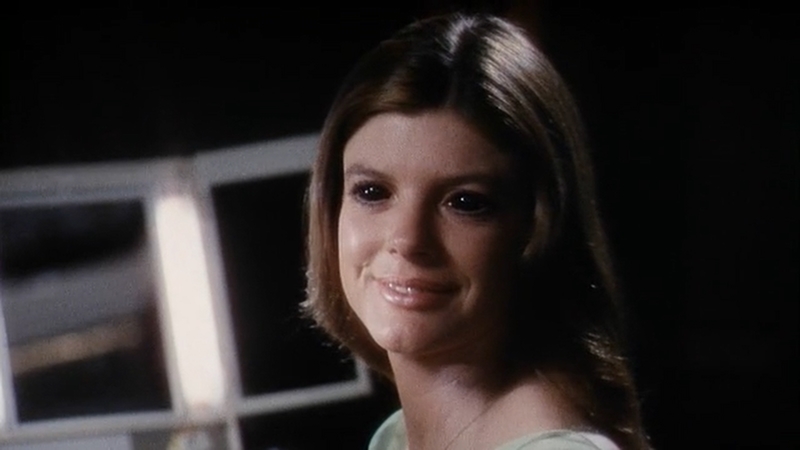
Joanna and Walter Eberhart (Katharine Ross and Peter Masterson) leave the hustle and bustle of New York City to suburban Connecticut, where life is simpler and the pace is slower. Something, however, isn’t quite right in the seemingly idyllic domestic world of Stepford (filmed in Darien and Fairfield, CT). Joanna* immediately feels alienated by the cleaning-obsessed housewives and their selfless devotion, catering to their husbands’ every whim.** But as Joanna is repelled by Stepford, Walter seems immediately at home, joining the exclusive Stepford Men’s Association. They carry out their meetings, sequestered in a 19th century mansion, away from the eyes of their spouses, who dress like they belong in Leave it to Beaver. Joanna finds comradeship in two other independent spirits, Bobby Markowe (Paula Prentiss) and Charmaine Wimpiris (Tina Louise), but their alliance proves to be short-lived when both friends seemingly transform into mindless housewives overnight.*** Soon, it’s Joanna against the rest of the town.  

* Fun Fact #1: Before Ross landed the role, Jeanne Seberg, Diane Keaton, and Tuesday Weld were considered for Joanna Eberhart. 

** Fun Fact #2: Levin, himself, wasn’t terribly pleased with the results, asserting the filmmakers missed the point: “In Stepford, the women would have been in hot pants and the men would have been at a softball game with the women bringing them cold beer.” (from 2002 Los Angeles Times interview) 

*** Fun Fact #3: In the scene where Joanna stabs her friend Bobbie’s doppelgänger, it’s not Ross’ hand but director Forbes.


Incident at the Pool

The Stepford Wives lays bare the awful truth about the “boys club” mentality, with the Men’s Association an antiquated rationalization for misogynistic behavior. The men in the film, galvanized by association leader Dale Coba (Patrick O’Neal), exert their considerable peer pressure on Walter to fall in line. Through the dynamics of the group, the men perpetrate what would be unthinkable as an individual. The Stepford men fear women as equals, so they must keep them subordinated. In a brief moment of vulnerability, Walter’s tearfully confesses his love to Joanna, but it’s not as much an admission of spousal devotion as a resignation that he’s already sold out. As Joanna gets closer to the truth behind Stepford’s patriarchal conspiracy, her husband gaslights her at every step. The disturbing climax, reinforced by the chilling final scene, suggests that suburbia has no place for diversity or outliers.* In the town’s push for absolute conformity, there is no escape. 

* Fun Fact #4: Jordan Peele cited The Stepford Wives as an inspiration for his own suburban nightmare film, Get Out.

Joanne's Doppleganger

In the world of The Stepford Wives, plausibility takes a backseat to building a satire of Swiftian proportions (instead of eating babies, they’re killing their wives). The women of Stepford are only good as servants and sex objects – a terribly dull existence for life partners. But the men of Stepford are equally vapid – they don’t want significant others that are intellectual equals or display independence, they only desire subordinates. And what about their children (as my wife pointed out)? It wouldn’t take very long for the kids to notice something’s wrong with mom. But exaggeration and contrast (tempered with a healthy suspension of disbelief) are cornerstones of satire. While the film version makes some necessary omissions and changes from book to screen, it remains largely faithful to the novel, underscoring the wide chasm between the men and women of Stepford. The Stepford Wives wasn’t met with unanimous praise upon its release, with some feminists decrying it as anti-woman, but it’s since withstood the test of time. If nothing else, it’s forced many to re-examine what a partnership means. 
 

The Stepford Wives 2004 Poster

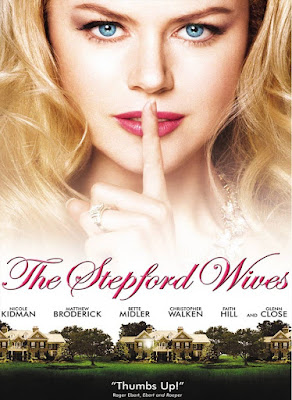
The Stepford Wives (2004) Directed by Frank Oz; Screenplay by Paul Rudnick; Based on the novel by Ira Levin; Starring: Nicole Kidman, Bette Midler, Matthew Broderick, Glenn Close, Christopher Walken, Roger Bart and Jon Lovitz; Available on Blu-ray and DVD 

Rating: **

“The Stepford Wives was too big and it was unsatisfying to do. Not that it was unsatisfying to do, but it was unsatisfying as a result, because as much as I loved parts of it, and I'm really proud of so much of it, the entire movie wasn't what I wanted it to be. It's my own fault, I didn't follow my instincts.” – Frank Oz (from 2007 AV Club interview with Nathan Rabin) 
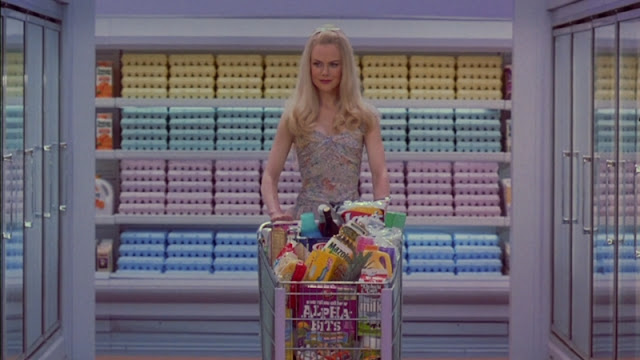
Joanne at the Supermarket

If the 1975 film version utilized Levin’s novel as a template, the remake used the story as a springboard. But what should have been a refreshing update proved to be a glaring weakness. Compared to the relatively low budget of the original film, the $90 million remake seems bloated (other than the sheen of Hollywood schmaltz and A-list actors, you’d be hard pressed to find where the money went). Instead of depicting a modest, bucolic neighborhood, the 2004 version goes one louder, making Stepford an exclusive gated community filled with gaudy, soulless McMansions. This could have been a good launching point for commentary about mass consumerism and America’s “bigger is better” mentality, but the satirical elements never go beyond the superficial.

Joanna at Awards Show

A successful book adaptation doesn’t require slavish devotion to the minutiae of the source material, but it should, at the very least, capture its spirit. Somehow, the filmmakers made the wrong choices about what to change every step of the way, starting with Joanna Eberhart (played by the usually reliable Nicole Kidman). This version of Joanna (a producer of a mean-spirited reality TV show) comes across as self-centered and unsympathetic. Likewise, it’s difficult to buy Matthew Broderick as her would-be alpha male husband. His character seems too wishy-washy to comply with the Stepford conspiracy. When he ultimately musters the courage to stand up to the town’s male leadership, it’s more of a plot contrivance than a natural progression of the character. But one of the film’s greatest mistakes is showing its hand far too soon. One of the wives begins to malfunction (sped up for “comic” effect) at a barn dance, leaving no ambiguity about Stepford’s secret. Compare this to an early scene in the 1975 version, in which one of the Stepford wives (following a seemingly minor car accident in a supermarket parking lot) appears to be experiencing a nervous breakdown. While her reaction seemed somewhat abnormal, given the context, it was entirely plausible.

Joanna and Bobbie

One bright spot in the remake is Bette Midler’s performance as Joanna’s nonconformist neighbor Bobbie Markowitz,* who seems to be the only character that could have been transplanted from the original film. Midler is obviously having fun with the role, and delivers some of the best lines. Unfortunately, Midler and Kidman don’t have nearly the same chemistry as Ross and Prentiss in the original film. We’re forced to take their friendship at face value, when in reality they’d probably never move in the same circles. 

* Fun Fact #5: According to a 2002 Hollywood Reporter article, Joan Cusack was originally cast to play Bobbie.

Microchip Implants

If the original film required suspension of disbelief, the remake stretches our resilience to the breaking point. We’re never entirely clear on where the film stands, with the transformation of the eponymous wives. Instead of employing android duplicates, the Men’s Association uses computerized brain implants to make the wives compliant. But when one of the wives pays out like a cash machine, it’s clear there’s more than microchips in the mix. When we learn that the effect of the neural implants is a reversible process, it takes the horror out of the original premise. 

Explaining the Process

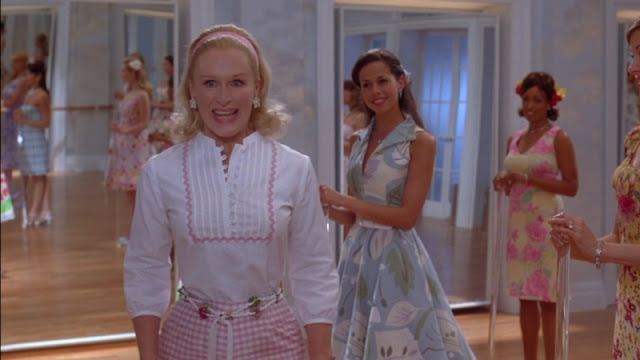
(MAJOR SPOILER ALERT) Perhaps the greatest betrayal of Levin’s story is that the source of the wifely switcheroo isn’t a male-led conspiracy, but the brainchild of welcome wagon lady Claire Wellington (Glenn Close), who only wanted to preserve the status quo. Instead of co-conspirators, the Stepford men (including her husband, the Men’s Association leader) are nothing more than pawns. When we see the Stepford husbands bumbling around in a supermarket towards the end of the film, it’s an obvious nod to the original’s final scene, but it isn’t as much a tribute as it’s a mockery. This is not to say that there couldn’t (or shouldn’t) be a comic reimagining of The Stepford Wives, but the 2004 version lacks the sardonic edge the material requires. Better luck next time?  


Sources: “The Art of Darkness” (2002), The Los Angeles Times, by Mary McNamara; “Cultural Studies; Stepping Out in Stepford Style,” (2002), The New York Times, by Ginia Bellafante; “The Stepford Wives: Inside the Making of the 1975 Feminist Horror Classic,” Entertainment Weekly, by Devan Coggan (2022); Hollywood Reporter (Nov. 25, 2002); Frank Oz Interview (2007), AV Club, by Nathan Rabin  


Wednesday, January 25, 2023

Japan-uary XII Quick Picks and Pans

Beyond the Infinite Two Minutes Poster

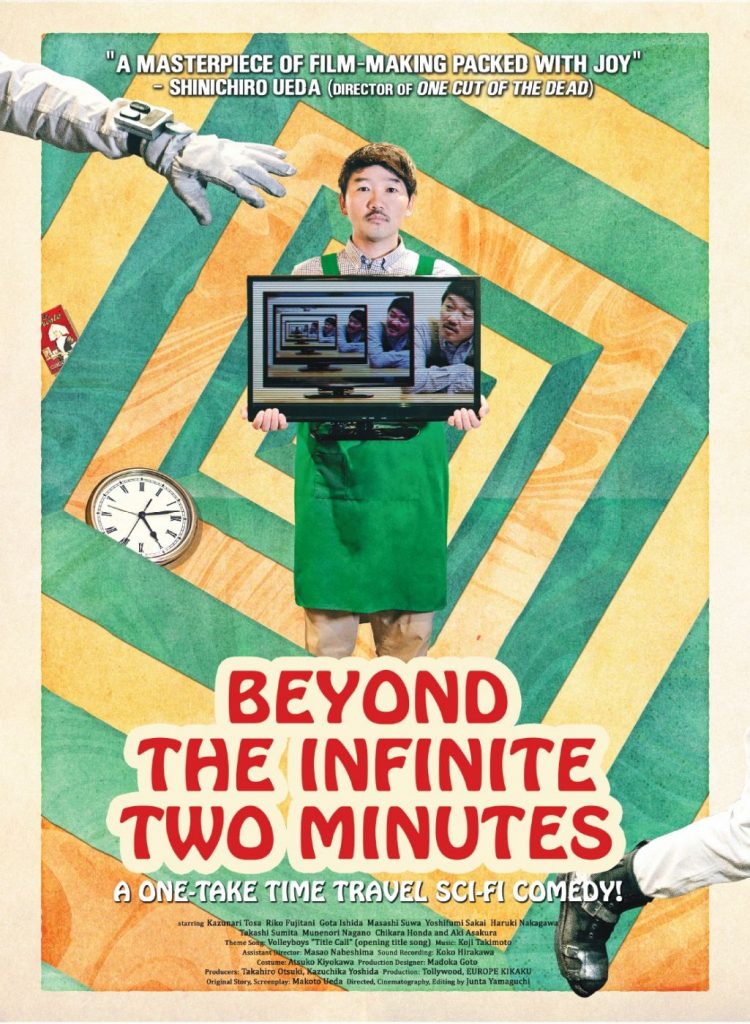
Beyond the Infinite Two Minutes (2020) In this clever sci-fi/comedy, Kato (Kazunari Tosa), a coffee shop owner, inadvertently discovers the means to see events two minutes in the future via his home computer. Soon, his friends and plucky co-worker attempt to   delve further into the mysteries of accidental time travel. But as they continue to monkey around with the new experience, events begin to cascade, and they’re sucked into a loop of correlation and causality, replete with paradoxes. Director Junta Yamaguchi confines the action to one building, but this limitation never seems restrictive or redundant, in a story that milks the concept for all its worth.   
Rating: ****. Available on Blu-ray, DVD, Amazon Prime and Tubi


The Legend of the Stardust Brothers Poster

The Legend of the Stardust Brothers (1985) Writer/director Macoto Tezuka’s lively musical/comedy ponders the ephemeral nature of fame and the fickleness of fandom. Rival musicians Shingo (Shingo Kubota) and Kan (Kan Takagi) strike a Faustian bargain with a shadowy producer to become the manufactured pop duo, the Stardust Brothers. Their chaotic rise and fall is told through a string of music videos. The results are an inspired combination of The Monkees, Get Crazy, and Phantom of the Paradise (in case you missed the copious references, the film is dedicated to Winslow Leach). It’s at once a pastiche of music star movies and a self-aware parody of pop music, but even that description is selling it short. You almost need a license to appreciate this much fun. 

Rating: ****. Available on Blu-ray, DVD and Tubi


Passing Fancy Poster

Passing Fancy (1933) In this charming silent comedy/drama from Yasujirō Ozu, middle-aged layabout Kihachi (Takeshi Sakamoto) helps Harue (Nobuko Fushimi) a young woman down on her luck get a job at a local tavern. Although Kihachi is smitten by her charms, it’s clear that Harue prefers his younger, cynical companion Jiro (Den Ôhinata).  Passing Fancy features nuanced performances by its talented cast, including Tomio Aoki as Kihachi’s crafty son Tomio, and Chôko Iida as the cheery but world-weary tavern owner Otome. It’s a bittersweet study of humanity during trying times, as only Ozu can present it.   

Rating: ****. Available on DVD (part of the Eclipse Silent Ozu collection)

The Ghost of Yotsuya Poster

The Ghost of Yotsuya (1959) Iemon (Shigeru Amachi) is a brash rōnin, who lusts after Oiwa (Katsuko Wakasugi), the daughter of a nobleman. After he’s denied Oiwa’s hand in marriage, Iemon kills her father in a fit of rage. It all goes downhill from there, when he murders Oiwa so he can marry another woman. Iomen soon discovers, however, that what goes around comes around when Oiwa’s bloody ghost exacts her terrible revenge. Director Nobuo Nakagawa‘s (Jigoku) Edo-period supernatural film provides ample thrills, with oodles of atmosphere and genuinely chilling imagery. 

Rating: ****. Available on DVD (Region 2)

Black Cat Mansion Poster

Black Cat Mansion (1958) In another excellent horror fantasy from director Nobuo Nakagawa (based on a novel by Sotoo Tachibana), Yoriko (Yuriko Ejima), a woman suffering from tuberculosis, is brought to her ancestral mansion to convalesce. She starts experiencing a number of disturbing occurrences, including a strange old woman who seems committed to her destruction. Things are complicated by her husband (and physician), Dr. Kuzumi (Toshio Hosokawa), who thinks it’s all in her imagination. In a flashback, we learn the mansion is the site of an old curse, targeted against the cruel samurai who once lived there. There are some nice creepy moments, as a cat spirit takes revenge on the samurai’s descendents (including Yoriko), although the film’s conclusion is a bit too abrupt. 

Rating: ***½. Available on DVD (Region 2)


Nightmare Detective Poster

Nightmare Detective (2006) Kyoichi (Ryûhei Matsuda) is a deeply troubled man with the ability to enter people’s dreams. He reluctantly assists Keiko (Hitomi), a young police detective, to help solve a case involving people who have suddenly been driven to suicide. The deaths are linked to a mysterious phone message by someone named “O.” In her quest for the truth, Keiko enters a dangerous game of cat and mouse with the suspect, in the twisted world of her dreams. Director/co-writer Shin'ya Tsukamoto’s supernatural horror film drags a bit in the middle, but the slow build-up leads to an energetic finale.   

Rating: ***½. Available on DVD

Bright Future Poster
Bright Future (2002) Yuji (Joe Odagiri) and Mamoru (Tadanobu Asano) are factory workers/friends with a relationship not unlike George and Lenny from Of Mice and Men. Emotionally stilted Yuji is unable to pick up on social cues, while his friend guides him through the complexities of human interaction. One day, Mamoru is arrested for the vicious murder of their employer, leaving his pet jellyfish to Yuji. The venomous jellyfish serves as a metaphor for Yuji’s emancipation from his codependence – like the creature, he’s suddenly out in the world on his own, opening himself to harm and harming others. Writer/director Kiyoshi Kurosawa’s film works best as a character study with poetic flourishes, rather than a linear narrative with a redemptive character arc.  

Rating: ***½. Available on DVD

Ocean Waves Poster

Ocean Waves (1993) Tadanobu Asano’s coming-of-age drama (based on a novel by Saeko Himuro) follows two high school friends, Taku and Yutaka who gradually drift apart over a new girl in town, Rikako. While the film takes pains to illustrate Rikako’s fractured home life, it does little to engender much sympathy for her character, who comes across as shamelessly manipulative and self-centered. It’s also hard to feel sorry for Taku, who continues to go along with her schemes. This Studio Ghibli television production is a step down from its theatrical releases, lacking the meticulous attention to detail and enjoyable characters we’ve come to expect from the animation house. It might be worth a look if you’re a Ghibli completist, but compared to the studio’s best, it rings hollow. 

Rating: ***. Available on Blu-ray and DVD


Killer Car Poster

Killer Car (aka: Ju-on Car) (2008) A more accurate title for this derivative horror flick would probably be Cursed Minivan, but that doesn’t quite have the same ring to it. A group of 20-somethings take a road trip to a secluded waterfall in a second-hand Nissan Elgrand. Unfortunately for the new owner and his passengers, the vehicle once belonged to a serial killer (established in an unnecessarily grisly prelude), and one of the victims now haunts the car. None of it makes a lot of sense, but Killer Car’s worst flaw is that the ensuing attacks seem completely pointless (why would the victim’s ghost attack innocent people instead of the man responsible for her death?). There’s a quick nod to The Texas Chainsaw Massacre, but that’s about the extent of what passes for inspiration in this movie. 

Rating: *½. Available on Tubi