(1962) Directed by John Gilling; Written by John Hunter and John
Gilling; Story by Jimmy Sangster; Starring: Kerwin Matthews, Glenn Corbett, Christopher
Lee, Andrew Keir, Marla Landi, Oliver Reed, Michael Ripper and Peter Arne; Available
on DVD.
Rating: ***½
“Tarted up with palms and banana trees to resemble the Caribbean,
Black Park near Pinewood looked most appetizing. It was a cruel deception. In
the middle of the park was a lake more stagnant and polluted than anything in
Poe and through this filth and the hazards of sharp underwater objects I, as
the pirate captain LaRoche, had to lead my piratical stars and a cohort of
piratical stuntmen.” – Christopher Lee (excerpted from his autobiography,
Christopher Lee: Tall, Dark and Gruesome”)
A great big shout out is in order for my superb co-host,
Gill Jacob from Realweegiemidget Reviews,
for helping make the Christopher Lee Blogathon a reality. I’m thrilled to be a part of this three-day-plus multi-blogger event,
covering numerous topics about a man who requires no further introduction. Be
sure to check out all the exceptional posts!
A pirate movie without a pirate ship? Well, with Hammer
being Hammer, no boat (not counting a matte painting, a snippet of stock footage
and a small interior set) means no problem. Instead, writer Jimmy Sangster (who
created the first draft of the screenplay and retained story credit) confined
the bulk of The Pirates of Blood River to land. In lieu of filming on
location in the Caribbean, the ever-cost-conscious filmmakers confined the
shoot to locations around England, including a lake in Black Park*
for an inlet, and a nearby gravel pit standing in for a sandy cliff. Production
designer Bernard Robinson and his team were masters of repurposing set pieces
and structures. The Huguenot colony featured in the film, built on the backlot
of Bray studios,** was used previously for several other productions, including
Brides of Dracula (1960), The Terror of the Tongs (1961), and TheCurse of the Werewolf (1961).
* Not So Fun Fact: Co-star Oliver Reed required treatment at
a hospital, due to an eye infection caused by exposure to the dirty lake water.
** Fun Fact #1: One of Hammer’s most ardent admirers of the
time was none other than Sammy Davis Jr., who paid a visit to the production.
Davis reportedly marveled at how they could make such deceptively sweeping
productions on such small sets.
Our story begins on an 18th century Huguenot
settlement, located on the Isle of Devon in the Caribbean. Jonathon Standing
(Kerwin Matthews) and his mistress Maggie (Marie Devereux) are caught mid-tryst
by local authorities. While attempting to flee, Maggie jumps in a river, and is
consumed by a school of hungry piranhas*/** (conveniently getting her character
out of the way, and providing the justification for the film’s title).
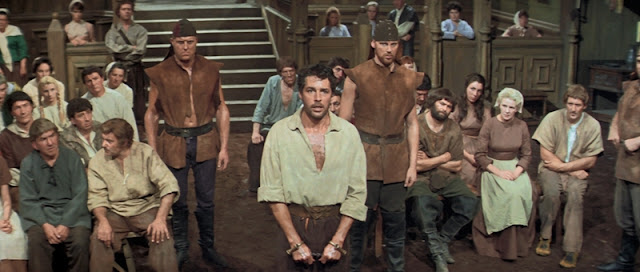
Jonathon, on the other hand, stands trial for adultery, and is subsequently judged
by a tribunal headed by his own father, Jason Standing (Andrew Keir). He begins
his 15-year sentence at a nearby penal colony, lorded over by ruthless guards,
but promptly makes his escape. His freedom proves to be short-lived, after an
unfortunate run-in with the dreaded pirate captain LaRoche (Christopher Lee)
and his band of cutthroats. He makes a deal with the pirates: in exchange for helping
him return to the colony, where he can uproot the unjust leadership and establish
new rule, he’ll providing safe haven for their ship. But when La Roche suspects
the colony is hiding treasure, he abruptly changes the deal, putting the
residents in jeopardy.
* Fun Fact #2: How or why piranhas ended up on a Caribbean
island is anyone’s guess, since they’re only native to the South American continent
(see Fact #2 in this cool article.)
** Fun Fact #3: According to film historian Marcus Hearn,
the effect of a school of bloodthirsty piranhas churning the waters was created
by simply throwing marbles into the lake.
While this is arguably Kerwin Matthews’ movie, all eyes are
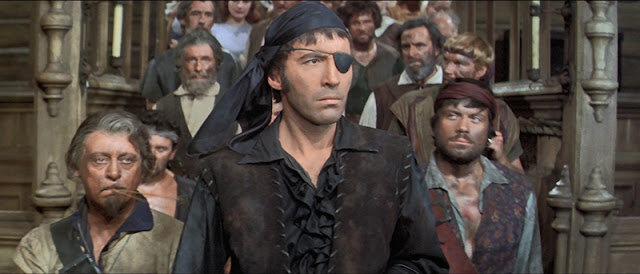
directed to Lee* (sporting a French accent), whenever he appears onscreen. LaRoche,**
clad entirely in black (in a stark contrast to his brightly adorned crew), is
an imposing and enigmatic figure, with his eyepatch and withered left hand. We never
learn about his mysterious origins, but we can assume his past was unhappy. He doesn’t
fit the stereotypical swaggering, boisterous pirate archetype. Instead of bellowing
orders, he remains lost in his thoughts. Despite his quiet, introspective
demeanor and physical limitations, LaRoche remains a formidable character. While
he carries his left arm like a gnarled branch, he brandishes as pistol and
sword with equal dexterity.
* Fun Fact #4: Lee and wardrobe mistress Rosemary Burrows
shared what could only be called an amicably contentious professional
relationship, across several Hammer productions. Per Burrows, “I remember saying
to him once: ‘You know, you really are nasty!’ And he said, ‘I have to tell
you, you’re pretty horrid!’ And from that day, that’s what we called each other
– in jest of course…” (excerpted from Hammer Films: The Unsung Heroes,
by Wayne Kinsey)
** Fun Fact #5: In Sangster’s first draft of the script, La
Roche was known as Captain Doom.
Apart from LaRoche, one of the most complex characters is
Jason Standing, played with intensity by the always reliable Andrew Keir. He’s a
man with deep convictions, but a tortured soul, nonetheless. Nothing rests easy
on his conscience, mired in his unquestioning fealty to the village council and
their twisted interpretation of faith, yet aware of the terrible price he pays
for his zealotry. Jason arguably emerges as the film’s true villain, using his
obstinance as a shield. He’s willing to sacrifice the lives of his community
for his ideals, reasoning their immortal souls take precedence over any worldly
comforts.

The film also features a much more substantial role for
Michael Ripper,* usually relegated to playing a constable, barkeep, or similar ancillary
character. He stands out, as LaRoche’s capricious right-hand man, Mack, whose loyalty
proves to be merely skin deep. In a moment of drunken indiscretion, he openly mocks
his captain, serving to erode LaRoche’s tenuous grasp on his crew. Ripper often
delivers his lines with a devilish grin, hinting that his character is scheming
something. Oliver Reed and Peter Arne also provide some good moments as pirates
Brocaire and Hench, respectively. In a memorable scene, proving there’s little
honor amongst thieves, they duel with blindfolds for the right to defile Jonathon’s
sister, Bess (Marla Landi).
* Fun Fact #6: With 33 credits to his name for Hammer films
alone, Ripper owns the distinction of appearing in more of the production
company’s films than any other actor.
When The Pirates of Blood River debuted in the U.K., playing
on a double bill with Mysterious Island, it chalked off another success
for Hammer, paving the way for more swashbucklers. As a piece of entertainment,
it’s somewhat uneven, due to its lack of shipboard action, and the fact that
the romantic possibilities are reduced to nil at the beginning. Anyone looking
for those elements might be disappointed, but the film compensates with some
fine performances by Lee, Ripper, and Keir (especially Lee’s idiosyncratic portrayal
of La Roche).
Sources for this article: Christopher Lee, Tall, Dark and
Gruesome, by Christopher Lee; The Hammer Story, by Marcus Hearn and
Alan Barnes; The Hammer Vault, by Marcus Hearn; Hammer Films: The
Unsung Heroes, by Wayne Kinsey; “14 Fun Facts About Piranhas,” by Helen
Thompson, Smithsonian Magazine


