

(1985) Directed by Tobe Hooper; Written by Dan O’Bannon and
Don Jakoby; Based on the novel Space Vampires by Colin Wilson; Starring:
Steve Railsback, Mathilda May, Peter Firth, Frank Finlay and Patrick Stewart;
Available on Blu-ray and DVD
Rating: ***½
“…as I was a dancer, I was used to have (sic) a special relationship with the body – it was a work instrument, I was not into anything provocative. I was just a dancer. So that maybe is the reason they chose me, because I was not using the body in terms of seduction.” – Mathilda May (from 2013 interview, “Dangerous Beauty”)

Note: This review refers to the longer “International Cut,” which includes additional footage, expands on the story, and restores Henry Mancini’s original score.
Mention Lifeforce, and the first thing that likely springs to mind for most folks are the scenes depicting a certain young French actress walking around au naturel. While those sequences certainly leave an (Ahem!) lasting impression, there’s much more to the film than that. Look beneath the surface trappings of gratuitous nudity, gory makeup and glowy special effects, and you’ll find a movie that isn’t afraid to ask the big questions. Director Tobe Hooper was approached by Cannon Films’ Menahem Golan to adapt Collin Wilson’s 1976 novel Space Vampires* into a big budget (for Cannon, at least) film. The British-based, 120-day shoot required the use of EMI-Elstree studios Stage 6 (referred to as the Star Wars stage), and utilized some of the top effects people of the day, notably, John Dykstra of Star Wars and Star Trek: The Motion Picture fame.
* Fun Fact #1: The film originally shared the same title as the novel, but Hooper recalled “there was an allergic reaction to what was considered a B-title.”
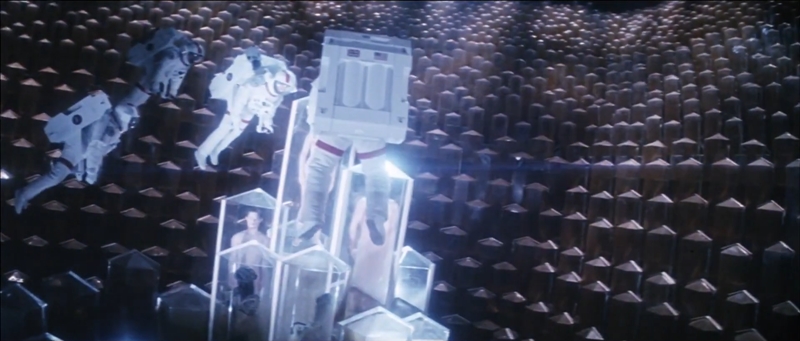
During a joint NASA/ESA mission to intercept Halley’s comet, Col Tom Carlsen (Steve Railsback) of the spaceship Churchill and his crew pick up something extraordinary: a massive alien ship in the tail of the comet. The commander decides to divert the mission to the mysterious spacecraft, which upon closer inspection has an organic appearance. As Carlsen and his fellow astronauts make their brief foray* into the ship’s cavernous hulk, they encounter the desiccated floating bodies of large bat-like creatures. Another chamber yields a more surprising discovery, with what appear to be three humans (one woman and two men)** entombed in crystalline sarcophagi. The ship returns to Earth, with the three bodies and alien remains in tow, but meets with calamity along the way. A rescue crew reaches the Churchill in Earth orbit, only to find the interior and astronauts charred beyond recognition. Somehow, the residents of the clear coffins appear to be unscathed from the fiery accident, and are brought to terra firma for further scrutiny. Before you can say “bringing them back to Earth was a terrible idea,” the humanoids escape their containers, and proceed to feast on the life energy of every hapless person they encounter. We soon learn, however, that Carlsen also avoided destruction on the Churchill, utilizing the ship’s escape capsule*** in the nick of time. British authorities take Carlsen into custody, as he harbors the secret about what occurred on the doomed mission, and may possess the key to stopping the rampage of the space vampires.
* Fun Fact #2: To simulate the astronauts floating in space, Hooper and company utilized the same team responsible for the flying rig used in Superman: The Movie (1978).

If there’s a solitary raison d'être for Lifeforce, it’s French actress Mathilda May, who commands attention whenever she’s on screen. May was cast after an exhaustive worldwide search (Hooper claimed approximately 50 actresses auditioned for the part)* for someone who would play a role that demanded excessive nudity.** May’s background as a professional dancer proved especially invaluable in her depiction of an alien presence, with her precisely controlled movement. She mesmerizes whenever she’s on the screen, conveying the right balance of otherworldly beauty and subtle menace. To the men who encounter her, she’s a siren – they’re powerless to resist her charms, even though meeting her won’t end well. She establishes an inextricable bond with Carlsen, which horrifies and tantalizes him in equal parts. She’s an ideal construct culled from his vision of an ideal woman, illusory and unobtainable (“I am the feminine in your mind.”).
** In his DVD commentary, Hooper glibly stated, “It was like her costume.”

Instead of focusing on Col. Carlsen’s obsession, I wish it had spent more time with Dr. Hans Fallada (Frank Finlay), a clear nod to Professor Quatermass in the Hammer films and BBC adaptations. Fallada is fascinated by the alien visitors and their implications. He opines that the creatures visited Earth long ago, giving rise to the vampire folklore and legends. It’s an intriguing story element that could have been developed further, rather than concentrating on tracking down the rogue vampires. The clunky middle act gets bogged down with Carlsen assisting British agents led by SAS agent Colin Caine (Peter Firth). No one questions his histrionics in his zeal to find the female space vampire, who’s jumped to a new body. Inexplicably, he’s given free rein to slap around a woman (Nancy Paul) suspected of harboring the malevolent vampire’s spirit and abuse sanitarium director Dr. Armstrong (Patrick Stewart), who has also been afflicted.

Unlike some traditional vampire films, the vampire rules are inconsistent. It’s unclear whether direct contact or mere proximity are necessary for a spirit to jump from body to body. The original three vampires, while insatiable, don’t appear to weaken rapidly, whereas the infected humans wither away at an accelerated rate, becoming the “walking shriveled” (Hooper’s term). Also, why does the female vampire possess a sexual magnetism toward men, but the male vampires don’t seem to have a similar effect on women? Taking this a step further, why couldn’t the vampires have had a similar mesmeric effect towards people of the same sex? With the exception of a brief kiss between two men (which is a bit of cheat, since one is inhabited by the female vampire’s spirit), the film restricts itself to heterosexual attraction, and overwhelmingly appeals to the male gaze. This limits the myriad possibilities of sex as lure, restricting the implicit theme to a superficial “women are scary”

The $25 million Cannon production was met with mostly mixed to negative reviews when it was first released, no thanks in part to the butchered U.S. version (at distributor Tri-Star’s insistence). Lifeforce has since gained a loyal following, not simply because of Mathilda May’s inimitable presence, but its wildly ambitious story. It boldly suggests something extraterrestrial in origin influenced human history and folklore, inhabiting our myths and fears. The climactic scene of mass pandemonium on the streets of London is reminiscent of the dénouement to Quatermass and the Pit (1967), which shares similar themes. At the same time, the story isn’t nearly as focused as Quatermass, but it’s a noble effort nevertheless. Lifeforce manages to balance some heady ideas with some good old-fashioned exploitation, creating an entertaining mix. It didn’t play it safe. If only more genre films would follow its lead.

