Showing posts with label Kaiju. Show all posts

Tuesday, January 27, 2026

Japan-uary XV Quick Picks and Pans


The Red Angel Poster

The Red Angel (1966) Set during the second Sino-Japanese War in 1939, The Red Angel follows Sakura (Ayako Wakao), a young Japanese army nurse stationed in China. The soldiers who end up in the military hospital are regarded as nothing but expendable components of the machinery of war, while nurses are told to look the other way and not become attached to the sick and dying. In spite of everything, she does her best to keep the injured troops happy before they die or return to the front lines. Ultimately, she falls in love with a disillusioned, morphine-addicted doctor (Shinsuke Ashida), who spends most of his time deciding who lives and who dies. While Yasuzō Masumura’s bleak, unflinching film isn’t an easy watch, it’s superbly acted, and its theme of retaining one’s humanity in the most inhumane of circumstances resonates just as strongly today. 

Rating: ****. Available on Blu-ray, DVD and Kanopy

Tokyo Chorus Poster

Tokyo Chorus (1931) When salaryman Shinji Okajima (Tokihiko Okada) stands up for a fired co-worker, he’s let go as well. Thus begins his search for a new job in a time when work is scarce. Contending with various financial setbacks (including a sick daughter and a son who wants a new bike), he struggles to keep his chin up. Shinji finds renewed purpose when he has a chance encounter with an old college professor, forcing him to reassess what’s most important. This early silent film by Yasujirô Ozu hits all the right notes, with moments of drama tempered by gentle humor - a bittersweet, albeit life-affirming portrait of family life in pre-war Japan. 

Rating: ****. Available on DVD (Included in Eclipse Series 10: Silent Ozu - Three Family Comedies)

Daimajin Poster

Daimajin (1966) The first in a trilogy by Daiei (followed by Return of Daimajin and Wrath of Daimajin), set in ancient Japan, is a bit of an anomaly in the world of kaiju that somehow got lost in the shuffle over the years. A benevolent feudal lord is murdered by an outsider who covets his position. When the new despot takes over, enslaving the villagers, he endeavors to wipe out any remaining heirs to the former leader. Still loyal to the Hanabusa clan, Kogenta (Jun Fujimaki) takes the surviving son and daughter (Tadafumi and Kozasa) for refuge in an enchanted mountain nearby. Ten years later, they’re back to recapture the village, with the help of a giant statue/god, Daimajin. The movie takes a while to get going, but it’s worth the wait for the ensuing kaiju mayhem. The Daimajin itself is a sight to behold, with its stern face and all-too-human eyes, making it a unique and terrifying creation. 

Rating: ***½. Available on Blu-ray (The Daimajin Trilogy Arrow box set) 

Inflatable Sex Doll of the Wastelands Poster

Inflatable Sex Doll of the Wastelands (1967) Don’t let the lurid title (the eponymous doll only has a cameo) mislead you. Writer/director Atsushi Yamatoya’s surreal neo noir about Shô, a hitman (Yûichi Minato) seeking revenge against those who murdered his girlfriend, is full of surprises. This unconventional film switches between reality and fantasy, depicting the hitman’s imagined revenge, versus the reality of the situation. Minato does a great job as the diminutive and unassuming cold-blooded killer Shô, who’s no better than his nemesis, Kô (Shôhei Yamamoto).   

Rating: ***½. Available on Blu-ray and Kanopy

Undertaker Poster

Undertaker (2012) Writer/director Naoyoshi Kawamatsu’s low-budget, shot-on-video flick is set in an unspecified number of years after a zombie outbreak has devastated Japan. Ryouichi (Yoshito Kobashigawa) performs a service for family members grieving over their loved ones who have turned into zombies. He hunts down and dispatches the infected, so the families can experience a modicum of closure. His latest clients are parents whose grown daughter has succumbed to the zombie-creating virus. Undertaker makes the most of its brief running time, with animated butterflies representing the souls of those who have passed on (I think), and some appropriately gruesome practical effects. 

Rating ***. Available on Blu-ray and DVD

A Haunted Turkish Bathhouse Poster

A Haunted Turkish Bathhouse (1975) In 1958 when brothels were officially outlawed in Japan, sex workers resorted to a workaround, the so-called Turkish bathhouse. One such worker, Yukino (Naomi Tani), is eager to leave her former life behind, with the promise of marriage to her boyfriend, Yûzô (Hideo Murota). Unfortunately for Yukino, her fiancé owes a large sum of money to a group of gangsters, forcing her to return to her previous profession. To add insult to injury, Yûzô’s not who he seems to be, running with criminals and scheming with the bathhouse madame. When deception turns to murder, Yukino’s younger sister, Mayumi (Misa Ohara) seeks revenge with the help of a cat demon. This (very) loose re-telling of Edgar Allan Poe’s “The Black Cat,” told through a traditional bakeneko mono (monster cat) lens features an entertaining mix of sex and violence with a supernatural twist. It’s probably not to everyone’s taste, but I’ll leave that to you to decide. 

Rating: ***. Available on Blu-ray

The Box Man Poster

The Box Man (2024) A reclusive man known only as “Myself” (Masatoshi Nagase) experiences the world from the perspective of his cardboard box. He photographs the people who pass by, logging notes and observing, but never interacting. He’s under surveillance by a doctor (Tadanobu Asano) who’s not really a doctor, and is assisted by a nurse (Ayana Shiramoto) who’s not really a nurse. As we eventually discover, whoever obsesses about the Box Man becomes the Box Man. The film might have worked better if it had been more succinct (it’s probably 30 minutes too long for its own good), starting off on a promising note, but becoming more muddled as it ambles on. 

Rating: **½. Available on Prime Video and Midnight Pulp

Monday, January 31, 2022

Japan-uary XI Quick Picks and Pans

The Night is Short, Walk On Girl Poster

The Night is Short. Walk On, Girl (2017) Masaaki Yuasa’s delightful animated film (based on the novel by Tomihiko Morimi) is a surefire cure for what ails you. Over the course of one night, we follow the exploits of unflappable coed Kōhai (meaning “Junior”), as she enters a drinking competition with a group of retirees, foils a middle-aged pervert, and searches for a cherished lost book from her childhood. Throughout the night, she’s pursued by Senpai (an upperclassmen), who hopes to win her affections. The film’s style is as colorful and fanciful as its ebullient protagonist, possessing an irresistible energy. Don’t look for any profound messages, except perhaps to refute George Bernard Shaw’s proclamation that youth was wasted on the young. It’s nothing more or less than a celebration of the joys of being alive – something we could all use right now. 

Rating: ****. Available on Blu-ray and DVD 

Wool 100% Poster

Wool 100% (2006) Writer/director Mai Tominaga’s modern fairy tale concerns two elderly sisters, Ume and Kame (played by Kyōko Kishida and Kazuko Yoshiyuki, respectively) who live alone in a big house, filled with junk. Ume and Kame collect more junk on their daily rounds, meticulously cataloguing their discoveries in scrapbooks. Their life takes an odd turn when a strange young girl (Ayu Kitaura) with a compulsion for knitting red yarn appears in their home. Tominaga’s often whimsical, visually playful film (complemented by a wonderfully eclectic score) examines the prisons we construct for ourselves, through the comfort and trap of ritual. 

Rating: ****. Available on DVD.

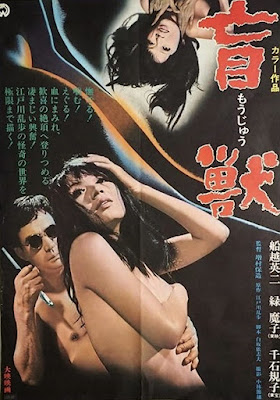
Blind Beast Poster

Blind Beast (1969) With the help of his mother (Noriko Sengoku), blind sculptor Michio (Eiji Funakoshi) kidnaps an artist’s model Aki (Mako Midori), so he can create his latest form of expression. As Aki descends into Michio’s world, she begins to come around to his way of thinking, where pleasure and pain are intertwined. It’s frequently difficult to watch, but more difficult to look away from this twisted tale of obsession by director Yasuzô Masumura’s (Giants and Toys, Black Test Car), based on a story by Rampo Edogawa. One of the highlights is Michio’s studio, populated with oversized sculptures, representing various parts of the human anatomy. The unforgettable conclusion is at once inevitable and tragic.    

Rating: ***½. Available on Blu-ray and DVD

Intimidation Poster

Intimidation (1960) Two childhood friends, Matakichi and Kyosuke (Kô Nishimura and Nobuio Kaneko), work for the same bank, but their careers have followed divergent paths. While the clever, sweet-talking Kyosuke has followed an upward trajectory, with a promotion to assistant director, his meek colleague has languished as a lowly clerk (much to the ire of his sister, who was dumped by Kyosuke). All is not as rosy as it seems for Kyosuke, who owes a small fortune from fraudulent loans (he must pay a would-be blackmailer 3 million yen, or suffer the consequences). This briskly paced neo-noir from director Koreyoshi Kurahara packs a lot in 65 minutes, with excellent performances by the leads, and a series of surprising plot twists. 

Rating: ***½. Available on DVD (part of the Criterion Eclipse Series The Warped World of Koreyoshi Kurahara)

Seance Poster

Séance (2000) Director/co-writer Kiyushi Kurosawa’s (no relation to Akira) slow-burn supernatural thriller (based on Mark McShane’s novel, Séance on a Wet Afternoon) creeps under your skin, with its meditation on the nature of guilt. Kôji Yakusho and Jun Fubuki play emotionally distant married couple Sato and Junko. When a little girl disappears, Junko views this as a perfect opportunity to apply her clairvoyant skills. When their plans go awry, Sato and Junko conspire to retain a semblance of normalcy, but the truth gnaws away at their conscience. Séance is a sobering look at the darkest depths of the human soul, painfully illustrating the disastrous consequences of compromising responsibility for selfishness.   

Rating: ***½. Available on DVD

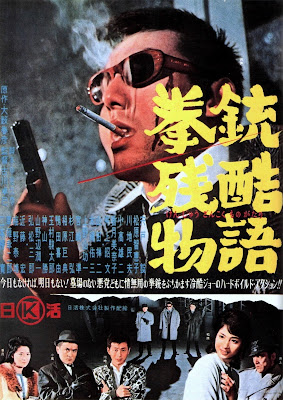
Cruel Gun Story Poster

Cruel Gun Story (1964) Takumi Furukawa’s fast-paced noir thriller features Jô Shisido as Joji Togawa, a career criminal freshly sprung from prison. Against his better judgment, he accepts a challenge to lead a small team to rob an armored car carrying 120 million yen. When he’s betrayed by the mob boss who hired him, he plots his revenge. Joji approaches his work with ice-cold precision, but has a soft spot for his disabled sister. Shisido is perfect as a criminal with a strict code of honor, maintaining his integrity in a world typified by double crosses and other dirty dealings. 

Rating: ***½. Available on DVD (part of the Criterion Eclipse series Nikkatsu Noir)

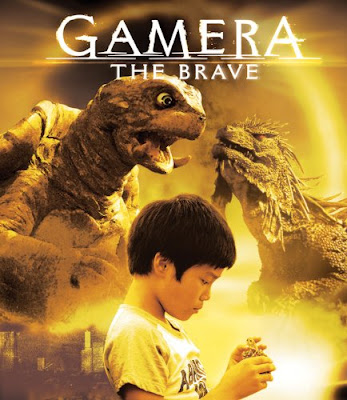
Gamera the Brave Poster

Gamera the Brave (2005) The latest Gamera flick to date might irritate some hardcore fans accustomed to the exceptional ‘90s trilogy, but I enjoyed this intentionally lower-key, kid-friendly outing. Instead of picking up where the trilogy left off, it’s a reboot of sorts harkening back, in spirit, to the original series of films with the giant turtle, when he was the friend of all children. A young boy, Toru (Ryô Tomioka) discovers an egg sitting atop a glowing red crystal, and takes it home (you can probably guess the rest). This version of Gamera is a smaller, gentler (And dare I say, cuter?) version of the eponymous kaiju hero. It’s somewhat of a letdown that he fights a rather generic enemy, but the human characters (particularly Toru’s father, Kousuke) are fairly well fleshed out. While it’s not exactly the sequel most of us wanted, it’s diverting enough.           

Rating: ***. Available on Blu-ray, DVD and Amazon Prime

Dead Sushi Poster

Dead Sushi (2012) Keiko (Rina Takeda), a budding young sushi chef, runs away from home after she tires of her father’s criticism. She takes a job as a server at an inn, which is hosting a company retreat. Unbeknownst to Keiko, the deposed company founder, seeking revenge against his former teammates, turns his experimental serum on their sushi, with deadly consequences. Writer/director Noboru Iguchi keeps everything suitably over the top (if you’re familiar with some of his other work, including Machine Girl and Robogeisha, then you likely know what you’re in for). Expect lots of tasteless sight gags (with an occasionally clever joke thrown in, for good measure) and a surprising amount of heart. You might never look at sashimi the same way again. 

Rating: ***. Available on Blu-ray, DVD and Tubi

Monster Seafood Wars Poster

Monster Seafood Wars (2020) A young biochemist develops a substance that will make animals grow to gargantuan proportions, resulting in an ordinary octopus, squid and crab transforming into kaiju. While they threaten the population of Japan, they have an unintended side effect – they’re also delicious. Writer/director Minoru Kawasaki’s (The Calamari Wrestler, Executive Koala) applies his signature goofy, no-budget approach to his kaiju tale. It’s a couple of notches below his best, but it’s not without its moments. It never takes itself too seriously, gently poking fun at tokusatsu movies, while embracing them. The pacing, however is inconsistent, and the story (which is probably a bit too deadpan for its own good) could have used a few more jokes. 

Rating: **½. Available on Blu-ray, DVD and Amazon Prime


Tuesday, July 21, 2020

Short Take: Pulgasari


(1985) Directed by Sang-ok Shin; Written by: Se Ryun Kim; Starring: Son Hui Chang, Ham Gi Sop, Jong-uk Ri, Gwon Ri, and Yong-hok Pak; Available on DVD and YouTube

Rating: **½ 

“They’re just an army of farmers. They have no strength. Give them no leeway and attack at once.” – General Fuan (Riyonun Ri)


There are few films as notorious as the North Korean giant monster movie Pulgasari, produced by none other than Kim Jong-il. The behind-the-scenes story reads like a work of fiction, with events more fantastic than anything depicted on screen. In the hopes of improving his country’s floundering film industry, Jong-il ordered the kidnapping of South Korean director Sang-ok Shin along with his ex-wife. After several years of imprisonment, Sang-ok was appointed the head of his own film company, and given pseudo-V.I.P. status (under the watchful eye of North Korean officials). Before eventually fleeing the country, he made a handful of films, including Pulgasari. In addition to utilizing substantial domestic resources for Pulgasari, Jong-il flew in a Japanese effects crew under false pretenses, including monster suit actor Kenpachirô Satsuma (the second individual to wear the Godzilla suit). The baffling events conjure memories of the old TV commercial tagline, “But wait, there’s more!” For anyone looking for a more detailed account, a good starting point is the 2003 Guardian article, “Kidnappedby Kim Jong-il: The Man Who Directed the Socialist Godzilla,” by John Gorenfeld.


The basic story reportedly stems from a Korean folktale* but appears to share some similarities with the Japanese Daimajin movies and, of course, Godzilla. Set in 14th-century Korea, a community of poor farmers are harassed, bullied and demeaned by the king’s soldiers, forced to toil for their benefit. In a final effort of desperation, an imprisoned blacksmith creates a figure out of rice (which embodies his soul). His daughter’s blood accidentally touches the creation, bringing it to life. Soon, the beleaguered villagers discover the wee beast has a taste for iron. Before you can say “dear leader,” little Pulgasari quickly grows to gargantuan proportions, providing the might behind the farmers’ revolt against the tyrannical king.

* Fun Fact: The first cinematic interpretation was reportedly the South Korean film, Bulgasari (1962), which is now presumed lost.

 Famous Last Words

The title creature, which resembles a cross between Godzilla and a bull, starts out as a pudgy little guy, who resembles Minya if you squint (or if you heard a second-hand description of the creature from someone with glaucoma). We’re treated to some Son of Godzilla-esque (un-intentionally comic?) moments as he stumbles around like a drunken sailor. As Pulgasari grows, his appetite for iron increases. Even after he’s defeated the king’s army (Sorry/not sorry about the spoiler), his hunger for metal doesn’t ebb. Eventually, his addiction deprives the farmers of their means of support (hoes, rakes, etc…), turning the film into a sort of kaiju version of If You Give a Mouse a Cookie (which was published the same year this movie was released. Coincidence or not?).


Despite Pulgasari’s uneven, frequently slipshod nature, it’s easy to see it was a large-scale production. The royal palace miniatures are decent enough, and it’s impressive to see crowd scenes that seemingly included thousands (supplied, courtesy of the North Korean army). Overall, Pulgasari is a mixed bag. One of the most beguiling aspects of the film is its theme of villagers overcoming adversity, after being ground under the heel of oppression by a ruthless, narcissistic dictator. Perhaps it was the period setting or fantasy elements (depicting a mythical time), but somehow the irony was lost on Kim Jong-il, who viewed the film as a masterpiece and a source of pride. It also inadvertently casts the heroes of the story in a bad light, with the farmers’ fighting prowess and bravery hinges entirely on Pulgasari’s considerable fortitude. Enjoyment of this movie requires some cognitive dissonance on the part of the viewer, overlooking the behind-the-scenes drama, its dubious messages, and melodramatic (bordering on histrionic) performances. On the other hand, it works fine as (dare I say) silly escapist fare. It’s a curiosity piece, sure to be pondered and debated for generations to come.

* Fun Fact: If you don’t have enough Pulgasari in your life, look for the 1996 remake, The Legend Of Galgameth.

Wednesday, January 15, 2020

Mothra


(1961) Directed by Ishirô Honda; Written by Shin'ichi Sekizawa; Based on the novel The Luminous Fairies and Mothra, by Shin'ichirô Nakamura, Takehiko Fukunaga and Yoshie Hotta; Starring: Furankî “Frankie” Sakai, Hiroshi Koizumi, Kyôko Kagawa, Yumi Itô, Emi Itô and Jerry Itô; Available on Blu-ray and DVD

Rating ***½

“We wanted to do something that was new, for the whole family, like a Disney or Hollywood type of picture. We wanted it to be brighter, nicer.” – Ishirô Honda (from Ishiro Honda: A Life in Film, From Godzilla to Kurosawa, by Steve Ryfle and Ed Godziszewski, with Yuuko Honda-Yun)


When you create one of the most distinctive, fearsome giant monsters of all time, how do you top it? To start with, you don’t. Seven years after Gojira made its debut, producer Tomoyuki Tanaka and Toho went back to the drawing board. Instead of creating a bigger, meaner rival to the super-sized reptile, they devised a whole new class of kaiju. The resulting movie, Mothra, is a different beast from Gojira. The titular creature, along with its origin, is less menacing, and more fanciful. While there’s plenty of room for social commentary, the overall tone is lighter, with an emphasis on fantasy over widespread devastation (although the film doesn’t skimp in that department).


After four shipwreck survivors are found alive and well on remote Infant Island (thought uninhabitable, due to atomic testing), a scientific expedition is launched to gather more facts. Although it’s a Japanese vessel and crew, the expedition is bankrolled by foreign tycoon Clark Nelson (played with great, sneering panache by Jerry Itô, billed as “Jelly” Itô in the American version), whose motivations go beyond simple intellectual curiosity. Sensing a story, intrepid reporter Senichiro “Zen” Fukuda (Furankî “Frankie” Sakai) stows away on the ship. When they reach the South Pacific isle, they discover a lush jungle and native population, including a pair of tiny twin fairies* (played by twin sisters Yumi and Emi Itô, aka, singing group, “The Peanuts”). Sensing an opportunity to make a quick buck (or equivalent), Nelson abducts the twins, transplanting them to Japan to star in his new revue, “The Secret Fairies Show.” Nelson learns too late that one of their seemingly innocuous songs is a distress call, which carries a telepathic link. They soon awaken an ancient creature on Infant Island, driven by an unrelenting compulsion to bring them back home. Unfortunately for Tokyo and anything else that’s in the way, it can only mean untold property damage and displaced citizens.  

* Fun Fact #1: According to the informative Mill Creek Blu-ray commentary by Steve Ryfle and Ed Godziszewski, the original story called for four 60-cm fairies, instead of the two 30-cm women that appear in the film.   


If some of the above description sounds familiar (minus the fairies), it’s not by accident, but design that the basic plot in Mothra parallels King Kong (1933). Director Ishirô Honda admitted to the many similarities, but with one principal difference: unlike the film with the big ape, his oversized moth* wasn’t destined for a tragic end. Otherwise, it’s easy to see how many elements are similar: the expedition, an isolated island populated by natives who worship a giant creature, an unscrupulous promoter, a squadron of fighter jets, and a towering city landmark that becomes a centerpiece for a key scene.

* Fun Fact #2: According to the disc commentary, Mothra’s caterpillar stage was the largest costume ever created by Toho, measuring approximately seven meters in length, and requiring five to six people to operate it.


Compared to King Kong, however, Mothra is more socio-politically conscious, reflecting some of the controversies of the time. As originally envisioned by Honda and the writers, the film would have been more political, but many of those elements were trimmed in favor of entertainment. Even with the necessary compromises, the finished product still leaves much for contemporary audiences to consider. The specter of the fictional country of Rolisica (a thinly veiled melding of the United States and Russia) looms over the story, with its militaristic society, imperialistic intentions, and (paralleling U.S. nuclear testing in the South Pacific) casual attitudes toward displacing indigenous cultures. On the other hand, Mothra dilutes its message a bit when the Infant Island “natives” are depicted by Japanese actors in brown-face. Cultural insensitivities aside, it’s easy to agree that the unconscionable entrepreneur Nelson (who’s backed by the Rolisican government), is the embodiment of all the negative aspects of outsiders, rolled into one. In his quest to obtain the fairies for his own gain, he thinks nothing of mowing down a group of unarmed natives with rifles. When he finally has his prize, Nelson’s dismissive attitude is laid bare as he comments, “Those fairies aren’t human. They’re merchandise.” *

* Not So Fun Fact: Sadly, Nelson’s abhorrent behavior is not without precedent. His treatment of the fairies recalls human zoos, which flourished in the late 1800s, lasting well into the mid-1900s.


In addition to Jerry Itô’s scene-stealing turn, Mothra boasts some fine performances by the other cast members, especially Frankie Sakai as tenacious reporter Zen, who likens himself to a snapping turtle (a bulldog in the American version). Comic actor Sakai keeps things from getting too serious, with some well-placed moments of schtick. Zen’s counterpart, plucky photographer Michi Hanamura (played by veteran actress Kyôko Kagawa, in her only kaiju film), lends balance to his scenes, keeping everything from going too far over the top. Also watch for a blink-and-you-miss-it appearance of Honda regular Kenji Sahara as a helicopter pilot. Arguably, the true stars of Mothra, outside of the giant insect itself, are pop duo The Peanuts, who convey a childlike innocence and grace under adversity. Their signature song needs no introduction, as it’s become firmly entrenched in pop culture.   


Eiji Tsuburaya and his effects crew put their all into the film, to make the star attraction,* in its final form, a truly memorable creation. Somewhat more refined versions of Mothra would appear in later movies, but the basic design owes much to this early version. Other standout effects sequences include a bursting dam, and a detailed replica of Tokyo Tower, where the juvenile Mothra, aka: The Very Angry Caterpillar (my apologies to Eric Carle for the cheap shot) undergoes a metamorphosis. The film’s climax,** which takes place in the Rolisican capitol, dubiously named New Kirk City (an amalgamation of New York, San Francisco and Los Angeles), provides another chance for Tsubaraya to showcase his signature brand of wholesale destruction.  

* Fun Fact #3: There were three Mothra models used for the film: 1) a small version, used only for long shots, 2) a medium version, with flexible wings; and 3) a large version with a 2.5-meter wingspan, with more rigid wings and illuminated eyes.

** Fun Fact #4: A different ending was originally shot, which has been presumed lost (although still frames exist). The original cost-conscious ending, featuring a confrontation between Nelson and Mothra was nixed by Columbia, in favor of the conclusion in an urban setting (New Kirk City).


Some might argue there’s an awful lot of build-up before we see the star attraction, in all its glory. The big “M” doesn’t appear, in its final form at least, until well into the third act. Before that, we’re treated to some shenanigans with Nelson, The Fairies, and Zen. When Mothra finally shows up, our patience is rewarded. Minor quibbles aside, it’s a solid debut for one of Toho’s most inspired, enduring, and yes, beautiful, creations. It’s the big bug movie to end all big bug movies (Okay, that distinction belongs to Them, but do you know what? Mothra is a close second.). The enduring kaiju would live to fight another day, facing off against Godzilla in 1964’s Mothra vs. Godzilla, and appear in numerous sequels. I anxiously await Mothra’s inevitable return.

Sources for this review: Ishiro Honda: A Life in Film, From Godzilla to Kurosawa, by Steve Ryfle and Ed Godziszewski, with Yuuko Honda-Yun; and Mothra Blu-ray commentary by Steve Ryfle and Ed Godziszewski

Sunday, January 7, 2018

The Mysterians (aka: Chikyû Bôeigun)


(1957) Directed by Ishirô Honda; Written by Takeshi Kimura and Shigeru Kayama; Story by Jôjirô Okami; Starring: Kenji Sahara, Yumi Shirakawa, Momoko Kôchi, Akihiko Hirata and Takashi Shimura; Available on DVD (Region 2)


Rating ***


“The space station is flying 42,000 kilometers above Earth. What we call flying saucers are their space ships. They can reach New York, London, Moscow and Tokyo at any time. They have command of the air. Will Earth be ruled by Man or Mysterians? No, only science can rule.” – Ryoichi Shiraishi (Akihiko Hirata)


The 1950s represented a golden age for science fiction films, producing some of the finest films of the genre. One of the staples that emerged was the alien attack sub-genre, notably, The Thing from Another World (1951) and War of the Worlds (1953). In Japan, many science fiction films focused on domestic threats, with Gojira (1954) and Rodan (1956), both directed by Ishirô Honda. Honda threw his hat in the alien invader ring with 1957’s The Mysterians (aka: Chikyû Bôeigun, or Earth Defense Force). Filmed in TohoScope (Toho’s answer to Cinemascope) stereo sound and in color, The Mysterians aimed for a more epic perspective, placing not only Japan, but Earth in jeopardy of annihilation.


On the eve of a harvest festival, a series of fires and cataclysmic events rock the city of Fuji. In an early scene, and one of the film’s highlights, a massive robot, Mogera (don’t look for its name in the movie), wreaks havoc and lays waste to the countryside, signaling the arrival of aliens from the planet Mysteroid. The Japanese military takes swift and decisive action to counter the threat. Meanwhile, the aliens, who call themselves Mysterians, establish a stronghold in their enormous burrowing spacecraft. An uneasy truce is proclaimed, as a band of top scientists are called upon by the aliens (clad in color-coded capes and giant helmets) to hear their requests: a plot of land three kilometers in diameter, and the right to mate with Earth women. The whole land thing gives the human leaders pause, but Earth isn’t ready to give up their women. In a multi-national operation based in Japan, Earth leaders plot to combat the Mysterians.


Considering how the Mysterians waste no time with hostile displays, it’s puzzling that they claim to come in peace. By contrast, in The Day the Earth Stood Still, Klaatu arrived in peace. Gort didn’t unleash his intergalactic fury until the foolish Earth people fired first. On the other side of the fence, the Mysterians practice a sort of extortion, claiming they won’t attack the Earth if they’re allowed their plot of land and the women. Upon their arrival, however, they’ve already caused untold destruction and (probably) death, abducted several women, and settled their spacecraft under the ground. There’s nothing to suggest their intentions are honest or noble from the beginning. They also don’t have anything to offer humanity, giving no indication the wish to share their technology.


An ongoing theme in many of Honda’s films is the threat of atomic holocaust, and the ensuing dangers of radiation. In the wake of destruction from the Mysterians, Japanese officials must deal with an irradiated landscape, as exemplified by dead fish in a stream. The Mysterians, themselves, are refugees from a devastating nuclear war on their home planet, which has driven them to search for a new place to live, and rendered them unable to produce healthy offspring. When one official proposes attacking the Mysterians with nuclear weapons, Dr. Adachi is quick to suppress this dangerous line of thinking (“We must not use H-bombs under any circumstances.”), fearing the terrible consequences of using such a powerful weapon. It’s a message we could still benefit from.


Veteran actor Takashi Shimura, alumnus of Akira Kurosawa films such as Ikiru and Seven Samurai, lends a quiet gravitas to the film as Dr. Adachi, who believes in taking a measured, but demonstrative approach to the threat of the Mysterians. Akihiko Hirata, perhaps best known as the conflicted scientist Dr. Serizawa in Gojira, plays physicist Ryoichi Shiraishi, who first discovers the existence of the Mysterians, and collaborates with them to achieve their goals. Considering how he’s touted as a brilliant researcher, it’s perplexing that Shiraishi is slow to pick up on the fact that the Mysterians are only in it for themselves. Kenji Sahara, a familiar face in many Honda films, plays Joji Atsumi, Dr. Adachi’s eager assistant. He’s the nominal hero, although he doesn’t really have much to do.


Few people are likely to walk away from The Mysterians with distinct memories of the performances, but the impressive effects and art direction are certain to linger. Eiji Tsubaraya supervised the creation of detailed miniatures and pyrotechnic effects, to simulate a credible battle between Earth and alien invaders. One of the most impressive effects depict a giant World Air Force rocket craft,* employed to attack the Mysterian base. The film predates Thunderbirds by almost a decade, but the flying ship effects could have given Derek Meddings a run for his money. Illustrator Shigeru Komatsuzaki designed the alien costumes, and interior of the spacecraft that has a passing resemblance to the Krell laboratory in Forbidden Planet (1956). While there are similarities, the alien control room interiors differ significantly, with the ample proliferation of red and blue neon accents.


* The flying effects/craft design share many similarities for the title craft in Honda’s later film, Atragon (1963).


The Mysterians deserves credit where it’s due, for depicting worldwide cooperation against a common foe – an enlightened view during the escalating Cold War. We also get to see an effective military effort for a change (these things often end up being one-sided affairs, with only a deus ex machina intervening to even the score). On the other hand, compared to some of Honda’s better efforts, it’s a rather dull affair. Each action scene is followed by talky scenes with the characters sitting around, deliberating about what should be done about the alien invaders. And on a different note, the male-centric perspective of the film may be off-putting to some. There are no substantial female characters in the film. – the women are little more than a commodity, existing only to be kidnapped or saved. If you can put up with the preponderance of XY chromosomes and some draggy spots, however, it’s still not a bad way to spend a rainy Saturday afternoon.