Showing posts with label Guilty Pleasures. Show all posts

Saturday, February 22, 2025

Attack of the 50 Foot Woman


Attack of the 50 Foot Woman Poster

(1958) Directed by Nathan Juran (Credited as Nathan Hertz); Written by Mark Hanna; Starring: Allison Hayes, William Hudson, Yvette Vickers, Roy Gordon, George Douglas and Ken Terrell; Available on Blu-ray and DVD 

Rating: ***½

Giant Nancy Archer

Thanks to Rebecca from Taking Up Room for hosting another edition of the So Bad It’s Good Blogathon, a celebration of the movies that defy conventional criticism, bringing us joy despite their (ahem) shortcomings. Be sure to drop by her website for links to all the participants’ posts about bad movies and the folks who love them. With this in mind, I humbly present to you, dear reader, the crème de la crap of bad movies, Attack of the 50 Foot Woman…

Alien Tries to Grab Nancy

“Every woman in Hollywood thought I was a husband stealer; I mean, everyone. I would walk into a party or any event and the women would literally grab their husbands and run the other way, and I always thought, if they’re that dense in Hollywood, where in the world would I go?” – Yvette Vickers (from DVD commentary) 

Honey Parker (Yvette Vickers): “You're the deputy, do something!”

Deputy Charlie (Frank Chase): “I can't shoot a lady!”  

Adjacent to the Cold War scares of alien invasions, 1950s audiences were constantly reminded of the real and perceived dangers of radiation. B-filmmakers made every effort to exploit its deleterious effects on people and creatures. Nathan Juran* was no stranger to directing movies about giant things. Besides his work with Ray Harryhausen (20 Million Miles to Earth and The 7th Voyage of Sinbad), he directed several television episodes for producer Irwin Allen (including Voyage to the Bottom of the Sea, Lost in Space, and Land of the Giants). Not content to let men have a monopoly on super-sized people, Juran and company set their sights on the fairer sex with Attack of the 50 Foot woman. Under the penny-pinching scrutiny of Woolner Brothers Pictures, Juran shot around the greater Los Angeles area** in just eight days. 

* Fun Fact #1: Before he directed films, Juran made his name as an art director, winning an Academy Award for How Green Was My Valley (1941). 

** Fun Fact: #2: Nancy and Harry Archer’s mansion featured in the film was a real home, located in the Hollywood Hills.


Honey and Harry

Amidst a glut of worldwide UFO sightings (inexplicably, the film avoids using the labels “UFO” or “flying saucer,” instead referring to the mystery object as a “satellite”), a spherical alien craft makes its presence known in the desert outskirts of a small California town.* Unfortunately for faded socialite Nancy Archer, she’s the sole witness to the unusual event, when the craft’s occupant makes a grab for her diamond necklace.** Wallowing in an endless, self-perpetuating spiral of depression and alcoholism, she’s become the laughingstock of the town. Because of the money she brings into the local economy, Sheriff Dubbitt (George Douglas) does his best to placate Nancy and humor her claim of a close encounter. If her compromised credibility isn’t enough, she must contend with the town’s worst-kept secret – Nancy’s gold-digging husband Harry is two-timing her with the salacious Honey Parker (Yvette Vickers), who lives in a dingy flophouse above Tony’s Bar. Nancy doesn’t have far to look to find her wayward husband. Considering the apparent size of the town and her husband’s predilection towards boozing it up and dancing, it narrows the choices considerably. She returns to the desert with her doubting husband, proving her assertion about the extraterrestrial visitor. Harry abandons her in the desert instead of admitting she was right all along (You’d think his first-hand UFO sighting would have made more of an impact than simply being a convenient way to get rid of her, but he was obviously thinking with his “other” brain). Nancy manages to return home, but she’s so visibly shaken that she’s immediately placed under a doctor’s care.*** Egged on by Honey, Harry schemes to administer a fatal overdose of medication. But hell hath no fury like a 50-foot woman scorned, and Nancy isn’t about to take this lying down. As is usually the case with sci-fi movies from the era, prepare for a cockamamie explanation involving a combination of radiation and stress (I surmise) that causes her subsequent rapid growth. 

* Fun Fact #3: In the original script, the town was Calabasas, but it’s never specified in the movie. 

** Yes, if a money-grubbing husband wasn’t enough, even space aliens want her diamond. 

*** On a side note, you’ve gotta love the screaming nurse trope, expertly illustrated by Eileen Stevens in the film. I understand that one doesn’t see a woman enlarged to monstrous proportions every day, but c’mon, show some professionalism.

Harry, Honey and Deputy Charlie

Allison Hayes deserves special mention for her sympathetic portrayal of the chronically depressed (euphemistically categorized as “exhaustion” in the movie) Nancy Archer, who’s trapped in a loveless marriage and coddled by everyone else like a petulant child. The only person in Nancy’s life who seems to genuinely care about her is her faithful butler Jess Stout (Ken Terrell), who regards her husband with thinly veiled disdain. It’s easy to see that Vickers* was having the time of her life, playing the amoral home-wrecker Honey, who vacillates from being sugary sweet to icily ruthless, frequently in the same scene. Frank Chase provides some intentional comic relief to the proceedings as the bumbling sheriff’s deputy Charlie, who isn’t above a bribe or two, to keep things quiet. Besides his consistently goofy demeanor, he has the honor of delivering one of the movie’s best lines (see above). 

* Fun Fact #4: In the scene where the rampaging Nancy Archer trashes Tony’s Bar, Honey is crushed by a heavy wooden beam. Vickers commented that she narrowly avoided disaster when a large nail sticking out of the beam came within inches of her neck.

Giant Space Alien

 The not-so-special-effects* are laughable, even by 1950s standards. Thanks to some slapdash matte effects, the spherical UFO, as well as the giant characters, are see-through (Then again, Nancy’s motives are rather transparent – drum beat, please). There’s also an enormous floppy hand, used alternately for the giant alien and enlarged Nancy (at one point an actor has to help it grab him). In a later scene, when Nancy lifts Harry in the air, it’s obviously a doll that someone purchased off a toy store shelf. Likewise, the costume budget seemingly couldn’t avoid cost-cutting measures, with the giant bald alien visitor** wearing medieval-esque garb (including the likeness of a bull on his back) that was likely repurposed from another movie. 

* Fun Fact #5: In all fairness, the film’s effects budget was always a sore point with Juran, who fought with the producers for more money – but ultimately lost. According to film historian Tom Weaver, who watched the director speak at a convention, Juran was still irritated by the slight, four decades later. 

** Fun Fact #6: Tony the barkeep and the somewhat perplexed giant alien were played by the same actor, Michael Ross.

Nancy Trashes the Bar/Hotel

Despite the movie’s inevitable tragic ending, I imagine some alternate universe version of Attack of the 50 Foot Woman, where the giant Mr. Clean alien is so smitten by her, she willingly accompanies him into his spaceship, and they fly off together to his home planet and live happily ever after (I guess I’m just a romantic at heart). The Warner Archive DVD features a fun commentary by star Yvette Vickers (along with Tom Weaver), who provides some nice insight about the making of the film and her acting career in general. Blending melodrama with sci-fi hokum and a sympathetic anti-heroine, Attack of the 50 Foot Woman is a cautionary tale for would-be philandering partners everywhere. If there’s the equivalent of the Academy Awards for superior bad movies, this movie would proudly stand at the top of the heap. 

* Not-So-Fun-Fact: On a sad note, Ms. Vickers passed away only a few years after her DVD commentary. For those with morbid curiosity, you can learn about the strange and macabre details surrounding Vickers’ death here. 


Sources for this article: DVD commentary by Yvette Vickers and Tom Weaver (2007)


Tuesday, March 12, 2024

Turkey Shoot


Turkey Shoot Poster

(1982) Directed by Brian Trenchard-Smith; Written by Jon George and Neill D. Hicks; Story by George Schenck, R. Wayland Williams and David Lawrence; Starring: Steve Railsback, Olivia Hussey, Michael Craig, Carmen Duncan, Noel Ferrier, Lynda Stoner, Roger Ward, Michael Petrovich and Gus Mercurio; Available on Blu-ray and DVD 

Rating: *** 

“We are all part of a great society. One which is the product of many generations of thought. While it is true that in the past, mistakes have been made, we now know that society depends on the wholehearted cooperation of every one of its members. There is no room for shirkers, malcontents or deviants. And we are here to help you gain your rightful places in that great society. Freedom is obedience. Obedience is work. Work is life.” – Thatcher (Michael Craig)

Prison Sign

Turkey Shoot (aka: Escape 2000 in the U.S.) rode the wave of Ozploitation films from the ‘70s and ‘80s, which promised excessive violence, flashes of gratuitous nudity, and death-defying stunts – a combination unpopular with critics but ideal for international audiences, hungry for movies that traipsed on the wild side. Director Brian-Trenchard Smith* described his movie as “a bit of a train wreck,” with a budget that was cut in half (to $1.6 million),**/*** just before shooting commenced. The lack of funds necessitated making concessions to the script: the filmmakers cut out the first 15 pages, which would have set up the dystopian society only hinted at by the rest of the film. Another four pages, depicting a climactic helicopter chase, were trimmed from the screenplay, and the shooting schedule (on location north of Queensland) was reduced to 28 days. 

* Fun Fact #1: Trenchard Smith commented: “I make a lot of films for pubescent males, being a perpetual pubescent male, perhaps.” 

** Fun Fact #2: According to Trenchard-Smith, the film was originally set in Depression-era America, circa 1933, but that changed to sometime in the near future, presumably someplace in Australia. 

*** Fun Fact #3: The prison camp set was designed for 500 extras, but only featured 20 to 70 at most, depending on the daily demands of the shoot.

Paul Anders

The opening credit sequence attempts to bridge the gap in the script’s missing prologue, through a montage of news clips depicting civil unrest. We can infer that the resulting future society of 1995 (!) has devolved into a police state, where individual rights have taken a backseat to control of the masses. In the following scene, we’re introduced to three of the key players, as they arrive to their assigned prison camp. Paul Anders (Steve Railsback), who has the most substantial backstory, is a repeat-offender – a political dissident who runs a covert radio show.* For Chris Walters (Olivia Hussey), it’s guilt by association as the formerly law-abiding shop owner is arrested for the misfortune of having the wrong friends. It’s not entirely clear why the third prisoner, Rita (Lynda Stoner), was sentenced to prison, although one can presume it has something to do with her freewheeling attitude, which seems counter to the ultraconservative sensibilities embodied by the sadistic warden, Thatcher (Michael Craig). Accompanying the warden is a small army of guards, who cater to his whims (and some of their own). Not long after they arrive, the new convicts are granted clemency, but there’s a catch. They must survive the hunt. 

* Fun Fact #4: The policeman who whacks Anders with his truncheon is none other than Trenchard-Smith.

Thatcher

In a movie not distinguished by its subtlety, Turkey Shoot features a surprisingly understated standout performance by veteran actor Michael Craig as the empathy-challenged warden Thatcher (guess who he’s named after?). He spews government-sanctioned rhetoric about rehabilitation, while exhibiting blatant disregard for the welfare of the prisoners. Craig (who wrote much of his own dialogue) hits the right notes as a career-minded mouthpiece for the ruling class and its calculating propaganda. Steve Railsback does an admirable job as Thatcher’s nemesis, Paul Anders, who refuses to succumb to the will of the fascist government. He represents the unbroken spirit that Thatcher detests, refusing to buckle under intimidation tactics. Even if it kills him, he’s determined to send the message that no jail can hold him for long.

Paul Anders and Chris Walters Watch in Horror

Olivia Hussey reportedly didn’t enjoy the shoot,* which comes across in her visibly uncomfortable performance (when Hussey objected to a nude scene, a body double was brought in). On the other hand, her unease works fairly well for the character, who’s very much a fish out of water. It takes very little time for the once-compliant model citizen to become disillusioned when she witnesses the abuses of the people in power. 

* Fun Fact #5: According to another cast member, Hussey was terrified by the prospect of being outdoors with Australia’s native wildlife.

Ritter

Ex-pro wrestler Roger Ward creates an appropriately imposing presence as the vicious Chief Guard Ritter, who doles out punishment with a sneer. In one of the most difficult scenes to watch, Ritter beats and kicks a diminutive female prisoner to death, followed by a later sequence when he sets an escapee on fire. Similarly, Gus Mercurio chews the scenery as Red, a man who takes pleasure in ensuring the inmates’ lives are a perpetual living hell. Of course, both characters’ appalling behavior are designed to manipulate the audience, so their horrible comeuppance can supply some much-needed catharsis.

The Hunters Before the Hunt

What would a variation of The Most Dangerous Game be without a cast of cartoonishly villainous hunters? Tito (Michael Petrovich) drives a mini-bulldozer with his trusty sidekick from a sideshow, the beast-man Alph (played by wrestler Steve Rackman), who has a penchant for inflicting pain (and munching human toes). Secretary Mallory (Noel Ferrier) is the picture of excess, with his portly stature, cigar, and phallic firearm. While it certainly seemed several of the male actors were enjoying themselves with their over-the-top roles, the only actress who seemed to be having fun was Carmen Duncan as amoral Jennifer. She dresses as if she’s about to attend a posh soirée with the upper crust, instead of killing unarmed prisoners in cold blood. Her weapon of choice is a crossbow with an assortment of arrows. She enjoys inflicting pain and satisfying her insatiable libido with equal gusto. Both appetites are intertwined as she sets her eyes on Rita. 

Alph

Brian Trenchard-Smith described Turkey Shoot as “1984 meets The Camp on Blood Island,” blending trashy excess with social commentary (dubious crimes and disproportionate punishment, as befits a society hellbent on controlling its citizens). Predictably, Turkey Shoot wasn’t a hit with Australian critics expecting high-minded entertainment, but that didn’t stop it from connecting with audiences to become a modest hit. Trenchard-Smith acknowledged it for what it was, a low-brow crowd pleaser with some heavy-handed satire thrown in for good measure. While the delivery is clunky in parts, Turkey Shoot reminds us that dystopian films never go out of style (we love to see the oppressed fight the oppressors). Although you might not respect yourself in the morning, it’s not a bad way to spend 90 minutes or so.


Sources for this article: Severin Blu-ray commentary by Brian Trenchard-Smith; “Turkey Shoot: Blood and Thunder Memories” documentary 


Saturday, February 24, 2024

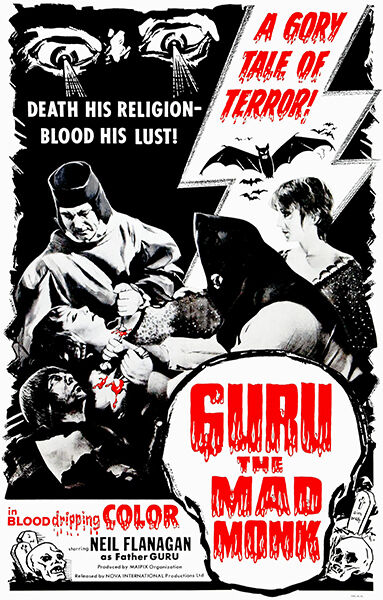
Guru, the Mad Monk


Guru the Mad Monk Poster

(1970) Written and directed by Andy Milligan; Starring: Neil Flanagan, Jaqueline Webb, Judith Israel, Paul Lieber, Jack Spencer, Frank Echols and Gerald Jacuzzo; Available on Blu-ray and DVD 

Rating: **½ 

“Talk comes cheap, my boy, and I’ve learned not to gamble on people’s words. I can’t afford to. I have learned in this mortal life of ours that it is each man for himself. I preach that God takes care of those who believe in him, but I’ve discovered that all my years of believing haven’t helped me one bit. Mother Church sends me little money to exist on, and even then, it doesn’t arrive when it’s supposed to, so I preach one thing and continue believing another. Self-survival. You would be well to remember this.” – Father Guru (Neil Flanagan)

Guru Sentences Nadja

A gargantuan thanks to Rebecca from Taking Up Room for hosting the latest edition of the So Bad It’s Good Blogathon, a continuing celebration of the best of the worst. Today’s offering is a piquant little number by the notorious filmmaker Andy Milligan, Guru, the Mad Monk. I would be remiss if I didn’t give thanks to author/blogger John Harmon for introducing me to the dubious charms of Milligan’s handiwork. Be sure to visit his blog, Tales from the Freakboyzone for articles about Milligan, and much, much more…

Guru, Nadja, Igor and Carl

The late great Andy Milligan’s ambition arguably outweighed his talent by a substantial margin, yet his films have more heart and craft than the generic big-budget prefabricated blockbusters typically churned out by the Hollywood studios. Milligan didn’t know the meaning of staying in his lane, given his limited means, creating costume period pieces for what would seem like pocket change to the typical Hollywood producer. Set in Eastern Europe presumably during the Middle Ages, Guru, the Mad Monk was his most cinematic to date (his first to be shot on 35 mm film), but don’t let that fool you – Cleopatra this isn’t. Guru was budgeted at an estimated $11,000* and in typical Milligan fashion, shot over six days. An old Manhattan church* provided a quasi-Old-World look (get used to it, since the church and its grounds are basically the only setting). The sound of waves crashing and seagulls screeching lead us to believe it’s on the remote island enclave of Mortavia (don’t bother looking it up). 

* Fun Fact #1: This was one of the few offerings by Milligan’s short-lived production company, Nova International Pictures (created in an effort to control his film distribution). 

** Fun Fact #2: According to Cinefear.com founder Keith Crocker, the ever-hot-headed filmmaker was known for entering theaters that held unauthorized screenings of his films, and stealing back the prints. 

*** Fun Fact #3: St. Peter’s Episcopal Church was built in 1831, while the wrought iron fence surrounding the structure dates back to 1790.

Carl Makes a Pact with Guru

Hungry for power and money, the corrupt Father Guru (Neil Flanagan), with the aid of his vampire companion Olga (played by Flanagan’s real-life spouse, Jaqueline Webb) and faithful hunchbacked assistant Igor (Jack Spencer), looks for ways to bring more revenue to his church. He finds the perfect opportunity in Nadja (Judith Israel), a young woman imprisoned for a murder she didn’t commit. Her lover Carl (Paul Lieber) implores Guru to spare her life. In turn he’s employed by the holy man to acquire bodies for medical experimentation, which can be sold for cash (Carl’s ventures away from the church economically occur off-screen). Guru’s plans are sidetracked, however, when Igor falls for Nadja. His position as de facto ruler of Mortavia is further threatened when Bishop Kopel (Frank Echols) pays him a visit, along with his intended replacement, Father Polanski (Gerald Jacuzzo).

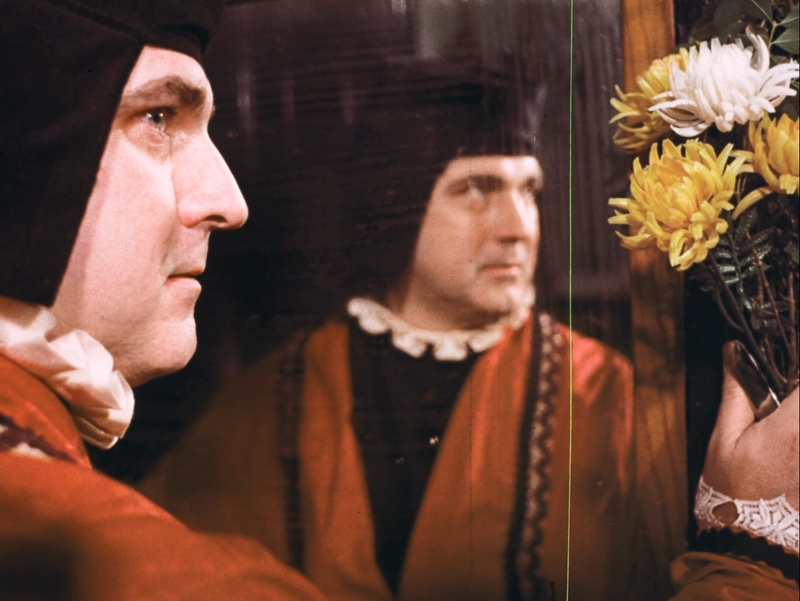
Guru's Mirror Scene

Milligan regular Neil Flanagan chews the scenery with his tour de force (or should I say, “tour de farce?”) performance as the title character. Guru’s contradictory behavior becomes a mouthpiece for Milligan’s deep-seated cynicism about organized religion and authority figures in general. In a scene that must be experienced to be believed, he argues with himself in the mirror, revealing the conflicted sides of his psyche (predating Andy Serkis’ motion capture performance as Gollum by 30 years). Every time he’s on screen, you know it’s going to be interesting. One of the few performers in the film with genuine talent, Flanagan was the secret weapon in Milligan’s troupe, having worked extensively in theatre, film, and television.

Igor and Guru

Flanagan aside, Milligan often rounded out his cast with non-actors pulled off the street, friends, lovers, and otherwise (hence, the varying quality of the performances). Paul Lieber,* who plays our hero Carl, recites his dialogue as if he’s reading the fine print in a non-disclosure agreement (calling him wooden is an insult to trees). On the other end of spectrum, Jack Spencer hogs the spotlight as Igor, grinning and hopping around like an overeager puppy, despite Guru’s constant barrage of insults and browbeating (“I can say anything to you, you ignorant bastard, and you just smile”). Jaqueline Web hams it up as Guru’s partner in crime, Olga, feeding off the blood of the executed. 

* Fun Fact #4: With 68 acting credits to date, one can only assume he’s gotten much better.

Look Ma, No Hands!

Guru’s not-so-special makeup effects, depicting the numerous tortures of condemned prisoners, would be gruesome if they weren’t so unconvincing. In one scene, a condemned man’s eyes (resembling hors d'oeuvres at a cocktail party) are gouged out, and a thief’s “hands,” which appear to have been pilfered from a department store mannequin, wobble before they’re chopped off. As stagey and cartoonish as the effects were, one crude decapitation scene was reportedly enough to make someone in the audience throw up.

Father Guru and Bishop Kopel

A highlight (or lowlight, depending on your point of view) of a Milligan production are the slapdash costumes,* created by Milligan himself. Guru’s costumes never disappoint, evoking a bygone, albeit indistinct, era. Witness scraps of furniture upholstery, curtains, and other assorted bits and pieces, held together with nothing more than pins and repurposed to vaguely resemble something from the medieval period, more or less. Meticulously researched adherence to period accuracy took a backseat to the practical requirement of having enough material to cover the cast’s derrieres. Another Milligan trademark on display was the copious amount of cloth draped over the walls of the cathedral to conceal modern fixtures. 

* Fun Fact #5: Frank Echols, who played Bishop Kopel, Guru’s superior, commented on his outfit: “Andy, I look like an old hooker off 8th Avenue.”

Nadja and Carl

Milligan claimed Guru was his worst film,* but don’t let that dissuade you (like most artists, he probably wasn’t the best judge of his own work). While it’s certainly uneven, Guru, the Mad Monk is among his most fun movies. Amidst the goofiness, there are some serious things to say, although considering Milligan’s fickle nature, you’re best advised to take any “messages” with a grain of salt. Working with budgets that would make 1940s Poverty Row productions look lavish by comparison, Milligan did a lot with virtually nothing. Perhaps that’s why his movies resemble something out of another time and place (or maybe another dimension). I would say Milligan’s films are an acquired taste, but I don’t think there’s a way to properly immunize yourself – you just have to dive in head-first. Either they click or they don’t. Lower your expectations, then lower them a few notches down from there, and you might have a good time (don’t expect Martin Scorsese or even H.G. Lewis levels of competence). Does it entertain? Yes, it does. Is it for everyone? Definitely not, but if you’re the kind of person that appreciates Milligan’s special brand of je ne sais quoi, you’re in for a treat. 

* Fun Fact #6: Editing the film was apparently a nightmare for Milligan, in no small part, due to the fact that sound and picture were recorded separately, and frequently out of synch.  


Sources for this article: The Ghastly One – The 42nd Street Netherworld of Director Andy Milligan, by Jimmy McDonough; Severin Blu-ray commentary by Keith Crocker; “Remembering Andy Milligan” featurette with Tom Vozza


Sunday, October 16, 2022

The Devil Bat


(1940) Directed by: Jean Yarbrough; Written by John T. Neville; Story by George Bricker; Starring: Bela Lugosi, Suzanne Kaaren, Dave O’Brien, Donald Kerr, Yolande Mallott (Donlan) and Guy Usher; Available on Blu-ray and DVD. 

Rating: ***

Note: This review is an expanded version of a capsule review from October 2015. 

Dr. Carruthers in His Secret Lab

“Formula. That’s but child’s play for a great scientist. Your brain is too feeble to conceive what I accomplished in the realm of science.” – Dr. Paul Carruthers (Bela Lugosi)

After a career high point with Dracula (1931), Bela Lugosi experienced a slow career decline, migrating from Universal to third-tier, so-called “Poverty Row” studios (including Monogram and PRC). But that doesn’t mean he didn’t appear in some notable features along the way. Lugosi portrayed more than a few mad scientists throughout his filmography, ranging from serious (The Raven) to bordering on self-parody (Bride of the Monster). He found the sweet spot, however, as the curiously named Paul Carruthers in PRC’s The Devil Bat.

Dr. Carruthers Admiring His Killer Bat

Dr. Carruthers lives a second life that he conceals from prying eyes. Adjacent to his formal lab is a secret lab, sequestered behind a panel, where the real work takes place (which in turn leads to a dungeon-like enclosure, housing his specially bred bats). He concocts an elaborate scheme for exacting revenge against business partners Henry Morton (Guy Usher) and Martin Heath (Edward Mortimer) along with their progeny, involving said bats and a special aftershave. Being a gifted chemist, you think he’d cut out the middleman with the bats, and create some kind of fast-acting, albeit undetectable poison. Then again, where’s the fun in that? After convincing his intended victims to wear his killer bat-attracting concoction, he sits back and enjoys the handiwork of the murderous flying mammals, as they swoop down on their unsuspecting prey, tearing out the victims’ aftershave-slathered throats.

Joe McGinty, Johnny Layton, and "One-Shot" McGuire

Enter go-getting Chicago Register* reporter Johnny Layton (Dave O’Brien) and his overly enthusiastic (Okay, how about obnoxious?) photographer, “One-Shot” McGuire (Donald Kerr). When he’s not snapping pics, he’s harassing the Heath’s French maid, Maxine (Yolande Donlan),** who somehow falls for him anyway (apparently in 1940,  you didn’t need charisma to woo the ladies, just a load of chutzpah). Layton also likes to mix his business with pleasure. Although he’s determined to get the scoop on the murders, he’s never too busy to sweet talk rich heiress Mary Heath (Suzanne Kaaren).*** 

* Fun Fact #1: Johnny’s boss, chief editor Joe McGinty, played by Arthur Q. Bryan, was known primarily for his voice talent. He was probably best known for providing the original voice for Elmer Fudd in the Warner Brothers cartoons. 

** Fun Fact #2: After winning a beauty contest, she wasn’t terribly keen on doing the movie. Per an interview, Donlan commented, “…I wasn’t even interested in it then! I wasn’t interested in being in a picture of that kind at the time.” 

*** Not-So-Fun Fact: Besides being an actress, co-star Kaaren was also an inventor. One of her most notable inventions was a pop-top can, which was appropriated by the Continental Can Company for a whopping $1.20.

Dr. Carruthers and His Next Victim

Lugosi is obviously having a blast with his role as the duplicitous Dr. Carruthers. Considering his tumultuous career, typified by grossly underpaid roles, relative to his co-stars, I can’t help but think his performance was at least semi-autobiographical. It must have been cathartic to channel his frustrations about those he believed had wronged him over the years. One of the film’s conceits is that Carruthers is such a genteel, kindly individual, no one would ever suspect him of any skullduggery (despite the fact that he has a clear motive for the murders). All the while, Lugosi seems to be winking at the audience with lines like: “I don’t think you’ll use anything else,” and “I want to try it out on several people first, and see if it works” (Mwah, ha, ha!).  

Dr. Carruthers' Secret Lab

Carruthers’ fuzzy science is never explained. Instead, we take it on face value that he can create giant bats simply by charging them with electricity, which somehow makes them increase in size (insert shots of real fruit bats). Yep, not only is he a chemical genius, but a wiz at bioengineering as well (unlike the lazy specialists depicted nowadays, those old-timey scientists did it all). The titular creature doesn’t disappoint. As it swoops in for the kill, the giant bloodthirsty bat shrieks like an enraged Muppet.
 
Another Victim of the Devil Bat

In one scene, in which Carruthers confronts Henry Morton, the company head replies with the patronizing comment, “You’re a dreamer, doc. Too much money is bad for dreamers.” In his DVD commentary, film historian Richard Harland Smith pointed out that most critics leave out the fact that Carruthers willingly sold out, so there wasn’t any wrongdoing on the part of the company. Despite this “gotcha,” something doesn’t sit right. The audience is missing some information that a few lines of exposition can’t provide. We don’t know if he was coerced to sell his cold cream formula for such a pittance or if it was simply a moment of poor judgment. Whichever reason was Carruther’s motivation for selling, it’s hard to have sympathy for a couple of businessmen that, in good conscience, lowballed the scientist and significantly profited off his invention. Does that mean Carruthers is justified in bumping off the cosmetics company family members one by one? Nope, but they certainly could have coughed up a little extra dough for the good doctor (Or perhaps he should have hired a good lawyer? Although I’d take killer bats over a court procedural any day.). It’s also worth noting that the Heaths and the Mortons are a pretty cold bunch. Mary Heath (Suzanne Kaaren) doesn’t seem particularly distressed about the fact that her brother was just viciously murdered, but seems to enjoy Layton’s flirting. 

Layton, McGuire, and Mary Heath

Lessons learned:

·       If you can’t have fun with your revenge plot, don’t do it at all.

·       Don’t upset a chemist, you never know what they’ll concoct next.

·       The more irritating you are, the more appealing you appear to the object of your affections.

·       A few pesky murders can’t thwart Cupid’s arrow.

Dr. Carruthers

The Devil Bat was ravaged by reviewers of the time, including one from Variety who dismissed it as “pretty terrible,” with “Acting, directing, photography – all poor.” But I think that misguided critic and their like-minded colleagues missed the point. Is it a self-conscious dark comedy or a naïve revenge thriller? Does it really matter? Considering the multiple one-liners that Carruthers employs in his send-offs, I suggest it would be the former. The Devil Bat may not have won many accolades, but it made me smile. Taken in the proper light, hopefully it will do the same for you. 

Sources for this article: Kino DVD commentary by Richard Harland Smith; Poverty Row Horrors! by Tom Weaver (1993)


Thursday, December 10, 2020

Fly the Unfriendly Skies: The Airport Movies


Airport

During a time when global travel is inadvisable or outright restricted, most of us can only dream about flying off to exotic, faraway locations, let alone enjoying frivolous travel within our own country. Back in the weird and wacky 1970s, Hollywood set its sights on every conceivable sort of calamity as a potential cash cow. One of the most enduring relics from this era were the Airport movies. Over the course of the decade-long series, four installments, each more audacious than the former, graced the silver screen. They were products of their time in the best and worst ways, featuring ridiculous feats of heroism, an expansive cast of recognizable faces from old and (then) new Hollywood, and quotable dialogue. On the other hand, the Airport movies reflected some aspects of a previous decade best left behind, with borderline racist comments, rampant workplace sexism, and atrocious fashions. Watching the Airport movies, we’re at once reminded of the rewards of travel and its inherent dangers. Considering the string of disasters depicted in these films, however, we’re reminded, on second thought, we’re probably better off staying home.

Airport Poster

Airport

(1970) Written and directed by George Seaton; Based on the novel by Arthur Hailey; Starring: Burt Lancaster, Dean Martin, Jean Seberg, Jacqueline Bisset, George Kennedy, Helen Hayes, Van Heflin, Maureen Stapleton; Available on Blu ray and DVD

Rating: ***

“It’s an old-fashioned, formula entertainment. It’s not art, it’s fun.” – Producer Ross Hunter (from 1986 L.A. Times interview by Dennis Hunt)

Airport

Airport general manager Mel Bakersfeld (Burt Lancaster) is having a rough night at (the fictional) Lincoln International. After spending a few too many long days at the office, managing crisis after crisis, his marriage to stuffy, waspish Cindy (Dana Wynter) is on the skids. He’s testing the bounds of his relationship with his assistant Tanya (Jean Seberg), while she ponders transferring to another position. Meanwhile, following the worst snowstorm in years, the airport is in danger of operations screeching to a halt, as Bakersfeld’s ground crew struggle to keep the runways clear with limited equipment. And if that isn’t enough, he’s faced with a public relations nightmare as a group of angry homeowners protest the noisy flyovers by airliners.

But that’s not all, folks…

Airport

Enter Dean Martin as Vernon Demerest a philandering pilot who’s coming to grips with the fact that his stewardess girlfriend Gwen (Jacqueline Bisset) is pregnant. Fold into this complicated batter Ada Quonsett, a plucky little old lady (Helen Hayes), with a talent for sneaking on flights. As Bakersfeld soon learns, the serial stowaway has more than a few tricks in her arsenal to elude unsuspecting airport officials (Who needs frequent flyer miles when you have her dubious skill set?). We’re also introduced to unflappable chief mechanic Joe Patroni, played with zeal by George Kennedy (Get used to that character, folks, because he provides a thread of continuity between the first movie and the sequels). Snow plows be damned, he’s determined to free a stranded 707,* if he has to do it himself. Oh, and last but not least (in what’s arguably the focal point of the film), down-on-his-luck ex-demolitionist, Guerrero (Van Heflin), takes the idea of bringing his work home with him just a smidge too seriously, boarding a 707 bound for Rome (flown by Vernon). Armed with a bomb and a flight insurance policy worth more than 200 grand, he intends to detonate the aircraft over the ocean, where there’ll be no traceable evidence.  

* Fun Fact #1: Petroni makes a point that the aircraft in question costs $8 million (or about $54 million in 2020 dollars), a lofty sum in 1970. For comparison, a new Boeing 787 will set you back about $170 million.

Airport

Much like many of the big American cars that came out of that era, Airport is a clunky, inefficient machine with more style than substance. It takes half the movie to arrive at the main conflict (Arguably 30-45 minutes could have been cut from the film, and no one would have complained). Also, Airport suffers from an abundance of split screens. What begins as a cute little stylistic flourish is repeated ad nauseum, to the point where you’ll be prompted to scream, “Enough already!” To his credit, writer/director George Seaton keeps multiple threads of Airport’s convoluted soap opera story going. Despite its myriad flaws, this ungainly bird somehow stays up in the air.

Airport 1975

Airport 1975

(1974) Directed by Jack Smight; Written by Don Ingalls; Based on the novel by Arthur Hailey; Starring: Charlton Heston, Karen Black, George Kennedy, Efrem Zimbalist Jr., Helen Reddy, Linda Blair, Dana Andrews, Sid Cesar and Erik Estrada; Available on Blu ray and DVD

Rating: ***

“Climb baby, climb.” – Alan Murdock (Charlton Heston)

Airport 1975

The Boeing 747 was a really big deal, in more ways than one when it entered service in 1970. You didn’t have to be an aviation enthusiast to appreciate its distinctive double-decker shape, massive proportions and luxurious amenities, which ushered in a new era of air travel. It’s therefore no surprise that the 747 should be the star of Airport 1975 (released in 1974). Disaster strikes (quite literally) when the airliner is diverted from L.A. to Salt Lake City, and the pilot (Dana Andrews) of a small private plane suffers a heart attack mid-flight. His craft collides with the huge passenger jet, leaving a gaping hole in the cockpit. In the blink of an eye, the number of personnel qualified to operate the plane drops to zero after the co-pilot is sucked out, the pilot (Efrem Zimbalist Jr.) is blinded by shrapnel, and the navigator (Erik Estrada) is killed by wreckage. All seems hopeless until intrepid stewardess Nancy Pryor (Karen Black) is forced to take the controls, with the help of ground control.

Airport 1975

Since this is an Airport movie, expect the requisite all-star cast, including Gloria Swanson, in her final film appearance, playing herself. Myrna Loy plays an alcoholic elderly lady. Sid Caesar appears as a chatterbox passenger, and Jerry Stiller spends most of the picture asleep while chaos reigns around him. In one scene that will be instantly familiar to anyone acquainted with a certain famous parody flick, see Helen Reddy as a singing, guitar-playing nun, entertaining Janice Abbott (Linda Blair), a sick kid awaiting a kidney transplant. George Kennedy is back as the irascible Joe Petroni, now a VP of operations for the fictional Columbia airlines. This time, there’s more at stake, with his wife and son, Joe Jr., aboard the damaged 747.

Airport 1975

No ‘70s disaster film would be complete without Charlton Heston (1974 was a busy year for Heston, who also appeared in Earthquake the same year) as ace flight instructor (and Pryor’s ex-boyfriend) Alan Murdock. He attempts a dangerous gambit by rappelling via helicopter to the damaged cockpit. Will he reach the cockpit in time, thus preventing an imminent tragedy? Will Murdock and Pryor patch up their relationship? I think you can guess the outcome, although the movie never addresses how the last-minute diversion to Salt Lake City affects poor Janice and her transplant. While the script conditions us to accept Murdock as the default hero, Nancy doesn’t get nearly enough credit for keeping the jumbo jet in the skies and preventing a passenger riot when they learn about the sudden shortage of pilots onboard. It’s difficult, nigh impossible, for modern viewers to imagine this film before Zucker, Zucker and Abrahams had the last word on airplane disaster flicks with their parody to end all parodies, Airplane! (1980), but that shouldn’t dissuade you from booking a ticket on Airport 1975.


Airport 77

Airport ‘77

(1977) Directed by Jerry Jameson; Written by Michael Scheff and David Spector; Based on the novel by Arthur Hailey; Starring: James Stewart, Jack Lemmon, Lee Grant, Brenda Vaccaro, Joseph Cotten, Christopher Lee, Darren McGavin, Kathleen Quinlan and George Kennedy; Available on Blu ray and DVD

Rating: ***

Karen Wallace (Lee Grant): “If I weren’t such a sinner how would you look like such a saint? Isn’t that why we’re together? If it isn’t, tell me, and I’ll stop acting like an idiot.”

Martin Wallace (Christopher Lee): “Why should I, my dear? You’re so proficient at it.”

Airport 77

The third installment of the durable series takes things up another notch with the most unlikely premise to date: a hijacked 747 sinks in the Bermuda Triangle. This time around, the filmmakers do away with any pretense that we give a hoot about the airport-based drama, concentrating solely on the aviation disaster. Family, friends and press are invited to a gala event hosted by billionaire Philip Stevens (James Stewart) on his island estate. The guests board Stevens’ private 747, loaded with priceless artwork, bound for his new museum. But evil-doings are afoot, as an organized ring of thieves conspire to rob the plane of its valuable cargo, and strand the passengers and crew on an island. Soon after they take control of the plane (with the passengers and crew incapacitated), their plans go awry when a wingtip smacks into an offshore oil derrick, subsequently causing the plane to careen into the ocean. Somehow, the jumbo jet remains miraculously intact after hitting the water, retaining its structural integrity even while it sinks.* Any semblance of credulity is stretched to the breaking point as the survivors are stuck at the bottom of the ocean, pondering their respective fates. Call me skeptical, but I doubt Boeing ever considered the viability of one of their aircraft doubling as a submersible.

* Fun Fact #2: Visitors to Universal Studios in the late ‘70s and early ‘80s (including Yours Truly) were treated to an attraction, Screen Test Theatre, where a few lucky audience members could participate in their own version of Airport ’77, and take home a copy for posterity.

Airport 77

Jack Lemmon is fine as stalwart pilot Don Gallagher, who risks life and limb (including learning how to scuba dive with Navy frogmen) to save the passengers. George Kennedy is back, reprising his role as Petroni (now employed by Stevens), although his character isn’t given much to do in this outing. In one brief scene, we learn that he’s been tasked to provide technical assistance to the U.S. Navy in their search and rescue operation. Expect the usual assortment of old and new Hollywood in the supporting cast. Olivia de Havilland and Joseph Cotten lend some old-school class to the production. Darren McGavin lends his gruff but lovable persona as operations manager Stan Buchek (a name that suspiciously sounds like Kolchak). Christopher Lee, playing a non-villainous role for a change, appears as oceanographer Martin Wallace. His selfless efforts helping humankind with undersea research are contrasted with his selfish wife Karen (Lee Grant), who uses booze as an excuse for her terrible, entitled behavior (Hmm… Perhaps she was the original template for the “Karen” meme?). Blind piano player Steve (played by Tom Sullivan) sings the non-hit “Beauty Is In The Eye Of The Beholder” (I’m sure the producers were looking for another “The Morning After,” but you’ll probably forget it as soon as it’s over).

Airport 77

Much like its predecessors, Airport ‘77 has more than its share of clunky elements, with plenty of plot holes and unresolved threads. It suffers from what seem to be excessive cuts – we don’t know enough about the characters and their relationships to care. Also, in several establishing shots, it appears that the nose of the jumbo jet is dangerously close to the precipice of a continental shelf, but nothing much is made of this. But undeveloped characters and missed opportunities aside, there’s something compelling in the premise, spurred by the 9-year-old inside us all, who asks “What if an airliner was stuck underwater?”* My suggestion? Make sure your chair is a reclined position while keeping your brain in standby mode, and enjoy a glass or two of your favorite beverage.

* Fun Fact #3: So, what does a commercial pilot think about such an unlikely scenario? Don’t count on it. Read more here.  

Airport 79

The Concorde: Airport 79

(1979) Directed by: David Lowell Rich; Written by Eric Roth; Story by Jennings Lang; Based on the novel by Arthur Hailey Starring: Alain Delon, Susan Blakely, Robert Wagner, George Kennedy, Sylvia Kristel, Eddie Albert, Bibi Andersson, Charo, John Davidson, Martha Raye and Jimmie Walker; Available on Blu ray and DVD

Rating: **

Isabelle (Sylvia Kristel): “You pilots are such... men.”

Capt. Joe Patroni (George Kennedy): “They don't call it the cockpit for nothing, honey.”

Airport 79

While notorious for many reasons, the 1970s also heralded some aviation milestones. The Concorde, one of the most ambitious (and ostentatious) examples of commercial aviation first flew in the late ‘60s, but didn’t enter service until 1976. The supersonic airliner, instantly recognizable for its sleek shape and delta wing configuration, was the vehicle of choice for the select few wealthy enough to afford a ticket. It was a symbol of excess that proved what was possible, if not particularly necessary. The same sentiment goes for this third and final sequel to Airport.

Airport 79

This time around, the filmmakers attempted to inject some intrigue into the mix, with a plot about corrupt arms manufacturer Kevin Harrison (Robert Wagner) and his TV news reporter girlfriend, Maggie Whelan (Susan Blakely), who stumbles on documents proving that he participated in illegal arms trafficking. Now she’s become a target as Harrison, willing to go o any lengths to keep her silent, schemes to shoot down her plane.

Airport 79

Once again, George Kennedy appears as the series’ common thread, Joe Patroni. I may have lamented the fact that Kennedy was under-utilized in the previous film, but I was wrong – oh, so wrong. The filmmakers somehow forgot (or hoped that audiences forgot) Petroni was a flight mechanic by trade (the first film made a point of stating that he only had clearance to taxi aircraft), but we’re suddenly expected to believe he’s a seasoned pilot, qualified to fly one of the most advanced airliners ever built. Throw in a steamy love scene no one asked for, add enough toxic masculinity for ten movies, and watch any good will he fostered in the first and subsequent films fly out the window. Patroni’s French co-pilot, played by Alain Delon (probably wishing he was still doing films for Jean-Pierre Melville), mainly reacts to his brash American counterpart, while cavorting with comely flight attendant Isabelle (Sylvia Kristel). Sadly, flight engineer Peter O'Neill (David Warner) isn’t given much to do.

Airport 79

The passengers are played by the usual odd assortment of has-beens and marginal celebrities, reduced to lame comic moments. Eddie Albert plays Eli Sands, the wealthy owner of the airline that operates the sole American Concorde. Jimmie Walker spends some quality time with his saxophone, Martha Raye contends with her irritable bowels, and Margarita (played by Charo, the “Cuchi Cuchi girl and frequent Love Boat guest star), attempts to smuggle her chihuahua onboard.


(There are a few spoilers ahead, but I suspect most folks won’t care). What follows are a series of mind-numbing plot holes big enough to fly a fleet of Concordes through. Harrison attempts to shoot down the supersonic airliner with an experimental surface-to-air missile, but Petroni’s flying skills save the day. With his plans thwarted, Harrison deploys a hired gun in a fighter jet, equipped with heat-seeking missiles. Before the French military can intercept the rogue plane, Petroni puts the Concorde through some acrobatic evasive maneuvers, while shooting flares out of an open cockpit window, all presumably at supersonic speed (at this point, the filmmakers must have decided to eschew anything remotely plausible). Petroni’s damaged craft is forced to make an emergency landing in Paris, but it doesn’t stop there, dear reader. After the big kerfuffle in the sky, which in the real world would have certainly spurred a massive international investigation, and likely grounded the aircraft for an unspecified time, the Concorde is tidied up and departs for the final leg of the journey to Moscow. In a last-ditch attempt to down the airliner, Harrison arranges a phony maintenance man to sabotage a cargo door so it will open mid-flight, resulting in rapid decompression. Said maintenance man is caught by authorities after giving chase on the runway, with cash spilling out of his suit. Pop quiz – If you were in a position of authority would you A), Immediately order the Concorde back to the airport, or B) Allow it go on its merry way? If you chose “B,” congratulations! You unnecessarily endangered the lives of everyone aboard, leaving the crew to attempt a crash landing in the Swiss Alps.

Airport 79

 Produced for a middling $13 million, this was the most expensive of the Airport films, but you’d be hard-pressed to see any evidence on screen, with some truly awful special effects on display (considering this was the same year as Alien, Star Trek: The Motion Picture, and Moonraker, it’s inexcusable). Airport ’79 turned out to be a disaster in more ways than one, with poor reviews and tepid box office performance. It’s hard to say much in the defense of this albatross, which brought the decade-long series to such an inauspicious end, but hey, we had a few laughs along the way, right?