Wednesday, April 30, 2025

Werner Herzog Month Quick Picks and Pans


The Enigma of Kaspar Hauser Poster

The Enigma of Kaspar Hauser (1974) In the early 19th century, a strange man with limited speech and mobility mysteriously appears in a small German village. Gradually, he learns how to interact with the people in the village and express his thoughts verbally. He meets resistance from some of the townspeople and local clergy, who seem more irked than curious about his unorthodox observations, untainted by socialization. This fascinating character study is anchored by a raw, emotive performance by Bruno S. as Kaspar Hauser, who communicates so much with movement and facial expressions. Herzog’s film hits all the right notes, with poignant moments and touches of unexpected humor. 

Rating: ****. Available on DVD and Tubi

How Much Wood Would a Woodchuck Chuck Poster
How Much Wood Would a Woodchuck Chuck? (1976) Werner Herzog shines the spotlight on the world of cattle auctioneers, with this engaging, deceptively simple documentary. We get a taste for the varied styles of several participants at the World Livestock Auctioneer Championship, nestled in Pennsylvania Amish country. The contestants’ rapid speaking style has a rhythmic, musical quality that mesmerizes the viewer – a language, Herzog asserts, created through capitalism. 

Rating: ****. Available on Prime Video and Tubi


Woyzeck Poster

Woyzeck (1979) Klaus Kinski stars as the titular Woszek, a 40-year-old career soldier in the Polish army. His life is filled with endless drills and derision from his superiors, much to the chagrin of his bored wife, Marie (Eva Mattes). His patience is stretched to the breaking point when Marie has an affair with his commanding officer. Kinski does an admirable job portraying a man who’s out of step with his peers, displaying a level of thoughtfulness and sensitivity ill-suited for military life.   

Rating: ***½. Available on DVD, Prime Video and Tubi


La Soufriere Poster

La Soufrière (1977) Herzog visits the tiny Caribbean island nation of Guadeloupe, on the cusp of a massive volcanic eruption. While the majority of the island’s residents were evacuated, we hear from the few who decided to stay behind to prepare for whatever fate awaited them. Shots of the abandoned streets of the main town conjure imagery of a post-apocalyptic world. While filmmaker and crew prepare for the worst, we learn about a similar catastrophe on a nearby island in 1902, when a population of 30,000 was wiped out in an instant. Herzog captures the ominous dread of meeting death head on, proving Alfred Hitchcock’s adage that “There’s no terror in the bang, only the anticipation of it.”  

Rating: ***½. Available on Prime Video and Tubi 


Herdsmen of the Sun Poster

Herdsmen of the Sun (1989) Herzog introduces us to the Wodaabe, a nomadic tribe who roam the Sahara Desert, following the whims of their cattle. He focuses his lens on a traditional ritual, in which the men of the tribe attempt to woo the women with dance and elaborate makeup and costumes. The documentary seems a bit thin with its short running time (only 52 minutes), but it’s a nice introduction to a group of people and customs that few westerners have ever witnessed. 

Rating: ***½. Available on Tubi


My Son, My Son, What Have Ye Done Poster

My Son, My Son, What Have Ye Done (2009) Michael Shannon stars as Brad Macallam, an unbalanced man who lives with his overbearing mother (Grace Zabriskie). The David Lynch-produced film traces Macallam’s descent into madness and murder, leaving clues but not necessarily the causes of his actions. In addition to Shannon, Herzog assembled a phenomenal supporting cast (including Willem Dafoe, Chloë Sevigny, Udo Kier, and Brad Dourif) for his slow-burn mystery/drama, which seems to suggest something lofty, but never quite gets to the point. 

Rating: ***. Available on Blu-ray and DVD


Monday, April 28, 2025

Cave of Forgotten Dreams


Cave of Forgotten Dreams Poster

(2010) Directed by Werner Herzog; Written by Werner Herzog and Judith Thurman; Starring: Werner Herzog, Jean Clottes, Julien Monney, Jean-Michel Geneste and Michel Philippe; Available on Blu-ray and DVD 

Rating: ***½


Cave Paintings

“There was intense competition to film it, particularly from French directors, all good, serious candidates, and I didn’t think I was in with much of a chance because the French think very territorially when it comes to their patrimoine. All the experts who had explored the cave were French, and my first hurdle was to gain their approval, then that of the regional government of the Ardèche.” – Werner Herzog (from his memoir, Every Man for Himself and God Against All

Cave Bear Skull and Bones

The closest thing we have to a time machine in which we can visit our ancient ancestors is examining the traces they left behind. The Chauvet Cave paintings in southeastern France, dating back approximately 32,000 years, were discovered as recently as 1994, and are among the oldest known examples of cave art.* The Paleolithic Period paintings remain perfectly preserved, due to a rockslide 20,000 years ago, which sealed Chauvet from the outside world. Now managed by the French government, the original entrance has been widened but sealed tight like a bank vault, with a locked metal door. In order to maintain the cave’s pristine appearance, access is restricted to a fortunate few with legitimate scientific interest.**. Facing competition from French filmmakers, Werner Herzog had to convince then French Minister of Culture, Frédéric Mitterrand, that he was the right person for the job. The results (originally presented in 3D) are the closest look most people are likely to get inside Chauvet Cave. Due to strict regulations, director/co-writer Herzog worked with a crew of four (including himself). They were only permitted to film for a maximum of four hours per day for less than a week. Within the confines of the filming window, they were forbidden to touch anything, or venture away from the confines of a two-foot-wide walkway, which ran the length of the 1,300-foot cave. 

* Fun Fact #1: While the paintings at Chauvet Cave are among the oldest known, two locations have them beat by a substantial margin: Maltravieso Cave in Spain (64,000 years) and the caves of Maros-Pangkep, South Sulawesi in Indonesia (51,000 years). 

** Not-So-Fun Fact: In 1963, French authorities closed another archaeological wonder to tourists, Lascaux Cave (featuring 17,000-year-old-artwork), as the accumulated breath of multiple visitors ultimately caused mold to grow on the cave walls. 

*** Fun Fact #2: Herzog’s shoot almost turned to disaster when the battery pack used to power the camera’s memory bank failed. Instead of missing out on four hours of filming, his crew fashioned a new battery from available parts, using only a tiny screwdriver and Swiss Army knife as tools.

Exploring the Cave

Cave of Forgotten Dreams provides insight into the nature of art as a means of human expression, confirming that such concepts as perspective and illusion of motion were employed by ancient artists. We can see what appears to be the birth of animation in the painting of a bison with eight legs, showing the range of motion. The cave paintings are also a document of a world that has come and gone, depicting animals that have long since vanished from the Earth, such as mammoths, wooly rhinos, and cave bears. The mind reels with speculation about who the individuals were who adorned its walls with artwork, and what sort of rituals the cave was used for. We’ll never know the names of the artists, their customs or culture, but for one curious artifact. Several paintings include the handprint of a single individual. Akin to their signature, the handprint uniquely identifies the artist because of a crooked pinkie finger on their right hand. We can also infer that the artist stood about six feet tall, based on the placement of the handprints throughout the cavern.

Julien Monney

We hear from several archeologists and other professionals who share a special affinity for Chauvet cave, and the paintings within. One of the most intriguing individuals interviewed by Herzog is archaeologist Julien Monney, who started out working for a circus as a unicyclist and juggler. Reminiscent of Herzog’s superior documentary, Encounters at the End of the World (2007), the interview underscores the sort of eclectic professionals working toward a common goal. Monney addressed the psychological and spiritual impact of his initial viewing of the paintings, stating that he needed to take several days away from the cave to process the images.

Handprints

Compared to some of his other documentaries, Herzog seems to take more of a backseat approach to the film, letting the cave paintings speak for themselves. Herzog, himself, is not featured as prominently, and his commentaries seem relatively sparse. One of the director’s trademarks, dwelling on shots for a protracted length of time, is present, although an overabundance of these shots (which repeat themselves several times) will likely test the attention spans of many viewers. While it’s a fascinating subject, the material is stretched a bit thin for a 90-minute documentary, which might have been better served by a shorter running time. Herzog goes off track during the last half-hour, discussing another cave in nearby southwestern Germany, as well as a greenhouse project several miles down river from the cave entrance. Regardless of the pacing issues, it’s virtually impossible not to be entranced by the subject matter. At its best, Cave of Forgotten Dreams is an almost metaphysical journey that transcends time, space, and human thought, providing a fascinating glimpse of something few of us will ever experience first-hand. 


Sources for this Article: Every Man for Himself and God Against All, by Werner Herzog, “Narrative Cave Art in Indonesia by 51,200 Years Ago,” Nature (July 3, 2024)

Monday, April 21, 2025

Aguirre, the Wrath of God

Aguirre, the Wrath of God Poster

(1972) Written and directed by Werner Herzog; Starring: Klaus Kinski, Ruy Guerra, Helena Rojo, Del Negro, Peter Berling and Cecilia Rivera; Available on DVD 

Rating: ****½

Aguirre and Crew

“I am the great traitor. There can be no greater! Whoever even thinks about deserting will be cut into 198 pieces! And then trampled upon until you can paint the walls with him. Whoever eats one grain too many or drinks one drop of water too much will be locked up for 155 years! If I, Aguirre, want the birds to drop dead from the trees, the birds will drop dead from the trees. I am the Wrath of God! The earth I walk upon sees me and quakes! But whoever follows me and the river, will win untold riches. But whoever deserts...” – Don Lope de Aguirre (Klaus Kinski)

“… I would have spent the entire budget in three days working in the studio, and of course, there was something authentic about the jungle which can’t be fabricated. You can’t create jungle in the studio. You have to go out there, and the story takes place in the Peruvian jungle; you have to go there. There’s no alternative to that.” – Werner Herzog

Gonzalo Pizarro and Don Lope de Aguirre

The purported feuds between Werner Herzog and the volatile actor Klaus Kinski* are legendary, most likely embellished to some degree by both parties for dramatic effect. But no matter whose account you believe, Kinski was notorious for being temperamental and difficult to work with. Despite the acrimony between the two, chronicled in Herzog’s stellar documentary, MyBest Fiend (1999), they somehow managed to put aside their differences to make five films together, starting with Aguirre, the Wrath of God. The script was written in 1971 on a tour bus in two-and-a-half days.** The then 28-year-old director set out with a crew of eight to shoot his low budget epic (budgeted at $380,000) on location in the Peruvian jungle, with the cast and crew living on rafts. Keeping the production on track was no small feat for Herzog, as he contended with limited food and supplies, managing Kinski’s wild rants,*** and near tragedy.**** 

* Fun Fact #1: Herzog was 13 when he first met Kinski, who occupied the same boardinghouse in Germany. 

** Fun Fact #2: A few scenes were lost from Herzog’s first draft of the screenplay when one of the soccer players he was traveling with vomited on his typewriter, along with several pages of the script. 

*** Fun Fact: #3: According to Herzog’s account, Kinski fired his Winchester rifle at a noisy hut full of extras. Thankfully, no one was killed, but one extra lost a fingertip. 

*** Not-So-Fun Fact: Herzog’s life and career were almost cut short on Christmas Eve of 1971, when he was taken off the passenger list to Cuzco at the last moment due to a change in routes. Later that day, the same plane he was supposed to take disintegrated in mid-flight, with all aboard killed, except for one teenage girl (chronicled in Herzog’s 1999 TV documentary Wings of Hope

Treacherous Mountain Path

The opening scene on a fog-shrouded mountain (Huayna Picchu) sets the tone for the rest of the film,* as conquistadors and their slaves** traverse treacherous mountain paths, which subsequently claim several lives. Don Pedro de Ursúa (Ruy Guerra) is appointed leader on their quest to the golden city of El Dorado by Gonzalo Pizarro (Alejandro Repullés), along with his second-in command, Don Lope de Aguirre (Klaus Kinski). Accompanying them on their journey, against the better judgment of Pizarro, are Ursúa’s wife Inez de Atienza (Helena Rojo) and Aguirre’s teenage daughter Flores (Cecilia Rivera). But it doesn’t take long before Aguirre, who doesn’t agree with his superior’s leadership, conspires to displace him. Aguirre chooses Don Fernando de Guzmán (Peter Berling) as emperor for the new land they hope to discover, but he’s at best, a figurehead who will comply with Aguirre’s machinations. Aguirre’s team travels down the tumultuous Urubamba River in rafts, while fending off attacks from unseen natives on the shore.   

* Fun Fact #4: Herzog stated that most of the footage was filmed on a handheld 35 mm camera, stolen from a film school in Munich. 

** Fun Fact #5: Herzog hired 450 indigenous people from the highlands as extras.

Aguirre

Despite the behind-the-scenes drama (including a shooting spree by an enraged Kinski),* it’s easy to admire Kinski’s mesmerizing performance, as a feral, malevolent force of nature. Instead of using makeup or prosthetics to depict the disabled Aguirre, Kinski portrayed his character’s infirmity through body movement. As directed by Herzog (or Kinski’s idea, depending on which story you prefer), Aguirre scuttles like a crab or spider, in a side-to-side motion. His uneven stance suggests a twisted body, with one arm longer than the other. He matches his unpredictable motion with an equally mercurial demeanor. While surprisingly tender to his daughter, he reserves his savage energy for his men. 

* Fun Fact #6: Kinski commented in his hyperbolic autobiography on his working relationship with Herzog: “…He doesn’t have the foggiest inkling of how to make movies. He doesn’t even try to direct the actors anymore. Long ago, when I ordered him to keep his trap shut, he gave up asking me whether I’m willing to carry out his stupid and boring ideas.”

Inez de Atienza

In stark contrast to Kinski’s scene-stealing performance, Mexican actress Helena Rojo chose a more subtle approach as the beleaguered Inez de Atienza. She contends with the disgrace of her husband’s imprisonment, along with the ever-increasing madness of Aguirre with quiet dignity, although her eyes and facial expressions suggest another story. After experiencing one injustice after another, she simply walks into the jungle, clad in her finest dress, vanishing without a trace. 

Attacking the Shore

In his DVD commentary, Herzog made it clear that this was not a history lesson, but a fictionalized account (including real historical figures) about Spanish conquistadors, their plunder of the New World, and subsequent ill-fated quest for the fabled golden city, El Dorado. While he didn’t hide the fact that most of the story was fabricated, his documentary-style approach creates a “fly on the wall” experience, as if Herzog traveled back in time to 1560 to capture a forgotten piece of the past. There’s a sense of immediacy that transcends fiction, to create its own reality. While adhering to a more naturalistic approach in general, Herzog incorporated sequences that are pure poetry. In one scene that exemplifies the vanquished and their once-proud legacy, a slave laments that he was once royalty, with no one permitted to look directly upon his face. In another scene, a soldier’s loud proclamation to overthrow Aguirre is met with swift retribution. In the midst of counting to ten, he’s cut off (quite literally) with his decapitated head finishing the count. It’s a surreal scene that doesn’t reflect reality, but it’s unforgettable nevertheless. Herzog’s crowning achievement is the haunting climactic scene with Aguirre alone on his raft, his plans in tatters, surrounded by scores of monkeys (although I doubt Kinski’s simian-tossing would win any awards from the ASPCA). 

* Fun Fact #7: Herzog purchased 400 monkeys in Iquitos for the scene. The monkeys were later released in the wild, rather than sold to another buyer.   

* Fun Fact #8: For the scene where Aguirre and his men encounter the remnants of a cannibal village, Herzog adorned the village set with a real mummy, which was somehow acquired by his brother.

Aguirre with Monkey

The road to ruin is paved with imaginary gold. Aguirre, the Wrath of God illustrates how a cult of personality, fed by the empty promise of untold riches, can lead a group of people to insanity and their ultimate ruin. Aguirre’s cult almost parallels Herzog’s obsession with filming his vision, regardless of the peril and hardship involved.* But there’s a method to Herzog and Kinski’s (alleged) madness. Although historical accuracy takes a back seat to art, Herzog somehow manages to capture the veracity of the setting, purveying a fiction that’s more truthful than pure fact. 

* Fun Fact #9: Perhaps as a final insult to injury, Herzog recounted how the exposed negatives of his footage (intended for developing at a lab in Mexico City) were lost. He feared that his movie was gone, only to have the lost reels discovered on top of a pile of trash at Lima airport. 


Sources for this article: Shout Factory Blu-ray commentary by Werner Herzog; Kinski Uncut, by Klaus Kinski; Every Man for Himself and God Against All, by Werner Herzog 

Sunday, March 30, 2025

Trog


Trog Poster

(1970) Directed by Freddie Francis; Written by Aben Kandel; Story by Peter Bryan and John Gilling; Starring: Joan Crawford, Michael Gough, Bernard Kay, Kim Braden; David Griffin, John Hamill and Thorley Walters; Available on Blu-ray and DVD 

Rating: **½ 

I’m elated to participate in another iteration of Brian Schuck’s (from Films Beyond the Time Barrier) “Favorite Stars in B Movies” blogathon. Be sure to check out all the exceptional entries! Today’s offering features the late great Joan Crawford in the crowning glory of her career (ahem) – okay, she probably wanted this deleted from her resume, but her loss is our gain with Trog (1970)…

Trog

“We believe that Trog could be the connection between the creatures of early civilization and man as we know him today. This Troglodyte who somehow survived is a living reminder of what happened after our ancestors the apes left the forest, and first started to walk on hind legs, and take shelter in the caves.” – Dr. Brockton (Joan Crawford) 

“You know what they'll say? They'll say that Trog has a very nasty temper. But what can you expect from a slimy beast? Go ahead, missing link – if that's what you are, you should be missing. You bloody monster!” – Sam Murdock (Michael Gough)

Dr. Brockton and Anne visit Trog

What if, by some accident of nature, we were able to meet one of our ancient ancestors? What could we learn from them, and how would they adapt to the world of the present day? Could we develop a common language? Well, don’t expect any profound answers regarding our origins or insights about the human condition. Trog is strictly Saturday matinee material.* Originally envisioned as a Tigon production,** directed by Hammer alum John Gilling, the film project passed hands to American producer Herman Cohen (best known for ‘50s drive-in hits, I Was a Teenage Werewolf and I Was a Teenage Frankenstein). Now with Freddie Francis (another filmmaker acquainted with Hammer) at the helm, Aben Kandel’s script was based on the original screenplay by Gilling and Peter Bryan. 

* Fun Fact #1: When Trog premiered in the States, it was the second-billed feature, along with Hammer’s Taste the Blood of Dracula (1970). 

** Fun Fact #2: Some working titles for the project were Trog, the Million-Year-Old Man, and The Missing Link.

Exploring the Cavern

A trio of spelunkers explore a cavern nestled in the English countryside, but excitement turns to horror when they discover they’re not alone. The angry cave resident kills one from their party and leaves another critically injured, with the surviving member emotionally scarred. Eminent anthropologist Dr. Brockton (Joan Crawford) returns with the surviving explorer to capture the troglodyte, whom she names “Trog.” Brockton attempts to make some sense of his presence, speculating that by some trick of nature, Trog overslept the Ice Age by a million years (give or take 100,000 years or so), ending up in the 20th century. The troubles are far from over, when Brockton brings Trog back to town to her research facility to observe his behavior. The village residents don’t take kindly to their new visitor (okay, technically he was there millennia before them, but who’s counting?) Their de-facto leader, unscrupulous real estate developer Sam Murdock (Michael Gough), argues that Trog is a menace that should be destroyed.

Trog with Dr. Brockton and Anne

Ever the consummate professional, Joan Crawford brings more dignity and gravitas to the role of Dr. Brockton than it deserved. Whenever she appears on screen, she commands attention. It’s apparent there’s bad blood between Brockton and Murdock that goes back long before the Trog incident, although the movie never makes clear what they previously could have done to get on each other’s bad side (other than some bad old-fashioned misogyny on Murdock’s part). Whatever happened, I’d wager it didn’t come close to harboring an unfrozen cave man. While I doubt Crawford envisioned ending her film career with Trog, judging from her performance, she seemed to treat it with as much respect as she did with Mildred Pierce (1945). From many accounts, she mostly enjoyed her time on the set, and even worked to promote the film, so it seems a stretch to opine that Trog “killed” her career.* Her reasoning for stopping with her 80th feature film, was likely more prosaic.    

* Fun Fact #3: Crawford was reportedly attracted to the film because of her admiration for Planet of the Apes (1968), although Trog likely wasn’t what she had in mind

Sam Murdock

Michael Gough clearly seems to be enjoying every minute as the fiendish Sam Murdock. Under the guise of public safety advocate, we all know he only wants Trog out of the way so he can build his housing project. It’s impossible not to cheer when he receives his well-deserved comeuppance after smashing Dr. Brockton’s laboratory like a petulant child. If anyone watching this film only knows Gough from his performance as Bruce Wayne’s genteel butler Alfred from the Batman movies, they’re in for a treat. If anyone dared to do a modern remake of Trog (Hey, why not a musical?), Murdock would surely be a NIMBY, bristling at the proximity of an anthropological research facility in the neighborhood (“Screw the anthropological find of the century! Don’t you know my property value is going down?”).

Trog Tries on Dr. Brockton's Scarf

Joe Cornelius does a respectable job playing the excitable missing link, with equal parts rage* and tenderness. While Trog clearly has a thing for Brockton’s daughter Anne (Kim Braden), this thread is never fully developed, despite the not-so-subtle hints at Beauty and the Beast. Instead, he carries away a random child at a nearby playground. We don’t get to see his softer side much, except for a brief scene where he tries on Dr. Brockton’s pink scarf (Sadly, we never get to see him get a makeover). Although the budget for Trog would probably make most Amicus or Hammer productions look lavish by comparison, at least the filmmakers splurged for a fairly decent mask.** While the mask is capable of producing different facial expressions, you can still see the actor’s eyes, suggesting the humanity within. Unfortunately, the relative care the filmmakers took with Trog’s face is marred by the fact that the rest of his body didn’t receive the same level of meticulous attention. 

* Fun Fact #4: Producer Herman Cohen fought with the British censors not to cut the scene in which Trog goes on a rampage in a nearby village and hangs a butcher on a meat hook. 

** Fun Fact #5: Film historian David Del Valle dispelled the long-held myth that Trog’s mask was repurposed from 2001: A Space Odyssey (“The Dawn of Man” sequence) (1968). Instead, two new masks were especially created for the film by Charles E. Parker, who coincidentally made the ape man masks for 2001.

Tapping Into Trog's Mind

Perhaps the most baffling aspect of Trog is that the missing link is uniformly regarded as a public nuisance by everyone outside of Dr. Brockton’s circle, instead of the unprecedented scientific find that he is. He’s little more than a dangerous exotic pet that must be kept locked up. Considering his scientific importance, he’s also the worst-kept secret. You’d think he would have been brought to a more secure facility, but then we wouldn’t have had Gough’s marvelously over-the-top lab destruction scene. We never get much insight into Trog’s motivations, although we catch a brief glimpse into his past, complete with anachronistic dinosaurs,* 

* Fun Fact #6: Trog’s flashback scenes were lifted from Irwin Allen’s The Animal World (1956), featuring animation from Ray Harryhausen and his mentor Willis O’Brien.

Trog Holding Girl

If you’ve watched more than a few “creature on the rampage” movies, you know it won’t end up well for Trog. But in spite of the trail of mayhem and murder he’s left, you can’t help but feel sorry for the big hairy guy. The idea of meeting our primitive ancestors has long captured the fascination of film and television producers over the years, from Iceman (1984) to Encino Man (1992) to Saturday Night Live’s “Unfrozen Caveman Lawyer” sketches (R.I.P., Phil Hartman). Trog is a paragon of this somewhat absurd tradition, with its curious mix of B-movie monster mayhem and camp. 


Sources for this article: Shout Factory Blu-ray commentary by David Del Valle; Interview with Kim Newman; IMD (for film quotes)


Monday, March 24, 2025

March Quick Picks and Pans

Bone Poster

Bone (1972) The lives of well-to-do white middle-aged couple Bill and Bernadette (Andrew Duggan and Joyce Van Patten) are turned topsy turvy when a mysterious black man called Bone (Yaphet Kotto) suddenly enters their lives. Writer/director Larry Cohen’s (in his directing debut) intriguing film defies easy categorization, while it lays bare the hypocrisies of upper-class life. Bone perpetuates an atmosphere of unease, keeping you guessing where it’s going from beginning to end, thanks to Kotto’s great performance as the enigmatic title character. 

Rating: ***½. Available on DVD and Tubi

Dr. Caligari Poster

Dr. Caligari (1989) Loosely based on The Cabinet of Dr. Caligari (1920) director/co-writer Stephen Sayadian’s hallucinogenic experience looks more like a filmed performance art piece than a traditional movie. Madeleine Reynal stars as the latest iteration of Dr. Caligari, who uses her patients as guinea pigs. Short on plot but big on atmosphere, Dr. Caligari’s fly-on-the-wall perspective flits from one weird set piece to another, like your own private sideshow. Filled with trippy scenarios and disturbing body horror, you might wonder if someone slipped something in your drink. Aside from the bizarre makeup effects and absurdist dialogue is a fun comic performance by Fox Harris (in his final role) as Caligari’s assistant, the warped Dr. Avol. What does it add up to? Beats me, but I enjoyed the trip. It’s safe to say Dr. Caligari won’t be everyone’s cup of tea, but if you’re tired of the same thing, this might just be what you’re seeking. 

Rating: ***½. Available on Blu-ray and Shudder 


The Mad Bomber

The Mad Bomber (aka: The Police Connection) (1973) Bert I. Gordon’s (yes, that Bert I. Gordon) seedy B-exploitation thriller set on the mean streets of Los Angeles might be this month’s biggest surprise. While writer/director Gordon doesn’t bring us giant spiders or enormous go-go dancing teens this go-round, he still manages to make everything seem larger than life with exaggerated situations and over-the-top performances. Chuck Connors stars as William Dorn, the eponymous “Mad Bomber,” who wants to make society pay for its transgressions after the drug overdose death of his daughter. With his comically strict adherence to decorum and social etiquette (think Serial Mom), Dorn almost could have been a character in a John Waters movie. Meanwhile a serial rapist (Neville Brand) is roaming the streets, and one police detective (Vince Edwards) thinks he may be the only person who can identify the bomber. Filled with nutty dialogue, gratuitous nudity, and a shaky moral compass, The Mad Bomber may not be anyone’s definition of “quality” cinema, but it’s damned entertaining – a career best for Gordon. 

Rating: ***½. Available on Blu-ray, DVD and Midnight Pulp

Hidden Poster

Hidden (2015) Before they hit the big time with Stranger Things (2016), writing/directing duo the Duffer Brothers made this gripping sci-fi/horror film set in a post-apocalyptic landscape. Ray and Claire (Alexander Skarsgård and Andrea Riseborough) live with their young daughter Zoe (Emily Alyn Lind) in a dingy underground shelter, below the charred ruins of a town. They live in a constant state of vigilance, avoiding the roaming “Breathers” who live above ground. With shades of Richard Matheson’s I Am Legend, and pre-figuring the thematically similar A Quiet Place (2018), Hidden is a taut, claustrophobic thriller with an interesting twist. 

Rating: ***½. Available on DVD

Bury Me an Angel Poster

Bury Me an Angel (1971) Writer/director Barbara Peeters’ (Humanoids from the Deep) biker revenge flick is almost worthy of its own sub-genre, due to its unconventional protagonist. When her brother is shot and killed for stealing a chopper, Dag (Dixie Peabody) embarks on a quest to find the killer, and exact her own brand of justice. As she roam’s the dusty landscape of the American Southwest, accompanied by fellow biker friends Jonsie and Bernie, they cross paths with a self-important cop (“What in the cornbread hell is going on?”), an officious high school principal, and a self-proclaimed witch. The standard revenge plot is nothing new, but Peabody keeps it fresh as the anti-authority lead character. 

Rating: ***. Available on Blu-ray and Prime Video

The Ghastly Ones Poster

The Ghastly Ones (1968) This head-scratcher from writer/director Andy Milligan is another bargain-basement Victorian-period drama with costumes (courtesy of Milligan) that look like they were hastily assembled from old curtains and carpet scraps (which probably isn’t far from the truth). Three sisters and their husbands are invited to a weekend at their deceased father’s estate, where they soon discover someone wants them dead. Milligan regular Hal Borske plays a hunchbacked servant with a surprising past, while one of the few bright spots is Milligan muse Neil Flanagan, who’s underused as an elderly lawyer. 

Rating: **½. Available on Blu-ray (in The Dungeon of Andy Milligan Collection), DVD and Tubi


3 Nuts in Search of a Bolt Poster

Three Nuts in Search of a Bolt (1964) Director/co-writer Tommy Noonan also stars as himself as a nebbish-y out-of-work actor. His luck changes when he’s hired by three individuals: unlucky-in-love stripper Saxie Symbol (Mamie Van Doren), a narcissist, and an alcoholic misanthrope. They can’t afford therapy individually, so they have Noonan stand in their place, as a patient with dissociative identity disorder. Psychiatrist Dr. Myra Von (Ziva Rodann) sees him as her cash cow, while Noonan struggles to keep up the charade. This “adults only” movie (filmed in black and white with color fantasy sequences) might have been risqué stuff by early ‘60s standards, but seems positively tame now, and what passes for “comedy” doesn’t translate well to modern audiences, starting with Noonan’s unfunny performance. 

Rating: **. Available on DVD and Tubi 


Sunday, March 16, 2025

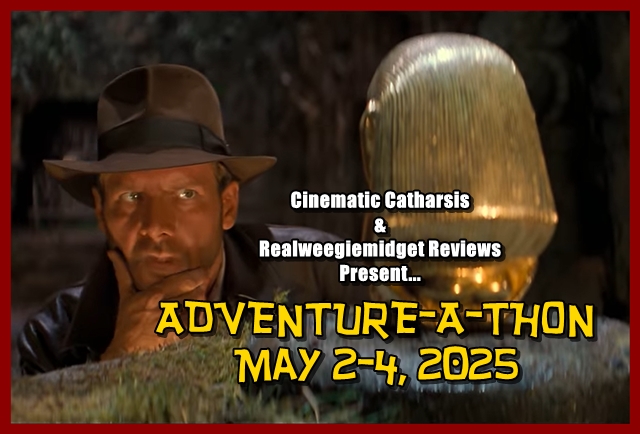
Announcing the Adventure-a-Thon!


Adventure-a-Thon Banner - Indiana Jones

Put on your safari hat and fasten your seatbelts, because Yours Truly and Gill from Realweegiemidget Reviews are about to take you on an Adventure-a-Thon! What exactly is an Adventure-a-thon, and how can you take part in all the fun? Read on, dear friends…

Big Trouble in Little China

The Adventure-a-Thon is a three-day (plus) celebration of the somewhat all-inclusive term, “Adventure.” Whether you’re traversing the Sahara, discovering ancient artifacts, or exploring the ocean’s depths, adventure is where you find it. For the purpose of this blogathon, we’re using IMDB’s definition. As a result, any film or television show that carries the “Adventure” label on the IMDB website (almost 52,000 choices!) is fair game.

Start your search here:

Movies (including TV movies) 

TV (TV shows) 

The Descent

But wait… There’s more! In conjunction with the Adventure-a-Thon theme, one lucky blogathon participant will win [Redacted]. Watch for the Day 1 Update on May 2nd, for a complete list of contest rules. Please be aware: the contest is open to blogathon participants in the USA, Canada and Mexico only! 

What: The Adventure-a-Thon 

Who: Hosted by Yours Truly (Barry P.) and Gill Jacob 

Where: Cinematic Catharsis and Realweegiemidget Reviews 

When: May 2-4, 2025


The Hunt for Red October

How: Please read the rules below, and send me your post request (review, podcast, etc…) via email (barry_cinematic@yahoo.com), BlueSky (@barrycinematic.bsky.social), Twitter/X (@barry_cinematic), Instagram (barry_cinematic), or by commenting below. You may also contact Gill by commenting on her post, or through her blog’s Contact Me page (Be sure to include a link to your blog, your blog’s title, and your preferred name). 

The Epic of Everest


The Rules… 

  1. You may review ANY film or TV show classified as “Adventure” on the IMDB website (see above for further details).
  2. Due to the large number of potential titles (nearly 52,000) for this topic, NO DUPLICATE MOVIE OR TV SHOW TITLES WILL BE ALLOWED. If a specific title has already been claimed, you may only include that title if it’s part of a list or retrospective review.
  3. Review choices may be requested as a comment on this page or you may contact me or Gill through the methods listed above.
  4. Add your BlueSky, Twitter/X or Instagram username so I can promote your post.
  5. A full list of blogs and review choices will be posted on a separate page (hosted by Gill), and updated regularly.
  6. Only original, never-before-published posts will be accepted.
  7. Limit TWO blog posts per participant, please.
  8. Please choose one of the banners below to display on your blog.
  9. Since Gill and I reside in two completely different time zones, please send a link of your post(s) to me and Gill on one of the days of the blogathon. Note: We will be publishing all links on both blogs, but due to the substantial time difference, your post might show up on a different day.
  10. The contest hosted by Barry is only open to blogathon participants in the USA, Canada or Mexico. If you wish to be considered for Barry’s contest, be sure to watch for the complete contest rules, which will be posted on the first day of the blogathon.
  11. Please also note: Gill and I have already claimed the following titles below: 

Gill at Realweegiemidget Reviews – Half a Chance (aka: 1 Chance Sur 2) (1998) 

Barry at Cinematic Catharsis – Sorcerer (1977)


Adventure-a-Thon Banner - The African Queen

Adventure-a-Thon Banner - The Rocketeer

Adventure-a-Thon Banner - Raiders of the Lost Ark

Adventure-a-Thon Banner - Prey


Saturday, March 1, 2025

“Attack of the…” Month Quick Picks and Pans


Attack the Gas Station Poster

Attack the Gas Station (1999) A group of aimless Korean youths hold up a gas station for kicks, taking the employees hostage. They get more than they bargained for, however, when they inadvertently escalate a gang war. Attack the Gas Station approaches its subject with sly humor and unexpected depth, delving into the histories of the disenchanted anti-heroes. Fasten your seatbelts, and get ready for some anarchic fun. 

Rating: ***½. Available on DVD 

Attack of the Beast Creatures Poster

Attack of the Beast Creatures (1985) What do you do when you set out to make your own monster movie, but the estimate to have the monsters fabricated costs far more than the entire budget? You make your own. The results are (ahem)… well, they tried. The survivors of a doomed ocean liner in the North Atlantic, circa May 1920, end up on a seemingly uninhabited island. They soon discover deadly acid pools and a bunch of vicious little red humanoid creatures with glowing eyes and sharp teeth. Soon, they have to fight their way through a hostile forest to get back to the lifeboat. Director Michael Stanley’s no-budget made-in-Connecticut wonder is nothing, if not ambitious. It’s not good, but never fails to entertain, with bad acting, laughable effects, and unintentional humor. 

Rating: ***. Available on Blu-ray 

Gyo: Tokyo Fish Attack Poster

Gyo: Tokyo Fish Attack (2012) Takayuki Hirao’s anime adaptation of Junji Ito’s bleak manga Gyo cuts many corners, blending cell art with less effective computer-generated animation. While it’s not the best Ito adaptation, it’s far from the worst. A young woman on vacation with her friends, falls into a nightmare situation when they’re overrun by foul-smelling sea creatures with mechanical legs. She returns to an apocalyptic version of Tokyo on a quest to find her boyfriend. Gyo tries to be more “adult” with excessive fan service, which detracts from the plot. Nevertheless, the horror of Ito’s original story shines through, as humanity, paying for the sins of the fathers, is brought to the brink of extinction. 

Rating: ***. Available on DVD 

Attack of the Robots

Attack of the Robots (1966) This somewhat deceptively titled spy spoof from director Jesús Franco is surprisingly competent, if a bit generic. Eddie Constantine (Alphaville) stars as retired Interpol agent Al Pereira, who’s enlisted to foil a plot to turn people into zombie assassins (controlled by a pair of special horn-rimmed glasses). Sophie Hardy provides some sizzle as Pereira’s Interpol counterpart, Cynthia Lewis, but there’s little chemistry between the two leads. There’s also some uncomfortable “Chinese” stereotypes portrayed by Spanish actor Vicente Roca as counter-spy, Lee-Wee. Look for Franco in a cameo as a nightclub pianist.   

Rating: **½. Available on Blu-ray, DVD and Tubi 

Attack of the Giant Teacher Poster

Attack of the Giant Teacher (2019) Kenzo Miyazawa (Makoto Kojima) is a night school teacher at a career crossroads, lacking energy or enthusiasm for his job. When he learns that the school is being closed down at the end of the year, he encourages his confused students to plan one final event: an Edo-period musical. Oh, and there just happens to be an insatiably hungry alien who wants to put Earth’s residents on its dinner plate. Attack of the Giant Teacher features some surprisingly colorful characters. Unfortunately, its reach far exceeds its grasp, with dreadful CGI effects and the giant teacher vs. kaiju action implied by the title doesn’t occur until the final five minutes. It probably would have been better to scrap the tokusatsu plot in favor of focusing on the dynamic of teacher and students alone, but the film has its moments. 

Rating: **½. Available on Blu-ray, DVD and Tubi

Ski Troop Attack Poster

Ski Troop Attack (1960) Filmed in South Dakota with most of the same cast and crew as Beast from Haunted Cave (1959), Roger Corman’s cut-rate World War II “epic” runs just over an hour (including a heap of stock footage). A small ragtag bunch of American soldiers led by the gung-ho Lt. Factor (Michael Forest) attempt to destroy a bridge, deep inside enemy territory. It’s pretty standard stuff, down to the soldier who can’t wait to get back home (Guess what happens to him?). For Corman completists only. 

Rating: **. Available on Blu-ray, DVD and Tubi

Attack of the Killer Refrigerator 

Attack of the Killer Refrigerator (1990) Shot on VHS for what looks like $50 (folks, this isn’t the movie to showcase your 4K TV), this horror spoof takes place during the course of one evening in a suburban house. After partying young people scrape the ice out of a refrigerator, the (wounded?) kitchen appliance is out for revenge, picking off the residents and guests one by one – and that’s about it. The short film only runs 16 minutes, so you don’t have much time to be bored. 

Rating: *½. Available on Blu-ray