Saturday, February 24, 2024

Guru, the Mad Monk


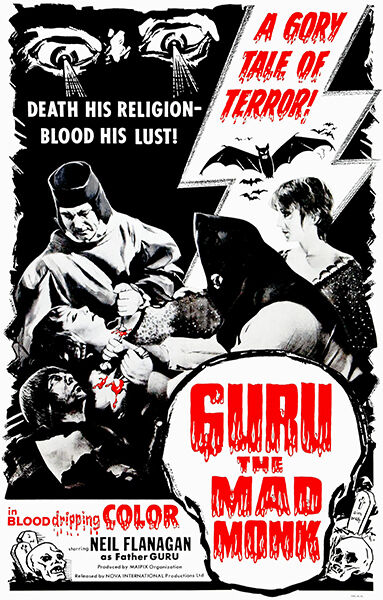
Guru the Mad Monk Poster

(1970) Written and directed by Andy Milligan; Starring: Neil Flanagan, Jaqueline Webb, Judith Israel, Paul Lieber, Jack Spencer, Frank Echols and Gerald Jacuzzo; Available on Blu-ray and DVD 

Rating: **½ 

“Talk comes cheap, my boy, and I’ve learned not to gamble on people’s words. I can’t afford to. I have learned in this mortal life of ours that it is each man for himself. I preach that God takes care of those who believe in him, but I’ve discovered that all my years of believing haven’t helped me one bit. Mother Church sends me little money to exist on, and even then, it doesn’t arrive when it’s supposed to, so I preach one thing and continue believing another. Self-survival. You would be well to remember this.” – Father Guru (Neil Flanagan)

Guru Sentences Nadja

A gargantuan thanks to Rebecca from Taking Up Room for hosting the latest edition of the So Bad It’s Good Blogathon, a continuing celebration of the best of the worst. Today’s offering is a piquant little number by the notorious filmmaker Andy Milligan, Guru, the Mad Monk. I would be remiss if I didn’t give thanks to author/blogger John Harmon for introducing me to the dubious charms of Milligan’s handiwork. Be sure to visit his blog, Tales from the Freakboyzone for articles about Milligan, and much, much more…

Guru, Nadja, Igor and Carl

The late great Andy Milligan’s ambition arguably outweighed his talent by a substantial margin, yet his films have more heart and craft than the generic big-budget prefabricated blockbusters typically churned out by the Hollywood studios. Milligan didn’t know the meaning of staying in his lane, given his limited means, creating costume period pieces for what would seem like pocket change to the typical Hollywood producer. Set in Eastern Europe presumably during the Middle Ages, Guru, the Mad Monk was his most cinematic to date (his first to be shot on 35 mm film), but don’t let that fool you – Cleopatra this isn’t. Guru was budgeted at an estimated $11,000* and in typical Milligan fashion, shot over six days. An old Manhattan church* provided a quasi-Old-World look (get used to it, since the church and its grounds are basically the only setting). The sound of waves crashing and seagulls screeching lead us to believe it’s on the remote island enclave of Mortavia (don’t bother looking it up). 

* Fun Fact #1: This was one of the few offerings by Milligan’s short-lived production company, Nova International Pictures (created in an effort to control his film distribution). 

** Fun Fact #2: According to Cinefear.com founder Keith Crocker, the ever-hot-headed filmmaker was known for entering theaters that held unauthorized screenings of his films, and stealing back the prints. 

*** Fun Fact #3: St. Peter’s Episcopal Church was built in 1831, while the wrought iron fence surrounding the structure dates back to 1790.

Carl Makes a Pact with Guru

Hungry for power and money, the corrupt Father Guru (Neil Flanagan), with the aid of his vampire companion Olga (played by Flanagan’s real-life spouse, Jaqueline Webb) and faithful hunchbacked assistant Igor (Jack Spencer), looks for ways to bring more revenue to his church. He finds the perfect opportunity in Nadja (Judith Israel), a young woman imprisoned for a murder she didn’t commit. Her lover Carl (Paul Lieber) implores Guru to spare her life. In turn he’s employed by the holy man to acquire bodies for medical experimentation, which can be sold for cash (Carl’s ventures away from the church economically occur off-screen). Guru’s plans are sidetracked, however, when Igor falls for Nadja. His position as de facto ruler of Mortavia is further threatened when Bishop Kopel (Frank Echols) pays him a visit, along with his intended replacement, Father Polanski (Gerald Jacuzzo).
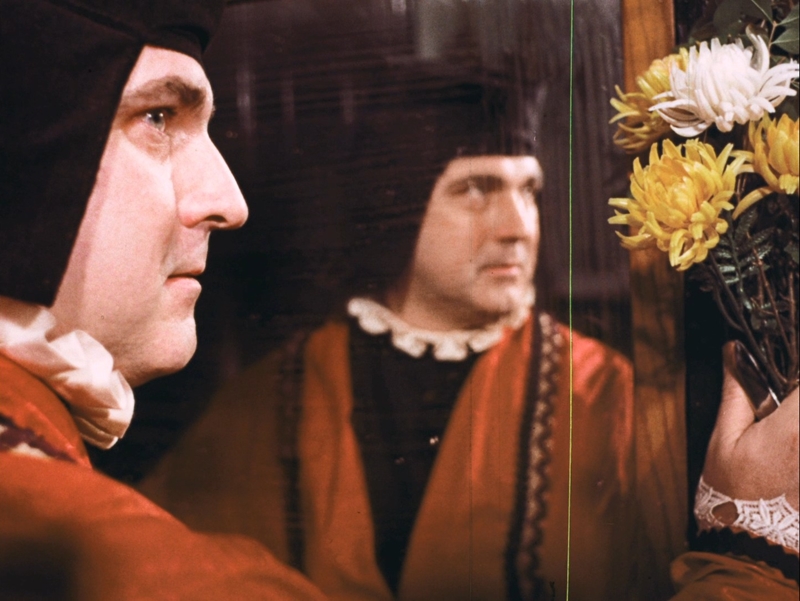
Guru's Mirror Scene

Milligan regular Neil Flanagan chews the scenery with his tour de force (or should I say, “tour de farce?”) performance as the title character. Guru’s contradictory behavior becomes a mouthpiece for Milligan’s deep-seated cynicism about organized religion and authority figures in general. In a scene that must be experienced to be believed, he argues with himself in the mirror, revealing the conflicted sides of his psyche (predating Andy Serkis’ motion capture performance as Gollum by 30 years). Every time he’s on screen, you know it’s going to be interesting. One of the few performers in the film with genuine talent, Flanagan was the secret weapon in Milligan’s troupe, having worked extensively in theatre, film, and television.

Igor and Guru

Flanagan aside, Milligan often rounded out his cast with non-actors pulled off the street, friends, lovers, and otherwise (hence, the varying quality of the performances). Paul Lieber,* who plays our hero Carl, recites his dialogue as if he’s reading the fine print in a non-disclosure agreement (calling him wooden is an insult to trees). On the other end of spectrum, Jack Spencer hogs the spotlight as Igor, grinning and hopping around like an overeager puppy, despite Guru’s constant barrage of insults and browbeating (“I can say anything to you, you ignorant bastard, and you just smile”). Jaqueline Web hams it up as Guru’s partner in crime, Olga, feeding off the blood of the executed. 

* Fun Fact #4: With 68 acting credits to date, one can only assume he’s gotten much better.

Look Ma, No Hands!

Guru’s not-so-special makeup effects, depicting the numerous tortures of condemned prisoners, would be gruesome if they weren’t so unconvincing. In one scene, a condemned man’s eyes (resembling hors d'oeuvres at a cocktail party) are gouged out, and a thief’s “hands,” which appear to have been pilfered from a department store mannequin, wobble before they’re chopped off. As stagey and cartoonish as the effects were, one crude decapitation scene was reportedly enough to make someone in the audience throw up.

Father Guru and Bishop Kopel

A highlight (or lowlight, depending on your point of view) of a Milligan production are the slapdash costumes,* created by Milligan himself. Guru’s costumes never disappoint, evoking a bygone, albeit indistinct, era. Witness scraps of furniture upholstery, curtains, and other assorted bits and pieces, held together with nothing more than pins and repurposed to vaguely resemble something from the medieval period, more or less. Meticulously researched adherence to period accuracy took a backseat to the practical requirement of having enough material to cover the cast’s derrieres. Another Milligan trademark on display was the copious amount of cloth draped over the walls of the cathedral to conceal modern fixtures. 

* Fun Fact #5: Frank Echols, who played Bishop Kopel, Guru’s superior, commented on his outfit: “Andy, I look like an old hooker off 8th Avenue.”

Nadja and Carl

Milligan claimed Guru was his worst film,* but don’t let that dissuade you (like most artists, he probably wasn’t the best judge of his own work). While it’s certainly uneven, Guru, the Mad Monk is among his most fun movies. Amidst the goofiness, there are some serious things to say, although considering Milligan’s fickle nature, you’re best advised to take any “messages” with a grain of salt. Working with budgets that would make 1940s Poverty Row productions look lavish by comparison, Milligan did a lot with virtually nothing. Perhaps that’s why his movies resemble something out of another time and place (or maybe another dimension). I would say Milligan’s films are an acquired taste, but I don’t think there’s a way to properly immunize yourself – you just have to dive in head-first. Either they click or they don’t. Lower your expectations, then lower them a few notches down from there, and you might have a good time (don’t expect Martin Scorsese or even H.G. Lewis levels of competence). Does it entertain? Yes, it does. Is it for everyone? Definitely not, but if you’re the kind of person that appreciates Milligan’s special brand of je ne sais quoi, you’re in for a treat. 

* Fun Fact #6: Editing the film was apparently a nightmare for Milligan, in no small part, due to the fact that sound and picture were recorded separately, and frequently out of synch.  


Sources for this article: The Ghastly One – The 42nd Street Netherworld of Director Andy Milligan, by Jimmy McDonough; Severin Blu-ray commentary by Keith Crocker; “Remembering Andy Milligan” featurette with Tom Vozza


Monday, February 5, 2024

Announcing the Mismatched Couples Blogathon


The Mismatched Couples Blogathon - The Shape of Water

Opposites attract, so the saying goes, but perhaps it should be “opposites distract.” Whichever way you look at it, we love to see synergy between two characters, but we enjoy it even more when there’s friction. With this in mind, Yours Truly and Gill Jacob from Realweegiemidget Reviews have conspired to bring you the Mismatched Couples Blogathon, a three-day (plus) exploration of less-than-ideal character pairings.

Little Shop of Horrors - Seymour and Audrey

There are countless examples of mismatched couples in cinema and TV, from buddy cop stories, to adventures, to romcoms, and everything in between. For the purposes of this blogathon, the “couple” can be romantic or non-romantic, as long as the relationship between the two characters is a key plot point. Here are just a few suggestions: 

·       The Odd Couple (1968) (The 1970-1975 TV version is perfectly acceptable too!)

·       Star Wars: A New Hope (1977) (Han and Leia or C3PO and R2D2)

·       The Princess Bride (1987) (Westley and Buttercup)

·       Moonraker (1979) (Jaws and Dolly)

·       The Adventures of Priscilla, Queen of the Desert (1994) (Tick and Marion)

·       Die Hard (1988) (John and Holly McClane)

·       It Happened One Night (1934) (Peter and Ellie)

·       Sometimes Aunt Martha Does Dreadful Things (1971) (Paul and Stanley)

·       The Fifth Element (1997) (Korben Dallas and Leeloo or Korben Dallas and Ruby Rhod)


Godzilla and Jet Jaguar

What: The Mismatched Couples Blogathon 

Who: Hosted by Yours Truly (Barry P.) and Gill Jacob 

Where: Cinematic Catharsis and Realweegiemidget Reviews 

When: March 29-31, 2024 

How: Please read the rules below, and send me your post request (review, podcast, etc…) via email (barry_cinematic@yahoo.com), Twitter (@barry_cinematic), Instagram (barry_cinematic), or by commenting below. You may also contact Gill by commenting on her post, or through her blog’s Contact Me page (Be sure to include a link to your blog, your blog’s title, and your preferred name).

 Important Note: Barry will be away from February 10th – 15th, and Gill will be away from February 29th – March 13th. As a result, please be sure to contact us both with your choices, to ensure that we don’t miss them. (See Rule #2) 

King Kong and Ann Darrow
 

THE RULES… 

1.     You may review ANY film or TV show related to the subject, with the exception of biopics. Book reviews are fine, as well. However, please restrict your choice ON-SCREEN couples (no tabloid or gossip material).

2.     To ensure that your blogathon choice is recorded in a timely manner, be sure to send all requests to Barry and Gill.

3.     We will not allow duplicate pairings, UNLESS you are covering a series of films or a retrospective of an actor/filmmaker’s work.

4.     A maximum of TWO entries will be permitted.

5.     When responding with your choice, be sure to add your Twitter/Instagram/Mastodon/Bluesky handle or a link to your Facebook page so we can promote your post.

6.     Please choose one of the banners below to display on your blog.

7.     A full list of blogs, podcasters and review choices will be posted on a separate page and updated regularly.

8.     Only original, never-before-published posts will be accepted.

9.     Send a link to your post/podcast/video to Gill and me during one of the days of the blogathon.

10.  Note: we will publish all the links on both blogs, with daily updates on March 29th, 30th and 31st. If you plan to participate, but you’re running late, please let us know as soon as possible, so we can post a last-minute update.

11.  Please also note: Gill and I have already claimed the following the titles below, so they are off the table, unless they’re included in a larger retrospective (see Rule 2 above).


Barry at Cinematic Catharsis – Pink Flamingos (1972)


Gill at Realweegiemidget Reviews – Kuolleet Lehdet (aka: Fallen Leaves) (2023)


Oh, and one more thing… Remember to grab a banner below and have fun!


Mismatched Couples Blogathon - The Odd Couple


Mismatched Couples Banner - Indiana Jones and Willy

Mismatched Couples Blogathon - C3PO and R2D2


Mismatched Couples Blogathon - The Shape of Water


The Mismatched Couples Blogathon - Polyester 


Wednesday, January 31, 2024

Japan-uary XIII Quick Picks and Pans


Howl from Beyond the Fog Poster

Howl from Beyond the Fog (2019) In this 35-minute short film from writer/director Daisuke Sato (effects crew, Godzilla: Final Wars, The Great Yokai War), set in the late 19th century, a village lake is guarded by a legendary creature. When a young blind woman and her family are threatened by greedy land developers, the fearsome kaiju (which is also blind) becomes her only salvation. The enchanting tale is depicted through puppetry, subdued light and acute camera angles to depict a monster of vast scale. Sato’s less-is-more approach creates a unique visual experience. My only quibble is that I wish the film were longer, leading me to hope the filmmaker makes a full-length feature someday. 

Special thanks to the late Twitter user Freddie Premo (RIP) for recommending this to me a couple of years ago. 

Rating: ****. Available on Blu-ray, DVD, Prime Video and Tubi


The Secret of the Telegian Poster

The Secret of the Telegian (aka: Densô ningen) (1960) In this sci-fi movie with noir overtones, a group of businessmen are being murdered one-by-one, while the assailant is nowhere to be found. Clues point to a former soldier who vowed revenge against the officers who smuggled gold in the waning days of World War II. With the help of a disabled scientist who developed a device to transport matter, he methodically carries out his plan to murder the wealthy profiteers. Jun Fukuda’s second directorial effort is well-paced and suitably creepy (thanks to some impressive effects by Eiji Tsuburaya). It’s a shame The Secret of the Telegian remains largely unknown outside of Japan (it never received a theatrical release in the U.S.), so it’s long overdue for re-discovery.   

Rating: ***½. Available on DVD (Region 2)


Bakemono Poster

Bakemono (2023) A demonic creature, spurred on by a bitter middle-aged man (Takashi Irie) who made a pact with it, feeds off suppressed rage. Writer/director Doug Roos’ non-linear film, featuring a diverse Japanese/international cast, follows several guests over the course of a few nights, in a sketchy Tokyo Airbnb.The monster (or “bakemono” in Japanese) lurks in the shadows, pitting individuals against each other (and themselves). The delightfully icky practical effects (also by Roos) recall the work of Rob Bottin on The Thing. It’s a disconcerting, unnerving experience that requires your full attention, but well worth the time. Watch out for it. 

Rating: ***½. Available: Blu-ray (through Indiegogo), but watch for it elsewhere soon!

The Idol Poster

The iDol (2006) Ken (Jin Sasaki), a 20-something otaku who obsessively collects vintage space-age memorabilia, acquires a bright green action figure, which possesses hidden powers. In the span of a day, the fickle plastic toy arranges a dream date with his favorite celebrity, only to have him lose all his worldly possessions several hours later. Director/co-writer Norman England’s Twilight Zone-esque premise works well within the confines of the short film, although it would have been nice to see this expanded into a longer feature. 

Rating: ***½. Available on Tubi 

Sailor Suit and Machine Gun Poster

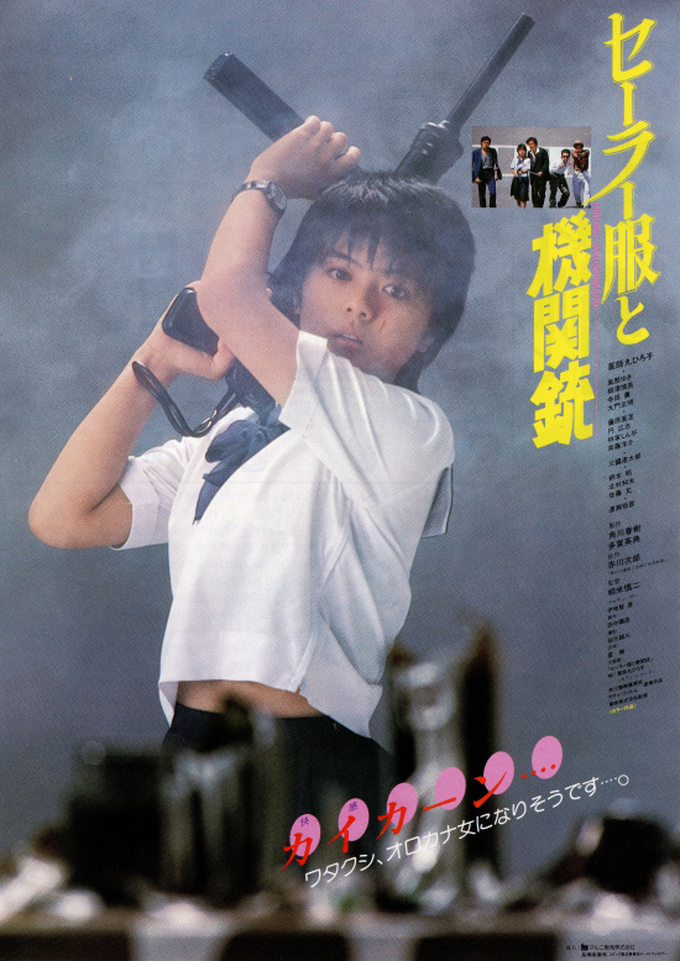
Sailor Suit and Machine Gun (1981) After her father’s sudden death, high school student Izumi Hoshi (Hiroko Yakushimaru) reluctantly becomes his successor as chairman of a small yakuza clan. As rival gangs close in to destroy them, she inadvertently discovers she has a knack for this kind of thing. Not your typical yakuza movie, Shinji Sômai’s sophomore effort is a winning combination of crime drama with social farce. 

Rating: ***½. Available on Blu-ray and Midnight Pulp


The Bullet Train Poster

The Bullet Train (1975) Jun'ya Satô’s tense disaster thriller borrows a page from Airport (1970), starring Shin'ichi (“Sonny”) Chiba in the George Kennedy role, as Aoki, a determined rail employee. In the film’s premise (which, in turn, influenced the 1994 movie Speed), a bullet train carrying 1,500 passengers faces the grim prospect of exploding if it drops below 80 kph. Officials feverishly endeavor to find a way to locate and deactivate the bomb. At two-and-a-half hours, The Bullet Train is a bit overlong, but on the other hand, it devotes a commendable amount of screen time to establishing the bomber (Ken Takakura) and his co-conspirators as sympathetic, three-dimensional characters with believable motivations. 

Rating: ***½. Available on Blu-ray, DVD and Tubi


House of Terrors Poster

House of Terrors (1965) After her husband dies in a psychiatric hospital, a grieving widow discovers that she’s inherited a villa he secretly purchased. A stipulation of his will contends that she must share the property with his ethically ambiguous father (who was also his doctor at the time of his death). Most of the film, which recalls Italian gothic horror films of the period, takes place in a spooky old mansion with a creepy hunchbacked caretaker (Kō Nishimura). Although House of Terrors (aka: The Ghost of the Hunchback) borders on being a bit too derivative for its own good, it’s well worth a look for the gloomy atmosphere and pervasive eerie mood. 

Rating: ***. Available on Blu-ray 

Ghostroads - A Japanese Rock n Roll Ghost Story

Ghostroads: A Japanese Rock ‘n Roll Ghost Story (2017) Manabe Takashi stars as the leader of a mediocre retro rock band. He has a sudden burst of inspiration when he encounters the ghost of a blues musician in an old, battered amp, but soon learns that inspiration doesn’t come free. Faced with a Faustian bargain, he must choose between fame and his bandmates. Ghostroads features some fun music and unexpected cameos (watch for L.A. alternative music radio figurehead Rodney Bingenheimer), but Darrell Harris doesn’t really convince as a blues legend, and it misfires as a comedy. At a sparse 77 minutes, however, it won’t wear out its welcome… much. 

Rating: **½. Available on DVD (Region 2) and Tubi 

Cube Poster

Cube (2021) Yasuhiko Shimizu’s remake of Vincenzo Natali’s mind-bending 1997 original about a group of strangers trapped in a vast multiroom structure adds a couple of interesting wrinkles to the original story, but otherwise doesn’t have anything new to say. Even the new booby traps seem uninspired. The characters are underdeveloped, and the drama over who lives and who dies seems more perfunctory than suspenseful. With no one to root for and few surprises, what was once novel is now repetitive and tedious. 

Rating: **. Available on Prime Video, Kanopy and Tubi 


Monday, January 22, 2024

The Bold and Bizarre World of Cinematic Yokai


The Great Monster War - Assorted Yokai

I love yokai! There, I said it. Ever since I was introduced to these fanciful and frightening beings in all their cinematic glory, I can’t get enough of the things that go bump in the night. But what exactly are yokai? These reclusive, elusive creatures belong to a broad category of mythical spirits (or monsters) that inhabit every corner of the Japanese countryside (and in some urban areas). Part cryptid, part urban legend, yokai are an integral component of Japanese folklore and pop culture. Chances are, if you’ve watched many Japanese movies, anime, or manga, you’ve seen yokai (sometimes translated as spirits, monsters, demons, or goblins) already in one form or another. But what are they?

Gashadokuro

There are literally hundreds of yokai, as diverse as the habitats they represent. Their temperament ranges from harmless to deadly. Many are tricksters who only want to frighten people away, but encounters with some can result in a nasty end. While the variety of yokai are far too numerous to cover here, I’ve chosen to focus on a baker’s dozen of the more popular examples that you’re most likely to encounter on your TV screen. What follows is a brief guide to yokai in the movies and where you can view them. Happy hunting! 

Kappa

Kappa (Water Sprite) 

By far one of the most widely known (and frequently depicted) yokai are kappa. While there are several variations, the stereotypical kappa is humanoid in appearance, but with a turtle’s beak and shell, as well as a ceramic plate on top of its head that must remain wet to maintain its vitality. Kappa are characterized by their fondness for sumo wrestling, eating cucumbers (Sushi fans might recognize the “kappa roll,” which includes – you guessed it.), and excessive flatulence. Although they’re generally depicted as benign, they have a mischievous streak, with a tendency to drag people into the waterways where they live. Some are also thought to attack the posterior of swimmers for a mythical organ within the colon. 

Where can you see them?

You don’t have to look very hard to find kappa in Japanese fantasy films. They’re featured prominently in Yokai Monsters: Spook Warfare (aka: The Great Yokai War) (1968) and Takashi Miike’s remake, The Great Yokai War (2005). In Summer Days with Coo (2007), they’re the star attraction. And before The Shape of Water (2017) introduced us to the possibility of (ahem) human-monster relations, the surprisingly charming Underwater Love (2011) featured the yokai in quite possibly the only Kappa-themed pinku musical. And last but definitely least, an “ordinary” kappa grows to extraordinary proportions in the middling Kaijū eiga-spoof, Death Kappa (2010).

Onibaba

Onibaba (Demon Hag) 

This is one yokai you don’t want to mess with. Appearing as an old woman, the Onibaba feasts on the livers of unborn children and the flesh of wayward travelers. Legend has it that she started out as a human being, but unfortunate circumstances forced her into existence as a supernatural entity.    

Where can you see them?

Look no further than Onibaba (1964), which approaches the legendary yokai from a more pragmatic perspective.

Nopperabo

Nopperabo (No-face) 

Perhaps the uncanniest yokai of them all are the Nopperabo, proving that when it comes to frights, less is sometimes more. They look normal enough until they turn around, revealing a face completely devoid of features (“Did they look like this?”). They’re not inherently dangerous like the Onibaba, but delight in creeping out unsuspecting humans who happen to cross their path. 

Where can you see them? 

Examples of these faceless wonders can be found in Along with Ghosts (1969) and Pom Poko (1994). 

Kara-kasa

Kara-kasa (Haunted Umbrella) 

My personal favorite yokai isn’t dangerous or especially fearsome, but relies on the element of surprise. A discarded oiled-paper umbrella takes on life of its own, sporting one large eye, a single shapely leg where the handle should be, and a solitary sandal. A natural-born trickster, the Kara-kasa likes to drop in on people unexpectedly. If their appearance isn’t enough to send someone running, they might provide additional enticement to vacate the premises with a sloppy lick from their serpentine tongue. 

Where can you see them? 

You’ll find examples of the kara-kasa in Yokai Monsters: Spook Warfare (1968) and 100 Monsters (1968). Also, watch for cameos in Pom Poko (1994) and Sakuya: Slayer of Demons (2000).

Rokurokubi

Rokurokubi (Long-necked Woman) 

At first glance, the Rokurokubi appear to be a normal human being (much like the nopperabo), but just when you’re lulled into a false sense of security, their true nature appears. The rokurokubi (who are uniformly female) enjoy scaring men out of their wits (and sometimes their life essence) with their absurdly long, twisty necks. 

Where can you see them? 

Rokurokubi are nearly as prevalent in films as kappa, appearing in Yokai Monsters: Spook Warfare (1968), 100 Monsters, The Great Yokai War (2005), and (briefly) in Pom Poko (1994).


Yuki-Onna

Yuki-Onna (Snow Woman) 

One of the more dangerous yokai, the Yuki-Onna resembles an attractive woman with an extremely pale complexion. They roam the snowy countryside looking for victims. Anyone unlucky enough to encounter them runs the risk of having his or her life energy drained and freezing to death.  

Where can you see them? 

The Yuki-Onna enjoyed her time in spotlight in a segment of Kwaidan (1964), and starred in her own film, The Snow Woman (1968). She also makes a guest appearance in The Great Yokai War (2005).

Kuchisake-Onna

Kuchisake-Onna (Slit-Mouthed Woman) 

One of the more recent yokai, Kuchisake Onna is the stuff of urban legend (and nightmares). Pray you never run into her. The lower portion of her face is concealed by a surgical mask or other piece of cloth, which conceals the fact that her mouth is slit from ear to ear in the hideous approximation of a smile. There’s no correct answer to her challenge, “Am I pretty?” If you answer “yes,” she follows you home, where a violent death awaits. If the answer is “no,” she reveals her visage, slashing the victim’s face in a grotesque mimicry of her disfigurement. 

Where can you see them? 

Perhaps not the best representation of the Kuchisake Onna, but Carved: The Slit-Mouthed Woman (2007) has its unsettling moments. 

Tanuki

Tanuki (Raccoon Dog) 

Unlike the other yokai on this list, Tanuki have real-life counterparts, inhabiting the Japanese countryside, albeit in dwindling numbers. Not really raccoons, but a member of the canine family, folklore suggests these critters possess supernatural properties. With their reputation as natural-born tricksters, Tanuki enjoy deceiving humans with their shape-shifting abilities. They’re also known for their enormous testicles (I didn’t make that up), as depicted by the ubiquitous statuettes around their native country. 

Where can you see them? 

Look no further than the bittersweet Pom Poko (1994), an entire movie devoted to the wily, fun-loving creatures, who wage a losing war with humans encroaching on their habitat.

Nuppeppo

Nuppeppo 

While they’re not exactly the rock stars of the yokai world, Nuppeppo (which is also Japanese slang for someone who wears too much makeup), you don’t have to look too hard to find them in the cinematic world (the real world is another story). These bipedal creatures are vaguely human in shape, but resemble a squat, featureless blob with legs, with a tendency to wander around abandoned places and graveyards. 

Where can you see them? 

You can find an example of the Nuppeppo in Yokai Monsters: Spook Warfare (1968) and 100 Monsters (1968).

Tengu

Tengu (Mountain Goblin) 

Tengu are supernatural mountain spirits that resemble men with wings and long noses. As with many yokai, there are many variations. They’re ambiguous in nature, however, as portrayed in film, they’re generally benevolent and monk-like. 

Where can you see them? 

One appears in The Great Monster War (2005), although with a blue complexion (rather than red).

Wanyudo

Wanyudo (Wheel Priest) 

The Wanyudo makes it presence known in spectacular fashion: as a fiery spinning wagon wheel with the face of a priest in the middle. This yokai has a vengeful streak, ready to run over whomever is foolish enough to get in their way. The Wanyudo dines on the souls of its unfortunate victims, subsequently dragging their bodies to hell. Villagers protect themselves against the Wanyudo by adorning their doors with a talisman. 

Where can you see them? 

You can catch a glimpse of the Wanyudo in The Great Yokai War (2005), and briefly in Pom Poko (1994).


Abura Sumashi

 Abura Sumashi (Oil Presser) 

This unassuming yokai is short, with a huge, boulder-like head, and dressed in a straw raincoat. Not much is known about the Abura Sumashi, however, their distinctive appearance is attributed to a curse for stealing oil when they were still in human form. 

Where can you see them? 

An Abura Sumashi appears as the nominal leader of the yokai in Yokai Monsters: Spook Warfare (1968) and The Great Yokai War (2005).

Mokumokuren

Mokumokuren (Haunted Shoji Screen) 

While they’re among the least threatening of yokai, Mokumokuren’s harmless nature doesn’t diminish their ability to creep you out. Like some of their yokai brethren, Mokumokuren are a prime example of taking something inanimate and innocuous and turning it into something vaguely sinister. A prevalent aspect of traditional Japanese architecture is the sliding paper (shoji) screen. Now imagine said screen adorned with multiple pairs of eyes, and you’ve got a Mokumoku-ren. If you ever felt you were being watched when you were alone, this could be the culprit. 

Where can you see them? 

You can spot the offending décor in The Great Yokai War (2005) 


Sources for this article: Yokai Attack! The Japanese Monster Survival Guide, by Hiroko Yoda and Matt Alt; Strange Japanese Yokai, by Kenji Murakami; The Book of Yokai, by Michael Dylan Foster; The Night Parade of One Hundred Demons, by Matthew Meyer; Japandemonium Illustrated, The Yokai Encyclopedias of Toriyama Sekien


Sunday, January 7, 2024

Jigoku

Jigoku Poster

(1960) Directed by Nobuo Nakagawa; Written by Nobuo Nakagawa and Ichirô Miyagawa; Starring: Shigeru Amachi, Utako Mitsuya, Yôichi Numata, Hiroshi Hayashi, Jun Ôtomo, Akiko Yamashita, Kiyoko Tsuji, Fumiko Miyata and Akira Nakamura; Available on DVD 

Rating: ****

The King of Hell

“The Greek philosopher Carneades posed this question: There’s a plank, and two people are drowning. If one of them hangs on to the plank, the other will die. In such a situation, if the one with the plank gets rid of the one without, is that person guilty? That’s more or less the idea of ‘an act of necessity.’ Mr. Nakagawa (the film’s director) said it may not be guilt in a legal sense, but it is guilt.” – Ichirô Miyagawa (screenwriter) 

Cinema transports us to places we’ve never been, and sometimes where we’d never want to be. With Jigoku (the Japanese word for “hell.”), director/co-writer Nobuo Nakagawa takes us on a journey where few other films dare to tread. Nakagawa doesn’t merely suggest hell, or give us a brief glimpse of the horrors awaiting; a substantial portion of the film is devoted to taking the viewer into a Buddhist version of hell and its numerous torments.* While the major studios, such as Toho, probably wouldn’t touch this subject matter with a three-meter pole, Shintoho and producer Mitsugu Ôkura proved to be up to the task. Sort of the equivalent of the “Poverty Row” film companies of the ‘30s and ‘40s in the U.S., Shintoho was known for churning out films with more lurid content (often dealing with sex, crime, horror and pulpy science fiction). Sadly, Jigoku (aka: The Sinners of Hell) proved to be the short-lived studio’s swan song, but what a way to make an impact. 

* Fun Fact #1: Referring to producer Mitsugu Ôkura, screenwriter Ichirô Miyagawa commented: “…Mr. Ôkura called in Mr. Nakagawa, asking if he had any good projects in mind. Nakagawa said he’d like to shoot a film about bad people who should go to hell. Mr. Okura said, ‘All right. Make a film called Heaven and Hell.’ When we completed the script, Okura scolded us, saying heaven was nowhere to be seen. I dodged the issue by saying I would write about heaven in the sequel.” For the record, the sequel was never made. 

** Fun Fact #2: The film’s powerful imagery, depicting some of the many punishments awaiting sinners within the eight greater hells  was based, in part, on the 12th Century painting, Jigoku-zôshi (the “Hell Scroll”) and the 10th Century text, Ōjōyōshū by Buddhist monk Genshin.   

Tamura and Shirô

Shirô Shimizu (Shigeru Amachi) is a young graduate student, engaged to the daughter of one of his professors (Akira Nakamura). In the opening scene, he attends a lecture by said professor, discussing the Buddhist concept of hell, setting the stage for the rest of the film. One night, after riding home from his fiancée Yukiko’s (Utako Mitsuya) house he asks his friend Tamura (Yôichi Numata) to take a detour. Tamura hits a drunken yakuza (Hiroshi Izumida) who wandered into the road, but instead of stopping to help, drives away. The yakuza’s grief-stricken mother and girlfriend (Kiyoko Tsuji and Akiko Ono) vow revenge. Soon afterward, another tragedy befalls Shirô after he insists that his fiancée take a ride home in a taxi, only to witness her death in a traffic accident. But Shirô’s troubles are only beginning when he’s plagued by a cascade of calamities upon his return to his home town – all while being hounded by the enigmatic Tamura.

Tormented by Tamura

Virtually no one’s hands are clean in the punitive world of Jigoku. The movie’s Faustian figure, Tamura, appears again and again, not only to remind Shirô of his sins, but the trespasses of the other people in his life. Tamura, himself, is a contradiction – at once, a malevolent presence, as well as Shirô’s suppressed conscience. Whether Tamura exists as a distinct individual or only as a figment of Shirô’s conflicted mind, is never made clear. His purpose is to draw out everyone’s dark deeds into the light. Rather than a model of virtue, Yukiko’s father is reminded of his failings on the battlefield, when he deprived a fellow soldier of their last sip of water from a canteen. Like an angel of death, Tamura pops up in Shirô’s home town to witness his father’s neglectful treatment of retirement home residents, feeding them tainted fish and sake.   

One of the Damned

Jigoku was groundbreaking in its explicit depiction of Buddhist hell’s myriad torments, based on karmic retribution. The damned are doomed to a perpetual hell of their own making, where punishment is doled out, based on their respective crimes in life. The final third of the film is devoted to a cornucopia of agonies in a nightmare landscape: people wade through a lake of filth, eyes are gouged out, bodies are flayed, and the damned are buried up to their necks (or inverted with only their feet sticking out).* It’s a disconcerting experience, bathed in red and green light, and redolent of symbolism throughout. 

* Fun Fact #3: According to actor Yôichi Numata, the studio was so cash-strapped that the cast had to dig their own holes.

A Fiery Fate

Jigoku was a box office disappointment, partially on account of mixed reviews and never receiving the distribution it deserved (the film company Shintoho ran out of money by that point), but it’s hard to imagine this surreal excursion into the underworld connecting with mainstream audiences. Although it likely baffled or disgusted those who managed to see it, the movie eventually became a cult classic in its native Japan, and has become a fertile ground for other filmmakers, following in Nakagawa’s footsteps (witness José Mojica Marins’ 1967 movie, This Night I’ll Possess Your Corpse, with its color hell-sequence). Its core message is simple: even if you can escape prosecution by the authorities or the scrutiny of your peers, you can’t flee your tormented conscience. Your mind becomes your own portable version of hell. Jigoku isn’t the easiest film to watch, nor the most narratively cohesive, but what it lacks in coherence, it makes up with an abundance of unforgettable imagery which will remain tattooed on your visual cortex. 


Sources for this article: “Building the Inferno,” 2006 making-of documentary for the Criterion DVD, Asian Horror, by Andy Richards; Japanese Visual Cultures:The Buddhist Hells; eMuseum – Tokyo National Museum