Friday, June 1, 2018

Dr. Terror’s House of Horrors


(1965) Directed by Freddie Francis; Written by Milton Subotsky; Starring: Peter Cushing, Christopher Lee, Michael Gough, Neil McCallum, Bernard Lee, Donald Sutherland, Katy Wild and Roy Castle; Available on DVD.

Rating: ***½

Note: This is an expanded version of a capsule review, which originally appeared here.

“The tarot deck is a picture book of life, an answer to the deepest questions of philosophy and history, and sometimes a means of prediction.” – Dr. Schreck, aka: Dr. Terror (Peter Cushing)


I would be remiss if I didn’t thank my blogging partner in crime Gill Jacob from Realweegiemidget Reviews for: A) nudging me out of blogathon-hosting semi-retirement, and B) suggesting that we include Amicus in this blogathon. Thus, The Great Hammer-AmicusBlogathon was born, with a multi-blogger retrospective of two amazing film production companies. Be sure to check out all the great submissions over the next few days! Today, I’m focusing on a childhood favorite from the Amicus side.


Long before I knew who Peter Cushing or Christopher Lee were, or what an Amicus or Hammer film was, there was Dr. Terror’s House of Horrors. Memory is a notoriously unreliable thing, but I can attest that this film was one of the major catalysts that set me on the path to a lifelong love of the horror genre. At least from the muddy recesses of my childhood recollections, it seemed this movie was on heavy rotation during the ‘70s, and I would watch it whenever it was on TV. The scares seem tame by comparison to many modern horror flicks, but I can’t help regressing to my seven-year-old self. It’s a product of a different time when a more genteel form of horror was the thing, favoring atmosphere over gore. I’m not about to settle the debate of Amicus vs. Hammer – both are too close to my heart, and both scratch a different itch. While Hammer pushed the envelope of good taste, with heaving bosoms and Grand Guignol flourishes, Amicus forged ahead with its more mannered approach.


Producer Max J. Rosenberg and writer/Amicus partner Milton Subotsky filmed Dr. Terror’s House of Horrors for less than 100,000 pounds and the desire to beat Hammer Films at its own game. This was their first foray into the horror anthology* format, which would become their trademark. The film was directed by Freddie Francis, who was no stranger to Hammer, having previously directed Paranoiac (1963), The Evil of Frankenstein (1964).

* Fun Fact: According to an interview with Rosenberg, the British horror anthology film Dead of Night (1945) influenced him to create his own portmanteau movie (from Uneasy Dreams: The Golden Age of British Horrors Films, 1956-1976, by Gary A. Smith).


Five lone travelers board a cramped train compartment and are met by the enigmatic Dr. Schreck (the German word translates as “fright” or “terror”), played by the incomparable Peter Cushing. Dr. Schreck appears quiet and unassuming, but an aura of mystery and darkness surrounds him. He sports a satyr-like beard and prominent eyebrows, suggesting a vaguely Mephistophelian visage. As the passengers settle in for the long evening ride, he reveals (by accident or design?) a deck of tarot cards. The film’s title is explained when he refers to his tarot cards as a “house of horrors,” although Dr. Schreck’s Train of Terrors might have been a more apt title. It’s no surprise that Christopher Lee is the real standout as pompous art critic Franklyn Marsh, who doesn’t have time for what he considers to be nonsense and superstition. He views Dr. Schreck as nothing more than a snake oil salesman, telling bogus fortunes. Perhaps as a means to quell his insecurities, he begrudgingly acquiesces to have his fortune told.


It’s best not to judge Dr. Terror’s House of Horrors by the first and last segments, which are the least effective. The first story seems the most Hammer-like, with its gothic setting, old house and remote location, but its strength is also its weakness. An architect returns to his ancestral home to help the new owner with renovations, uncovering a dark secret about a centuries-old curse. It’s heavy on atmosphere, but the most inconsequential of the bunch. The filmmakers saved the most inconsequential story for last. In “Vampire,” Dr. Bob Carroll (a youthful Donald Sutherland) is an American family doctor who marries a pretty young French woman. They return to the States to start a new life together, but he soon discovers his new bride isn’t quite what she seems. We never see Dr. Carroll’s motivation to take the action that he does, leading to an unsatisfying climax. And even by 1965 standards, the underlying theme of vampires representing fear of outsiders is more than a wee bit stale. Even if the final segment is less than worthy, however, the conclusion to the framing story, with Dr. Schreck and his fellow travelers, brings the film to a satisfying, if inevitable, end.


The second and third tales, “Creeping Vine” and “Disembodied Hand,” which captured my imagination as an impressionable young child, fare much better. In “Creeping Vine,” an intelligent plant strangles everything in its path (you can guess what happens to the family dog). “Disembodied Hand” concerns the aforementioned critic Marsh (Lee), and his acerbic, mean-spirited attack on accomplished artist Eric Landor (Michael Gough). But when the tables are turned on Marsh, we learn he can dish it out, but he can’t take it. Marsh suffers a blow to his ego, pride gets in the way of reason, and in a fit of rage (well, in a customarily reserved British manner) hits Landor with his car. The artist’s severed hand soon seeks revenge. There are some unfortunate dodgy effects (today you could probably find a better fake hand at your local gag shop), but it’s not the point. “Disembodied Hand” is an excellent metaphor for the injurious effects of criticism on the artist, how it’s much easier to tear something down than to create.  


Another standout tale is, “Voodoo” a cautionary tale about the consequences of cultural appropriation. During a visit to the West Indies (which looks suspiciously like a soundstage), a jazz musician (Roy Castle) observes a secret voodoo ritual, and decides to write down the sacred music, much to the chagrin of the natives. When he returns to England to perform the music in a nightclub, he suffers dire consequences. The message is simple and simply told, but still worth heeding: sometimes it’s best not to tamper with things you don’t understand.


Your mind could probably go in endless circles about the tarot cards in the film. It’s established by Schreck that his fortunes represent possible futures, but the fifth card, which reveals their ability to change the future, suggests otherwise. The ending demonstrates that the five passengers’ fates were predestined, but if this is true, why the pretense of futures that could never occur? As a kid, I didn’t really think about this, and as an adult, I try not to ponder it too much – it’s too headache-inducing. Is it the best Amicus portmanteau film? Not by a long shot. It’s strictly middle of the pack by Amicus standards (my favorite portmanteau films were Tales from the Crypt and Asylum). It’s easy to fall back into the trap of childhood nostalgia, as parts of it don’t stand the test of time, but that’s selling it short. It’s still a worthy film, good for low-grade scares and a general creepy atmosphere, thanks in part to Mr. Cushing’s performance. It’s a worthy introduction to the world of Amicus horror anthologies, which reminds us of the beauty of the format – if you don’t like one story, another one’s just around the corner. Dr. Terror’s House of Horrors may not be Amicus’ “best” from a technical standpoint, but it remains a sentimental favorite; sort of the cinematic equivalent of comfort food that never fails to bring me back to a simpler time and place.


Monday, May 28, 2018

Musical May Quick Picks and Pans


Tommy (1975) Writer/director Ken Russell’s hallucinatory adaptation of The Who’s seminal rock opera engages your senses and intellect. Roger Daltrey plays the title character, a “deaf, dumb and blind kid” who “sure plays a mean pinball,” and becomes a latter-day messiah. After suffering the trauma of watching his father die before his eyes, young Tommy becomes closed off to any sensory input. Ann-Margret and Russell-regular Oliver Reed play Tommy’s mother and stepfather, who try in vain to bring Tommy back from his sensory-deprived state. Some standout sequences/songs are “Cousin Kevin,” with Paul Nicholas (played with sadistic glee), “The Acid Queen,” performed by Tina Turner, “Pinball Wizard” with Elton John (wearing impossibly enormous boots), and “Sally Simpson,” featuring Russell’s daughter Victoria. Watch for Jack Nicholson in a small role as a psychiatrist (yes, he sings, too).

Tommy was originally released in Quintaphonic sound (a forerunner of Dolby Digital and other multichannel formats), which was exclusive to the film, and re-created for the Blu-ray and DVD. The best way to watch this is to let the music and imagery flow. Don’t get hung up on deciphering the minutiae. Retro gaming enthusiasts take note: unfortunately, several pinball machines were harmed in the making of this film.

Rating: ****. Available on Blu-ray and DVD


The Umbrellas of Cherbourg (aka: Les Parapluies de Cherbourg) (1964) This endearing, melancholy musical from director Jacques Demy captures the ephemeral quality of young love. Catherine Deneuve is enchanting as 16-year-old Geneviève, who works in her mother’s run-down umbrella shop. She meets Guy (Nino Castelnuovo), an auto mechanic. He becomes the love of her life, but fate intervenes when he’s drafted into the army and sent to Algiers. While Guy is out of the picture, she captures the fancy of a wealthy benefactor. It might be heretical, but I opine it’s not the music that’s the main draw, but the gorgeous cinematography and art design. Each scene is immersed in a beautiful palette of colors, which skillfully complement the mood and characters. It’s a timeless story of joy and anguish, with a final scene that’s at once heartbreaking and life-affirming.  

Rating: ****. Available on Blu-ray and DVD


1776 (1972) Your high school history class was probably never as interesting as this witty musical, directed and written by Peter H. Hunt, and based on the 1969 stage production by Sherman Edwards. History buffs might take pause, but it’s a fine introduction to the arduous process that birthed the Declaration of Independence. The film boasts some wonderful performances, including William Daniels as a fiery John Adams (“I’m obnoxious and disliked”) and Howard Da Silva as a quick-tongued Benjamin Franklin. Watching the members of the Continental Congress hemming and hawing, bickering, and fraught with indecision and concessions, we’re reminded how little has changed when it comes to our elected representatives. On a side note, it’s amusing to observe when a “G” rating meant something quite different. It’s peppered with sexual innuendos that would likely fly over the heads of the kids in the audience, and we’re provided a unique explanation for Thomas Jefferson’s writer’s block. It might not replace that U.S. History class you slept through, but it’s a good launching point for discussion of the events that launched a revolution.

Rating: ****. Available on Blu-ray and DVD


The Lure (aka: Córki Dancing) (2015) This Polish mermaid musical marks the audacious feature film debut of director Agnieszka Smoczynska, blending ancient folklore with a modern soundtrack. Mermaid sisters Silver and Golden (Marta Mazurek and Michalina Olszanska) leave the water to explore life on land and get a taste for the human world. They become instant sensations at a strip club, but old habits die as their nature takes over. Golden lures men to their death, and devours them. Silver falls in love with Mietek (Jakub Gierszal), a young musician at the club, but there’s a catch (pardon the bad pun), which could mean her demise. The Lure is filled with energetic songs, visually engaging, and ultimately tragic. It’s also unlike any other musical I’ve seen, making Smoczynska one to watch.

Rating: ***½. Available on Blu-ray and DVD


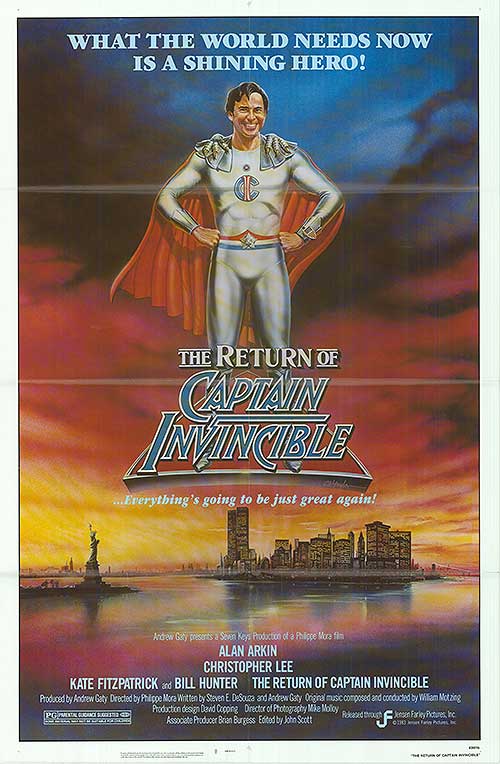
The Return of Captain Invincible (1983) Christopher Lee sings (more on this in a moment)! Philippe Mora directs this Australian-produced comedy/musical, starring Alan Arkin as the titular character, a washed-up, alcoholic ex-superhero. A lengthy newsreel-style prologue explains Captain Invincible’s rise during WWII and fall after McCarthy hearings, followed by his self-exile in Australia. Arkin isn’t very likeable as Captain Invincible, the jokes rarely work, and the songs are terrible to almost passable (one aptly titled song, “Bullshit,” consists solely of the BS word repeated multiple times), but it has its brief moments. Christopher Lee seems to be having fun as Captain Invincible’s archnemesis, Mr. Midnight, and belts out a couple of tunes as well, including a Richard O’Brien-penned tune “Name Your Poison.” Will Captain Invincible get his act together in time to save the world? Can Christopher Lee carry a tune? Will you stay awake long enough to find out? It’s an odd mixture that’s more miss than hit, but it might be worth a look, if only to confirm that someone gave this mess a green light.

Rating: **½. Available on DVD  


Rockula (1990) This ill-advised movie doesn’t work as a comedy or a musical. Dean Cameron plays Ralph, a 400-year-old vampire who lives with his lusty, overbearing mom (Toni Basil). He falls into a rock career while pursuing Mona (Tawny Fere), an old, reincarnated love who was killed by pirates hundreds of years ago. Despite being an ancient vampire, he never attacks anyone, and doesn’t appear to possess any superhuman abilities, except for transforming into a weird squashy bat-thing. The climax includes one of the most awkwardly choreographed fight scenes between Ralph and Mona’s ex-boyfriend Stanley (Tomas Dolby). Bo Diddley appears in the film as well, but he doesn’t have much to do. Rockula has a weak vampire, lame songs and bland leads. It’s innocuous and good-natured enough, but not worth your time. Don’t bother. 

Rating: **. Available on Blu-ray, DVD and Amazon Prime

Tuesday, May 22, 2018

Little Shop of Horrors


(1986) Directed by: Frank Oz; Written by Howard Ashman; Based on the musical play by Howard Ashman, which was based on the screenplay by Roger Corman and Charles B. Griffith; Starring: Rick Moranis, Ellen Greene, Levi Stubbs, Vincent Gardenia, Steve Martin, John Candy and Bill Murray

Available on Blu-ray and DVD

Rating: ****

“…Howard Ashman was very helpful…he suggested not to be subtle. Just to be flat out bold, and start singing immediately, as opposed to trying, in most musicals, where you transition from talk to singing. Here, on purpose, on stage, on the movie, we have them singing flat out immediately, and it’s a wink to the audience saying, ‘We know it’s a musical we’re just gonna go all the way with it.’” – Frank Oz (from DVD commentary)


Whenever someone says they don’t like musicals, Little Shop of Horrors inevitably pops up on most people’s short list of exceptions. It’s not difficult to see why. In some ways, it’s the anti-musical, with its morbid, B-movie premise, based on the off-Broadway stage production, which in turn was based off the quickie Roger Corman comedy/horror film from 1960.* The core story remains intact: A young nebbish toiling away in a skid row flower shop inadvertently stumbles upon a plant with an unusual appetite. He nurtures the sickly flora to health, but before he knows it, it’s the plant that’s controlling him, not the other way around. Budgeted at a relatively modest $25 million,** director Frank Oz’s version of the film was substantially more elaborate than the source material, with the six-month shoot taking place on the cavernous 007 sound stage at Pinewood Studios.

* Fun Fact #1: I’m not counting the 1973 pseudo-remake/softcore parody, Please Don’t Eat My Mother.

** Fun Fact #2: Producer David Geffen originally envisioned Little Shop of Horrors as a low budget (around $6 million) production, with Steven Spielberg executive producing and Martin Scorsese directing.


Rick Moranis was perfectly cast as Seymour Krelborn, the klutzy florist who becomes an unwilling accomplice to the monster plant’s murderous diet. Ellen Greene excels (in a role she originated on the London stage) as Seymour’s ditzy-but-big-hearted co-worker Audrey. Vincent Gardenia amuses as their sarcastic, penny pinching boss Mr. Mushnik (spelled “Mushnick” in the Corman film). Crystal, Ronette and Chiffon (Tichina Arnold, Michelle Weeks and Tisha Campbell-Martin, respectively) serve as a musical version of a Greek chorus, our tour guides through Seymour’s skid row neighborhood. Levi Stubbs from The Four Tops lends his amazing vocal talents for the enormous carnivorous plant, Audrey II. The plant itself,** designed by Lyle Conway, appears in four different sizes, with the final form requiring a crew of up to 60 individuals to operate.

* Fun Fact #3: Before Greene was (wisely) selected, the studio considered Barbra Streisand and Cyndi Lauper for the role of Audrey.

** Fun Fact #4: In his DVD commentary, Oz explained that three sets were employed to create the illusion of Audrey II singing and moving: one with human actors, one specifically with the plant, and another one for special effects. Moranis alone was shot in the standard 24 fps, but due to the limitations of working with foam rubber, scenes with Audrey II were shot in 16 fps and sped up. Likewise, when the human actors appeared together with Audrey II, they had to act out their scenes very slowly, to match the slower frame rate.


As good as the leads are, many of the smaller roles almost steal the show, with all at the top of their comedic game. John Candy, who ad-libbed his dialogue, appears as Wink Wilkerson, the manic host of a radio show focusing on weird things. Steve Martin plays the sadistic dentist Orin Scrivello like a sociopathic Elvis. He finds his match in a masochistic patient played by Bill Murray (taking over the role from Jack Nicholson in the original film), also ad-libbing his lines. The movie also features fun cameos by Christopher Guest and Jim Belushi.


A musical is only as strong as its songs, but thanks to the songwriting team of Howard Ashman and Alan Menken (The Little Mermaid, Beauty and the Beast), Little Shop of Horrors is more than up to the task. “Skid Row (Downtown)” is an early standout, conveying the desperation of Seymour and Audrey’s living conditions. “Somewhere That’s Green” is Audrey’s ode to suburban life that jumped off the pages of Better Homes and Gardens, replete with Tupperware parties and eating TV dinners with her imaginary family (including kids that are carbon copies of their parents). “Dentist!” is Orin Scrivello’s tribute to sadism. With the show-stopping (Oscar-nominated) “Mean Green Mother from Outer Space” Audrey II reveals his true intentions.


(Spoiler Alert) The “Director’s Cut” Blu-ray recreates, in a rough form, what preview audiences experienced, and much to Oz’s dismay, rejected. As originally planned, the film remained true to the stage production, as well as, the original movie. Unfortunately for Oz and a team of effects people who worked on the original ending, preview audiences in San Jose and Los Angeles didn’t like the idea that Seymour and Audrey were killed off, and the plant prevailed. In the end, the original ending was scrapped, in favor of something more audience-pleasing. Admittedly, seeing this different version, after the revised ending I’ve known and loved all these years, was a hard pill to swallow. I’m glad we can finally experience the film, more or less, as it was intended, but it’s a complete, and not entirely comfortable, shift in tone. According to Oz: “…when the plant kills Seymour and Audrey on stage, the actors afterwards take a bow. The difference is in movies they don’t take a bow. They’re gone and so the audience lost the people they loved, as opposed to the theater audience where they knew the two people who played Audrey and Seymour were still alive.” (excerpt from 2012 Entertainment Weekly interview, “Little Shop of Horrors: A Q&A with Frank Oz”)


Little Shop of Horrors is one of those uncommon instances where the new version improves upon the source material. Not to denigrate the Corman movie, which is charming in its own right, but the 1986 film adds a level of pathos not present in the original. Despite being a multimillion dollar production, Oz and writer Howard Ashman stay true to its humble origins. The combination of infectious songs, funny gags, likeable leads, and a great monster add up to an irresistible viewing experience. If you haven’t seen it yet, what are you waiting for? If you have, see it again.