Sunday, November 8, 2015

Out of the Past


(1947) Directed by Jacques Tourneur; Written by Geoffrey Homes (aka: Daniel Mainwaring); Based on the novel Build My Gallows High by Geoffrey Homes; Starring: Robert Mitchum, Jane Greer, Kirk Douglas, Rhonda Fleming, and Virginia Huston; Available on Blu-ray and DVD

Rating ****½

“…How did I know she’d ever show up? I didn’t. What stopped her from taking a boat to Chile or Guatemala? Nothing. How big a chump could you get to be?” – Jeff Bailey (Robert Mitchum)


What makes a film noir a film noir? While no two people may agree on the genre’s constraints, you know what you’re looking at the moment you see it. Throughout Noir-vember, my month-long exploration of these distinctive films, I hope to delve deeper, and create my own definition. Don’t expect any new revelations, but every new title (for me at least) promises to be an education on this vibrant and diverse category. Many films may contain similar themes (a private eye caught in a web of conspiracy beyond his understanding or control, a shifty dame, duplicitous friends, an urban jungle, etc…), but the permutations are endless. The brilliance, after all, is in the details, as different filmmakers shuffle around these ingredients like professional chefs interpreting a time-worn recipe. One of the finest examples of the genre, blending all of these disparate and familiar elements, is Out of the Past. 


Based on the novel Build My Gallows High (which was the British release title) by Geoffrey Homes (aka: Daniel Mainwaring), and masterfully directed by Jacques Tourneur, Out of the Past features snappy dialogue and a twisty plot to weave its tale about a man in over his head. Shot on location in San Francisco and Bridgeport, California, Mexico City and Acapulco, Tourneur establishes time, place and mood, contrasting the bucolic with urban. Most of the film’s scenes are at night, setting the melancholy tone, and casting its characters in literal and figurative darkness.


Robert Mitchum stars as ex-private detective Jeff Bailey, who runs a gas station in a quiet little Northern California town. He thought he escaped his past life, until his former employer’s hired goon starts sniffing around. Mitchum is perfect in the role as a man steeped in regret and a longing for a simpler life. His impassive, sleepy-eyed expression belies a calculating mind and a storm raging within. We learn about Jeff’s backstory through a flashback, recalling how he was hired by the mob boss Whit (Kirk Douglas) to find the woman that shot him and absconded with his $40,000. Jeff tracks her down in Mexico, but ends up falling in love with her. Mitchum delivers his lines with dry humor (“That’s one way to be clever, look like an idiot.”) and a world-weary heart, as one who’s seen it all and done it all. When he suspects he’s being manipulated by his employer, he comments, “…all I can see is the frame. I’m going in there now to look at the picture.” He’s resigned to his fate, aware that he’s walking into a trap, but powerless to stop it. All he can do is hope to reverse the outcome.  


Jane Greer* excels as femme fatale Kathie Moffat, easily the film’s most complex character. She’s capable of displaying tenderness one moment and the viciousness of a caged animal in the next. Kathie plays both sides for her own ends, changing allegiances like a new ensemble. She’s a far cry from the female characters depicted in the past, who sit passive by the sidelines. Her innocent ingénue act is merely a cover for a scheming cobra, ready to strike. She’s an architect of her fate, judiciously balancing her hatred for Whit with her love for Jeff, but never at the expense of her own interest. By comparison, Jeff’s girlfriend Ann (Virginia Huston) is purposefully bland, representing a hopeful future that remains out of reach.   

* Fun fact: Greer was the girlfriend of Howard Hughes, who owned RKO Studios at the time.


Douglas shines in his second film appearance, as kingpin Whit, who presents a deceptively amiable façade, but hides a violent streak. Despite the fact that Jeff has betrayed him, he’s determined to bring him back into the fold. He manipulates people like chess pieces, and is determined to hold onto whatever is his at any cost, with the tenacity of a remora (“I fire people, but nobody quits me.”).


It’s worth noting another character that doesn’t receive much attention, but deserves more praise. As opposed to the flashier roles, there’s a nice low-key performance by former child actor Dickie Moore as a young deaf/mute man who works for Jeff at the gas station. He conveys so much with so little, bringing the film to a conclusion with merely a nod.


Out of the Past reminds us that film noir is all about contrasts: shadow and light, the bucolic versus urban, glamorous versus plain, and submissive versus dominant. Screenwriter Homes weaves an elaborate story that commands our attention, but manages to stay one step ahead. But as author Jim Ursini observes in his DVD commentary, film noir is more about the “why” of characters and their psychology, rather than the “how,” or machinations of the plot. The climax subverts the audience’s expectations, leading to a “happy” ending that depends on your definition of happy. Out of the Past is a classic example of film noir, and a fine introduction to the genre. It exemplifies what this type of movie does so well, taking us on a dark ride into the seamier recesses of the soul.

Saturday, October 31, 2015

October Quick Picks and Pans – Halloween 2015


A Girl Walks Home Alone at Night (2014) Just when you thought you’ve seen every spin on the vampire genre, along comes this assured feature film debut by writer/director Ana Lily Amirpour. With a Persian language soundtrack, Iranian Setting (filmed in California) and magnificent black and white cinematography, Amirpour makes a lasting impression. Arash (Arash Marandi) ekes out a meager existence in the slums of Bad City, where drugs and prostitution are commonplace. Sheila Vand plays the title character (the word “vampire” is never used) who strolls the streets and alleyways, and preys on the denizens around the slum. She’s highly selective about her choice of victim, however, dispatching those who cause suffering to others, or fail to contribute to the community. This hypnotic film might be deliberately paced, but don’t confuse that with boring. Amirpour takes the time to introduce us to the residents of Bad City, creating a world that’s bleak, immersive and believable.

Rating: ****. Available on Blu-ray, DVD and Netflix Streaming


Ginger Snaps (2000) Here’s a rarity: a clever horror/comedy with smart teen characters. Director John Fawcett and writer Karen Walton draw parallels between adolescence and lycanthropy. Sisters Brigitte (Emily Perkins) and Ginger (Katharine Isabelle) are misfits at their high school, until Ginger begins to change. She starts noticing guys, smoking weed and acting defiant at home, much to the chagrin of her parents. But in Ginger’s case, she faces more than just the usual teen angst and hormonal imbalances after she’s bitten by a werewolf. Perkins and Isabelle are terrific as siblings that are growing apart, as well as Mimi Rogers, in a nice supporting role, as their clueless, fashion-challenged mother. Ginger Snaps loses some momentum in the final third, with an action-oriented climax and conventional ending, but the rest is a solid effort.

Rating: ***½. Available on Blu-ray, DVD and Hulu Streaming


The Dark Hours (2005) Kate Greenhouse stars in this psychological horror film as psychiatrist Samantha Goodman, a woman wrestling with her inner demons. As she deals with the reality of a recently diagnosed brain tumor and her cold marriage, she attempts to soldier on as an objective clinician. After a particularly stressful encounter with a sociopathic patient, she decides to take some time off to sort things out, and heads to a secluded cabin (Is there any other kind?), to rendezvous with her husband and sister. They soon discover an unwanted guest, an escaped patient who wants to make her pay for his perceived mistreatment under her care. Although it’s difficult to watch at times, and falls into some unfortunate clichés (you can guess what happens to the dog), director Paul Fox and writer Wil Zmak keep things tense throughout, leading to a strong finish.

Rating: ***½. Available on DVD


El Barón del Terror (aka: The Brainiac) (1962) If you strip away the superficial differences, the basic story of this Mexican horror flick wouldn’t have been out of place in a Hammer film. In 1661, Spanish nobleman Vitelius d'Estera (Abel Salazar) is accused of witchcraft, and burned at the stake. Before he succumbs to the flames, he vows revenge against those who sentenced him. Sure enough, he returns 300 years later in a comet that crashes to earth. The demonic baron is a wonderfully unique and silly creation, with a pulsing head and forked tongue, which he uses to suck out the brains of his victims. Can his deadly rampage be stopped? This enjoyable little film exceeded my expectations with a brisk pace and the conviction to follow through with its loopy premise. I hope you’ll like it too.  

Rating: ***½. Available on DVD and Netflix Streaming


The Devil Bat (1940) Director Jean Yarbrough’s Poverty Row cheapie has to be seen to be believed (or disbelieved).  Bela Lugosi stars as mad scientist Paul Carruthers, who vows revenge against a cosmetic magnate and his family for making millions of dollars off of his inventions. Carruthers develops an aftershave that attracts giant killer vampire bats that he created in his lab (unlike the lazy specialists depicted nowadays, those old-timey scientists did it all). The unconvincing puppets (we’re treated to close-up shots of a real fruit bat) swoop down on their unsuspecting prey, tearing out their aftershave-slathered throats. This goofy, but diverting movie tells its story in just 68 minutes, and falls squarely into so-bad-it’s-good territory

Rating: ***. Available on Blu-ray, DVD and Hulu


The Boogens (1981) Judging from such an inauspicious title, you probably shouldn’t expect much, but The Boogens isn’t terrible, it’s just not terribly good. The filmmakers use a little too much restraint – we barely see the titular creatures that lurk in a silver mine. Also, nothing much happens for the first two-thirds of the movie, unless you count spending time with a bunch of dull people as character development. I applaud the low budget monster movie trappings, but not the execution.  

Rating: **. Available on Blu-ray and DVD


Macabre (2009) Writer/directors The Mo Brothers prove no good deed goes unpunished. On the way to Jakarta, a group of friends pick up a young woman wandering alone in the rain. They’re welcomed into her house, where her mother repays their kindness with dinner, but the guests realize too late that nothing is at it appears, and find leaving is much more difficult than they imagined. Macabre starts out on a promising note, but relies too heavily on relentless gore and a predictable plot. This well made, but ultimately pointless exercise confuses a “more is more” approach, rather than adopting a more subtle tact. The deadly serious tone could also have benefited from some dark humor to cushion the blows. 

Rating: **. Available on Hulu


From a Whisper to a Scream (aka: The Offspring) (1987) Poor Vincent Price. He deserved better than to be attached to this sub-par horror anthology, directed and co-written by Jeff Burr. Price plays elderly historian Julian White, who introduces four tales (the stories range from awful to mediocre) about a cursed town in Tennessee. Low production values and weak writing hinder the quartet of tales, about necrophilia and incest, a man who’s discovered the secret of immortality, a freak show, and Civil War cannibalism. Poe and Lovecraft’s names are invoked, but it’s tough to see the influence of the authors’ body of work. Even though he’s not given much to work with, Price does his best with the material. My advice: If you’re craving this sort of thing, see one of the Amicus anthologies instead.

Rating: **. Available on Blu-ray and DVD

Monday, October 26, 2015

The Hands of Orlac (aka: Orlac's Hände)


(1924) Directed by: Robert Wiene; Written by  Louis Nerz; Based on the novel Les Mains d’Orlac by Maurice Renard; Starring: Conrad Veidt, Alexandra Sorina, Fritz Kortner, and Carmen Cartellieri;
Available on DVD

Rating: ***

“I feel like it comes from you, along the arms, until it reaches the soul. Cold, terrible, relentless…” – Paul Orlac (Conrad Veidt)


Thanks to Crystal from In the Good Old Day of Classic Hollywood for inviting me to participate in the Silent Cinema Blogathon. Since this is also Horror Month, I chose an appropriately macabre-themed story, The Hands of Orlac.  


Accepting the core premise of The Hands of Orlac requires taking a step out of the contemporary mind-set. Although it’s now an approved medical practice, the concept of limb transplantation probably seemed far-fetched, and a bit off-putting, to 1920s audiences.* If viewers were willing to go along for the ride with such a fanciful notion, it’s not too hard to imagine donor hands retaining the properties of their former owner.  

* Fun fact: The first successful hand transplant didn’t occur until 1999. 


Director Robert Wiene, who previously directed star Conrad Veidt in the landmark film The Cabinet of Dr. Caligari, takes the viewer on another mesmerizing trip. While it would be easy to mistake this for another German film, Wiene shot The Hands of Orlac in Austria. It shares some of the stylistic touches of its German contemporaries, but it belongs in a category of its own. Expressionistic flourishes punctuate rather than dominate the scenes. One of the most memorable visuals involves the smoldering wreckage from a fiery train crash, resembling a hellish village of twisted metal. In another scene, the main hall of Orlac’s father’s house (cared for by a cadaverous butler) appears like a catacomb.


Veidt anchors the film as brooding concert pianist Paul Orlac. After he loses his hands in a train accident, his anguished wife, Yvonne (Alexandra Sorina), pleads with skilled surgeon, Dr. Serral (Hans Homma), to save his hands (“His hands are his life.”). Serral replaces Orlac’s hands with those of executed murderer, Vasseur. As Orlac learns about the unwitting donor, the hands appear to take on a life of their own.  In another (perhaps too literal) scene, the specter of Vasseur hangs over him like a storm cloud. Repulsed by his new hands, and strange impulses, he shuns physical contact with his wife (“These hands will never be allowed to touch another person!”). The amputation of Orlac’s hands signifies his castration anxiety, manifested in his (implied) absence of libido and chaste marital relationship. The decidedly absurd premise becomes plausible, thanks to Veidt’s commitment to the role. I wish I could extend the same praise for Veidt’s co-star Sorina, but her histrionics are hard to take. She chews up the scenery with her overacting, when a subtle approach would have been much more effective.  


The Hands of Orlac incorporates horrific elements, but the film is better classified as a psychological thriller with some science fiction elements (hand transplant) thrown in. As Orlac’s sanity disintegrates, we’re left to speculate if he’s truly capable of carrying on Vasseur’s murderous legacy. (Spoiler alert!) Thrown into the mix is shadowy figure Nera (Fritz Kortner), who manipulates the other characters like a master puppeteer, and pretends to be the resurrected Vasseur. The climax devolves from a psycho-sexual, supernatural thriller into a whodunit mystery with a prosaic blackmail plot.


Aside from some less than extraordinary plot twists, the film suffers from a languid pace, and sacrifices character development in favor of mood and atmosphere. Because so much of the film takes place in Orlac’s tormented mind, it’s an inevitable byproduct that there’s a notable lack of energy to many of the scenes. Over the years, however, The Hands of Orlac has proven to be an enduring template for other interpretations of Maurice Renard’s original novel. The most notable example was the devilishly fun Mad Love, a rare remake that surpasses the original. In the 1935 remake, Dr. Gogol (Peter Lorre) is the focal character (combining the characters of Dr. Serral and Nera), with Colin Clive as pianist Stephen Orlac and Frances Drake as his wife Yvonne. The idea of a body part rebelling against its owner was used to comic effect in Sam Raimi’s amazing splatter comedy Evil Dead 2, and Orlac’s basic premise was recycled for the not-so-stellar 1991 thriller Body Parts, starring Jeff Fahey. While it might not be the definitive film version, The Hands of Orlac, one can’t deny its influence. It’s worth seeking out for its powerful imagery and Veidt’s galvanizing performance.

Thursday, October 22, 2015

The Descent


(2005) Written and directed by Neil Marshall; Starring: Shauna Macdonald, Natalie Mendoza, Alex Reid, Saskia Mulder, MyAnna Buring and Nora-Jane Noone; Available on Blu-ray and DVD.

Rating: ****

“I love the ending. I think the ending poses a lot of questions. Some people are gonna dislike it. What can you do? Some people want things easily resolved, but I like the fact that people walk away with very different ideas about what it means.” – Neil Marshall (from the DVD commentary)


Way back in the ‘80s, during my intrepid high school days, I tried my hand at amateur spelunking. A friend told me about a particular cave located in Simi Valley, California, which was rumored to be a hideout for the Manson family. My curiosity and general lack of common sense compelled me to ignore the warning signs about trespassing on private property, and accompany my friend on an exploration of the isolated rocky chasm. The initial climb down wasn’t so bad until I was forced to squirm down a constrictive tunnel on my back, with a rock wall hanging mere inches above my face. At that moment, my only thought was how unfortunate it would be for me if an earthquake occurred, or if I suddenly became stuck. While getting in was no picnic, climbing out proved to be even more problematic. Since you’re reading this now, however, I’m sure you can ascertain it all worked out, although it’s an experience I don’t care to repeat. With his Freudian nightmare, The Descent, writer/director Neill Marshall tapped into my deepest fears about the subterranean darkness.


Marshall set out to create a movie that recalled his favorite horror movies of the ‘70s and ‘80s. In the opening credits, he pays homage to John Carpenter, by using the same font used in some of the filmmaker’s most iconic movies, such as The Thing, The Fog and Escape from New York. What follows is a relentless assault on the psyche, as the tension gradually builds. With a combination of clever effects and set design, Marshall and crew create a believable underground environment. CGI is used sparingly, which augments the visuals, instead of calling attention to the effects.


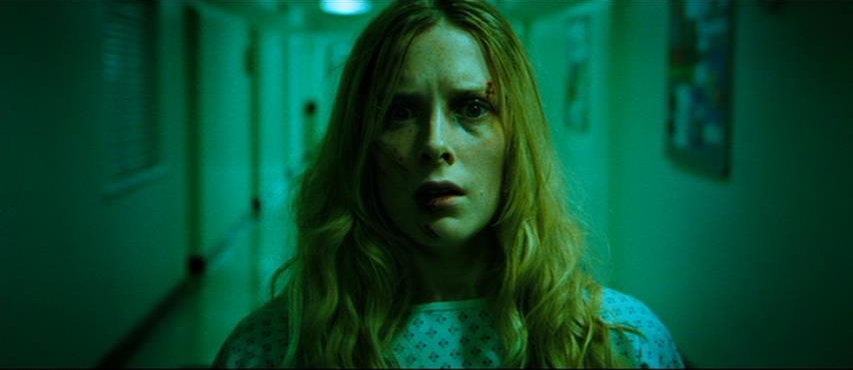
In the opening scene, Sarah (Shauna Macdonald) and her adventurous friends enjoy a whitewater rafting excursion, while her husband and daughter observe idly from the shore. The scene that follows is probably the most visceral and jarring sequence in the movie, as we, the audience are complicit in Sarah’s traumatic event. In the blink of an eye, her life is changed forever. Fast forward a year, and Sarah is still grappling with her grief, and taking antidepressants. She experiences recurring visions, where she relives the tragedy, and dreams about celebrating her deceased daughter’s birthday. Sarah and the audience remain on shaky ground, as we’re never quite sure which visions are real, and which are in her mind.  


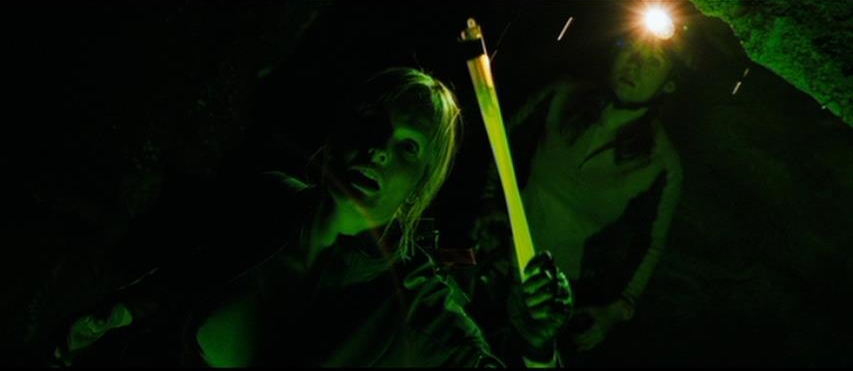
The friends have assembled again, in North Carolina,* to tackle another outdoor adventure. Led by their gung-ho companion Juno (Natalie Mendoza), they venture into what turns out to be an uncharted cave. The explorers learn too late that Juno’s self-aggrandizing ambitions might have led them to ruin. After a tunnel collapses, they’re left with no choice but to move forward, with the hope that they can find an exit. As tempers flare, and one friend suffers a particularly nasty compound fracture, they begin to question if escape is possible. To make matters worse, as they forge deeper into the cave, they discover they’re not alone. Lurking in the hidden crevices are blind, cave-dwelling bipeds with a taste for human flesh. The creatures navigate the tunnels using echolocation, in the form of unnerving clicking sounds.

* Fun fact: The Scottish countryside stood in for the Appalachian Mountain region depicted in the film.


As with any quality horror film, The Descent is open to multiple interpretations. To borrow a page from Sigmund Freud, it balances manifest (what’s on the surface) and latent (underneath the surface) elements. The darkness of the cave (the film was originally titled The Dark) becomes a milieu for our deepest-seated fears and anxieties. It was suggested to me that the film was a female version of Deliverance (minus the hillbilly rape), with its themes of people against nature, and a clash of societies. It’s easy to draw numerous parallels with the characters and situations (replace outdoorsy Juno with the survivalist Lewis, played by Burt Reynolds). It doesn’t take an expert in psychoanalysis to decode the overt symbolism of the cave, as the bloodied characters squeeze through the cave’s restricted confines, in a perverse mimicry of childbirth. The most compelling (and plausible) theory, however, suggests the film’s events are fabrications of Sarah’s mind, and the proverbial descent is her plunge into madness.  


Of course, we can take many of these interpretations with a grain of salt when we consider Neil Marshall wanted to create something that would scare the crap out of us, and succeeded in spades. The Descent remains his most accomplished effort to date, and one of the best pure horror films in the past decade. It holds up, whether one takes a literal stance or looks for something deeper (pardon the obvious pun). Grown up me, if there is such a beast, enjoys entertaining these numerous theories, but six-year-old me just wants to see some monsters. At the end of the day, both go home satisfied.