Sunday, July 12, 2015

The Mummy


(1959) Directed by Terence Fisher; Written by: Jimmy Sangster; Starring: Peter Cushing, Christopher Lee, Yvonne Furneaux, Felix Aylmer, Eddie Byrne and George Pastell; Available on Blu-ray and DVD

Rating: ****

“Film acting is basically done with your mind and with your eyes. If it doesn’t show in your eyes, it doesn’t convince anybody. But it did enable me, with movement and with eyes, to create a character once the priest had become the Mummy.” – Christopher Lee (from Christopher Lee and Peter Cushing and Horror Cinema, by Mark A. Miller)


After the success of TheCurse of Frankenstein and Horror ofDracula, the writing-directing team of Jimmy Sangster and Terence Fisher, along with stars Peter Cushing and Christopher Lee, returned for Hammer’s third re-interpretation of Universal’s monster movies. In this case, Fisher and company proved the third time remained a charm. The Mummy is a classic revenge tale with a refreshingly sympathetic take on one of horror’s most enduring monsters.


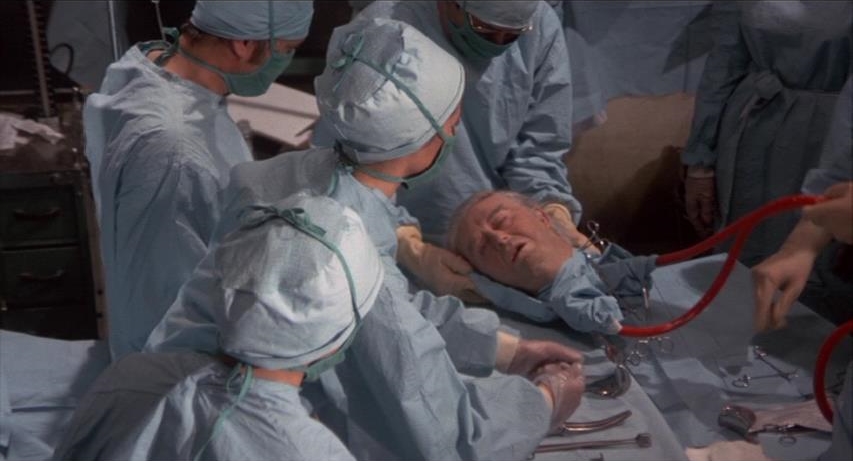
The story opens in Egypt in 1895, where our protagonist, John Banning (Cushing) is on an archaeological dig with his father Stephen (Felix Aylmer) and Uncle Joe (Raymond Huntley). Unfortunately for John, he’s incapacitated by a broken leg, leaving the elder Banning family members to uncover the tomb of the princess Ananka. Stephen ignores the dire warnings from Karnak worshipper, Mehemet Bey (George Pastell), and suffers the consequences. Fortunately for John, he wasn’t present to witness the incident that drives his father mad, although he’s not off the hook. The story jumps to 1898 England, where Mehemet has traveled to enact revenge against those who have disturbed the tomb of Ananka. After his uncle and father (now living in a sanitarium for the mentally ill) are murdered, it dawns on John that he’ll likely be the next victim.


Cushing provides his character the suitable flourishes of sophistication and dry wit we’ve come to expect from his prior performances.* He walks with a permanent limp, a byproduct of the leg injury that never properly healed. But his malady hasn’t slowed down his fascination with ancient mythology or a desire to determine the intentions of the mysterious Egyptian who has taken up residence in his town. Cushing took an active interest in the filmmaking process, and The Mummy was no exception. Seeing a golden opportunity to exploit the potential of pre-production artwork for his film, he shrewdly suggested to Fisher that a spear should pierce the rampaging monster.

* The younger Banning sure knows how to turn on the charm. Noting his wife Isobel’s (Yvonne Furneaux) uncanny resemblance to Ananka he states, “She was considered the most beautiful person in the world,” then proceeds to kill the moment by following up with, “Mind you, the world wasn’t so big then.”


Lee arguably has the more difficult role as the 4,000-year-old title creature, due to his necessarily mute performance. In a flashback sequence, we witness the High Priest Kharis (Lee) violate the tomb of his beloved princess, resulting in the ultimate penalty. Kharis is subjected to a ritualized punishment, whereby his tongue is cut out,* and he’s buried alive with Ananka’s remains, condemned for all eternity to guard the princess from harm. Swathed in cloth strips from head to toe (or “another bandaged juggernaut,” as Lee described his character – from his autobiography, Tall, Dark and Gruesome), he conveyed more through his eyes than most actors could with their entire bodies and voices. This mummy is far from a mindless killing machine, thanks to Lee, who endows him with a soul. When Kharis looks upon Isobel, he evokes our sympathies, recalling an unfulfilled, forbidden love. Lee manages to pull at our heart strings, despite enduring physical pain** for the role.

* As was customary during this transitional era, Hammer catered to International markets with different versions of the same film, including more explicit scenes such as topless handmaidens and a bloodier depiction of Kharis’ punishment. Sadly, these cuts do not appear to exist on home video.

** Lee sustained back and shoulder injuries carrying Furneaux through a swamp in the movie’s climax.


Let’s face it, no one watches a Hammer film for a balanced treatise on cross-cultural injustice, but there was room in The Mummy for some post-modern social commentary. While it’s tough to excuse Mehemet Bey’s methodology as he exacts revenge against John and his kin, he has a valid point about the Englishmen’s insensitive treatment of his homeland’s culture. When John pays Mehemet an unexpected visit, it provides the Egyptian an opportunity to articulate the conflict between invasive outsiders versus preservation of culture: “It has often puzzled me about archeologists. Has it never occurred to them that by opening the tombs of beings who are sacred, they commit an act of desecration?” John sees no wrong in his profession, failing to see how his attempt to enrich his society’s understanding, comes only at the other culture’s expense. He adds fuel to the fire by calling the deity Karnak a “third-rate god.” From Mehemet’s perspective, it’s easy to see why he would consider John ignorant and intolerant, meddling in things he doesn’t understand for scholarly pursuit. The film’s relatively balanced approach is undermined, however, by some good old fashioned xenophobia, as when Mehemet states “In my country, violence is commonplace.” In an early scene, another character comments, “I don’t like the look of him. He’s a foreigner.”


If you’re digging too deep, you’re probably missing the point of The Mummy. Hammer’s spirited re-telling is intended to be nothing more or less than Saturday matinee material, featuring a re-animated revenge monster that kills people in gruesome ways. Fisher’s efficient direction, accompanied by a rousing, epic score by Franz Reizenstein, make sure that everything moves along at a good clip. Not everyone, including the writer of the 1932 Universal version, Nina Wilcox Putnam, was entertained,* but if it raised eyebrows in its day, it’s worth taking note. It’s another winner from Hammer that holds up admirably to its classic Universal counterparts, and really delivers the goods.

* Putnam referred to Hammer’s version as “this disgusting English remake.” (from The Hammer Vault, by Marcus Hearn)

Sunday, July 5, 2015

The Anniversary


(1968) Directed by Roy Ward Baker; Written by Jimmy Sangster; Based on the stage play by Bill MacIlwraith; Starring: Bette Davis, Sheila Hancock, Jack Hedley, James Cossins, Christian Roberts and Elaine Taylor; Available on DVD

Rating: ****

“I’ve never met a more professional person, but she was the most demanding person off the set.” – Jimmy Sangster on working with Bette Davis (from The Anniversary DVD commentary)


Free association time: when you hear “Hammer Films,” what’s the first thing that comes to mind? Okay, what’s the second thing? If you didn’t just repeat “horror” you win a kewpie doll.*  While horror became Hammer’s bread and butter throughout the ‘50s and ‘60s, the little production company’s filmography has always been incredibly diverse, including swashbucklers, dramas, mysteries, sci-fi, comedies and more. A while back, I reviewed The Nanny, a slow-burn thriller starring Bette Davis that kept you guessing until the end. Three years later, Davis was again courted by Hammer to work on the black comedy, The Anniversary, where there’s no ambiguity about whom the antagonist is.

* Please allow up to 8-10 years for shipping and handling.


Former production manager turned screenwriter Jimmy Sangster had more than a decade’s experience writing screenplays for Hammer, including 1965’s The Nanny. At Hammer’s behest Sangster reluctantly* assumed the dual role of screenwriter and producer for The Anniversary. It was a troubled production from the start, with friction between original director Alvin Rakoff and Davis. Irritated with his prescribed methods of blocking, Davis ordered him fired** a week into filming. Although the film was now behind schedule and over budget, things went much better with veteran director Roy Ward Baker, whom Davis had met several years ago. Fresh off the directing job of Quatermass and the Pit (one of my personal favorites), Baker was forced to re-shoot Rackoff’s previously filmed scenes, instead of picking up where he left off. Although Davis had a reputation for being difficult behind the scenes, Baker commented she was always punctual, and remained professional when working with the other actors.

* Sangster’s wife wasn’t enamored with the prospect of her husband collaborating with Davis once more, threatening to leave if “that woman” came into the country again. She promptly made good on the promise. (ibid)

** According to Sangster, he was told by Fox executives that, “It’s not a Hammer Film. It’s not a Fox film. It’s a Bette Davis Film. She wants a director change? You change the director.” (ibid)


Based on Bill MacIlwraith’s stage play, The Anniversary lambastes dysfunctional family traditions, as three brothers gather to celebrate their parents’ anniversary. Although their father has been deceased for several years, their mother insists on the annual ritual of celebrating the date. In the opening scenes, the family members brace for the inevitable storm, as they and their significant others are subjected to a litany of verbal abuse by their dear mother. The eldest Taggart son, Henry (James Cossins), is a momma’s boy, still living at home and trying to live up to her expectations as the perfect son, albeit with an unfortunate fondness for women’s undergarments. He’s obedient to a fault, and ready to step in to assist her at a moment’s notice. Middle son, Terry (Jack Hedley) plans to emigrate to Canada with his wife Karen (Sheila Hancock) and their five children, where they can live an ocean away from his domineering mother.  The youngest, Tom (Christian Roberts), is the family playboy who brings home a different fiancée every year. This time might be different, as his intended, Shirley (Elaine Taylor), isn’t about to go down without a fight.


Davis appeared to be enjoying every minute of screen time as the caustic, one-eyed matriarch, Mrs. Taggart,* who might be Hammer’s most awful monster. Armed only with her caustic wit and a forked tongue, she relies on mind games and well-timed insults to ensure her progeny remain wrapped around her little finger. I think the term “sadistic glee” was penned to describe Mrs. Taggart, who wields emotional blackmail like a trained assassin. She locates each individual’s weak spot, and proceeds to mount an individualized attack with surgical precision. It’s unsurprising that Davis has the lion’s share of the film’s terrific lines, but she does just as well conveying disdain and annoyance with a simple gesture or raised eyebrow. While everyone else avoids confrontations, she thrives off of making everyone uncomfortable in order to preserve her version of family unity. And just when we think she’s had her comeuppance at the film’s climax, we realize the redoubtable Mrs. Taggart has more than a few tricks left up her sleeve.

* Davis supplied her own colorful wardrobe, including custom-made eyepatches.


Despite being based on a stage play, Roy Ward Baker keeps the film’s pace brisk, without letting things get too stagey. Aside from the verbal gymnastics, Baker finds ways to avoid being too static, and not restrict the action to one set. The Anniversary featured all the right ingredients – swift direction, snappy dialogue and stellar performances (especially by Davis), but it wasn’t a critical or box office success at the time. The Anniversary is a grossly underappreciated gem in Hammer’s illustrious crown, long overdue for re-evaluation by film fans and Hammer-philes alike.

Tuesday, June 30, 2015

June Quick Picks and Pans


White Dog (1982) Co-writer/director Samuel Fuller’s tale of pets and prejudice (co-written by Curtis Hanson and based on a novel by Romain Gary) was deemed too volatile by Paramount when it was completed, and was promptly buried before it saw a release. It eventually made it to theaters nine years later in limited release, but remains seldom seen. When a young actress (Kristy McNichol) accidentally runs into a dog with her car, she takes him home and nurses him back to health. She soon learns there’s more to the dog’s history when she discovers he’s been trained to attack black people. In a last-resort effort, she enlists the aid of animal trainer Keys (Paul Winfield), who makes it his personal mission to cut out the ingrained behavior like a cancer. The story is told in broad strokes, filled with some implausible situations, yet, the core ethical/moral dilemma shines through, like a modern-day fable. The story follows an inevitable trajectory, leading to a sobering ending.

Rating: ***½. Available on DVD.
                               

Under the Skin (2013) I admired Under the Skin for its artistic integrity, even though I didn’t particularly enjoy it. Scarlett Johansson stars in this arthouse sci-fi/horror hybrid as an attractive, albeit emotionless woman who roams the city streets in a delivery van, picking up single men. She lures them to her home with the promise of anonymous sex, where they’re dissolved in a liquid substrate that oozes from the floorboards. The ritual repeats with a series of different men, from different walks of life. Although the film successfully maintains an eerie sense of dread, it plods along at a glacial place, and remains as emotionally distant as its main character. Johansson deserves kudos, however, for her icy performance, and for branching out from the usual Hollywood claptrap. Ultimately, the film’s message, if any, gets obscured. Whether this little Scottish independent production is a cautionary tale about dating, or judging by surface appearance, or something similar, is anyone’s guess.

Rating: ***. Available on Blu-ray and DVD


Jack’s Back (1988) Writer/director Rowdy Herrington’s (Roadhouse) murder mystery aims high, but never quite lives up to the promise of its lurid subject matter. James Spader stars in a dual role as identical twins Rick and John Wesford. While investigating a series of murders fashioned after Jack the Ripper, medical internist John is killed. Rick follows his twin’s footsteps, attempting to unravel the mystery. Considering the macabre template of the original murders, it fails to generate much in the way of suspense or thrills. Spader is likable in the lead role(s), and Robert Picardo is good as a psychiatrist. It’s too bad the story never gets out of second gear. Jack’s Back would have been a decent television movie when it came out, but as a theatrical production, it lacks the punch the premise demands.  

Rating: **½. Available on Netflix Streaming (as of today’s date)


The Dark Backward (1991) This sporadically amusing film from writer/director Adam Rifkin has all the trimmings of a cult film, but never quite hits the mark. The story takes place in some sort of ill-defined post-apocalyptic landscape where all of the consumer products are dominated by one brand. Judd Nelson stars as the nebbishy Marty Malt, a garbage collector who moonlights as an inept stand-up comic. One day, a third arm grows out of his back, and he suddenly becomes a hit. One of the biggest problems with the film is it works a little too well convincing us he’s a terrible comedian, but falls flat with the surrounding comic scenes. The rest of the movie is an endurance test, seeming at least 20 minutes too long. Bill Paxton appears as Marty’s obnoxious buddy Gus. Normally, Paxton’s appearance in a movie is a good thing, but in this instance, I wanted to punch him in the face. Wayne Newton as a sleazy agent isn’t much better.  One of the only bright spots is James Caan as an unscrupulous, money-grubbing doctor. The Dark Backward comes close, but no cigar.

Rating: **½. Available on DVD.

Saturday, June 27, 2015

Cinematic Dregs: The Thing with Two Heads


(1972) Directed by Lee Frost; Written by: Lee Frost, Wes Bishop and James Gordon White; Starring: Ray Milland, “Rosey” Grier, Don Marshall, Roger Perry and Chelsea Brown; Available on Blu-ray and DVD

Rating: ***

“Genius must be prolonged. Philip, I want to transplant my head on a healthy body.”

 – Dr. Maxwell Kirshner (Ray Milland)

“Honey, I know you don’t like to answer a lot of questions, but how did that happen?”

– Lila (Chelsea Brown)


After a nearly one-year absence, I decided to revive Cinematic Dregs, an ongoing exploration of the crème de la crap from film’s nether regions. Yes, there are many excellent blogs that already handle this sort of thing, but I couldn’t truly call myself eclectic if I didn’t throw some of the more questionable celluloid offerings into the mix occasionally. A hearty “thanks” goes out to the good people at Olive Films for supplying a screener copy of today’s dreck du jour from the weird and wild early ‘70s.


The Thing with Two Heads handles some of the most volatile, ethically challenging issues plaguing our society, in the silliest way imaginable. The basic premise is sound: what if an individual from the upper echelons of society is forced to cohabitate with someone from the lowest rungs? Of course, since this is a product of American International Pictures, we can’t expect a sublime meditation on race relations and classism. Instead, we’re treated to clunky dialogue and wacky hijinks.


It’s a testament to Ray Milland’s professionalism that he treats the material with far more gravity than it deserves. Milland stars as the cantankerous Dr. Maxwell Kirshner, director of the Kirshner Transplant Foundation, a brilliant surgeon and unabashed racist. He demonstrates a revolutionary new procedure to transplant a head onto another body, using a gorilla* as a test subject. Unfortunately for the host body, this means amputating the original head, once the body has had sufficient time to accept the transplant. Max, who happens to be suffering from a terminal illness, sees this as a suitable means to an end, and sets out to find a new body for his head. When his health takes a turn for the worse, his assistant, Dr. Philip Desmond (Roger Perry), is forced to make a last-minute decision, and strikes a deal with the Lt. Governor to secure a death row inmate for the experimental procedure. It’s interesting to note the filmmakers attempted to create some semblance of veracity for the scenes depicting surgery (the film credits two medical advisors, Dr. Cadvan Griffiths and Rod Steele). Well, at least they devoted screen time to show the medical team sterilizing Max’s basement for the secret procedure.

* Fun fact: The dual-noggin simian was created and performed by a young Rick Baker.


“Rosey” Grier plays convicted murderer Jack Moss. On his way to the electric chair, he figures he has nothing to lose by volunteering for a medical experiment that will eventually prove fatal. In his mind, he’s just bought himself 30 more days to prove his innocence. Of course, the physicians neglect to reveal the details of their little experiment to him, other than stating it’s a “transplant.” It should come as no surprise that neither Max nor Jack is particularly keen on the new arrangement. Max is horrified to discover he’s become, by proxy, the very thing he despises, while Jack is mortified to learn his body now has an unwelcome new appendage.* They spend the rest of the movie bickering at each other and trading insults. The mind reels over the missed opportunity for a sitcom here, but all I could think of was how uncomfortable it must have been for both performers to play the two-headed person.

* Jack’s girlfriend later inquires, “Honey, I was wondering… Do you have two of anything else?”


Not about to take things lying down (or sedated), Jack finds the opportunity to make his getaway. This leads to a chase scene on cars and dirt bikes that drags on a bit too long (I suppose the producers figured, “We hired the stunt men on motocross bikes and police cars for the whole day, and damn it, we’re gonna use ‘em!”). You have to respect how Jack’s long-suffering girlfriend Lila (Chelsea Brown) seems so nonplussed about the whole affair. When she answers the door and sees her fugitive boyfriend sporting an extra head, does she gasp with incredulity, or shriek in horror? Nope. She simply responds, “You get into more shit,” as if acquiring the head of a rich racist white dude was just another one of his schemes. (Spoiler alert!) Perhaps the biggest stretch, apart from said cranial transplant, is the happy ending as Jack and his cohorts drive off, presumably continuing the search for the guy who framed him. The question of his innocence is never firmly resolved, and they seem blissfully unaware of the massive police dragnet that likely awaits them before they cross the county line. 


The Thing with Two Heads is the sort of head-scratching exploitation classic that could only spring from one decade. Call it ridiculous, misguided, or ham-handed, but I had a great time with it, making this edition of Cinematic Dregs the most enjoyable yet. Just don’t think about it too much. No, really. Don’t. This schlock masterpiece only reminded me there are so many bad movies and so little time. Yep. Cinematic Dregs is back. And like a film-blogging Tom Joad, wherever the rich tapestry of film history is being abused, I’ll be there.