Thursday, October 29, 2020

Having a Ball with the Phantasm Sequels


It’s not an exaggeration to state there was nothing else like the original Phantasm when it was unleashed upon unsuspecting audiences in 1979. Don Coscarelli’s low-budget wonder employed an almost indescribable mixture of genres and tones, all under the overarching theme of the fear of death. Although most would label Phantasm as horror, it employs many different items from its toolbox, with elements of science fiction, action, mystery, and brief comic moments. It’s a funhouse attraction, purposely designed to engage the viewer through a baffling lens of dream reality. From one moment to the next we’re left questioning what we just saw – or thought we saw. The mystery is the thing. Ultimately, we’re left to draw our own conclusions.

After the success of the first movie, the idea of a sequel seemed inevitable, except that Coscarelli was unsure how to proceed with the daunting task of topping his first film. Perhaps as a result of this uncertainty, the subsequent Phantasm films took the series in unexpected directions. Over the next four decades, we’ve witnessed the continuing saga of Reggie and Mike as they square off in time and space against their enigmatic opponent, the Tall Man. How do the sequels measure up? Read on…

Phantasm II

(1988) Written and directed by Don Coscarelli; Starring: James Le Gros, Reggie Bannister, Angus Scrimm, Paula Irvine, Kenneth Tigar and Samantha Phillips; Available on Blu ray and DVD

Rating: ***½ 

“…I had a lot of demand after the first Phantasm as to doing a sequel, and I resisted it for a number of years, because I really didn’t know how to make the story work. I had already seen the original Phantasm as a one-off, and one day, about a year before we started shooting, this idea came to me that we would start the moment after Phantasm I had ended.” – Don Coscarelli (from DVD commentary)

At $3 million (a drop in the bucket by Hollywood standards), Phantasm II was by far the biggest budgeted film in the Phantasm series, and it shows. The long-awaited follow-up to the mind-bending original featured a greater sense of scope and more polished effects. This time, instead of one wicked silver sphere, we’re treated to three of the nasty balls, equipped with a plethora of deadly hardware. Setting the pace for all of the subsequent sequels, Phantasm II is a road movie, with Reggie (Reggie Bannister) and Mike (James Le Gros) hitting the asphalt in their venerable ’71 Plymouth Barracuda,* in pursuit of the Tall Man (Angus Scrimm). Along the way, they meet Liz (Paula Irvine), a young woman with a psychic connection to Mike, and Alchemy (Samantha Phillips), a perky hitchhiker. They join in the quest to take down the Tall Man and his minions, who roam from town to town like a plague, sucking the life out of the residents. 

* Phun Phact #1: According to Coscarelli, there were three 1971 Plymouth Barracudas used for filming: The “Hero,” the “Stunt,” and the “Wreck.”


It’s Reggie’s (Reggie Bannister)** turn to shine, as he takes charge (with a chainsaw and four-barreled shotgun) to become the hero we didn’t know we needed. Phantasm II is especially notorious for replacing the original Mike (A. Michael Baldwin) with James Le Gros, at the insistence of the studio.*** Le Gros is the Rodney Dangerfield of the series – he doesn’t get a lot of respect for the unenviable position of replacing the actor who established the role, but he does a respectable job. Also, he delivers one of the movie’s best lines (“Reg, who are we kidding? I’m a 19-year-old kid, you’re a bald, middle-aged, ex-ice cream vendor.”). Compared to the other cast members, Paula Irvine is a little stiff as Liz, paling in comparison to co-star Phillips, who approaches her character Alchemy with an uninhibited, free-spirited performance. Phillips shares a most unusual love scene with Bannister, and also provides one of the movie’s biggest shocks. Phantasm II**** is an under-valued chapter in Coscarelli’s saga, setting the stage for the adventures to follow.

** Phun Phact #2: In an example of life imitating art, Reggie Bannister worked at Sunnyside Mortuary in Long Beach, California, in between acting gigs.

*** Phun Phact #3: Among the young actors who auditioned for the role of Mike was a 23-year-old Brad Pitt.

**** Phun Phact #4: While at Universal, Coscarelli made his acquaintance with Sam Raimi, who wanted a role in the upcoming sequel. Due to the limited cast, Coscarelli couldn’t accommodate him, but gave a nod to Raimi in the film in a cameo of sorts – as a bag of ashes.  

Phantasm III: Lord of the Dead

(1994) Written and directed by Don Coscarelli; Starring: Reggie Bannister, A. Michael Baldwin, Angus Scrimm, Bill Thornbury, Gloria Lynne Henry and Kevin Connors; Available on Blu ray and DVD

Rating: ***

“You have lived in this flesh construct for long enough. Now it is time to come back to me.” – The Tall Man (Angus Scrimm)

Coscarelli remedied one of his regrets with the previous film by bring back A. Michael Baldwin to reprise his role as Mike. We also see the return* of Mike’s older brother Jody (Bill Thornbury), who shows up briefly, in otherworldly form. In the third outing, we learn more about the unique relationship Mike shares with his archnemesis, the Tall Man. While the budget was a step down from the previous film, Coscarelli made good use of available resources, including an expansive mausoleum at Angeles Abbey Memorial Park in Compton, California, and an impressive assortment of hearses, courtesy of the L.A. Hearse Society.

* Phun Phact #5: Watch for a blink-and-you-miss-it cameo of Kat Lester (the Woman in Lavender from the first film), who appears at Reggie’s hospital bed. Lester would return as her eponymous character in the fifth film.

Phantasm III also introduces us to several new characters. The most notable is Rocky (Gloria Lynne Henry), a nunchaku-wielding Gulf War vet. She’s more than a match for Reggie, and seemingly immune to his clumsy advances. Much less welcome is an obnoxious kid, Tim (Kevin Connors), who sets up booby traps in a house for some Home Alone-style hijinks. He takes on a cartoonish trio of looters, dispatching them one-by-one with his deadly toys. Coscarelli included Tim as a call-back to the first movie, but he’s a poor substitute for young Mike, and only makes me wish there were more scenes with adult Mike. Even if it’s one of the lesser outings in the series, it’s worth a look for Mike’s return, the introduction of Rocky, and the most elaborate stunt of the series, involving a pink Cadillac hearse.**

** Phun Phact #6: Coscarelli noted in his autobiography that stunt driver Bob Ivy was knocked unconscious as his hearse flew through air. When the car hit the stunt ramp, Coscarelli (serving as cameraman) instinctively blinked while he was panning, but still managed to keep the shot framed.

Phantasm IV: Oblivion

 (1998) Written and directed by Don Coscarelli; Starring: Reggie Bannister, A. Michael Baldwin, Angus Scrimm, Bill Thornbury, Heidi Marnhout and Bob Ivy; Available on Blu ray and DVD

Rating: ***½

“I have cats, and if you’ve ever seen your cat play with a mouse…it really is just a game. And they love it. And you know, the game’s not over. How many times has the Tall Man said that? It’s just begun.” – Reggie Bannister (from DVD commentary)


Of all the Phantasm films, Phantasm IV: Oblivion (originally titled Phantasm Phorever) might be the best example of doing more with less. While managing diminishing monetary resources, Coscarelli arranged makeup by KNB EFX Group for next to nothing, and re-purposed unused footage from the first film for flashbacks (the original cut of Phantasm was three hours, but it was eventually trimmed to about 90 minutes). Additionally, some key location shots were done without permits. In one of the most impressive examples of Coscarelli’s guerilla filmmaking, he shot one scene at dawn on Wilshire Boulevard in L.A., effectively creating the illusion that the city was deserted. In another scene, set during the Civil War, Coscarelli saved money on wardrobe and props by hiring a group of Civil War re-enactors.*  


The fourth entry breathes new life into the series by providing a glimpse into the Tall Man’s past, as Jebediah Morningside, a 19th century scientist. When he opens a portal to another dimension, he’s transformed forever, setting the wheels in motion for the events in the Phantasm saga. Reggie has some nice moments when he helps a stranded motorist (Heidi Marnhout). As in the previous film, Bill Thornbury makes a brief appearance as Jody, but the character never regains his footing. Despite some necessary cost-cutting, it’s a satisfying film that sets up the final chapter, with a cliff-hanger of sorts. Who knew we’d have to wait nearly two decades for the follow-up?

* Phun Phact #7: Coscarelli had two friends appear as corpses in the two upright coffins: the body on the left belongs to Roger Avary (co-writer of Pulp Fiction), while on the right is frequent Coscarelli collaborator Guy Thorpe.


 Phantasm: Ravager

(2016) Directed by: David Hartman; Written by Don Coscarelli and David Hartman; Starring: Reggie Bannister, A. Michael Baldwin, Angus Scrimm, Bill Thornbury, Dawn Cody, Gloria Lynne Henry, Stephan Jutras and Kathy Lester; Available on Blu ray and DVD

Rating: **½

“The budget on Phantasm Ravager, by necessity, was almost half of the original. We were making a target film, by fans for fans. By nature, it had to be the lowest-budget Phantasm on record.” – Don Coscarelli (from his autobiography, True Indie)


 After years of speculation, a fifth (and final?) installment of the series came to fruition, made with a minimal crew (using no more than five individuals at a time). Following the example of the previous film, several location shots were done without permits. The production also utilized Reggie and his wife Gigi’s house for one of the main locations. To its credit and its detriment, it’s the most ambitious of the sequels, taking us forward and backward in time through multiple dimensions and an alien world.

Rest home-Reggie believes he’s battling the Tall Man and his undead minions, until he faces the sad realization it might all be a product of his dementia. It’s an interesting thread seeing Reggie come to grips with aging, jumping between different realities as he continues the fight.  On a touching note, Phantasm: Ravager marked the final performance by the late Angus Scrimm, who was in poor health, but still willing and eager to play the Tall Man one last time.   There are some nice moments, particularly between Scrimm and Bannister, but these are only moments. Ravager introduces us to one of the most unlikable characters of the entire series (the extent of his wit is to call Reggie “Baldy.”), Chunk (Stephen Jutras), a mercenary fighting the Tall Man in a post-apocalyptic wasteland.

Unfortunately, Ravager can’t keep up with its ambitions. There’s so much going on, it often feels like more than one Phantasm installment, with 20 years of ideas crammed into a 90-minute movie. Also, the over-reliance on CGI (Director/co-writer David Hartman unwisely chose to depict the spheres with CGI instead of practical effects), give the film an unintended video game look. Coscarelli and Hartman throw some bones to the fans with a new incarnation of the ‘Cuda (introducing the “Battle Cuda”), and (Minor Spoiler) we get a welcome (if all too fleeting) cameo from one of the stars of part III, Rocky (Gloria Lynne Henry). If there’s one thing we’ve learned from the first movie and its progeny, the fight against the Tall Man is never over. Even if the fifth movie falls short of the mark, it ends with a glimmer of hope, leaving the door open for further excursions into the strange, hallucinogenic world of Phantasm.

* Phun Phact #8: Genre fans will appreciate the tunnel scene, shot in the venerable Bronson Cave at Griffith Park in Los Angeles, California.


Sources for this article: Blu-ray commentaries, The Phantasm Collection; True Independent, by Don Coscarelli 

Wednesday, October 14, 2020

Spider Baby, or the Maddest Story Ever Told

(1967) Written and directed by: Jack Hill; Starring: Lon Chaney Jr., Carol Ohmart, Quinn K. Redeker, Beverly Washburn, Jill Banner, Sid Haig, Mary Mitchell and Karl Schanzer; Available on Blu-ray, DVD and Amazon Prime

Rating: ****

“One thing that has come to my attention over the years about this film is that young girls of the age they’re supposed to be here find this movie so touching and so warm, and they have become really big fans, and I think it has to do with the unconditional love within the family, that no matter how naughty you are, you’re still loved. And I think that’s one of the things about the movie that makes it perennially popular.” – Jack Hill (from Arrow DVD commentary)

Some movies slip through the cracks, as lost relics from another time. Others crawl out of the cracks, only to find a second life years later. Spider Baby, or the Maddest Story Ever Told (originally titled Cannibal Orgy), continues the tradition of eccentric families in gothic houses,* such as The Cat and the Canary, The Old Dark House and The Addams Family. Take elements from each, adding a homicidal twist, and this only begins to scratch the surface of this macabre comedy. Writer/director Jack Hill, a disciple of Roger Corman, shot the film in 1964 on a budget of roughly $60,000. Sadly, Hill’s movie was locked up in litigation several years before it finally saw a nominal release. The film eventually resurfaced on home video, and as these things sometimes go, has steadily built a small but dedicated following.

* Fun Fact #1: The house in the film is located in the Highland Park neighborhood of Los Angeles. Through careful framing and editing (intercut with shots from the Paramount Ranch in Agoura Hills, California), the filmmakers created the illusion that it was tucked away in the middle of nowhere. The once dilapidated house, built in 1899, has since been restored.

From the opening credits sequence, song spoken/sung by star Lon Chaney Jr,* you can tell this isn’t going to be your usual genre flick. The goofy/creepy lyrics serve as a fitting introduction to the tone of the story that’s about to unfold. The film begins with a brief explanation of (the fictitious) Merrye Syndrome, a degenerative neurological disorder causing sufferers to regress to an earlier stage of life. Cut to an unassuming courier (Mantan Moreland), as he locates the secluded Merrye estate, only to subsequently meet his demise when one of the occupants, Virginia (Jill Banners), partakes in a friendly game of “spider.” The family caretaker Bruno (Lon Chaney Jr.), arrives home, to find the courier’s body and his undelivered letter (informing them of an impending visit by a lawyer). Enter gold-digging relative Aunt Emily (Carol Ohmart), with her mild-mannered brother Paul (Quinn Redeker) in tow, who meet up with her aptly named attorney Schlocker (Karl Schanzer) to assess the Merrye children’s living conditions. Things go from weird to weirder when situations force them to spend the night in the house.

* Fun Fact #2: According to director Jack Hill, Chaney was his first choice for the role of Bruno, but the actor’s agent wanted too much money. Hill subsequently decided to pursue John Carradine, but when he discovered Carradine had the same agent, Hill fell back to his initial pick. Chaney settled on a smaller paycheck because he was eager to play the role.


At the core of Spider Baby is Chaney’s terrific, underappreciated performance. He seems to be enjoying himself, in one of his juicier late-life roles, which exploits his full range as an actor. The family finds safe harbor in Bruno, entrusted with the care of the children. He’s the glue that keeps the family together, as their surrogate father, chauffeur,* disciplinarian (which amounts to mild rebukes), and moral compass (“Elizabeth, how many times have I told you it’s not nice to hate?”). In their own dysfunctional way, it’s a system that works, only thrown into disarray when someone infringes on their family unit. Bruno inhabits a difficult place, straddling both worlds – trying to preserve the insane ecosystem within the house while serving as a buffer to the outside world. His role also provides some droll comic moments. In one scene, where the guests discuss old horror movies, inevitably mentioning The Wolf Man (1941), Bruno remarks in his deadpan Larry Talbot voice, “There’s going to be a full moon tonight.” Chaney displays the more emotional side of his character in another scene, when he comes to the tearful realization that people are going to follow in the lawyer’s footsteps to break the family apart. He tries in vain to keep a brave face for the sisters, but he knows it’s a lost cause.

* Fun Fact #3: The classic Duesenberg featured in the film cost $100 a day to rent, which was coincidentally the same rate for the actors.

The three “children,” (all young adults) live in a state of arrested development, caused by their inherited condition (a byproduct of inbreeding). Elizabeth (Beverly Washburn),* who’s nominally more responsible than her siblings, is left in charge. She appears to be more in control of her impulses, but appearances are deceiving. As her arachnid-obsessed sister Virginia, Jill Banner steals the show whenever she’s on screen, conveying a combustible mixture of innocence and naïve malevolence. It’s a remarkable, fearless performance, considering it’s her first (she didn’t tell her family she was working on the movie). Elizabeth and Virginia’s brother Ralph (Sid Haig) is the most devolved of the three, with his feral behavior** and the intellect of a mischievous toddler. While Emily and Schlocker are repulsed by the kids, Peter seems to take everything in stride, commenting about Ralph’s childlike exuberance and cheerfully accepting a helping of rabbit that’s served on his plate (Spoiler: It’s not rabbit). In one of the squirmiest scenes, Virginia seduces Paul, much to his chagrin, sitting in his lap and teasing him as a prelude to her “spider” game.  

* Fun Fact #4: According to Washburn, she and her co-star, Banner were bestowed with affectionate, if less than flattering, nicknames by Chaney, who respectively called them “Cracker Ass” and “Bubble Butt.”

** Fun Fact #5: In preparation for his role Sid Haig observed primates at the zoo and children cavorting on a playground. Haig observed in the DVD commentary that both groups displayed similar behaviors.

Spider Baby is a spirited mixture of dark comedy and horror that rewards on repeat viewings. It engages the eyes and ears with moody cinematography by Alfred Taylor, spooky set designs by Ray Storey, and an energetic score by Ronald Stein. In spite of the family’s strange, sometimes reprehensible actions, when filtered through the sympathetic lens of Bruno, we can’t help but like them. Perhaps the assortment of oddball characters and moral ambiguity was too eccentric for the tastes of mainstream audiences at the time (even now it would probably be a tough sell). But if you’re looking for something that’s not the same old thing made by committee, this might be well worth your time. Who knows? In spite of yourself, you might just find yourself falling in love with the Merrye family.

 * Fun Fact #6: Hill wrote an (as of this date) unfilmed sequel, Vampire Orgy, which would have followed the continuing exploits of Ann and Peter. 

Saturday, October 3, 2020

The Boys from Brazil

(1978) Directed by Franklin J. Schaffner; Written by Heywood Gould; Based on the novel by Ira Levin; Starring: Gregory Peck, Laurence Olivier; James Mason, Lilli Palmer, Uta Hagen, Steve Guttenberg, Denholm Elliott, Rosemary Harris, Bruno Ganz and Michael Gough; Available on Blu-ray and DVD

Rating ***½ 

“In that particular role, the appearance helped a great deal. I had a nasty little mustache and my hair was blackened. The exterior and the accent helped a lot… Then, of course, there was the idea of working with Sir Laurence Olivier. He was just about ‘it’ in my opinion.” – Gregory Peck (excerpted from 2000 Los Angeles Times interview with Steve Proffitt)

I’d like to extend a big thanks to Rebecca Deniston from Taking Up Room for hosting The Atticus and Boo Blogathon, focusing on the film achievements of esteemed actors Gregory Peck and Robert Duvall. Today’s selection is perhaps one of the more dubious roles of Peck’s career, but a suitably ghoulish one for the month of October.


At first glance, The Boys from Brazil might seem to be a curious choice for Horror Month. Technically, it’s not a horror movie, but a science-fiction/thriller. Considering, however, that the main character is one of the most contemptible figures from history, Dr. Joesef Mengele, labeling this as horror seems appropriate. Mengele was responsible for numerous atrocities in Auschwitz, using prisoners as guinea pigs, the details of which I won’t delve into here. Of special note were his experiments with twins, which for the purposes of this story, led him to cloning. They might not have saved Hitler’s brain, but Mengele managed to collect some of his DNA so neo-Nazis could carry on the dictator’s twisted legacy. The Hitler clones were then placed in homes throughout the world by a shadowy adoption agency, with strict fathers and doting mothers. Mengele’s endeavors to strike the proper nature/nurture balance, all in the hopes of producing at least one viable ruler to build a future Fourth Reich. If this sounds bonkers, you’re not wrong.


Peck plays Dr. Mengele with conviction and intensity, as a man so deluded by the righteousness of his cause, he thinks he’s doing humanity a service. He’s bereft of conscience or compassion, with the solitary goal of supporting a diseased ideology.  Mengele carries on his unethical research in Paraguay* using the indigenous population as test subjects, far away from the prying eyes of society. One of the hallmarks of playing a credible villain is that he doesn’t see himself as evil. There’s no sneering delivery of monologues, or grandiose cackles. Mengele, as portrayed by Peck, doesn’t see himself as a bad person; he’s simply performing a task no one else can or would do. James Mason is also good in a supporting role as his right-hand man, Eduard Seibert. When push comes to shove, Seibert doesn’t share Mengele’s zeal for the cause, favoring self-preservation over duty.

* Fun Fact: Instead of shooting in South America, the filmmakers chose to film the Paraguay scenes in Portugal, creating a simulated jungle, replete with the requisite flora and fauna.


It must have been a relief for Laurence Olivier, who played a sadistic Nazi dentist in Marathon Man (1976), to play his former character’s opposite (and Mengele’s nemesis), Nazi-hunter Ezra Lieberman. Compared to Mengele, who has secured the funds of wealthy benefactors, Lieberman works on a shoestring budget. His European base of operations has a leaky roof, and he has trouble paying the rent on time. Ignoring these setbacks, he’s resolute in his dogged quest to bring escaped war criminals to justice.

Considering the subject matter, which intermittently lapses into exploitive territory, the film introduces some thoughtful elements. In one scene, Lieberman discusses the possibilities and implications of human cloning with a geneticist, played by Bruno Ganz (who, incidentally, portrayed Hitler in the grim 2004 historical drama, Downfall). On the plus side (if there could be such a thing), it could be a means of bringing back people who have made significant contributions to society (such as scientists and artists). On the other hand, as illustrated in the film, it could be a Pandora’s box that could bring back history’s worst examples of humanity. A key theme, which serves as a counterpoint, is that one is more than the end result of his or her genetic makeup. It’s impossible for Mengele and his cronies to control all of the environmental factors. It’s a foregone conclusion that many of the clones he’s created are bound for different destinies. Despite the unsavory ramifications of cloning, Liebeman understands that you can’t answer immorality with immorality. When pressed by a fellow Nazi hunter, he adamantly refuses to be party to killing the now 14-year-old children (played by Jeremy Black in a quadruple role).


The filmmakers make things ambiguous with regard to the clones. Due to their privileged upbringing, they seem to have a sense of entitlement, but on the other hand, the film never paints them as particularly bad or good. (SPOILER ALERT) In the final, over the top confrontation between Lieberman and Mengele, Bobby Wheelock, a Hitler clone, decides to help Lieberman at the end.* He doesn’t do it out of a sense of right and wrong, but out of mutual benefit. His enigmatic response provides, perhaps, a glimpse of the adult he will be become. He’s not exactly on the path to becoming a good Samaritan, but falls far short of becoming another architect of mass genocide.

* Another Fun Fact: MST 3K fans take note, this film is source of the line “You freaked-out maniac!” exclaimed by Bobby Wheelock (Jeremy Black). 

The Boys from Brazil is an A-list film with a B-movie premise. While it’s hard to imagine how the filmmakers managed to coerce such a pedigreed cast of actors to sign on to this production, their presence lends a needed dose of veracity to the proceedings. The film uses a tricky recipe, which takes a touchy subject, throws in a dash of exploitation, and mixes in a dose of intrigue to create a potent, if slightly uneven brew. Peck deserves special mention for his performance, as one of the most beloved actors of his generation playing a character with no redeeming qualities. The Boys from Brazil is an effective enough thriller, as long as you can appreciate its unabashed pulp sensibilities.  

Wednesday, September 30, 2020

Space Month Quick Picks and Pans


Aniara (2018) In the near(ish) future, Earth has suffered one ecological disaster after another, prompting a mass exodus to Mars. A massive luxury spaceship (with an interior that seems to have been designed by Ikea) ferrying a group of would-be colonists embarks on its three-week journey to Mars. Disaster strikes, however, when an emergency course correction results in a breach in the ship’s reactor, forcing the craft to dump its nuclear fuel to prevent another catastrophe. The change in direction sends the giant spacecraft hurtling in the wrong direction, without the means to turn around. The rest of the film follows the passengers and crew over the next several years, as they vacillate between hope and despair, attempting to comprehend their new reality on a voyage without end. This thoughtful Swedish science fiction film from writer/directors Pella KÃ¥german and Hugo Lilja is a darkly existential science fiction with a fatalistic streak (Director Claire Denis explored similar themes in High Life, released the same year). It’s thought-provoking stuff, but undeniably bleak. Warning: you might need a hug after watching this.

Rating: ****. Available on Blu-ray, DVD and Hulu

Cosmic Voyage (aka: Cosmic Journey) (1936) This fun silent Soviet film from director Vasily Zhuravlyov balances hard science with whimsical adventures. Set in the near future of 1946, a determined inventor (Sergey Komarov) plans a journey to Earth’s satellite in his giant rocket. Despite efforts from his detractors to derail the mission, he travels to the moon with his assistant (Ksenia Moskalenko) and an eager boy scout (or the Russian equivalent) in tow. They encounter weightlessness along the way, and explore the rocky lunar surface. Cosmic Voyage features some impressive visuals (including stop-motion animation to depict their lunar adventures), which rival the imagery in Things to Come (also from 1936). It’s a thoroughly charming excursion, which never takes itself too seriously. Good fun.  

Rating: ***½. Available on DVD and YouTube


Prospect (2018) Writer/directors Christopher Caldwell and Zeek Earl’s space western starts as a tale of survival and greed, but morphs into something more. Damon and Cee (Jay Duplass and Sophie Thatcher), a father and daughter prospector team, land on a forest moon, and must contend with toxic dust and hostile competitors, also looking to strike it rich. When he meets his untimely demise, Cee must survive on her own, forming an uneasy alliance with Ezra (Pedro Pascal of The Mandalorian fame) an enigmatic, soft-spoken prospector. Prospect does a lot on a small budget (reportedly in the neighborhood of $3 million), with good use of location shots (filmed in in Washington State’s Hoh rainforest) and some decent CGI (used sparingly). The performances, especially by Thatcher and Pascal, are uniformly solid. At its heart, it’s a simple tale that reminds us that people are not always who they seem to be, and companionship can come from the unlikeliest of places.

Rating: ***½. Available on Blu-ray, DVD, Hulu and Kanopy


In the Dust of the Stars (aka: Im Staub der Sterne) (1976) This groovy offering from East Germany’s DEFA Studios needs to be seen to be believed. Cosmonauts respond to a distress signal, but when they arrive on the planet TEM 4, their host denies anything’s wrong. He does his best to distract the puzzled space travelers (with funky, drug-filled parties and interpretive dancing) to hasten their departure, although one crewmember suspects their minds have been tampered with. This would be a great midnight movie candidate thanks to the plethora of weird hairstyles and bizarre costumes, some (ahem) interesting dance moves, and a cartoonishly evil leader (who looks like a dead ringer for Airplane’s Stephen Stucker). Pacing issues bog the movie down a bit, but it’s worth a look just to see how wacky movies could get behind the Iron Curtain.

Rating: ***. Available on DVD (Out of print) and Kanopy


Supernova (2000) This space obtusity suffers from an identity crisis. Is it an action thriller, a space-based romance, a brooding character study, or a cerebral science fiction tale? The infamously troubled production (director Walter Hill was fired, and credited as Thomas Lee) juggles all of these elements, but handles none of them well. A sociopathic survivor from a mining outpost brings a glowing whatsit that might be the end to humanity onboard a deep-space rescue ship. The movie never fully explores the ramifications of the alien artifact. Instead, it spends most of its time with a predictable cat and mouse plot and trying to make us believe that James Spader and Angela Bassett (both dependable actors) are attracted to each other. The lack of chemistry between the leads is just endemic of the rest of the cast and filmmakers, who just seem to be going through the motions.

Rating: **. Available on Blu-ray and DVD

Queen of Outer Space (1958) A rocket ship’s planned rendezvous with a space station is thwarted when the station is annihilated by a death ray. To avoid certain destruction, the crew (clad in costumes pilfered from Forbidden Planet) divert their rocket ship and crash land on Venus, where they encounter a civilization ruled by women. Based on the sexist attitudes and behavior of the astronauts, it’s easy to see why Venusian society shunned men. Inexplicably, many of the Venusians find them irresistible. There’s kitsch appeal, thanks to the goofy plot and the casting of Zsa Zsa Gabor as the leader of a revolt, but that only takes you so far. Technicolor and Cinemascope can’t save this one from being a groan-worth bore. You’re better off watching one of the many genuine genre classics from the era (take your pick).

Rating: **. Available on Blu-ray and DVD.


War Between the Planets (aka: Il Pianeta Errante) (1966) Catastrophes on Earth are linked to a rogue planet that’s flying through the solar system, creating a destructive “wind” in the vacuum of space (don’t break your brain trying to make sense of it). The insipid narration doesn’t do this movie any favors, and far too much celluloid is wasted on a dull love triangle with an uncharismatic lead, played by Giacomo Rossi Stuart (although his hair is quite a special effect). At virtually the last minute, when a team of astronauts attempt to destroy the alien planet, they discover that it’s a vast living thing. Sadly, this admittedly intriguing concept is never fully explored. Instead, we’re tormented by more drama between characters we don’t care about.

Rating: **. Available on Amazon Prime and Tubi


Cat-Women of the Moon (1953) Here’s another entry in the curious lost-civilization-of-outer-space-Amazons sub-genre. This time four men and a woman embark on a perilous voyage to the moon. Once they’re in space, navigator Helen Salinger (Marie Windsor) somehow finds time to pull out her hairbrush and a compact. She’s stuck in the middle of a love triangle between the gruff commander and a trigger-happy astronaut, who believes in shooting first (with a revolver that has unlimited ammunition) and forgetting to ask questions later. Meanwhile, her mind is controlled by a society of moon women in black leotards. They exert their feminine whiles to influence the other crew members so they can steal the Earth ship and take over the planet. It’s one small step for space movies, one giant leap backward for positive women’s roles. Don’t bother.

Rating: *½. Available on DVD and Tubi

Sunday, September 20, 2020

Lifeforce


(1985) Directed by Tobe Hooper; Written by Dan O’Bannon and Don Jakoby; Based on the novel Space Vampires by Colin Wilson; Starring: Steve Railsback, Mathilda May, Peter Firth, Frank Finlay and Patrick Stewart; Available on Blu-ray and DVD

Rating: ***½ 

 “…It’s about relationships. About the relationship between men and women, and how that can turn. It can be about how there can be a dominance in a relationship, how it can flip-flop back and forth, and it had all of those incredible things that I grew up wanting to see…” – Tobe Hooper (from 2013 DVD commentary)

“…as I was a dancer, I was used to have (sic) a special relationship with the body – it was a work instrument, I was not into anything provocative. I was just a dancer. So that maybe is the reason they chose me, because I was not using the body in terms of seduction.” – Mathilda May (from 2013 interview, “Dangerous Beauty”)

Note: This review refers to the longer “International Cut,” which includes additional footage, expands on the story, and restores Henry Mancini’s original score.

Mention Lifeforce, and the first thing that likely springs to mind for most folks are the scenes depicting a certain young French actress walking around au naturel. While those sequences certainly leave an (Ahem!) lasting impression, there’s much more to the film than that. Look beneath the surface trappings of gratuitous nudity, gory makeup and glowy special effects, and you’ll find a movie that isn’t afraid to ask the big questions. Director Tobe Hooper was approached by Cannon Films’ Menahem Golan to adapt Collin Wilson’s 1976 novel Space Vampires* into a big budget (for Cannon, at least) film. The British-based, 120-day shoot required the use of EMI-Elstree studios Stage 6 (referred to as the Star Wars stage), and utilized some of the top effects people of the day, notably, John Dykstra of Star Wars and Star Trek: The Motion Picture fame.

* Fun Fact #1: The film originally shared the same title as the novel, but Hooper recalled “there was an allergic reaction to what was considered a B-title.”


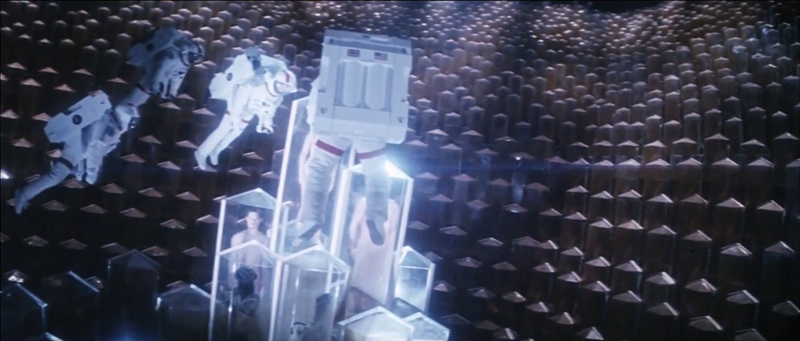
 During a joint NASA/ESA mission to intercept Halley’s comet, Col Tom Carlsen (Steve Railsback) of the spaceship Churchill and his crew pick up something extraordinary: a massive alien ship in the tail of the comet. The commander decides to divert the mission to the mysterious spacecraft, which upon closer inspection has an organic appearance. As Carlsen and his fellow astronauts make their brief foray* into the ship’s cavernous hulk, they encounter the desiccated floating bodies of large bat-like creatures. Another chamber yields a more surprising discovery, with what appear to be three humans (one woman and two men)** entombed in crystalline sarcophagi. The ship returns to Earth, with the three bodies and alien remains in tow, but meets with calamity along the way. A rescue crew reaches the Churchill in Earth orbit, only to find the interior and astronauts charred beyond recognition. Somehow, the residents of the clear coffins appear to be unscathed from the fiery accident, and are brought to terra firma for further scrutiny. Before you can say “bringing them back to Earth was a terrible idea,” the humanoids escape their containers, and proceed to feast on the life energy of every hapless person they encounter. We soon learn, however, that Carlsen also avoided destruction on the Churchill, utilizing the ship’s escape capsule*** in the nick of time. British authorities take Carlsen into custody, as he harbors the secret about what occurred on the doomed mission, and may possess the key to stopping the rampage of the space vampires.

* Fun Fact #2: To simulate the astronauts floating in space, Hooper and company utilized the same team responsible for the flying rig used in Superman: The Movie (1978).

 ** Fun Fact #3: Billy Idol was originally approached to play one of the male space vampires, but when casting plans fell through, the filmmakers brought in Chris Jagger (Mick’s younger brother) for the part. 

 *** Side Note: Considering the crew’s size, the escape pod (which conjured images of the tiny space capsule from the 1965 schlock-fest Monster a Go-Go), seems ridiculously small. Apparently designed for one lucky astronaut, it begs the question: How would they decide who lived and who died?


 If there’s a solitary raison d'être for Lifeforce, it’s French actress Mathilda May, who commands attention whenever she’s on screen. May was cast after an exhaustive worldwide search (Hooper claimed approximately 50 actresses auditioned for the part)* for someone who would play a role that demanded excessive nudity.** May’s background as a professional dancer proved especially invaluable in her depiction of an alien presence, with her precisely controlled movement. She mesmerizes whenever she’s on the screen, conveying the right balance of otherworldly beauty and subtle menace. To the men who encounter her, she’s a siren – they’re powerless to resist her charms, even though meeting her won’t end well. She establishes an inextricable bond with Carlsen, which horrifies and tantalizes him in equal parts. She’s an ideal construct culled from his vision of an ideal woman, illusory and unobtainable (“I am the feminine in your mind.”).

 * Fun Fact #4: According to Hooper, Olivia Hussey was among the actresses considered for the role. Some male actors that were considered for various other characters included Klaus Kinski, Terrence Stamp, and John Gielgud.

** In his DVD commentary, Hooper glibly stated, “It was like her costume.” 


Instead of focusing on Col. Carlsen’s obsession, I wish it had spent more time with Dr. Hans Fallada (Frank Finlay), a clear nod to Professor Quatermass in the Hammer films and BBC adaptations. Fallada is fascinated by the alien visitors and their implications. He opines that the creatures visited Earth long ago, giving rise to the vampire folklore and legends. It’s an intriguing story element that could have been developed further, rather than concentrating on tracking down the rogue vampires. The clunky middle act gets bogged down with Carlsen assisting British agents led by SAS agent Colin Caine (Peter Firth). No one questions his histrionics in his zeal to find the female space vampire, who’s jumped to a new body. Inexplicably, he’s given free rein to slap around a woman (Nancy Paul) suspected of harboring the malevolent vampire’s spirit and abuse sanitarium director Dr. Armstrong (Patrick Stewart), who has also been afflicted.


Unlike some traditional vampire films, the vampire rules are inconsistent. It’s unclear whether direct contact or mere proximity are necessary for a spirit to jump from body to body. The original three vampires, while insatiable, don’t appear to weaken rapidly, whereas the infected humans wither away at an accelerated rate, becoming the “walking shriveled” (Hooper’s term). Also, why does the female vampire possess a sexual magnetism toward men, but the male vampires don’t seem to have a similar effect on women? Taking this a step further, why couldn’t the vampires have had a similar mesmeric effect towards people of the same sex? With the exception of a brief kiss between two men (which is a bit of cheat, since one is inhabited by the female vampire’s spirit), the film restricts itself to heterosexual attraction, and overwhelmingly appeals to the male gaze. This limits the myriad possibilities of sex as lure, restricting the implicit theme to a superficial “women are scary”


The $25 million Cannon production was met with mostly mixed to negative reviews when it was first released, no thanks in part to the butchered U.S. version (at distributor Tri-Star’s insistence). Lifeforce has since gained a loyal following, not simply because of Mathilda May’s inimitable presence, but its wildly ambitious story. It boldly suggests something extraterrestrial in origin influenced human history and folklore, inhabiting our myths and fears. The climactic scene of mass pandemonium on the streets of London is reminiscent of the dénouement to Quatermass and the Pit (1967), which shares similar themes. At the same time, the story isn’t nearly as focused as Quatermass, but it’s a noble effort nevertheless. Lifeforce manages to balance some heady ideas with some good old-fashioned exploitation, creating an entertaining mix. It didn’t play it safe. If only more genre films would follow its lead. 

Tuesday, September 8, 2020

Space Truckers

(1996) Directed by Stuart Gordon; Written by Ted Mann and Stuart Gordon; Starring: Dennis Hopper, Stephen Dorff, Debi Mazar, Charles Dance, George Wendt and Vernon Wells; Available on Blu-ray (Region B) and DVD (Out of Print)

Rating: ***

“I had this idea that had been kicking around for years about truck drivers in space, and had gotten to be friendly with Ted Mann (co-writer), and it turns out that both of us were frustrated astronauts, and when we were kids, that’s what we both had dreamed about, going into space… And when I told him the idea of blue-collar people in space, just doing their jobs, he really responded, and we started just throwing together a treatment.” – Stuart Gordon (excerpt from 2018 featurette, “Space Trucking with Stuart Gordon”) 

The late, great Stuart Gordon will forever be associated with his H.P. Lovecraft adaptations, particularly Re-Animator (1985) and From Beyond (1986). A deeper dive into his filmography, however, yields some surprising titles, spanning multiple genres. Produced on a budget of $27 million,* the sci-fi/comedy Space Truckers** was his largest-budgeted film to date. It was filmed on a sound stage at Ardmore Studios in Ireland,*** where a nearby beach served as a desert. While the film saw some overseas distribution, it wasn’t released theatrically in the U.S., instead debuting on HBO.

* Fun Fact #1: The filmmakers were approached by Universal, which would have added more money into the film’s production and distribution, but one of the film’s producers turned the studio down. 

** Fun Fact #2: According to Stuart Gordon, Stephen Dorff’s agent wasn’t enamored with “Space Truckers,” so the actor’s contract included a clause that gave him a final say on the title.

*** Fun Fact #3: Gordon remarked that while the movie’s final title was in limbo, Variety listed the film as “Untitled Irish Space Movie.”


If you took the space diner scene from Spaceballs (1987), minus the chestburster, and turned it into its own movie, you might get something like this. Set within our solar system circa 2196 (or 2145, depending on which of the film’s trailers you believe), Space Truckers depicts the blue-collar side of space colonization, with people performing the intensive manual labor required to keep things going. The space truckers are the life blood of the colonies, shipping goods throughout the solar system. After veteran trucker John Canyon (Dennis Hopper)* has a falling out with his boss Keller (George Keller), he accepts a lucrative but risky assignment, hauling an illegal payload to Earth with no questions asked. He has a thing for Cindy (Debi Mazar), a waitress at the truck stop’s greasy spoon, and finds the perfect way to win her hand (if not her heart). Canyon agrees to take her with him to Earth, where she can be reunited with her mother, if she agrees to marry him. Enter plucky but inexperienced novice trucker Mike Pucci (Stephen Dorff), who connives his way into tagging along. The mismatched trio soon learn that they’re in for much more than anyone had anticipated when they tangle with a cargo of biomechanical battle drones, and encounter ruthless space pirates, led by Macanudo (Charles Dance).

* Fun Fact #4: According to Gordon, the mercurial Hopper commented that he was the “worst” director he’d ever worked with.

Despite any disagreements Dennis Hopper might have had with Gordon, he does a fine job portraying the irascible trucker Canyon. He doesn’t take any crap from anyone, and is prepared to fight for what he believes in. Beneath his crusty exterior, though, it’s easy to see he has a soft spot for hard luck cases like Cindy and Mike. Debi Mazar is good as flighty, New York-accented Cindy. Unlike Canyon, she’s more than willing to compromise her ideals if she can get ahead. Stephen Dorff, especially as Cindy’s object of affection, is significantly less convincing. Their romance seems perfunctory at best, with little on-screen chemistry. Considering her character’s choices throughout the film, it’s a safe bet that she’d sell him out if she found a better opportunity. Charles Dance threatens to steal the show from everyone else as the cybernetic space pirate Macanudo. It’s obvious he enjoyed playing the sneering villain (apparently, he was encouraged by his daughter to play the part). Also, be sure to watch for fun cameos from Stuart Gordon regulars Barbara Crampton and Carolyn Purdy-Gordon (the director’s wife).

Space Truckers keeps its metaphorical tongue firmly planted in its cheek, which carries through to the whimsical flourishes of the space designs. Gordon stated that he made a conscious effort to include color in the typically colorless environment of space, including garish floating billboards and custom paint jobs on the truckers’ ships. The living spaces/interiors have a lived-in look (based on concepts by Ron Cobb), similar to Outland (1981), but the truck stop diner’s curved floor owes a debt of gratitude to the design of the spacecraft Discovery’s main interior in 2001: A Space Odyssey (1968). In contrast to Cobb’s nuts and bolts approach, Hajime Sorayama designed the appearance of the sleek cybernetic warriors.* Gordon commented that, in retrospect, he wished all the effects were CGI. Personally, I’m glad this wasn’t the case. The practical, model-based effects hold up the best, while the early CGI effects show their limitations. In a scene where Canyon punches one of Keller’s thugs, there’s an unconvincing spray of computer-animated blood and a floating tooth that resembles a popcorn kernel. Likewise, the computer-rendered pirate ship resembles video game graphics (Yes, I know they’ve gotten much better in 20+ years). Comparatively, the practical effects are much more compelling, if not exactly realistic (e.g., Canyon’s rig, The Pachyderm 2000, and various makeup effects and prosthetics). Among the most memorable creations are the “square pigs” that fit neatly in their cubical pens.

* Fun Fact #5: In order to match the decidedly feminine body contours in Sorayama’s concept artwork, the robots were all played by female models.

Considering Gordon was working with a larger budget, Space Truckers doesn’t look like an expensive production, which works to its advantage. It’s a B picture through and through, more interested in off-kilter ideas (whether they work or not) than surface gloss. Space Truckers doesn’t have a big message (other than greed, corruption and the lust for power will always be around), and never takes itself too seriously. It’s just trying to have a good time, inviting us along for the ride. So, grab a cold one (or two), sit back, and take in the view.