Thursday, February 20, 2020

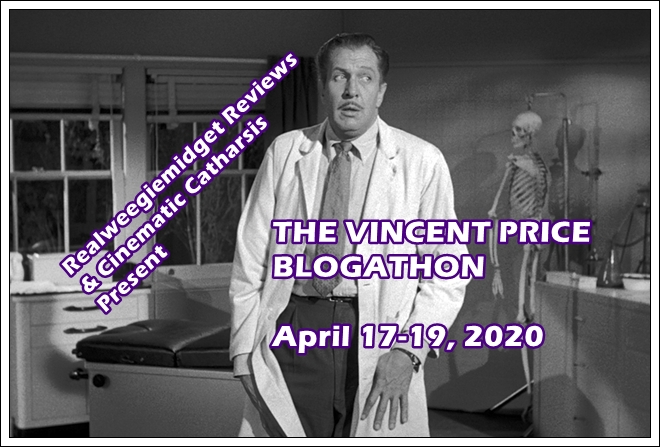
Announcing The Vincent Price Blogathon


It had to happen. You knew it was inevitable. You just didn’t know where it was coming from or when it would occur. Without additional fanfare, I, along with blogging partner extraordinaire Gill Jacob of Realweegiemidget Reviews, proudly present The Vincent Price Blogathon. We hope to showcase, with your help, all things wild, wonderful and (yes), wacky about this true Renaissance man.


Aside from a handful of contemporaries, few would dispute his position as the reigning crown prince of horror, but his career has spanned multiple genres, and encompassed a multitude of interests that went far beyond the silver screen. You don’t have to restrict your topic to movies. Feel free to explore virtually any aspect of Mr. Price’s amazing life, including his work on the stage, numerous TV appearances, voiceover work, cookbooks, and philanthropic efforts. Oh, and don’t let the “blog” in blogathon scare you. We will happily accept submissions from your podcast, YouTube channel, Facebook/Instagram post, public restroom scrawlings (okay, maybe not); wherever your Vincent Price muse takes you. Surprise us!


Not sure where to start? You can find a list of Mr. Price’s movies here

Still stumped for a topic? Feel free to reach out and bounce your idea off us. We won’t bite (much)!


What: The Vincent Price Blogathon

Who: Hosted by Gill Jacob and Yours, Truly (Barry P.)

Where: Realweegiemidget Reviews and Cinematic Catharsis

When: April 17-19, 2020

How: Please read the rules below, and send me your post request (review, podcast, etc…) via email (barry_cinematic@yahoo.com), Twitter (@barry_cinematic), or by commenting below. You may also contact Gill by commenting on her post, or through her blog’s Contact Me page. (Be sure to include your preferred name, along with your blog’s title).

NOTE: Find an updated list of participants here.


Here are the rules…

1.     You can review ANY of his films or TV shows. Or if you want to review books or topics about him that’s fine with us as well.
2.     We will allow just one duplicate review for each topic/title (movie, book or TV show). If a specific title has already been claimed twice, you may only include that title if it’s part of a list or retrospective review. If you choose to write about Vincent Price, tell us what your topic will be. We won’t accept posts which are uncomplimentary or disrespectful to him.
3.     Review choices can be added as a comment on this page or you may contact me through the methods listed above.
4.     Add your Twitter username so we can promote your post.
5.     A full list of blogs and review choices will be posted on a separate page and updated regularly.
6.     Only original, never-before-published posts will be accepted.
7.     Send a link of your post link to Gill or me on one of the days of the blogathon.
8.     Note: We will be publishing all links on both blogs, each day of the blogathon.
9.     Please also note: Gill and I have already claimed the following titles below. As a result, we will only accept ONE more review for each of these films (first come, first served).

Barry at Cinematic Catharsis – Dragonwyck (1946)

Gill at Realweegiemidget Reviews – Theatre of Blood (1973)


One more thing:

If you plan to participate, or just want to show your support, please grab one of the following banners to display on your blog:


We can’t wait to see your submissions. Be creative, and above all, have fun!

Sunday, February 16, 2020

Short Take: The Frighteners


(1996) Directed by Peter Jackson; Written by: Fran Walsh and Peter Jackson; Starring: Michael J. Fox, Trini Alvarado, Dee Wallace Stone, Jake Busey, Jeffrey Combs, Chi McBride, Jim Ffye, John Astin and Troy Evans; Available on Blu-ray and DVD

Rating: ***

“There haven’t been that many ghost movies, not comparatively…It’s quite good because you have a lot of freedom; flexibility to make up your own rules. It’s not like a vampire film with all the garlic and the stakes in the heart, a werewolf film with silver bullets and things. Ghost films, a lot of ghost films, treat ghosts in different ways, so there are no real rules…” – Peter Jackson


Before Peter Jackson was a household name, he left his mark in cult circles with titles such as Bad Taste (1987) and Meet the Feebles (1989). He gained a larger audience with Dead Alive (aka: Braindead) (1992) and widespread critical acclaim with Heavenly Creatures (1994). Bridging the gap between these lower-budget efforts and his later, mega-budgeted productions was The Frighteners (1996), which seems to have become lost in the shuffle over the years. Jackson and crew shot The Frighteners in New Zealand (standing in for a small American town) over the course of six months, on location in the coastal community of Lyttelton* and Weta Studios in Wellington.

* Fun Fact #1: If you look carefully to the left of Trini Alvarado (who appears as Lucy Lynskey) in a funeral scene you might spot a fire in the hillside. According to Jackson, the film crew burned down Bannister’s house, which was the most efficient means of disposal during the final day of shooting in Lyttelton.


Michael J. Fox stars as self-proclaimed psychic investigator Frank Bannister, who’s earned a reputation as a scam artist. Bannister is a broken man, living in an uncompleted house (a metaphor for a life in shambles). When he’s not drumming up business at funerals, promising to reunite the bereaved with their deceased loved ones, he helps people rid their homes of supernatural pests.* As we soon discover, he’s a scam artist with a twist, endowed with the ability to see spirits and communicate with them. He uses this gift for his own ends, staging poltergeist infestations, with a little help from ghostly accomplices Cyrus and Stuart (Chi McBride and Jim Fyfe).

* Fun Fact #2: Jackson’s infant son Billy (in a red jumpsuit) appears in one scene, in which three babies float in midair (assisted by Frank’s spectral buddies).


The Frighteners boasts some fun, quirky performances,* but none quite compare to Jeffrey Combs’ idiosyncratic portrayal of Agent Milton Dammers. Dammers exists in his own little world, with oddly specific facial expressions and odd mannerisms (for example, he can’t tolerate being shouted at by women), or when he warns the local sheriff (Troy Evans), “You are violating my territorial bubble.” Dee Wallace is also good as the mentally disturbed Patricia Braley, who keeps us guessing until the end. Jake Busey is suitably maniacal as her mass-murderer boyfriend Johnny Bartlett, returning as a malevolent spirit. John Astin also makes an amusing appearance as The Judge, an Old West gunslinger (with makeup designed by Rick Baker) who’s falling apart, piece by piece.

* Fun Fact #3: Jackson planned to find a New Zealand-based actor to play Hiles, the drill sergeant ghost, but when auditions didn’t pan out, he offered the role to R. Lee Ermey for a reprisal of sorts of his infamous character from Full Metal Jacket.


The ghost effects hold up, combining blue screen techniques with traditional makeup to create a diaphanous appearance. Unfortunately, many of the early computer-generated effects haven’t aged nearly as well. These technical issues would be easy enough to overlook, if not for concerns with the story and pacing. The action is frenetic, rather than focused, with some humorous bits that fall short. One of the key characters, Ray Lynskey (Peter Dobson), who appears mainly for comic relief, seems more extraneous than essential to the plot. It’s an unsatisfying balancing act between horror and comedy, which was handled much more effectively in Jackson’s earlier film, Dead Alive. In his DVD commentary, Jackson admitted to constant re-writes during production, stating that he and long-time writing partner Fran Walsh probably needed more time to work on the script. On a tangential note, it’s unlikely anyone would give the script a green light today, with a mass shooting as one of the key scenes/plot points. If the finished film is a hit and miss affair, the scales are tipped slightly in its favor, thanks to some eccentric performances. Although The Frighteners may not be one of Jackson’s best efforts, it merits a look, perhaps if only for what could have been.

Sunday, February 9, 2020

The Haunting of Julia (aka: Full Circle)


(1977) Directed by Richard Loncraine; Written by Dave Humphries; Based on the novel Julia by Peter Straub; Starring: Mia Farrow, Keir Dullea, Tom Conti, Jill Bennett, Robin Gammell and Cathleen Nesbitt; Available on DVD (Import)

Rating: ****

“I’m happy. Excited about everything being suddenly new, like all this, and I’m more frightened than I’ve ever been in my whole life. It’s like stepping out on a window ledge and feeling so alive, because all the time, part of you wants to jump. Sometimes I feel I’ve already jumped.” – Julia Lofting (Mia Farrow)

“Evil never dies.” – Heather Rudge (Cathleen Nesbitt)


Before I delve into this week’s movie, here’s a much-deserved shout out to Gabriela of Pale Writer for hosting The Magnificent Mia Farrow Blogathon. Be sure to check out the posts from other bloggers, showcasing the talented actress and her work. I’m pleased to contribute to this blogathon (and as the opening post for Ghost Month) with a discussion of Farrow in the seldom-seen supernatural film, The Haunting of Julia (aka Full Circle). WARNING: There are some spoilers ahead.

There are few events that come close to the all-encompassing trauma of a parent losing a child. The Haunting of Julia depicts a woman in mourning over her daughter’s death, and her attempts to come to grips with life afterwards. Director Richard Loncraine (working with a script adapted from the Peter Straub novel Julia) adopts a simple approach, short on effects-laden spectacle, but big on atmosphere and nuanced performances. As suggested by the title, it’s as much about how a person, rather than a musty old edifice, can be directly affected by a haunting.


The film opens on a tragic note, with Julia Lofting’s (Mia Farrow) daughter Kate choking on an apple. In a moment of panic, Julia attempts to save her by performing an impromptu tracheotomy with a kitchen knife. To this viewer it’s a bit of a chicken-or-egg dilemma that we’re not sure if the daughter dies from choking or her mother’s botched attempt to save her. The end result is the same, as the daughter expires before the paramedics arrive. The story jumps forward several weeks later, after Julia is released from the hospital. Instead of going home with her husband Magnus (Keir Dullea), she actively avoids him, purchasing an old house instead. Not long after she’s moved in, however, Julia begins to notice a series of unusual occurrences: her bedroom’s heater turns on by itself, during a séance, arranged by her sister in law Lily (Jill Bennett), a medium (Anna Wing) becomes inconsolably disturbed, and one of Julia’s guests is pushed down the staircase by an unseen force. Julia learns about the morbid history of her home, where a young girl, Olivia Rudge, died under circumstances similar to her daughter, nearly 40 years ago. She takes it upon herself to learn more about the girl, and her connection to a group of kids who tortured and killed a young neighbor boy.


Farrow, sporting the same pixie cut as her title role in Rosemary’s Baby a decade prior, is the embodiment of all-consuming grief. A cloud of depression looms over Julia’s head, coupled with overwhelming guilt over the death of her daughter. She finds some solace in her new home, away from her loveless marriage. Now that Kate is gone, she and Magnus have lost the only thing they had in common. When her sister in law Lily (Jill Bennett) nudges her to reconcile with Magnus, Julia simply replies, “Needs me? There’s a side I haven’t seen.” In her new, independent life, she’s determined to find meaning in her daughter’s death. Julia’s trajectory shares some interesting similarities with John, the main character of another ‘70s supernatural film, Don’t Look Now (1973). Both films featured protagonists who suffered the death of a child, and both had visions that formed the basis of an obsession, which in turn led to their personal destruction (both meet their end in a strikingly similar, bloody fashion).


Tom Conti shines as Julia’s friend Mark, a ray of sunshine in her otherwise gloomy life. As the film’s most likable character, he displays the compassion her husband is incapable of showing. It’s a credit to the filmmakers that they didn’t try to turn their relationship into something else. A lesser film would have played up the implied romantic aspects, forcing the characters into a perfunctory love scene. As it stands, there’s an undeniable chemistry between them; if events in the film would have played out otherwise* it seems plausible that a romance would have eventually blossomed. What we see on the screen, however, is strictly platonic.

* Random Observation: Mark meets his untimely demise in a bathtub, no thanks to a malevolent spirit and a radio. It just goes to prove if you listen to Pat Boone while bathing, prepare to suffer the consequences.


Keir Dullea is icily effective as Julia’s emotionally distant husband Magnus. He doesn’t understand her behavior subsequent to Kate’s death, and thinks she should move on with things and return home. At the same time, he believes she’s mentally unstable, and intends to hire a psychiatrist to have her institutionalized. Magnus’ lack of empathy is evident in his delivery of a non-apology, when he says, “Whatever it is that you think I did to you, I’m sorry.” In the end, he’s more concerned about losing her money, and by extension his prestige, than reconciling their damaged relationship.


The film has a few narrative hiccups along the way, which suggest that some sequences might have been truncated or omitted entirely. In one of the most glaring gaps, her husband meets his end halfway through, while sneaking around Julia’s basement. No one questions why his harassment of Julia suddenly stops, or notices any strange odors emanating from downstairs. In a similar vein, Julia doesn’t seem to be concerned when Mark fails to show up at her doorstep, even though he emphatically stated he would accompany her on a visit to Heather Rudge (Olivia’s now elderly mother, who resides in a sanitarium).


As with many supernatural films from the 1970s, The Haunting of Julia doesn’t rely on jump scares, elaborate visuals, or immersive sound effects that have become so prevalent in today’s storytelling. Instead, it maintains a slow burn throughout, starting with a feeling of unease in the opening scene, gradually escalating to a solemn conclusion. In one of the most chilling scenes, a ghostly child’s hand runs across Julia’s face as she sleeps. Much of the horror is conveyed through the actors’ expressions and intonations. The audience is prompted to fill in the blanks when Julia speaks with two of the individuals (now grown men) who were in Olivia’s twisted circle, providing a glimpse into the girl’s awful nature. The Haunting of Julia illustrates how ghosts can manifest themselves in myriad ways: as a memory that refuses to die, wish fulfilment (seeing the deceased individual), or a bridge from the realm of the dead to the living. We’re reminded that ghosts are as much (if not more so) a manifestation of the mind than a spectral being. When most people think of Mia Farrow and horror, Rosemary’s Baby immediately springs to mind, but I suggest there’s another title equally worth talking about.

* Side Note: Unfortunately, you might have to dig around to find this film. As of this date, it’s only available as a French import DVD or for download/streaming through Amazon or iTunes. Hopefully someday we’ll see a remastered Blu-ray through Arrow, Criterion, or similar. 

Sunday, February 2, 2020

Japan-uary IX Quick Picks and Pans


Harakiri (1962) Hanshiro Tsugumo (Tatsuya Nakadai), a disgraced samurai, arrives at the gates of a rival clan, requesting the right to commit ritual suicide. The leaders are skeptical about the veracity of his intentions, based on the actions of former visitors, who made similar claims but were only looking for a handout. Director Masaki Kobayashi (working from a script by Shinobu Hashimoto, which was based on a novel by Yasuhiko Takiguchi) tells much of the story through flashbacks, gradually revealing how Tsugumo reached this pathetic state. Nakadai’s intense performance anchors the film, playing his role like a man possessed. Harakiri expertly illustrates how concepts such as honor and reputation are built on shaky ground, and how the truth (which serves as the foundation) can be malleable.

Rating: ****½. Available on Blu-ray and DVD


A Letter to Momo (2011) Writer/director Hiroyuki Okiura spins a bittersweet, beautifully animated tale that employs gentle comic moments to balance the serious themes. After her father’s untimely death, Momo, a young girl, and her mother move from Tokyo to the remote island community of Shio. Adjusting to island life proves to be a challenge, as Momo contends with her grief, and ambivalence about forming new friendships. Her problems multiply when she encounters three mischievous (and very hungry) goblins, who seem reluctant to leave her alone. Momo’s evolving relationship with the goblins (from animosity to acceptance) opens the door for her to gradually experience new friendships and begin the healing process. A Letter to Momo provides a touching portrait of the many faces of grief, and how one girl learns to literally and metaphorically overcome her demons.

Rating: ****. Available on Blu-ray, DVD and Kanopy


Shoplifters (2018) Five unrelated individuals living on the fringe of society form a loose family unit, finding love and belonging in each other. The “mother” (Sakura Andô) and “father” (Lily Franky) subsist off odd jobs, while the elderly “matriarch” of the group (Kirin Kiki), earns money through a grifting scheme. The quintet grows to six after an abused five-year-old girl (Miyu Sasaki) enters their lives. At every turn, they skirt the law, and societal norms, so they can maintain some semblance of livability. All the while, we know it’s a lifestyle (which includes casual shoplifting to supplement their meager existence) that can’t be sustained, which leads to an inevitable, heartbreaking conclusion. Writer/director Hirokazu Koreeda illustrates how the concept of family is a construct – it’s not blood, but the emotional connections between individuals that matter.

Rating: ****. Available on Blu-ray (Region B) and DVD             


Zoo (2005) Like most anthology films, the genre-spanning Zoo is a bit of a mixed bag, but its five segments, based on stories by author Otsuichi, are distinctive and frequently unsettling. In the tense, unnerving, “Seven Rooms,” directed by Masaki Adachi, seven women and one small boy are trapped in seven cells for some unknown purpose. In the emotionally charged “So Far,” a boy is torn between a mother and father who no longer see each other, a novel representation of how children process estrangement. Junpei Mizusaki’s “The Poem of Collected Sunlight” (similar in theme to “Presence” from Robot Carnival), the sole animated segment, features an android woman who learns about life and death from her creator. In “Kazari and Yoko,” an abused high school girl finds companionship and purpose after she’s befriended by an elderly woman. Hiroshi Ando’s title segment is uneven but has some genuinely disturbing moments. With a story to fit every mood, Zoo is recommended viewing.

Rating: ***½. Available on DVD


The Living Skeleton (1968) Hiroki Matsuno spins a tale of ghostly revenge, anchored by a mesmerizing, moody performance by Kikko Matsuoka, in a dual role as twin sisters. A ship re-surfaces from its watery grave, with its dead occupants returning to exact retribution against the group of thugs who hijacked their vessel and murdered them. The Living Skeleton has an abundance of memorable visuals on a tight budget, with atmospheric, black-and-white widescreen cinematography by Masayuki Katô and creepy, low-key effects by Tarô Fukuda and Keiji Kawakami. Likewise, the macabre story is full of creepy surprises.

Rating: ***½ . Available on DVD (part of the Criterion Eclipse Series 37: When Horror Came to Shochiku)


Female Prisoner #701: Scorpion (1972) This first in a series of three films, directed by Shun'ya Itô stars Meiko Kaji as Nami Matsushima, a woman imprisoned for attacking the corrupt police detective (Natsuyagi Isao) who set her up. She endures the jeers and abuse by sadistic prison guards and other prisoners who want to kill her. This stylish exercise, with expressionistic flourishes includes some standout scenes: a shower fight with a broken bottle and a sequence in which Matsushima is forced to dig a pit, while her fellow inmates are ordered to bury her alive. Brash, violent, and unabashedly exploitive, this movie hits all the right buttons.

Rating: ***½. Available on Blu-ray, DVD, Amazon Prime and Shudder


Yatterman (2009) Takashi Miike tackled virtually every genre, so it was only a matter of time before he tried his hand at this (mostly) family friendly sci-fi/fantasy adventure, based on the 1977 anime series Yattāman. The story (such as it is), concerns the exploits of boyfriend/girlfriend team (Shô Sakurai and Saki Fukuda) and their giant robotic wolf defending the world from evil. Their archnemesis, shapely villain Doronjo (Kyoko Fukada) is assisted by her goofy henchmen, rat-like Boyacky (Katsuhisa Namase) and the pig-like Tonzuraa (Kendô Kobayashi). The silly, cartoonish action (packed with sexual innuendos) seems to take place on an alternate universe Earth. There’s a ton of action, colorful designs and some nutty throwaway gags, but something seems to be missing from the mix. If you’re a Miike fan or just like mindless fun, it might be worth a look. Just don’t look for much else.

Rating: ***. Available on Blu-ray and DVD


Tokyo 10+01 (2003) Set in the near future, this sporadically entertaining sci-fi comedy pits eleven contestants in a competition. The prize: a large cash bonus and a pardon from their crimes (Shaky alliances and double-crosses ensue.). Unfortunately, it’s hampered by cut-rate production values and cheap effects. Also, the 70-minute running time somehow seems to be stretched thin. The characters are reduced to two-dimensional stereotypes (the nerd, the man-hating temptress, a fast-talking con man, twin acrobats, etc...), and after the premise is set up, it doesn’t know where to go. Writer/director Higuchinsky has done much better (Uzumaki, Long Dream). Do yourself a favor and see Battle Royale or The Running Man instead.  

Rating: **½. Available on DVD


Ghost Squad (aka: Gôsuto sukuwaddo) (2018) If you’re familiar with prolific writer/director Noboru Iguchi’s previous work (The Machine Girl, RoboGeisha), then you already have an idea what to expect: scantily clad heroines, copious amounts of gore (although not as much as in earlier films), and slapstick comedy. A socially awkward young woman with thoughts of suicide is visited by the ghosts of three young women who were murdered. She assists them in their quest for vengeance against their killers, and in turn, they help her tackle her problems (abusive father, demeaning boss). It’s a fun premise, with a few funny bits scattered throughout, but it’s ultimately undermined by uneven pacing, paper-thin characters, and a slipshod story.

Rating: **½. Available on DVD and Amazon Prime


Lupin the Third: Strange Psychokinetic Strategy (1974) This live action adaptation of Monkey Punch’s venerable creation about a gentleman thief misses something in the translation from manga to the big screen. As presented here, our nominal protagonist (Yûki Meguro) is loutish and insufferable, taking too many moments to wink at the camera. The plot meanders, and the cartoon-style sequences (accompanied by slide-whistle sound effects) and unfunny gags are only there to underscore Lupin’s insatiable libido. Instead of the irascible rogue depicted in his anime incarnation, he comes across as a borderline sex offender. Aside from an unlikable protagonist, the film could have benefited from a proper nemesis for Lupin. As presented here, police inspector Zenigata (Shirô Itô), is a bumbling fool. My suggestion: skip it, and watch Lupin III’s animated adventures in The Castle of Cagliostro instead.   

Rating: *½. Available on DVD

Monday, January 27, 2020

Short Take: Mr. Thank You (aka: Arigatô-san)


(1936) Written and directed by Hiroshi Shimizu; Based on a short story by Yasunari Kawabata; Starring: Ken Uehara, Michiko Kuwano, Mayumi Tsukiji, Kaoru Futaba, Ryuji Ishiyama, Einosuke Naka and
Available on DVD

Rating: ****

“So far this fall, I’ve seen eight girls cross this pass, headed for paper factories and cotton mills, and who knows what else. Sometimes I think I’d be better off driving a hearse.”
– Ken Uehara (Mr. Thank You)


Who among us who ride (or have ever utilized) public transportation, hasn’t speculated about the lives of our fellow passengers? We cast furtive glances and pick up snippets of conversations, hoping to glean tidbits of information that will add up to a coherent composite. Hiroshi Shimizu’s Mr. Thank You (aka: Arigatô-san) explores this simple premise, following a bus driver and his passengers on a typical route. Due to the long (in relative terms) route and cramped confines of the petite bus, we get a more intimate profile of the passengers.


The opening montage introduces us to our protagonist, a mild-mannered bus driver (Ken Uehara),* as he makes his daily rounds. We learn how he earned his nickname as “Mr. Thank You,” traveling the narrow, dusty roads, calling out a friendly “Arigato” (“Thank you”) to everyone he encounters, as they clear a path for his bus. He’s very popular with the women he encounters along the way, but there’s no time for romance beyond brief flirtatious exchanges. He does his best to help the people that come and go along his route, whether they can afford a bus ticket or not. In some cases, help might consist of conveying goods (such as the latest hit record), or simply relaying information. Despite the daily hardships he witnesses, he takes everything in stride, with grace and a smile.

* Fun Fact: If Uehara looks familiar, he’s appeared in many films over the next several decades, including a few from Ishirô Honda, typically as a distinguished elderly scientist/official (Mothra, Gorath, Atragon).


In its gentle, understated way, Mr. Thank You provides ample commentary about the sorry state of affairs in 1930s Japan, reminding us that the Great Depression was very much a global phenomenon. A doctor on his way to visit an expectant mother comments, “Every village is producing lots of babies… And when they grow up, the boys become vagrants, and the girls are sold cheap by the dozen.” Work is scarce, and those who manage to find something often face uncertainty and peril. Mr. Thank You, casually assesses the grim reality of the situation, observing, “The girls who cross these passes rarely make it back.” He stops briefly to chat with one itinerant worker, cognizant of the fact that she can’t afford to ride on the roads that she helps to build.  


Among a series of hard luck stories, the saddest tale belongs to a 17-year-old and her mother (Mayumi Tsukiji and Kaoru Futaba), who board the bus, headed for a train station. The girl is destined to suffer the fate of many young women in rural towns who have not yet married, sold off to a Tokyo brothel. In one scene, she admonishes her mother, “I’m ashamed to tell people the truth. From now on, just say I’m going to visit relatives in Tokyo” Her mournful story is contrasted with a happy father and daughter returning from Tokyo, who have just finalized the daughter’s wedding plans. For them, it’s a time of celebration and happy memories – a sharp, heart-rending contrast to the awful future that awaits Futaba’s character.  


Another key character is the young (unnamed, as are her fellow passengers) woman who sits behind the driver (Michiko Kuwano). She’s only a few years older than the girl, but has experienced much more in those years, traveling from town to town to find work (what sort of work is never mentioned, but we can only speculate). She compares herself to a migratory bird, and like a bird, takes the girl under her wing during their journey. Kuwano enjoys some of the film’s best comic moments, as she shelters the girl from a lecherous, middle-aged businessman with less than honorable intentions.  


The film’s gentle comedic sequences, accompanied by Keizô Horiuchi’s jaunty score, bely the serious undertones throughout. It’s the comedy, however, that makes it easier to digest the more unsavory bits, so Shimizu’s film never seems heavy-handed or preachy. Isamu Aoki’s hair-raising cinematography perfectly illustrates the dizzying heights Mr. Thank You’s bus traverses, navigating treacherous switchbacks, and narrowly averting the precarious cliff edges. Mr. Thank You provides a fascinating glimpse into another time and place, when the world seemed much larger, and a 20-mile stretch of road was a vast expanse.

Wednesday, January 15, 2020

Mothra


(1961) Directed by Ishirô Honda; Written by Shin'ichi Sekizawa; Based on the novel The Luminous Fairies and Mothra, by Shin'ichirô Nakamura, Takehiko Fukunaga and Yoshie Hotta; Starring: Furankî “Frankie” Sakai, Hiroshi Koizumi, Kyôko Kagawa, Yumi Itô, Emi Itô and Jerry Itô; Available on Blu-ray and DVD

Rating ***½

“We wanted to do something that was new, for the whole family, like a Disney or Hollywood type of picture. We wanted it to be brighter, nicer.” – Ishirô Honda (from Ishiro Honda: A Life in Film, From Godzilla to Kurosawa, by Steve Ryfle and Ed Godziszewski, with Yuuko Honda-Yun)


When you create one of the most distinctive, fearsome giant monsters of all time, how do you top it? To start with, you don’t. Seven years after Gojira made its debut, producer Tomoyuki Tanaka and Toho went back to the drawing board. Instead of creating a bigger, meaner rival to the super-sized reptile, they devised a whole new class of kaiju. The resulting movie, Mothra, is a different beast from Gojira. The titular creature, along with its origin, is less menacing, and more fanciful. While there’s plenty of room for social commentary, the overall tone is lighter, with an emphasis on fantasy over widespread devastation (although the film doesn’t skimp in that department).


After four shipwreck survivors are found alive and well on remote Infant Island (thought uninhabitable, due to atomic testing), a scientific expedition is launched to gather more facts. Although it’s a Japanese vessel and crew, the expedition is bankrolled by foreign tycoon Clark Nelson (played with great, sneering panache by Jerry Itô, billed as “Jelly” Itô in the American version), whose motivations go beyond simple intellectual curiosity. Sensing a story, intrepid reporter Senichiro “Zen” Fukuda (Furankî “Frankie” Sakai) stows away on the ship. When they reach the South Pacific isle, they discover a lush jungle and native population, including a pair of tiny twin fairies* (played by twin sisters Yumi and Emi Itô, aka, singing group, “The Peanuts”). Sensing an opportunity to make a quick buck (or equivalent), Nelson abducts the twins, transplanting them to Japan to star in his new revue, “The Secret Fairies Show.” Nelson learns too late that one of their seemingly innocuous songs is a distress call, which carries a telepathic link. They soon awaken an ancient creature on Infant Island, driven by an unrelenting compulsion to bring them back home. Unfortunately for Tokyo and anything else that’s in the way, it can only mean untold property damage and displaced citizens.  

* Fun Fact #1: According to the informative Mill Creek Blu-ray commentary by Steve Ryfle and Ed Godziszewski, the original story called for four 60-cm fairies, instead of the two 30-cm women that appear in the film.   


If some of the above description sounds familiar (minus the fairies), it’s not by accident, but design that the basic plot in Mothra parallels King Kong (1933). Director Ishirô Honda admitted to the many similarities, but with one principal difference: unlike the film with the big ape, his oversized moth* wasn’t destined for a tragic end. Otherwise, it’s easy to see how many elements are similar: the expedition, an isolated island populated by natives who worship a giant creature, an unscrupulous promoter, a squadron of fighter jets, and a towering city landmark that becomes a centerpiece for a key scene.

* Fun Fact #2: According to the disc commentary, Mothra’s caterpillar stage was the largest costume ever created by Toho, measuring approximately seven meters in length, and requiring five to six people to operate it.


Compared to King Kong, however, Mothra is more socio-politically conscious, reflecting some of the controversies of the time. As originally envisioned by Honda and the writers, the film would have been more political, but many of those elements were trimmed in favor of entertainment. Even with the necessary compromises, the finished product still leaves much for contemporary audiences to consider. The specter of the fictional country of Rolisica (a thinly veiled melding of the United States and Russia) looms over the story, with its militaristic society, imperialistic intentions, and (paralleling U.S. nuclear testing in the South Pacific) casual attitudes toward displacing indigenous cultures. On the other hand, Mothra dilutes its message a bit when the Infant Island “natives” are depicted by Japanese actors in brown-face. Cultural insensitivities aside, it’s easy to agree that the unconscionable entrepreneur Nelson (who’s backed by the Rolisican government), is the embodiment of all the negative aspects of outsiders, rolled into one. In his quest to obtain the fairies for his own gain, he thinks nothing of mowing down a group of unarmed natives with rifles. When he finally has his prize, Nelson’s dismissive attitude is laid bare as he comments, “Those fairies aren’t human. They’re merchandise.” *

* Not So Fun Fact: Sadly, Nelson’s abhorrent behavior is not without precedent. His treatment of the fairies recalls human zoos, which flourished in the late 1800s, lasting well into the mid-1900s.


In addition to Jerry Itô’s scene-stealing turn, Mothra boasts some fine performances by the other cast members, especially Frankie Sakai as tenacious reporter Zen, who likens himself to a snapping turtle (a bulldog in the American version). Comic actor Sakai keeps things from getting too serious, with some well-placed moments of schtick. Zen’s counterpart, plucky photographer Michi Hanamura (played by veteran actress Kyôko Kagawa, in her only kaiju film), lends balance to his scenes, keeping everything from going too far over the top. Also watch for a blink-and-you-miss-it appearance of Honda regular Kenji Sahara as a helicopter pilot. Arguably, the true stars of Mothra, outside of the giant insect itself, are pop duo The Peanuts, who convey a childlike innocence and grace under adversity. Their signature song needs no introduction, as it’s become firmly entrenched in pop culture.   


Eiji Tsuburaya and his effects crew put their all into the film, to make the star attraction,* in its final form, a truly memorable creation. Somewhat more refined versions of Mothra would appear in later movies, but the basic design owes much to this early version. Other standout effects sequences include a bursting dam, and a detailed replica of Tokyo Tower, where the juvenile Mothra, aka: The Very Angry Caterpillar (my apologies to Eric Carle for the cheap shot) undergoes a metamorphosis. The film’s climax,** which takes place in the Rolisican capitol, dubiously named New Kirk City (an amalgamation of New York, San Francisco and Los Angeles), provides another chance for Tsubaraya to showcase his signature brand of wholesale destruction.  

* Fun Fact #3: There were three Mothra models used for the film: 1) a small version, used only for long shots, 2) a medium version, with flexible wings; and 3) a large version with a 2.5-meter wingspan, with more rigid wings and illuminated eyes.

** Fun Fact #4: A different ending was originally shot, which has been presumed lost (although still frames exist). The original cost-conscious ending, featuring a confrontation between Nelson and Mothra was nixed by Columbia, in favor of the conclusion in an urban setting (New Kirk City).


Some might argue there’s an awful lot of build-up before we see the star attraction, in all its glory. The big “M” doesn’t appear, in its final form at least, until well into the third act. Before that, we’re treated to some shenanigans with Nelson, The Fairies, and Zen. When Mothra finally shows up, our patience is rewarded. Minor quibbles aside, it’s a solid debut for one of Toho’s most inspired, enduring, and yes, beautiful, creations. It’s the big bug movie to end all big bug movies (Okay, that distinction belongs to Them, but do you know what? Mothra is a close second.). The enduring kaiju would live to fight another day, facing off against Godzilla in 1964’s Mothra vs. Godzilla, and appear in numerous sequels. I anxiously await Mothra’s inevitable return.

Sources for this review: Ishiro Honda: A Life in Film, From Godzilla to Kurosawa, by Steve Ryfle and Ed Godziszewski, with Yuuko Honda-Yun; and Mothra Blu-ray commentary by Steve Ryfle and Ed Godziszewski

Wednesday, January 8, 2020

Summer Wars


(2009) Directed by Mamoru Hosoda; Written by Satoko Okudera: Original story by Mamoru Hosoda; Starring: Ryûnosuke Kamiki, Nanami Sakuraba, Mitsuki Tanimura, and Sumiko Fuji; Available on Blu-ray and DVD

Rating: ****

“This particular film revolves around one family, and the issues I think that family has to deal with are probably relatable to issues that face real families all over the world. That’s at the core of it; we started out telling the story of a family.” – Mamoru Hosoda


There’s something about a summery setting in movies that gets us (especially in the thick of winter, as of this writing) wistful about long hot days, short nights, and sipping our favorite cool beverage while lazing about. The reality, of course, is when we’re actually in the thick of it, it’s often too hot and sweaty to endure, and (at least from my perspective), it just makes me yearn for the reprieve that autumn brings. With Summer Wars, filmmaker Mamoru Hosoda (The Girl Who Leapt Through Time, The Wolf Children) recalls the idealized summer in our minds, with celebrations, good food and great company, accompanied by the ubiquitous sound of cicadas* in the countryside. Oh, and there’s this pesky AI that threatens the fate of the world…

* Fun Fact #1: If there’s one sound that’s synonymous with summer in Japan, it’s the humble cicada. There are 35 known species in Japan, each with its unique call. You can find out more here (including sound clips).


Popular college student Natsuki Shinohara (Kazuma Ikezawa) offers nerdy high schooler Kenji Koiso a unique opportunity to accompany her to her house over the summer, in exchange for some easy money. Unfortunately for Kenji, she doesn’t reveal the whole story. He learns, much to his horror, that she wants him to pretend to be her boyfriend/fiancé. They arrive at her ancestral home, to celebrate the 90th birthday of family matriarch Sakae Jin'nôchi (Sumiko Fuji). In the first of many trials that await him, Kenji must convince her grandmother and numerous family members that he’s the only one for her. Soon, he has much bigger fish to fry when his identity is hijacked, and he unwittingly enables the AI program “Love Machine” to take control of OZ, a vast virtual complex. On the one hand, OZ is a social network and gaming mecca, but it also controls worldwide commerce, finance and infrastructure. Suddenly, Kenji is accused of being a criminal mastermind, and to add icing to the cake, Natsuki’s ruse is revealed. An annoying prank becomes a dire harbinger of doom when Love Machine takes control of a wayward space probe, potentially targeting one of the world’s nuclear power plants. Now, he’s presented with a two-fold dilemma: patching things up with Natsuki’s family and saving the Earth.


One of the joys of Summer Wars is its meticulous depiction of Natsuki’s family.* While many of them would be little more than window dressing in another film, Hosoda takes the time to introduce us to the various members (30 individuals, according to Hosoda) and their idiosyncrasies. Sakae is the heart and soul of the Jin'nôchi clan, strong-willed, passionate, and above all, service-minded, with a strong sense of duty to her community. Even after Kenji’s bluff is called, she sees something in him the others don’t see, as a worthy companion for her granddaughter. Another key player is, Natsuki’s uncle, Wabisuke Jin'nôchi (Ayumu Saitô), brash, impulsive, impudent, and the brilliant creator of Love Machine. In his fight to help regain control of OZ, Kenji finds an unlikely ally in Natsuki’s young cousin, Kazuma Ikezawa (Mitsuki Tanimura), who leads a second virtual life under the avatar King Kazma, a badass martial arts rabbit. Even the family’s beloved Shiba Inu, Hayate, gets his moment in the sun. Hosoda somehow manages to keep the disparate elements of the family drama and looming cyber-threat up in the air without crashing to the ground. The overarching theme of loyalty under adversity defines how the family deals with its inner conflicts and how they face the global crisis. Beside the positive aspects of family, Hosoda masterfully captures the less than savory dynamics that many of us can likely relate to, with cliques, shaky alliances, and petty animosities.

* Fun Fact #2: If you’re a trifle confused (and who wouldn’t be?) about who’s who in the Jin'nôchi clan, there’s a handy fan wiki page, which attempts to set the record straight.


Kenji, by far, demonstrates the most growth among the myriad characters in the movie. When he arrives at the Jin'nôchi residence, he’s a fish out of water, unable to measure up to the imaginary boyfriend that Natsuki fabricated (based on her prototypical idol, Wabisuke). Poor Kenji, by contrast, is timid and soft-spoken, and has never dated before. He’s far from helpless, however; his superpower of sorts is his head for numbers, which enables him to decode long sequences. It’s gratifying to watch him find his place, as he discovers his own voice, teaming up with Natsuki’s family to battle a seemingly unstoppable enemy. 

The virtual world of OZ is colorful, immersive and bewildering, unrestricted by the boundaries of the physical world. It’s easy to see how someone could become lost in this alternate reality, where your avatar can be an idealized version of yourself, and you can live out your fantasies. On the flip side, Summer Wars illustrates the perils of such an online arena, where we blindly put our trust out in the ether, taking for granted our identities and information will be safe. As intriguing as OZ’s online universe is, the film remains firmly rooted in the real world (another movie from a lesser filmmaker might have made Oz the primary focus). The family drama is front and center, so we can appreciate how high the stakes are when they’re sucked into the mix. Visual spectacle is something quite a few filmmakers can do well, but the ability to incorporate believable characters you care about is in short supply. Managing to handle both deftly is a talent few can match. Filled with stunning imagery and an abundance of heart, Summer Wars is another winner to add to Mamoru Hosoda’s impressive resume.