Friday, October 22, 2021

The 3rd Hammer-Amicus Blogathon Has Arrived – Day 1 Recap


Hammer-Amicus Blogathon Banner - Cushing

After a one-year hiatus, the Hammer-Amicus Blogathon has risen from the grave for yet another round. Once again, my co-host extraordinaire, Gill Jacob from Realweegiemidget Reviews has joined me to preside over the three-day blogging event. We’d like to extend a big thanks to our regulars, who have participated in our previous Hammer-Amicus blogathons, and a warm hello to those who are joining us for the first time.   

We’re excited to see such a wide variety of posts, covering deep cuts in Hammer and Amicus’s respective catalogs, shining the spotlight on some unknown and unloved titles. Once again, there’s something for everyone here, covering a wide range of genres, from horror and mystery, to musicals, and everything in between. 

If you plan to participate but you’re not quite ready, don’t despair, we’ll post your link on days two or three. Post a comment below, email me at barry_cinematic@yahoo.com, or reach me on Twitter (@barry_cinematic). You may also contact Gill by commenting on her post, through her blog’s Contact Me page, or on Twitter (@realweegiemidge). 

Now, on with the show! Be sure to check out the following links, and tune in Saturday and Sunday for recaps of days two and three.


Hammer


The Witches Poster

There’s sure to be double, double toil and trouble if you miss Angelman’s review of The Witches (1966). 

These Are the Damned Poster

This is Michael Denney’s (from Maniacs and Monsters) review of These Are the Damned (1962). 

The Black Glove Poster

Rebecca Deniston from Taking Up Room throws down the gauntlet with her review of The Black Glove (aka: Face the Music) (1954). 


Cloudburst Poster

Prepare for some stormy weather when Terence Towles Canote from A Shroud of Thoughts reviews Cloudburst (1951). 


Captain Kronos - Vampire Hunter Poster

Join John V. from John V's Eclectic Avenue, as he rides along with Captain Kronos: Vampire Hunter (1974). 


The Vengeance of She Poster

Holger Haase from Hammer and Beyond prepares us for TheVengeance of She (1968).

The Lady Vanishes Poster

Gill Jacob from Realweegiemidget Reviews appears with her review of The Lady Vanishes (1979). 


Demons of the Mind Poster

It’s a Freud for all, when I examine Demons of the Mind (1972).


Amicus


The Beast Must Die Poster

Take a (Werewolf) break from the ordinary, when Scampy from The Spirochaete Trail discusses The BeastMust Die (1974). 

Ring-A-Ding Rhythm Poster

Hey, daddy-O, get hip to John L. Harmon’s review of Ring-A-Ding Rhythm! (1962).

Amicus Horror Anthologies - Tales from the Crypt

Jay from Cinema Essentials invites us to read about the Amicus Horror Anthologies.


It's Trad, Dad Poster

The good folks at That's Cool, That's Trash! discuss what those kooky young people are listening to these days, in It's Trad, Dad! (aka: Ring-A-Ding Rhythm!) (1962).

Supper with the Stars Cover

Gill Jacob is back to serve a second helping in the blogathon, paging through Peter Fuller and Jenny Hammerton’s new book, Supper with the Stars, with Your Host Vincent Price (2021). 


Demons of the Mind

Demons of the Mind Poster

(1972) Directed by Peter Sykes; Written by Christopher Wicking; Original Story by Frank Godwin; Starring: Robert Hardy, Shane Briant, Gillian Hills, Yvonne Mitchell, Patrick Magee and Paul Jones; Available on Blu-ray and DVD 

Rating: ***½ 

After a one-year hiatus, I’m back with my co-host with the most, Gill Jacob from Realweegiemidget Reviews, to present the third installment of the Hammer-Amicus Blogathon. Be sure to check out all the wonderful posts over the next few days!

Aunt Hilda, Baron Zorn, and Dr. Falkenberg

“Demons of the mind. Mankind is on the brink of understanding itself at last. Pure knowledge. And myself, leading the hunt.” – Dr. Falkenberg (Patrick Magee) 

“When I came to make this film, what struck me most strongly was the central very serious idea of looking at the life of Mesmer and origins of looking at psychopathic behavior and hysteria and treating through hypnotism.” – Peter Sykes (interview excerpt, featured in Hammer Films: The Unsung Heroes, by Wayne Kinsey) 

Baron Zorn

It was a changing world for Hammer films in the 1970s, as the production company reluctantly sought to keep pace with the times. It was a period of fits and starts, challenging older styles and stretching the boundaries of what could be depicted on screen, while retaining what was distinctly Hammer. While some might argue that it was a period of decline for the company, some unique films sprung from the changing landscape, including Demons of the Mind. Originally titled Blood Will Have Blood (reduced to a line in the movie), Peter Sykes, a first-timer for Hammer, handled the directorial duties. British locations stood in for the story’s German countryside, including Wykehurst Place, located in West Sussex.** 

* Fun Fact #1: In case you’re counting, the film featured three performers from A Clockwork Orange (1971): Gillian Hills, Virginia Wetherell, and Patrick Magee. 

** Fun Fact #2: If the sprawling estate in the film looks familiar, it’s no coincidence. The Gothic Revival mansion (designed in 1871 by Edward Middleton Barry), has appeared in several film and television productions over the years, including All the Colors of the Dark (1972), and The Legend of Hell House (1973).

The Zorn Family and Aunt Hilda

Baron Friedrich Zorn (Robert Hardy) harbors an awful family ailment (including madness, incest, and bloodlust),* which he’s unwittingly transferred to his offspring, Elizabeth and Emil (Gillian Hills and Shane Briant, respectively). With the help of their aunt Hilda (Yvonne Mitchell), he keeps them apart, locked away in their rooms, where they’re subjected to bloodletting (in an effort to purge the sickness). When the mental condition of Zorn’s grown children fails to improve, Zorn secures the services of the controversial Doctor Falkenberg (Patrick Magee), who’s developed some radical treatments of his own. Meanwhile, several young women from the nearby village have gone missing, raising the suspicions of the local residents and a wandering priest (Michael Hordern). 

* Fun Fact #3: According to The Hammer Story, per the original screenplay, the family curse was not purely psychological in nature, but attributed to lycanthropy.

Emil and Elizabeth Zorn

Gillian Hills and Shane Briant are believable as sister and brother, whose bonds are a little too close for comfort. As Elizabeth Zorn,* Hills imbues her character with a distant, dreamy quality. She appears passive and emotionally stunted, due to being locked away for years. Briant portrays Emil as a caged animal, restless and wary. Spurred on by his intense distrust of his father and aunt, Emil’s primary motivation is to reunite with his sister. Instead of helping ameliorate their symptoms Baron Zorn has exacerbated their ongoing illness. Under Falkenberg’s hypnosis, his terrible history emerges, involving violent, animalistic urges (despite a professed disgust for blood), followed by impotence, and the subsequent suicide of his wife. In turn, he transfers his shortcomings and neuroses to his children. In one scene, he discourages a visitor from pursuing a relationship with Elizabeth, stating, “She’s incapable of love.” He reserves the worst, however, for Emil who may have inherited his father’s darker, destructive impulses. 

* Fun Fact #4: The role of Elizabeth was originally slated for Marianne Faithfull.


Dr. Falkenberg

The always great Patrick Magee stands out as Doctor Falkenberg (based loosely on Austrian physician Franz Mesmer). Accused of being a charlatan for his unorthodox theories and methodologies, he’s ousted from his institute, taking up a private practice. As a proponent of the budding field of psychiatry/psychology, he believes there’s a cure for the Zorn family’s “curse.” Although unabashedly egotistical and self-aggrandizing, Falkenberg seems to have a genuine interest in discovering the root of the illness, and finding a way to correct their maladies. He uses hypnotism as a means of exploring the unconscious minds of his patients, and attempts a risky form of experimental therapy, employing a woman from the village (Virginia Wetherell) as a substitute for Elizabeth. Ultimately Zorn’s fatalism about his condition, and his children’s condition by proxy, undermines Falkenberg’s treatment.

* Fun Fact #5: The odd device Dr. Falkenberg employs to hypnotize Baron Zorn was based on actual equipment used by Mesmer in the 18th-19th centuries.

Elizabeth and Emil as Children

Demons of the Mind delves deeply into Freudian (before Freud existed) concepts of childhood trauma, transference, sublimation, and the unconscious. While Mesmer’s (and by extension Falkenberg’s) belief in a “universal fluid” that regulated the wellbeing of the mind doesn’t hold a lot of water now (pardon the pun), he was ahead of his time with regard to exploring the roots of childhood trauma, and using hypnotism as a tool for therapy. Falkenberg refers to the family illness as a disorder, and not a sickness of the blood (as Zorn would attest). As it turns out, both are right and wrong. While draining Elizabeth’s blood was a futile effort, Zorn’s belief that he passed on a disease was a step in the right direction. For his part, Falkenberg failed to acknowledge that Zorn’s blood (i.e., genetics) could have contributed to the current situation. The Zorn estate, itself, is a fitting metaphor for the family’s malady. Photographed from skewed angles, the structure and everything in it seem purposely off-kilter. As Elizabeth’s would-be suitor, Carl (Paul Jones) observes, “This place reeks of madness and decay.”

Village Ritual

The film briefly segues into folk horror territory when we witness a ritual in the nearby village. The residents dance with an effigy of Death, chanting, “We carry Death to the fires of hell. All is well.” At one point, a visitor asks about meaning of the ritual, but no one seems to knows about its significance. It’s an interesting thread that’s (sadly) never fully explored. It does provide a foreshadowing, of sorts, for the events that follow. The villagers eventually rise up against Zorn, spurred on by the wandering priest who fans the flames of evil, painting Zorn as a focus of evil. Why the villagers would choose to follow an outsider, upsetting the status quo, is another question.

Emil Zorn

Compared to Hammer’s output of the time, Demons of the Mind remains something of an outlier, not quite fitting into the “horror” mold, while retaining many of the trappings of the genre. Is it a psychological thriller, family drama, or a gothic romance? An argument could be made for any of these. It’s a potent cocktail of Freud’s greatest hits, eschewing any physical manifestation of monsters for the cerebral kind. To borrow another Freudian concept, we can only view the surface of these characters, but there is much to explore what lies underneath their exteriors. With its heady themes, Demons of the Mind wasn’t exactly the sort of move intended for audiences that wanted to forget their troubles for 90 minutes and have a good time. Subsequently it was no surprise that distributor EMI was less than thrilled with the finished product, which promptly faded into obscurity. The fact that Demons of the Mind defied expectations of what a Hammer film could be is at once, to its credit and detriment. It’s an often fascinating, sometimes perplexing viewing experience, which merits reappraisal.  


Sources for this article: Featurette, “Blood Will Have Blood: Inside Demons of the Mind”; The Hammer Story, by Marcus Hearn and Alan Barnes; Hammer Films: The Unsung Heroes, by Wayne Kinsey 

Sunday, October 10, 2021

This Night I’ll Possess Your Corpse

This Night I'll Possess Your Corpse Poster

(1967) Directed by José Mojica Marins; Written by Aldenora De Sa Porto and José Mojica Marins; Starring: José Mojica Marins, Tina Wohlers, Nadia Freitas, Antonio Fracari and Jose Lobo; Available on Blu-ray and DVD 

Rating: ***½ 

“When I shot Inferno em Cores (Hell in Colors), I had to find a hue for Hell. Since the film was black and white, I thought it would look beautiful to add some color to the white parts. It would highlight the victims in Hell. The scene was all white, and it was snowing the whole time. That highlighted the people. Now, a colorful Hell is my view. No one has ever come back from Hell to tell me what color it is. Each one sees it as they please. I saw a colorful one, and it worked better than in black and white.” – José Mojica Marins

Coffin Joe

José Mojica Marins’ follow-up to his groundbreaking film, At Midnight I’ll Possess Your Soul (1964), continues the saga of Zé do Caixão (aka: Coffin Joe) and his tireless quest to find the perfect woman to bear his son. Anyone foolish enough to get in his way must prepare to suffer the consequences. As with its predecessor, This Night I’ll Possess Your Corpse (aka: Esta Noite Encarnarei no Teu Cadáver) explores the Coffin Joe’s tumultuous relationship with the sacred and the profane. Compared to the brisk 13-day shoot for the first movie, the second Coffin Joe installment* was more complicated, requiring three months. 

* Fun Fact #1: As with his first production, Marins employed mostly amateurs for the majority of the roles. Marins recalled that several of the performers from the Hell scene had to return to their day jobs, still covered in plaster.

Coffin Joe and Victims

Once the angry mob descended upon him in the first film, Coffin Joe’s fate appeared to be sealed. But in the unerring logic of sequels, no one ever truly dies. It turns out he was only mostly dead (with apologies to The Princess Bride). After a brief stint in the hospital, and an ensuing murder trial (in which he’s exonerated), he’s back in town, and up to his usual misanthropy, misogyny, and any other “mis” word you might care to attach to him. This time, however, he’s joined by his faithful hunchbacked assistant Bruno (Why is it always Bruno or Igor?), played by Jose Lobo, who helps collect potential vict—ahem, candidates for Brazil’s most ineligible bachelor. He subjects his prisoners to all sorts of torture to satisfy his sadistic pleasures, including tarantulas, a snake pit,* and a stone device that pulverizes his victims, like a crude hydraulic press. 

* Not-So-Fun Fact #1: According to Marins, the actress playing Jandira was a little too convincing in her snake pit performance, as she was actually being strangled by a large constrictor. Once Marins and his crew realized what was going on, they jumped in to save her. Surprisingly, she agreed to do another take of the scene.

Coffin Joe and Marcia

Marins doesn’t portray, so much as inhabit Coffin Joe. You get the feeling he’s not merely playing a character, but possessed by the spirit of his demented creation. Coffin Joe shuns the spiritual world and human frailties, in the service of his lofty, amoral ambitions. He practices his own form of eugenics (“The perfect man can only come from the union of two perfect beings.”), convinced that his son will help usher in a new world, free of superstitions and (what he considers to be) weak human emotions. At the same time, he’s a man of profound contradictions, denying spiritualism or a higher power, but fearing retribution from above. He despises adults, yet holds a special reverence for children (“Look. Nature’s perfect creation… children. Pity that they grow up to become idiots, in search of nothing.”). This Night I’ll Possess Your Corpse is a fascinating study in human behavior in the face of evil. It illustrates how someone could perpetrate ghastly atrocities, and still become revered by certain individuals. Despite the fact that most of the villagers want to destroy him, a devoted mini-cult forms around Coffin Joe. At once rejected by him as an imperfect candidate for breeding, Marcia (Nadia Freitas) becomes his willing accomplice. Marcia’s eventual remorse about assisting him (in the film’s latter third) only seems perfunctory, designed to reinforce the film’s moralistic message, rather than refute her role in Coffin Joe’s skullduggery. Considering the scenes that preceded her change of heart, Marins forces us to confront the unsettling notion that there’s a small part inside us that enjoys watching Coffin Joe’s sadistic deeds, and wants him to succeed (think Michael Myers, Freddie Krueger, or Jason Voorhees).

Coffin Joe in Hell

This Night’s main attraction is undoubtedly its color sequence, providing a stark visual contrast to Coffin Joe’s black-and-white world. When he learns that he’s killed a pregnant woman (who cursed him before she expired), he fears some form of divine punishment (despite his professed atheism). In the midst of a nightmare, he’s dragged off to Hell by a gangly, faceless demon, where he meets his ultimate fate. Not since The Wizard of Oz has there been such a jarring, eye-opening cinematic experience. Of course, since it’s Marins’ movie, instead of a fanciful technicolor Oz with prancing munchkins, we get his version of Hell, filled with demons carrying pitchforks, exacting torments a’plenty. Besides Coffin Joe, Marins appears in a dual role, as Satan himself, seated on a throne and presiding over the mayhem. And what a fascinating vision of Hell it is: Rather than the usual clichéd depictions of fire and brimstone, it’s perpetually cold, comprised of white caverns and perpetual snow blowing around.*/** An endless parade of nearly naked people writhing in endless torment, while various body parts emerge from the cavern walls and ceiling. This colorful Hell is more than an arbitrary stylistic flourish. It’s important symbolically, as Coffin Joe is confronted with an experience that contradicts his rigid world view. Seeing Hell sends him into an existential tailspin. 

* Fun Fact #2: In order to simulate snow, the filmmakers used a plentiful and cheap commodity, popcorn. 

** Not-So-Fun Fact #2: According to Marins, the dry ice and smoke created an electrical discharge on the Hell set, causing discomfort for the actors (including himself), lending some unintentional realism to the scene.

Coffin Joe's Hell

The second title in the Coffin Joe trilogy (the disappointing third installment, Embodiment of Evil, was released in 2008) manages to satisfactorily reprise the story of the original, while expanding on its themes and visuals. Not unlike its enigmatic main character, the Coffin Joe films are a contradiction. Marins doesn’t spare us the horrific imagery, but in the spirit of a warped morality play, reminds us Coffin Joe’s detestable acts have dire consequences. Compared to the previous film, it’s a bit overlong, with some pacing issues that slow the middle part down. The bulk of the film is arguably more of the same, as Coffin Joe tortures and murders his way through the village, but the eye-opening Hell sequence alone is worth the price of admission. This Night I’ll Possess Your Corpse presents a strangely charismatic yet loathsome horror villain who has few peers. Marins invites us to follow Coffin Joe and his warped ideology, while reminding us how his merciless pursuit of perfection is a futile one. He also prompts us to consider how anyone, no matter how loathsome, can have their own fan club. 

Thursday, September 30, 2021

Silent September V Quick Picks and Pans


Orochi Poster

Orochi (1925) Tsumasaburô Bandô stars as Heisaburo Kuritomi, a disgraced samurai. After being castigated by his master for a fight he didn’t initiate, he’s marked as a troublemaker. His life only continues to take a downward spiral from there, after he’s eventually banished from his village. The now masterless samurai (ronin) moves to a new town, where (due to a series of misadventures and misunderstandings) he becomes the local pariah. Bandô captivates in his tragic role, as a man doomed to live a life of unrequited love and failed aspirations. Orochi reminds us that the outwardly virtuous, as well as the apparently detestable, may not be all that they seem to be. The DVD from Digital Meme’s “Talking Silents” series provides a uniquely engaging viewing experience, featuring Benshi narration, in which a host tells the story, performing the voices for each of the characters.

Rating: ****. Available on DVD

The Dragon Painter Poster

The Dragon Painter (1919) Sessue Hayakawa stars as Tatsu, a mercurial artist living a monastic existence in the mountains. All of his paintings are an interpretation of his long-lost love, a woman who was turned into a dragon 1,000 years ago. After viewing his art, an elderly painter views him as his worthy disciple. In an effort to keep the reluctant artist, he convinces Kano that his daughter Ume-Ko (Tsuru Aoki) is the woman he’s been questing all his life. As embodied by Hayakawa, The Dragon Painter (based on the novel by Mary McNeil Fenollosa) demonstrates how madness and talent frequently reside together. Much like Tatsu’s creations, it’s a simple tale, elegantly told, managing to create a nuanced character study with bold, spare strokes. 

Rating: ****. Available on DVD (Out of Print)


The Blue Bird Poster

The Blue Bird (1918) This visually imaginative fantasy film from director Maurice Tourneur (the father of director Jacques Tourneur), based on a play by Maurice Maeterlinck, is a delightfully weird and wonderful feast for the eyes. Two young children, Mytyl and Tyltyl (Tula Belle and Robin Macdougall) search for the Blue Bird of Happiness, with the aid of a fairy (Lillian Cook). With the help of his magic cap, Tyltyl sees things as they truly are. Along their quest, they experience a series of whimsical (and sometimes downright creepy) adventures, finding a new appreciation for the things they already possess. While the conclusion won’t surprise anyone, it’s a fun voyage, perfect for kids, or adults who never lost touch with the kid inside.   

Rating: ****. Available on DVD (Out of Print)


The Queen of Atlantis Poster

The Queen of Atlantis (aka: Missing Husbands, or L'Atlantide) (1921) French soldiers locate a missing army lieutenant (Georges Melchior) wandering alone and dying of thirst, in the Saharan desert. His companion, Captain Morhange (Jean Angelo) is nowhere to be found. Thus begins the story (told in flashback) of one man’s quest for the lost city of Atlantis. Stacia Napierkowska co-stars as the capricious Queen Antinea, a woman wielding irresistible power over men. The French/Belgian production features some impressive sets and stunning location photography, highlighting Algeria’s stark, merciless desert landscape. Arguably, the film’s nearly three-hour running time could have been cut by a third, but it remains an engrossing tale of obsession driving men to extreme behaviors. 

Rating: ***½. Available on DVD


Siren of the Tropics Poster

Siren of the Tropics (1927) Josephine Baker stars (in her first feature) as Papitou, a free-spirited resident of the French Antilles. You have to wade through some annoying island native stereotypes, but Baker’s charisma shines through. A lecherous businessman (Georges Melchior) with designs on his goddaughter decides to get her fiancé out of the way, by sending him to the Antilles under the auspices of prospecting minerals. He conspires with a shady business associate to ensure that he never makes it back to France. Siren of the Tropics has something for everyone, filled with drama, action, romance, and a dash of screwball comedy (Baker’s chase scene on an ocean liner reminded me of a Buster Keaton routine). But of course, the film’s true raison d’etre is a chance to showcase Baker’s formidable dancing prowess. 

Rating: ***½. Available on DVD (Part of the Josephine Baker Collection)

The Saphead Poster

The Saphead (1920) In Buster Keaton’s first full-length feature, the comic actor plays Bertie Van Alstyne, the scatterbrained son of a tycoon (William H. Crane). Bertie risks being cut off from his inheritance unless he finds a way to become a productive member of society. Can Bertie win the respect of his doubting father, and prove his merit to his sweetheart? Keaton wasn’t a headliner in The Saphead, and it shows, with the film lacking the elaborate pratfalls of his later features. It’s not without its charms, however, especially when Keaton’s singular comic genius is allowed to shine through. Unfortunately, the movie is bogged down by the other peripheral characters, and a plot that focuses on stock trading, so watch accordingly. 

Rating: ***. Available on DVD


The Circus Poster

The Circus (1928) Charlie Chaplin returns for more hijinks with his Little Tramp character. After a misunderstanding with local law enforcement, he stumbles into a circus, mid-performance. His accidental routine becomes a surprise hit with the audience, and he becomes the unwitting star of the show. The film isn’t one of Chaplin’s best, but it has some inspired moments, including one scene where he’s supposed to mimic the gags of a troupe of clowns, only to end up undermining their act. He befriends a young trapeze artist (Merna Kennedy), who lives with her abusive ringmaster stepfather (Al Ernest Garcia). Kennedy and Chaplin’s chemistry seems more perfunctory than genuine, and her character’s dysfunctional relationship with her stepfather never achieves a satisfactory resolution. Nevertheless, there are some nice comic moments peppered throughout, which provide more than enough for me to give The Circus a recommendation. 

Rating: ***. Available on Blu-ray and DVD


Friday, September 24, 2021

The Epic of Everest

The Epic of Everest Poster

(1924) Written and directed by Captain John Noel; Available on Blu-ray and DVD

Rating: ***** 

“To us Everest was but a mountain – a thing of rock and ice and snow. To the Tibetans she was more – she was what they named her, ‘Chomolungma,’ ‘Goddess Mother of the World.’ Now could it be possible that something more than the physical had opposed us in this battle where human strength and western science had broken and failed?” – Captain John Noel (Excerpted from closing statement) 

I’m honored to take part in the Rule Britannia Blogathon, hosted by Terence Towles Canote of A Shroud of Thoughts, covering the exceptionally influential and eclectic cinematic output of the United Kingdom.     

Mount Everest

Mount Everest has long epitomized all things unattainable. Reaching its 29,032-foot crest, in the eyes of many, is tantamount to achieving an impossible goal. At the time The Epic of Everest was released, no one (or at least no one from the Western world) had successfully achieved this daunting feat. Captain John Noel, who joined the British army in northern India, specifically to document what he called “The Third Pole” (since the North and South poles had been successfully reached), set out to do just that. The Epic of Everest * chronicles Great Britain’s ill-fated third attempt to reach the peak (attempted previously in 1921 and 1922). Noel’s film covered the bulk of this arduous journey,** starting in India, and approaching the mountain from its northeast face, through Nepal. The 200-mile trek (walking roughly 12 miles per day), involved dozens of Sherpas, and a caravan of pack animals. 

* Fun Fact #1: Noel documented the second attempt in his earlier 1922 film, Climbing Mount Everest. The filmmaker had to rent his own theater to exhibit the feature, due to lack of interest from distributors who felt it was missing a love interest. 

** Fun Fact #2: According to Noel’s daughter, Sandra, the filmmaker took along 14 cameras so that each pair of climbers could have a small camera (with 2 minutes of footage) and a pocket camera, to capture images from their unique vantage points. Not-So-Fun side note: The cameras and exposed film that belonged to the victims are still atop Everest today (and presumably intact). What secrets about the explorers’ last moments remain locked on that lost celluloid?
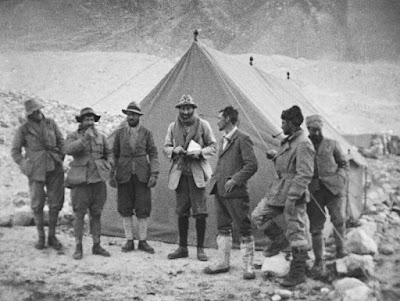
The Explorers

Instead of concentrating on the individual personalities of the explorers, Noel chose to focus on the expedition itself, and their perilous climb. One character, however, emerges from the story, Everest itself. At one point, Noel describes the mountain with anthropomorphic terms, as an unfathomable, wrathful entity that “frowns upon us.” The gargantuan mountain dominates many of the shots as they inch closer toward their goal, its foreboding presence paradoxically beckoning and unwelcoming. Although we never get to know the explorers as individuals, there’s something uniquely human about their collective endeavors. Through a custom-made telephoto lens (built by Noel, himself), we witness the last footage of George Mallory and Sandy Irving,* two miles distant, as they make their final ascent, before vanishing. They appear as black specks against a sea of white, a somber epitaph for their endeavors. 

* Not So Fun Fact: Mallory and Irving presumably died only 600 feet from their destination. Mallory’s body was discovered many decades later, albeit with questions left unanswered (Did he reach the summit or didn’t he?), but the location of Irvine’s body remains a mystery.

A Cliffside Monastery

The BFI did a remarkable job restoring the film to its past glory, while refraining from making it appear too pristine. In an age when we’ve grown accustomed to crystal-sharp 4K images, it’s easy to look upon the scratches, pops and grain with jaded eyes. But in this case, the technical limitations are an asset. Filtered through the camera lenses of the time and equipment that would be considered primitive by modern standards, we, the audience, are privy to a secret world few of us could every fully understand. It’s a kind of magic, from the pink-tinted opening shot of Everest, to scenes of Tibetan monasteries and fortresses of Kampa Dzong and Shekar Dzong, built into towering cliffs. We feel privileged to be able to be along for the ride. We’ve seen these magnificent structures since, in color and high definition, but those images don’t compare to what’s on display here. Noel’s film makes them appear ethereal, like something out of a fantasy tale or a dream – all the better to ruminate about how these structures were carved into the rock, centuries ago. The film takes every opportunity to depict the harsh, unforgiving landscape of rock, glaciers and snow, buffeted by punishing winds and unpredictable weather. In one of the final scenes, clouds roll over craggy terrain covered in ice and snow, casting a shadow like a death shroud. The modern score by Simon Fisher Turner (commissioned for BFI’s 2013 re-release), enhances, rather than detracts from the film. Turner’s soundtrack provides a contemplative aural backdrop, matching the images beautifully, and incorporating authentic sounds from the era.

Mount Everest

Is The Epic of Everest a tale of hubris? Man against the elements? Absolutely. But there’s much more to the story. The film portrays the explorers as interlopers in a world they scarcely understood. Rather than dismiss native superstitions, Noel considers how the Tibetan Lamas predicted they would not succeed in their quest, but they helped the team anyway (Perhaps the lamas knew that the Western explorers could only learn through their mistakes?). We’re constantly reminded of the sheer immensity of the undertaking for the benefit of a small group of privileged individuals. Considering the tremendous toll on human life and resources,* it’s not difficult to see how this expedition must have seemed pure folly, if not borderline suicidal. One aspect not adequately addressed by the movie is the risk to the lives of the many Sherpas who made the expedition possible (it fails to mention the fact that two perished). There’s a begrudging respect for the people that reside and thrive in such an inhospitable climate.

* Not So Fun Fact: To date, 305 climbers have lost their lives, attempting to scale the world’s tallest mountain. Of those 305, about 200 bodies have not been recovered, a grim reminder of the immense risks involved.

An Icy Landscape

Why would anyone take such an enormous risk? For bragging rights to be the first, or simply to bask in the knowledge that they are doing something few would ever attempt? Most of us don’t have the luxury of time or money to travel around world, and even if we did, we would never be able to explore more than a fraction of all the corners of the globe. I’m aware that I’ll never climb Everest, but through documentaries such as these, I can experience the thrills and challenges vicariously. Considering the subject matter, it was a safe assumption that The Epic of Everest would be about man against nature, and the inevitable victory of our indomitable will against incalculable odds. Instead, it was something much more. It’s almost incidental that the explorers fell short of their goal to conquer Everest. The journey (physical and mental) is the thing. Noel’s meditative film is nothing short of astonishing, reminding us that our failings are just as important as our victories. There’s something ultimately comforting and humbling to know that in spite of our human arrogance and lofty aspirations, there are still things greater than us, vast and unknowable beyond our comprehension. 

* Fun Fact #3: During the film’s initial release, it was originally exhibited as an immersive experience, including painted sets and a chorus of Tibetan Monks. 


Sources for this article: “Introducing The Epic of Everest” 2008 featurette; “Fictitious Tales, Actual Odysseys,” by J. Hoberman, New York Times, October 11, 2015; “Captain Noel’s 1922 Conquest of Everest,” by David L. Clark, American Cinematographer, August 1990; “Our TeamClimbed Everest to Try to Solve its Greatest Mystery,” by Mark Synnott, National Geographic Magazine, July 2020    

Sunday, September 19, 2021

Tramp, Tramp, Tramp


Tramp, Tramp, Tramp Poster

(1926) Directed by: Harry Edwards; Written by: Frank Capra, Tim Whelan, Hal Conklin, J. Frank Holliday, Gerald C. Duffy and Murray Roth; Starring: Harry Langdon, Joan Crawford, Edwards Davis, Tom Murray and Alec B. Francis; Available on DVD (included on Harry Langdon… The Forgotten Clown) 

Rating: *** 

“Systematic absentmindedness is the most comical thing imaginable …the four greatest stimuli to laughter are rigidity, automatism, absentmindedness, and unsociability.” – Harry Langdon (excerpted from the article “The Case for Harry Langdon: How and Why Frank Capra Was Wrong,” by Ben Urish, Journal of Popular Culture)

Harry Langdon

Harry Langdon was one of the biggest silent comedians of his day, but unlike Chaplin, Keaton or Lloyd, time hasn’t been kind to his legacy. Although he briefly enjoyed success that equaled or surpassed his comic contemporaries, he’s not nearly as well-known, nor regarded as favorably today. Outside of film historians and some ardent silent movie fans, Landon never enjoyed a post-mortem resurgence of popularity. Why did some other silent comics endure, and why did Langdon become a footnote? First of all, Langdon was a latecomer to the big screen, making his first short at age 40, so his body of work wasn’t quite as robust. Also, his brand of comedy, with his signature man-child character, doesn’t seem to have aged nearly as well. In the mid ‘20s, however, he could apparently do no wrong, establishing himself in more than 20 shorts, and making his feature film debut with Tramp, Tramp, Tramp.

Harry and Betty

Amos Logan (Alec B. Francis) is finding it hard to compete, with his 40-year-old homegrown shoe business. With few orders and rent overdue, he may have to close shop for good. Meanwhile, sales are booming for nearby rival, Burton Shoes. Its president and founder, John Burton (Edwards Davis) decides to host a cross-country walking competition, promising a $25,000 cash prize to the winner.* Amos’ son Harry (Harry Landon), considers this an opportunity to save his father’s business. He inadvertently creates an archrival in champion walker (and his father’s landlord) Nick Kargas (Tom Murray). Kargas’ animosity towards Harry is only exacerbated when circumstances force them to share a hotel room.** The odds seem hopelessly against Harry’s favor, but he finds additional motivation in the president’s daughter, Betty Burton (Joan Crawford), who adorns the shoe company’s advertisements. It would be a gross understatement to mention that he’s absolutely smitten by her (“I’m so crazy about that girl, I’m crazy.”). If the internet existed back then, Harry likely would have set up a fan account in her honor. Alas, he resigns himself to pilfering cutouts of her face from billboards. 

* Fun Fact: According to the Bureau of Labor Statistics inflation calculator, this would be equivalent to $393,056.03 in today’s dollars. 

** In a joke that (rightfully) wouldn’t pass muster today, Kargas gives him a combination of sleeping pills and alcohol to get him to sleep.

Harry Begins the Race

Harry embarks on his cross-country trek, peppered with a series of misadventures. In one of the film’s best gags, he straddles a fence, situated precariously over a sheer cliff face, oblivious to the dizzying heights below. Thanks to his charmed existence, he turns a potentially life-threatening situation into a boon. His luck temporarily runs out when he winds up on a chain gang, but he can’t be contained for long. The film’s climax saves the most elaborate gags (featuring collapsing buildings) for last, with Harry battling a deadly cyclone. Will Harry prevail against the elements, win the race, and get the girl? My virtual lips are sealed.

Harry with Pic of Betty

According to his nephew (also named Harry Langdon), “Our laughter at Harry’s characters is largely on the basis of their naivete and failure to even know that they have a problem” (excerpted from “Film Comedian – The Adult Child,” from Literature Film Quarterly). Herein lies the key to understanding Langdon’s comedy. Landon’s man-child character exists in a constant state of befuddlement, leaving chaos in his wake. A similar character was adopted by Paul Reubens, many years later, as Pee-wee Herman. On the surface, Reubens’ creation seems to be a direct descendent, if not for one significant difference. Although he’s essentially a child in a man’s body, Pee-Wee Herman possesses a sort of relatable, world-weary savvy, able to engage the rest of the world on his terms using wit and ingenuity. On the other hand, Langdon’s character is comparatively one-note, retaining his innocent, childlike (some might say childish) outlook – his personal triumphs are largely the result of dumb luck. As a result, Langdon’s schtick doesn’t resonate at the same level. His character will likely induce a polarizing effect, which you’ll either find oddly endearing, or it will grate on your nerves.

Harry in a Chain Gang

A good comedy film should have, among other things, more gags that land instead of flop. Tramp, Tramp, Tramp is no exception. Distilled to its essentials, the film isn’t much more than a string of gags orbiting a simple plot. Considering the fact that at least half a dozen people contributed to the script, it’s unsurprising that (even at 62 minutes), the movie meanders, with some scenes dragging on too long, while others seem shoehorned into the story. Unsurprisingly, Crawford and Langdon don’t have much chemistry together. She seems more amused by Harry’s antics than genuinely infatuated with him. Why Betty would fall for someone who was so pathologically obsessed with her is anyone’s guess (in Harry’s case, I suppose flattery gets you everywhere). Tramp, Tramp, Tramp is an enjoyable (if somewhat superficial) romp, overall. While it might not be the best example of silent comedy from the era, it has some inspired moments, and is certainly worthy of your time and consideration. If you’re unfamiliar with Langdon, this movie (along with The Strong Man, also from 1926), is a good place to start.


Sources for this article: “The Case for Harry Langdon: How and Why Frank Capra Was Wrong,” by Ben Urish, Journal of Popular Culture; “Film Comedian – The Adult Child,” from Literature Film Quarterly) 

Saturday, September 11, 2021

The Man Who Laughs


The Man Who Laughs Poster

(1928) Directed by Paul Leni; Written by J. Grubb Alexander (Adaptation) and Walter Anthony (Titles); Based on the novel L'Homme Qui Rit by Victor Hugo; Starring: Conrad Veidt, Mary Philbin, Olga Baclanova, Brandon Hurst, Cesare Gravina, Stuart Holmes and Josephine Crowell; Available on Blu-ray and DVD 

Rating: **** 

“A woman has seen my face and yet may love me! If such a thing is possible, then I have the right to marry Dea.” – Gwynplaine (Conrad Veidt) 

Note: The following review is an expanded version of a capsule review from September 2013.

Gwynplaine and Ursus

Cruelty and love are two things that know no bounds. The protagonist of Victor Hugo’s politically charged period piece, experiences both, albeit not in equal measures. Universal’s big-budget 1928 version* cast the largely unknown (to American audiences) German actor, Conrad Veidt,** while his fellow countryman, Paul Leni (The Cat and the Canary),*** handled the directing chores. The Man Who Laughs represented a transitional phase, when movie theaters were gradually gearing up for talkies. As a result, two versions were released: standard silent, and a music score**** with limited sound effects. 

* Fun Fact #1: Hugo’s story had been filmed at least twice before, as a 1909 French short (now presumed lost), and a 1921 Austrian feature, Das Grinsende Gesicht (aka: The Grinning Face). 

** Fun Fact #2: The film was originally envisioned as a vehicle for Lon Chaney, as the logical follow-up to The Hunchback of Notre Dame (also based on a Hugo story) and The Phantom of the Opera, but it had to be recast when Chaney left Universal for MGM. 

*** Fun Fact #3: Something to file away in the “What Could Have Been” department – Universal considered Dracula directed by Leni and starring Veidt in the title role. If not for Leni’s untimely death from blood poisoning in 1929, along with The Man Who Laugh’s tepid reception at the box office, it’s possible we could have seen a very different version of the classic 1931 horror film. 

**** Fun Fact #4: The partial sound version includes the ditty “When Love Comes Stealing,” featured prominently in a montage with the two leads, reminding us that an obligatory sequence with a would-be hit song is nothing new in Hollywood.    

Ursus, Young Gwynplaine, and baby Dea

After arranging the capture of Lord Clancharlie (also played by Veidt), who’s fallen out of favor with King James II (Sam De Grasse), the treacherous jester Barkilphedro (Brandon Hurst) concocts a plan to remove Clancharlie’s son Gwynplaine (the rightful heir to the throne) from the picture. The child is sold off to Comprachicos (a Spanish-derived term created by Hugo, meaning “child buyers),* and disfigured by one of their surgeons. When the Comprachicos are banished from England, young Gwynplaine (Julius Molnar, Jr.) is abandoned and left to die in a frozen wasteland. He rescues a baby girl, still clutched in her dead mother’s embrace, and makes his way to a circus wagon. Both children are taken in by Ursus (Cesare Gravina), a kindly performer. Skip forward several years, and the adult Gwynplaine and blind orphan named Dea (played by Mary Philbin, who co-starred with Lon Chaney in Phantom of the Opera), roam England with Ursus in a traveling sideshow. Gwynplaine’s show catches the attention of the scheming Duchess Josiana, played by Russian-born Olga Baclanova (best known for her role as the deceitful trapeze artist Cleopatra in Freaks). As the lowly Gwynplaine’s fate intersects with the aristocracy and he becomes their pawn, he endeavors to find his true destiny. 

* It’s worth noting that evidence suggests the Comprachicos (who were supposedly Romani in origin) never existed – making this an unfortunate effort, on Hugo’s part, to demonize Romani people for the purpose of his story.   

Gwynplaine and Josiana

In one scene, in which Gwynplaine is summoned to Josiana’s bedroom, she seduces him, evoking conflicted emotions. As someone accustomed to being the object of derision, he wrestles with her sudden interest in him, nearly succumbing to her advances. There’s something distinctly Freudian (Madonna/Whore Complex) about his attitude toward Josiana and Dea. While Dea represents his ideal of virtuous, almost asexual love, Josiana is pure libido. Baclanova takes every opportunity to vamp it up, chewing the scenery like it’s her last meal. She provides an almost irresistible temptation for Gwynplaine, who’s likely never experienced any carnal pleasures. Josiana displays a fetishistic infatuation with his disfigurement, which excites and repels him. In comparison, Philbin’s role is much more passive, as she emotes and pines away for Gwynplaine. His love for Dea is less about the pleasures of the flesh, and more about gaining her unconditional acceptance (even though she clearly adores him). Compared to Baclanova’s flashier antics, the top-billed Philbin comes up a bit short. In all fairness, however, Dea’s function, story-wise, is considerably more limited.

Gwynplaine 

In an effort to puff up the mystique surrounding Gwynplaine’s appearance, studio publicists touted that Veidt only wore minimal makeup, instead creating the character’s distinctive look through his alleged mastery of facial musculature (deemed “muscular makeup”). While there is a kernel of truth to the studio propaganda, much of Gwynplaine’s appearance can be attributed to Jack Pierce’s (responsible for the iconic look of Universal’s monsters in the ‘30s and ‘40s) makeup. Veidt wore a constrictive mouth appliance, which included false teeth and hooks to keep his mouth in a grotesque approximation of a grin, causing considerable discomfort. The actor was unable to speak intelligibly, but after some practice, learned to create a limited range of mouth expressions. It’s a testament to his acting prowess that he was able to convey a complete range of emotions, from elation to abject sorrow (and everything in between) despite the physical limitations imposed by Pierce’s makeup. As convincing as the makeup is, it would amount to little, if not for Veidt’s tragically beautiful performance. His expressive, often tear-stained eyes convey pathos in every scene. When he’s not on stage, Gwynplaine hides his mouth from everyone, including Dea (despite her inability to see him). He’s deeply ashamed of his appearance, trapped in a hideous visage and (at least to his eyes) unlovable.

Gwynplaine and Dea 

Leni,* who cut his cinematic teeth as an art director before directing, brought his unique eye for visuals to The Man Who Laughs, with expressionistic flourishes peppered throughout. For his part, Veidt proves it’s not simply the makeup that makes the performer. Although Philbin is overshadowed by Veidt, her co-star Baclanova, and Brandon Hurst (who seems to be having a blast as a jester with a perennial devilish grin), her character serves a vital purpose, proving that kindness prevails. And let’s not forget the unsung hero of the story, Homo the Wolf (played by a German Shepherd named Zimbo), who has a pivotal scene during the film’s climax. It’s easy to see how The Man Who Laughs has influenced other movies and media. Gwynplaine’s unforgettable appearance, with his mouth frozen in a permanent rictus and severely swept back hair, is commonly attributed as the inspiration for Batman’s arch nemesis, The Joker (created by Bill Finger, Jerry Robinson and Bob Kane). Additionally, the “love is blind” theme, ** with a seemingly unlovable person finding love, has been recycled many times (Maybe it was my brief dalliance with Troma films that’s to blame, but it’s not too much of a stretch to draw a parallel between Gwynplaine and Dea with the Toxic Avenger and his blind girlfriend). The film’s conceit that Gwynplaine’s face evokes laughter from all who see him is a litmus test for the other characters’ (and by extension, the audience’s) compassion. While the individual elements may be familiar to modern audiences, The Man Who Laughs persists as a timeless classic because it blends these elements so well. 

* Fun Fact #5: Leni reportedly used a three-foot gong to startle his performers into providing the appropriate reaction. 

** It seems a bit disingenuous that films often portray a woman who falls for a man with a physical abnormality, and rarely the other way around. It would be nice to see some enterprising filmmaker reverse this time-worn trope for a change.


Sources for this article: “The Face Deceives,” by David Cairns and Fiona Watson; and “Paul Leni and The Man Who Laughs” by John Soister (featurettes on Eureka Blu-ray)