Wednesday, February 24, 2016

The Once Over Twice: One Crazy Summer


(1986) Written and directed by Savage Steve Holland; Starring: John Cusack, Demi Moore, Joel Murray, Bobcat Goldthwait, Tom Villard, Curtis Armstrong and Joe Flaherty; Available on DVD

Rating: ***½

“I was there a couple of summers ago, and they had movies to rent about Nantucket, and there was this and Moby Dick.” – Savage Steve Holland

“We can’t let those people walk away with everything. I mean, if we give into those people, we’re giving into all the cute and fuzzy bunnies in the world.” – Hoops McCann (John Cusack)


Yes, it’s true; I’ve wanted to review One Crazy Summer since my blog’s inception. Sure, there are loftier titles from some film historian’s snooty bucket list, but I wager you’ll never hear the words “dog from Mars” uttered in any of those films. Don’t get me wrong, I agree that Better Off Dead deserves its cult status, but John Cusack’s second collaboration with writer/director Savage Steve Holland has never gotten its due. While one film has garnered a throng of rabid followers who can probably spout every bit of dialogue and re-enact every scene, I humbly opine that One Crazy Summer has the better lines and gags.  


One Crazy Summer belongs to that venerable staple of ‘80s cinema, the summer getaway movie, but manages to take a (mostly) unique spin on the formula. Cusack stars as Hoops McCann (playing the same sort of hapless schmoe he perfected in Better Off Dead), an aspiring animator who’s unlucky at life and love. After graduating from Generic High School, he decides to spend the summer with his pal George Calamari (Joel Murray – Yep, Bill’s younger brother) on Nantucket Island. On the way to the island, he meets a bohemian-type singer, Cassandra (Demi Moore). Since Nantucket is within spitting distance from Martha’s Vineyard (in relative terms), the setting provides ample opportunity for numerous Jaws references.


Written over the course of a weekend, One Crazy Summer is a slap-dash effort that somehow works, chock-full of gags, ranging from slapstick to sublime. I’ll try not to reveal too many, since they’re best discovered rather than described, but watch for a clever homage to the Twilight Zone episode “Eye of the Beholder,” and a drive-in marquee featuring a double bill of Chainsaw Date and Hemorrhoids from Hell.* The story is bracketed by Holland’s clever animated sequences,** featuring cute fuzzy bunnies that are anything but benign, depicts McCann as a bipedal rhino, and serves as a window into his anxieties about love and acceptance.

* Fun Fact #1: In the DVD commentary, Holland revealed that the drive-in films within the film were written and shot by Bobcat Goldthwait, who became an acclaimed director in his own right.

** Fun Fact #2: In the final animated sequence, watch for two bunnies that suspiciously resemble a pair of popular movie critics. Holland explained this was his way of retaliating after they gave his previous film negative reviews.


Cusack is almost eclipsed by a terrific supporting cast, including SCTV alumnus Joe Flaherty as the gun-obsessed General Raymond and Curtis Armstrong as his peace-loving son, Ack Ack Raymond.  The bumbling Stork brothers, Egg and Clay (played by Bobcat Goldthwait and Tom Villard, respectively) provide some amusing scenes. I suppose I could understand how some might find Goldthwait’s manic, shrieking persona grating, but it fits the character, and it’s used to great effect in one key scene (the payoff just wouldn’t have been the same without him). Bruce Wagner has a small but amusing role as George’s deranged Uncle Frank, who’s obsessed with winning a $1 million prize from a radio contest.


One major plot point involves an obnoxious blue blood teen Teddy (Matt Mulhern) and his ruthless real estate developer father’s (Mark Metcalf) plot to build a Lobster Log restaurant on the spot of Cassandra’s grandfather’s house. After Cassandra fails to raise enough funds to save the home from demolition, her friends hatch a plan to take on Teddy in the annual winner-take-all regatta. It’s here that the film falters a bit, starting with an obligatory ‘80s montage, as Hoops and his rough and tumble crew bring a rickety sailboat up to snuff.  The mildly amusing nautical hijinks that follow take precedence over real laughs, leading to a predictable climax. It doesn’t take a student of cinema to figure out who will emerge victorious.


I imagine Mr. Cusack and Ms. Moore are less than eager to answer questions about One Crazy summer, but there’s no shame keeping this movie on their resumes. Sure, it’s not The Grifters or G.I Jane, but I daresay both of those films put together don’t have half of the laughs. While I doubt we’ll be seeing a Criterion version in any of our lifetimes, One Crazy Summer deserves some respect, especially compared to its better-known predecessor. If a representative from the National Film Preservation Board approached me, and wanted my opinion about which one should be saved for posterity (Hey, this is my unrealistic fantasy, okay?), I would go with One Crazy Summer. I still find it funny today, which is more than I can say for most teen comedies, revisited with jaded eyes. It can be painful to re-watch something I enjoyed in my teens, only to find it doesn’t stand the test of time, but I’m happy to report this one passes the test. It’s time for One Crazy Summer to step out of the shadow of its more popular cousin and have its day in the sun.  

Wednesday, February 17, 2016

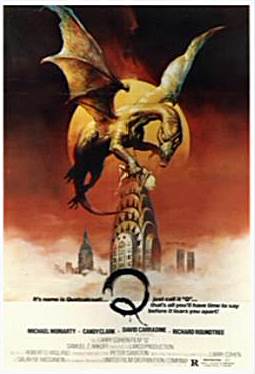
Q: The Winged Serpent


(1982) Written and directed by Larry Cohen; Starring: Michael Moriarty, Candy Clark, Richard Roundtree and David Carradine; Available on DVD

Rating: ***½

“I think the Chrysler Building is a lot more attractive than the Empire State Building, by far. And I thought that the Chrysler Building deserved to have recognition. King Kong has immortalized the Empire State Building. I thought this building deserves to have its own movie.” – Larry Cohen (from 2003 DVD commentary)


If Ray Harryhausen had worked for Roger Corman, the result might have been something like Q: The Winged Serpent, a delightfully schlocky throwback to an earlier era of filmmaking. The film was conceived out of adversity, when writer/director Larry Cohen was fired from directing the Mickey Spillane potboiler I, The Jury. Within a week of leaving the project, Cohen bounced back with his own production, with assistance from former American International mogul Samuel Z. Arkoff. Filmed for a meager $1.2 million, Q features some fun special effects and an impressive cast.


Reflecting the director’s guerilla filmmaking style, Q was shot on location on the streets of New York City,* often without authorization. Although Cohen and his crew were permitted to film inside the Chrysler Building,** they were never cleared to film in the maintenance area at the top, where the title creature made its home. In the climactic scene, which riffs on King Kong, the crew fired machines guns filled with blanks, causing quite a stir for the city’s residents. Filming wrapped in just 18 days, typical for a Cohen production.  

* Fun fact: Cohen stated he was inspired to write the screenplay by observing NYC’s varied architecture, which reminded him of “great religious edifices” that might be worthy of attracting some ancient god.

** Cohen takes every opportunity to exploit the beautiful art deco designs of the Chrysler Building, inside and out.


The citizens of New York are being picked off one by one by an enormous flying creature (seen only in brief flashes) with a taste for human heads. Cohen wisely chose to keep the monster’s onscreen appearances to a minimum,* for most of the movie’s duration, allowing the viewers’ minds to fill in the blanks, and building suspense in the process. While the special effects by David Allen, Randall William Cook and Peter Kuran aren’t quite up to Harryhausen’s standards, they serve their purpose, and compliment the film’s low budget vibe.

* Cohen observed, “…the more you show, the less interesting it becomes.”


Michael Moriarty (in his first collaboration with Cohen) plays part-time hood and full-time loser Jimmy Quinn, who can’t seem to hold a job or control his temper. Initially hired as the wheel man on a diamond heist, he’s drawn in deeper when his accomplices insist that he share the risk and carry a gun. Somehow, Jimmy ends up with the jewels, but loses them while evading the cops. While hiding inside the roof of the Chrysler Building, he discovers the roosting place for the beast, along with an enormous egg. When the cops apprehend him, he uses the creature’s location as a bargaining chip, but demands $1 million and a full pardon in return. Moriarty imbues his character with humor and pathos, making what could have been a throwaway role something truly memorable (although I probably could have done without his scat singing). Similar to Elisha Cook, Jr’s character in The Killing, they’re small fish in a big pond, tired of being kicked around by life.


Q features some fine supporting performances as well, including Candy Clark as Jimmy’s long-suffering girlfriend Joan. She’s probably better than he deserves, putting up with his rants and mood swings, but even she has limits. David Carradine and Richard Roundtree play Shepard and Powell, police on the trail of a serial killer, who’s carrying out ancient Mayan rituals to appease the Mayan god Quetzalcoatl. Only Shepard (David Carradine) seems to see a connection between the killer, the mythical beast, and the giant bird that’s terrorizing the city.


Q: The Winged Serpent harkens back to a time when all you needed was a little ingenuity and a big creature to entertain audiences. Cohen deftly mixes lowbrow entertainment with highbrow performances, for his post-modern monster flick, proving you don’t need a huge budget to get big thrills. Q never aspires to be great cinema, but embraces its B-movie roots. As a bonus, the film features more depth to its characters than you would normally expect. It’s one of Cohen’s best efforts, and an unsung gem from 1982. In a year distinguished by many exceptional genre films, Q manages to hold its own against its higher profile contemporaries.

Thursday, February 11, 2016

The Hitcher


(1986) Directed by Robert Harmon; Written by: Eric Red; Starring: C. Thomas Howell, Rutger Hauer, and Jennifer Jason Leigh; Available on DVD.

Rating: ***

“…I cut off his legs, and his arms, and his head, and I’m gonna do the same to you.”
 – John Ryder (Rutger Hauer)

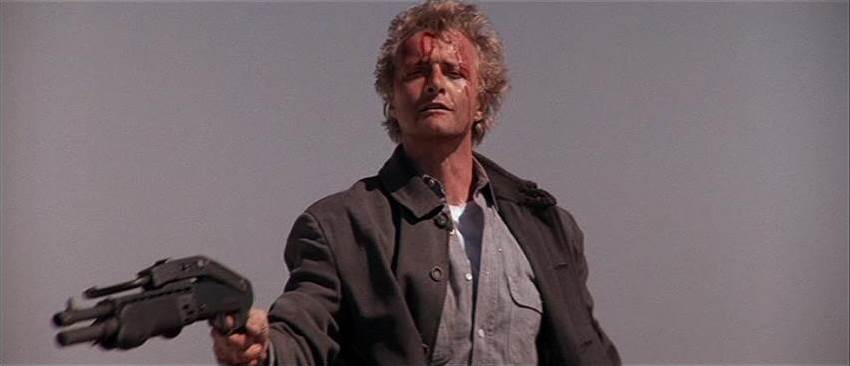
The Hitcher is an unnerving, perplexing film that vacillates between being an intimate thriller and an action movie, like Hitchcock filtered through Michael Bay’s lens. Despite a lukewarm critical and box office reception, the film has gained a loyal cult following over the years, thanks in no small part to Rutger Hauer’s chilling performance as the titular character. Set in the dusty American southwest, The Hitcher focuses on Jim Halsey (C. Thomas Howell), a young man tasked with a “drive-away,” transporting a car from Chicago to its owner in San Diego. During a rainy, tedious night, he decides to pick up a drifter to break up the monotony, which turns out to be a big mistake. Things escalate quickly, as Jim learns about his passenger’s true intent, and the cat and mouse games begin.  


Hauer’s icy portrayal of the sociopathic Ryder is by far the best thing about the film. From one minute to the next, you’re never sure what he’s planning to do. As Ryder taunts Jim with “I want you to stop me,” you get the feeling he never has less than the upper hand.  Every scene with Hauer oozes menace. In one of the best scenes, he sits in the back of a station wagon, playing with a pair of kids, while their oblivious parents are up front. Under different circumstances, the sequence would be innocuous, but given the exchange between Ryder and Jim in the previous scenes, you know this won’t come to a good end.


Howell does a serviceable (if unremarkable) job as Ryder’s stooge. Similar to a Hitchcock protagonist, he’s an ordinary man caught up in extraordinary circumstances, but he’s no James Stewart or Cary Grant. Compared to his opponent, Jim doesn’t seem particularly bright, as he continues to place himself in jeopardy and let his guard down. As Ryder outsmarted Jim at every turn, I wished the film had included a character with more of an edge. One intriguing thread the film introduces but never follows through with is a connection that forms between the two, but it’s never fleshed out, thanks to a few too many high-octane action chase scenes.


Jennifer Jason Leigh does a good job with the hand she’s dealt as Nash, a likeable but naïve roadside café waitress. Nash is a small town girl with aspirations for something better, even if she can’t quite articulate what that something would be. When Jim is framed for murder, she stands up for him, but the two characters never build much chemistry. Ultimately, Nash isn’t given much to do except become one of Ryder’s pawns.


Upon its release, The Hitcher was unfairly taken to task by some critics for being too violent and sadistic. Although there are a few “gross out” moments, director Robert Harmon and screenwriter Eric Red demonstrated commendable restraint by keeping most of the more horrific events off-screen. Ryder’s descriptions of what he did to his victims create more horrific imagery in the mind’s eye than anything that could have been depicted on screen.


Where the film falters is its over-reliance on road chase sequences, with plentiful car crashes and explosions, which only divert the audience from Ryder and Jim. The Hitcher becomes the shaggy dog of thrillers, as one situation builds off of the next, making the film more unbelievable as it progresses. When things get out of hand, it’s hard to imagine the local authorities wouldn’t have called for assistance from state police or the FBI. As the body count escalates, logic would dictate he’d put as much distance between himself and Ryder as possible, instead of checking into a local motel with Nash.


I would never profess to put myself in the minds of other viewers, or question their fealty to The Hitcher, but I wager the first thing to come to mind would be Hauer’s terrifying portrayal of evil incarnate. Howell pales by comparison, appearing out of his league when the two actors are together. The showier, stunt-laden scenes just seem shoehorned into the film to keep viewers with short attention spans entertained. While The Hitcher falls short of the classic that some would have you believe, it’s worth checking out for Hauer’s deranged, mesmerizing performance, and almost makes me want to forgive the film’s trespasses. If you’re looking for a more successful film about a sociopathic hitchhiker, however, you might consider Ida Lupino’s 1953 film noir, The Hitch-Hiker.

Thursday, February 4, 2016

The Gate


(1987) Directed by Tibor Takács; Written by: Michael Nankin; Starring: Stephen Dorff, Christa Denton and Louis Tripp; Available on DVD

Rating: ***

“It was competing with Freddy and Friday the 13th, but it was never intended to do that.” – Tibor Takács

“…I, of course, having been falsely impressed that I could be the next Ray Harryhausen, not knowing that there’s only one Ray Harryhausen – that job was taken already. But I figured, I’m gonna do it all myself. I’m gonna sculpt those things and animate them, and design the scenes…” – Randall William Cook (Special Effects Designer & Supervisor)


I think I might have been a Canadian in a past life. It’s the only way to explain my unnatural affinity for our friendly neighbor to the north. With this in mind, I was excited to once again take part in the O CanadaBlogathon, celebrating the eponymous country’s myriad cinematic contributions. A hearty thanks to co-hosts Kristina of Speakeasy and Ruth of Silver Screenings for inviting me back. Coincidentally (Or is it?), today’s selection also coincides with ‘80s Month on my blog, so this post is a bit of a two-for-one deal – because I like to pass the savings on to you, dear reader.


1987’s The Gate was a low budget effort (approximately $2.5 million Cdn.), filmed in a Toronto suburb that could just as well be Anywhere, U.S.A., except for a couple of clues: a bottle of HP sauce on the kitchen table, and a hastily scrawled note that includes the word “favourite” (Hey, Canada, I’m onto you.). The film belongs to a sub-genre peculiar to the ‘80s, the family friendly horror movie (e.g., Gremlins, The Monster Squad). Nowadays, horror is widely regarded to be a strictly adult domain, but once upon a time, there was a category for intrepid kids and their open-minded parents; films that were scary but not too scary, and maybe a tad politically incorrect. 


Screenwriter Michael Nankin culled fears from his childhood to shape the script, including anxieties about being left alone, and an urban legend about a dead workman sealed into the walls of a house. He also blended in Lovecraftian elements, concerning a race of “old ones” who would reclaim the world for their own. Added into the mix is the loss and grief associated with a deceased loved one, and you’ve got a film ripe for exploring the characters’ inner and outer demons.


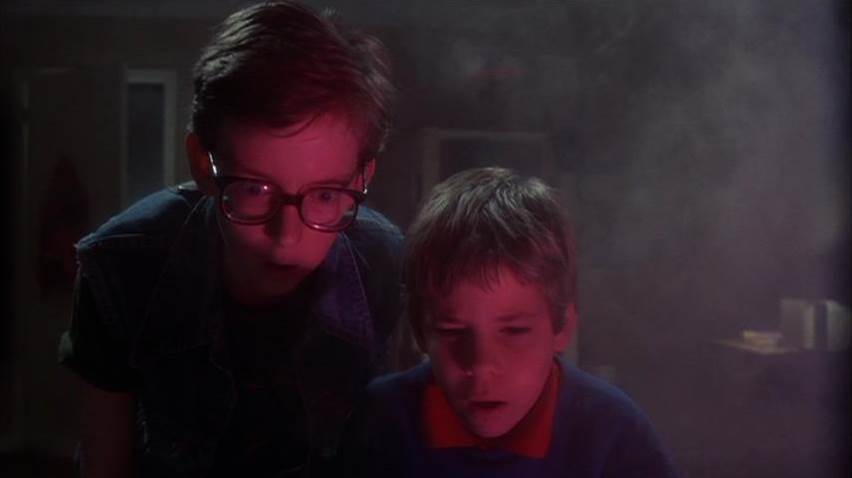
The Gate features some nice performances by a pre-pubescent Stephen Dorff as Glen and Louis Tripp (sporting a super-sweet Killer Dwarfs jacket) as his eager friend Terry. When they dig a hole in Glen’s backyard,* they discover a huge geode, and inadvertently open a portal to a hoary netherworld, populated by malevolent beings. Thankfully, they have a secret weapon, in the form of a record from Terry’s favorite metal band (the only album they recorded before dying in a plane crash). In another nod to urban legends, the record plays a hidden message about combating the demons when played backwards. Rounding out the cast is Christa Denton as Glen’s older sister Al, who’s left to babysit him while their parents are out of town. Glen and Al are convincing, not only because the young actors were about the same age as their respective characters, but on account of how well they interact together. The brother-sister relationship is believable because it captures the petty irritations and sibling rivalries that inevitably occur. 

* Fun fact: Similar to the events in the film, Nankin recalled digging a hole in his friend’s backyard. But instead of encountering demonic forces, a gardener fell in and sued the friend’s family.


Yeah, the actors are all well and good, but nobody came here for their youthful hijinks. We’re here for the monsters, and The Gate has ‘em in spades. Randall William Cook’s stop-motion effects are the main attraction, providing a Ray Harryhausen-esque touch. Cook takes a nice, low-fi approach (Yeah, screw you, CGI, and the digitally rendered horse you rode in on.) to depicting the film’s nasty little demons and one giant, multi-armed creature, through a combination of stop-motion animation and actors in monster suits.* A scene where a zombie collapses and explodes into a gaggle of little creatures is especially memorable.

* Another fun fact: Cook utilized forced perspective shots for the hordes of little demons surrounding the human actors. Cook and crew studied an unlikely source, Darby O’Gill and the Little People, for inspiration (think demons instead of leprechauns).


And just in case you thought The Gate was simply mindless entertainment, it provides some valuable lessons. If you’re leaving your house in the hands of your teen, and suspect they’re going to throw a party, guess what? They’re gonna throw a party. If there’s a gaping passageway to the bowels of hell in your backyard, don’t lean in for a better look. And whatever you do, hang onto those vintage metal albums. You never know when they could come in handy for fending off the forces of evil.


Perhaps the best lesson to be gleaned from The Gate is it’s about time to see a revival of the kid-friendly horror flick. With the proliferation of safe, innocuous computer-animated fare, the idea of a family movie that pushes a few boundaries is a genuinely novel concept, by today’s standards. The closest thing to it was Joe Dante’s similarly themed (and also filmed in Canada) 2009 throwback, The Hole. Sure, The Gate isn’t the most original movie, but it makes up for any deficits with sheer momentum and earnestness. It knows how the game is played, and pushes your buttons efficiently. If you keep your expectations in check, it’s still a heck of a lot of fun.