Monday, June 24, 2013

Cinematic Dregs: Young Einstein


(1988) Directed by Yahoo Serious; Written by Yahoo Serious and David Roach; Starring: Yahoo Serious, Odile Le Clezio, John Howard, Peewee Wilson and Su Cruickshank; 
Available on DVD.

Rating:**

“…Then there's the time the country rallies together to beat back Hell, like the time we as a nation said no to Yahoo Serious.”  Joel (Joel Hodgson) from Mystery Science Theater 3000

After nearly 25 years ago, it was time to confront my demons, and revisit a dark period in my past that I had kept hidden from the world.  While my memory of Young Einstein was somewhat hazy, I seemed to recall the film as eccentric and misunderstood.  As a video store clerk, I was prone to championing it to anyone who’d listen.  I’d quote a few choice lines at the drop of a hat, and even purchased the soundtrack.  Now I’m not saying that I was off the mark with all of my movie choices, but everyone makes an error in judgment now and then.*  Realizing that tastes change over the years, I knew that time was nigh to re-evaluate my assessment of Young Einstein.  Could I have been wrong?  Was it an unfairly maligned comic gem or an unfunny misfire worthy of our collective scorn?

* Referencing my first, ill-chosen pick for a girlfriend, my mom commented, “You have taste in your ass.”  Take that as you will. 


So, what did a second viewing, separated by two and a half decades, yield?  Was Young Einstein as bad as its reputation suggested?  Yes and no.  Humor is a subjective thing.  Some people find Adam Sandler hilarious and Woody Allen grating.  Some prefer Buster Keaton’s antics to Charlie Chaplin’s Little Tramp.  There’s no surefire formula for comedy, and there’s no accounting for taste.  With this in mind, I can only report that I found Young Einstein sporadically amusing, and by sporadic, I mean a couple scenes elicited a smirk.  Not to say there weren’t some clever visual gags, but they were often nullified by the film’s mugging lead.


The film asks us to take a huge leap by accepting its basic premise – Albert Einstein didn’t really grow up in Germany, but on a Tasmanian apple farm.  If you’re good with that, then you’ll probably accept anything, as its titular character hobnobs with science luminaries Charles Darwin, Sigmund Freud and Marie Curie.  Young Einstein plays fast and loose with history and science, as our hero simultaneously discovers the theory of relativity, invents rock ‘n roll and puts bubbles in beer.  When an apple lands on Einstein’s head, resulting in an epiphany, we need to suspend our disbelief that the laws of gravity weren’t discovered before 1906. 


Yahoo Serious (aka: Greg Pead), who started out with documentary and short comic films, took the auteur route (and I use the term “auteur” very loosely here) with Young Einstein.  His name appears in the credits six (!) times, as star, director, writer, producer, stunts and supervising editor.  It’s a lot of pieces to juggle, and unfortunately Mr. Serious can’t keep everything in the air for long.  First the good.  He obviously has an eye for visuals, with some nicely framed vistas and elaborate set pieces.  The film is infused with frenetic energy, which might not keep you from being annoyed, but you won’t be bored.  But Serious’ enthusiasm is also his undoing.  He seems like a precocious child who will try anything to get your attention, waving his arms about and shouting, “Look at me, look at me!  Aren’t I funny?”  Some of the questionable comic choices were obviously cribbed from old Warner Brothers cartoons, as when he shows up twice in blackface to simulate getting fried by electricity.  The soundtrack is peppered with wacky sounds to punctuate the “silly” moments.   While the music tracks represent a nice sampling of Aussie pop and rock from the 80s, they contribute to scenes that resemble music videos rather than integral parts of a whole (what Roger Ebert would have labeled the “Semi-Obligatory Lyrical Interlude”).  When he frolics on the beach with his girlfriend and newly invented surfboard, the results look like something from the old Monkees TV show.


As I re-watched Young Einstein, I was painfully aware of the fact that I wasn’t nearly as fond of it as I remembered.  While the film was a huge hit in Australia (despite mixed critical reception), it failed to win over many fans in the United States.  Perhaps my original impression was obscured by my post-adolescent desire to buck the trend of popular opinion?  I suppose I’ll never be able to reconcile this chaotic stage in my past.   Young Einstein is best described as a near miss; a curiosity best left as a cinematic footnote.  Serious swings for the fences, but ends up with a foul ball.  I’m keeping the soundtrack, though.

Monday, June 17, 2013

Mary and Max


(2009) Written and directed by Adam Elliot; Starring: Toni Collette, Philip Seymour Hoffman, Barry Humphries and Eric Bana; Available on Blu-ray, DVD and Netflix Streaming.

Rating: ****

“Max hoped Mary would write again. He'd always wanted a friend. A friend that wasn't invisible, a pet or rubber figurine.” – Narrator (Barry Humphries)

It’s hard to imagine there was a time, not too long ago, when people corresponded through letters, and would wait days, weeks, or even months for a reply.  Now we’re instantly connected with folks around the globe, thanks to Facebook, Twitter, and thousands of other internet avenues.  We refer to individuals we’ve never met face to face as our friends, while our neighbors are complete strangers.  The global community has shrunk, but next door remains a mystery.  In this bold new age of instant gratification and a world without borders, it seems something has been lost in the tradeoff. 


Mary and Max tells the (purportedly true) story about a lonely eight-year-old girl in Melbourne who initiates an unlikely friendship with a reclusive middle-aged man in New York.  Mary Daisy Dinkle (voiced by Bethany Whitmore and Toni Collette) is a shy, imaginative young girl.  Due to a large brown birthmark on her forehead, she’s the object of ridicule in her school.  She finds little solace at home, as her alcoholic mother and emotionally distant father (who appear to have been forged from a Roald Dahl book) are mired in their own little worlds.  One day, Mary picks a name out of a New York phone book, and sends a letter in the hope that some of life’s burning questions can be answered by someone living in a distant land.  It’s by sheer happenstance that she ends up finding a kindred spirit by the name of Max Jerry Horowitz.


Max (Philip Seymour Hoffman) is a morbidly obese social recluse with Asperger’s syndrome (now classified under the somewhat generic-sounding term “autism spectrum disorder”).  He’s an alien on his own planet, trapped in self-imposed exile from the rest of the human race.  His home town of New York is depicted in black and white, mirroring his literal-minded perceptions.  Other people are a constant source of confusion to Max, with his inability to gauge others’ emotions and non-verbal cues.  He lives a quiet, monastic existence in his tiny apartment with his goldfish, one-eyed cat, and imaginary friend, Mr. Ravioli, who sits quietly in the corner reading self-help books.  He longs for a friend, while being outwardly incapable of maintaining a meaningful connection with another human being.  Mary’s first letter breaks through his malaise, thus forging a long-distance friendship, based on their mutual love of cartoon characters called Noblets, all things chocolate, and outcast status.  Max views her questions regarding matters of the heart or being the object of bullying as simply problems to be solved. 


Writer/director Adam Elliot deserves kudos for creating a story that’s alternately hilarious and heartbreaking.  Bittersweet, with emphasis on the bitter, Mary and Max goes to dark places that Pixar or Aardman would fear to tread.  It’s not afraid to explore the abject despair that only the truly alienated can experience.  The stop-motion animation style matches Elliot’s warts-and-all approach, with character designs that aren’t cute or cuddly.  While Max’s borderline grotesque features aren’t likely to inspire plush toys, T-shirts or other merchandise, his appearance underscores the isolation he likely feels on a daily basis.


True to its non-traditional pretensions, Max and Mary doesn’t wrap everything up in a neat little package, with the underdogs triumphant.  In the end, Mary’s life is still a mess, and Max... well, let’s just say he hasn’t changed much.  The final scene is poignant and fitting to the main characters.  It might not be the one we were hoping for, but it shows a great deal of integrity on the part of the filmmakers.  It’s easy to forget that the characters are cast in plasticine, since they display more depth than many characters in live action films.  Their artificiality belies the fact that they can still evoke real emotions.  It’s a beautiful tale that reminds us friends can come from unexpected places, whether we want them or not.

Wednesday, June 12, 2013

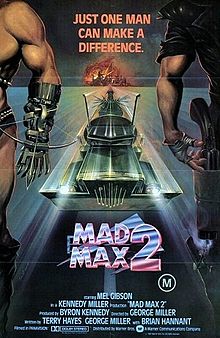
Classics Revisited: The Road Warrior (aka: Mad Max 2)


(1981) Directed by George Miller; Written by George Miller, Terry Hayes and Brian Hannant; 
Starring: Mel Gibson, Bruce Spence, Vernon Wells and Michael Preston;

Available on Blu-ray and DVD


Rating: *****


“In the roar of an engine, he lost everything.  And became a shell of a man, a burnt out, desolate man, a man haunted by the demons of his past, a man who wandered out into the wasteland.  And it was here, in this blighted place that he learned to live again...”

– Narrator (Harold Baigent)


The Road Warrior (known as Mad Max 2 outside the U.S.) is simply one of the finest action films every committed to celluloid.  It helped spawn an entire sub-genre of (mostly lesser) post-apocalypse movies, and established Mel Gibson as an international star.  Speaking of Gibson, let’s confront the pink elephant in the room and acknowledge that much has already been said about his recent transgressions and ill-chosen words.  But conjecture about how he took a wrong turn or an in-depth examination of his ideologies is irrelevant to this review.  The recent controversy has only marred the fact that The Road Warrior is an exceptional film, worthy of praise for its raw energy and spirited performances.


If Mad Max is about the vestiges of civilization, struggling to maintain law and order in a society moving towards lawlessness, then its superior sequel is about humankind’s complete descent into chaos and disarray.  Director/co-writer George Miller introduces us to this new world disorder through black-and-white stock news footage depicting public unrest and war, intercut with scenes from Mad Max, to bring the uninitiated up to speed with the previous film’s events (a similar introduction was employed by Brian Trenchard-Smith in his Ozploitation film Turkey Shoot).  We’re introduced to Max as he roams a desolate highway with his dog, * vigilant for any scraps that the old world saw fit to leave behind.  Gasoline, referred to as “juice,” is now more valuable than human life.  The bleak desert landscape is inhabited by roving bands of thugs, intent on getting their share of what’s left while leaving death and destruction in their wake.  Amidst this wasteland stands a tiny enclave of survivors, determined to protect the precious lives, and small oil refinery residing within their makeshift fortress walls. 


* Fun fact: Max’s dog, a Blue Heeler, was rescued from a local pound, only a day before he was supposed to be euthanized.  (Spoiler alert) Although the dog meets an unhappy end in the film, Miller stated that the actual animal lived out his days on a ranch following the shoot.


Miller stated that he made Mad Max 2 to “overcome the frustrations” of the first film.  He wanted to speak through “film language,” rather than dialogue to get his point across.  The film was shot in continuity, so adjustments could be made as the filmmakers went along.  Contributing to its unpolished, improvised look, Miller employed an “immersion” approach for the cast, featuring discussions about their respective characters, rather than a formal rehearsal.


Max (Mel Gibson) is the epitome of the reluctant hero.  Deprived of his former life as a cop and family man, he wanders the wasteland in a peripatetic haze, existing but not really living.  Gibson’s nuanced, enigmatic performance recalls Clint Eastwood’s Man with No Name (and to a lesser degree, Harrison Ford as Han Solo), as a laconic loner who’s disenfranchised himself from the rest of the world.  Self-preservation takes precedence over concern for anyone else.  There’s no room in his emotionally scarred heart to accommodate any new relationships.  When the Feral Kid (Emil Minty) adopts him as an unwitting father figure, Max responds by pushing him away.  In spite of himself, however, Max rises to assume the hero role.  Although his motivations are outwardly governed by selfish reasons, a miniscule flicker of humanity still presumably burns within.


Miller reportedly studied the writings of Joseph Campbell in preparation for The Road Warrior; especially The Hero with a Thousand Faces.  One common Campbell theme, archetypes, figures prominently in the film, with its assortment of eccentric and iconic peripheral characters.   Bruce Spence stands out, quite literally, as The Gyro Captain.  Resembling an Australian Ichabod Crane with his tall, gangly form, he’s determined to make the best of the paltry lot life has dealt him.  Vernon Wells makes an impressive entrance as the sadistic, Mohawk-coiffed Wez, who lives to destroy.  The Humungus (played by ex-Mr. Sweden, Kjell Nilsson), is the mysterious leader of a band of cutthroats.  His body is a visual contradiction, with a perfectly sculpted muscular physique, but a mask that conceals his disfigured face.  With apologies to the memory of Mr. Campbell, perhaps these archetypes could best be described, respectively, as The Opportunist, The Berserker, and The Despot.


Cinematographer Dean Semler helped bring Miller’s apocalyptic, kinetic vision to life, with his stunning camerawork.  Through alternating frame rates, hand-held cameras, and inventive angles, the viewer is sucked into the action front and center.  As a result, one feels more like an active participant, rather than a passive viewer in the final 13-minute road chase sequence.*  One other factor that contributes significantly to the immediacy of the action is that all of the stunts were done with real people and real vehicles (elements that seem lost in today’s CGI-laden blockbusters).


* Due to an extremely tight shooting schedule, Semler was forced to shoot the final chase scene during different times of the day, resulting in varying light levels.  While it might be a bone of contention among snooty cineastes, I tend to believe that most viewers will scarcely notice. 


Clocking in at 95 minutes, The Road Warrior is a lean machine, with no scene out of place.  It’s a thrill ride from start to finish.  Miller perfected a formula that inspired a multitude of lazy imitators over the years – just throw a bunch of junk around, add punk rock-look bikers, and voilà, you have an instant post-apocalypse movie.  Thankfully, the saga of Max didn’t end with this film, but continued with an underrated sequel, Mad Max Beyond Thunderdome, and the upcoming, much heralded, and delayed, Mad Max: Fury Road, with Tom Hardy assuming the lead role.  While it will be interesting to see what Miller does with his latest iteration of Max, The Road Warrior will likely endure as his masterpiece.  Accept no substitutes!

Wednesday, June 5, 2013

The Once Over Twice: Patrick


(1978) Directed by Richard Franklin; Written by Everett De Roche; Starring: Susan Penhaligon, Robert Helpmann, Rod Mullinar, Julia Blake and Robert Thompson; Available on DVD.

Rating: ****

“And how’s our creature from the id this afternoon?” – Dr. Roget (Robert Helpmann)

Australia Month kicks off with the lesser-known, but no less-deserving supernatural suspense film Patrick.  I learned about this movie through the excellent documentary Not Quite Hollywood, which is a great primer for Aussie exploitation cinema of the 70s and 80s (If you haven’t seen it by now, why not?).  While Patrick reminded me a bit of early De Palma (especially Carrie) and Hitchcock, director Richard Franklin manages to pay homage to his influences without seeming derivative.  It’s a nifty little thriller that transcends its modest roots.


Produced for approximately $400,000 (Australian), Franklin’s third feature film originally ran 140 minutes, but was trimmed to 112 minutes.  The U.S. version was cut more drastically, and dubbed to mask the Australian accents.  Thankfully, the final Australian cut is readily available on DVD, which served as the source for this review.  According to Franklin, Patrick was influenced by two separate events: a fake gorilla exhibit in a British circus sideshow, which was designed to freak out the bewildered patrons; the second, a supposedly “true” story about a man who becomes paralyzed after jumping out of a window, following the discovery of his wife in bed with another man.  The finished product represents a blend of these two disparate events, with a masterful combination of shock and suspense. 

In the opening scene, we witness the incident that leads the title character to his lamentable current state.  After electrocuting his mother and her lover in a tub, Patrick lapses into a coma.  He’s taken to a private hospital, the Roget Clinic, and kept alive through a respirator and a team of nurses who regard him as little more than a vegetable.  Patrick, however, proves the old adage that still waters run deep.  Robert Thompson creates a truly memorable and creepy performance as Patrick, with his dead, unblinking stare,* creating one of the most iconic images in Australian film.

* Fun fact: Prescription eye drops were used, so Thompson could stare without blinking for up to a minute at a time.


Susan Penhaligon turns in a fine performance as Kathy Jacquard, a new nurse who’s been assigned to Room 15, where Patrick resides.  She believes there’s activity inside Patrick’s head, despite the fact that the only sign of life he exhibits is a spit response.  The response is dismissed by Dr. Roget (Robert Helpmann) as simply an involuntary action of the nervous system, which he demonstrates through one of his brain-dead frogs.  Roget’s pronouncement defines how he approaches Patrick, like one of his many frogs.  He’s a test subject to be studied, poked, prodded, and ultimately discarded in the name of science.  His disregard for Patrick’s safety is exemplified by a scene later in the film, when he performs ECT (shock treatment) on his comatose patient.


In addition to Helpmann’s unethical doctor, Patrick features several other noteworthy performances.  Julia Blake (who must be channeling Louise Fletcher’s Nurse Ratched),   is convincingly loathsome as Matron Cassidy, the hospital’s head nurse.  She regards Kathy with contempt, and considers Patrick to be nothing more than a waste of space.  Rod Mullinar plays Kathy’s estranged husband Ed, who hopes to reconcile their fractured marriage.  He becomes embroiled in a love triangle with his wife and Dr. Wright (Bruce Barry), a neurologist she’s enlisted to prove her patient is self-aware.  Neither Ed nor Dr. Wright, however, suspect there is another party vying for Kathy’s affections.


Everett De Roche’s literate script alternately references Shakespeare’s The Tempest and Oscar Wilde’s The Ballad of Reading Gaol.  De Roche directly references the Bard’s work as Dr. Roget damns Patrick as: “A devil.  A born devil on whose nature, nurture can never stick.”  By extension, De Roche references Forbidden Planet, with the proverbial monster that’s unleashed by Patrick’s jealousy.  Patrick is a force of unbridled anger, without the governing influence of the superego.  One influence not cited by Franklin is Mad Love (link to review), which seems to be Patrick’s spiritual ancestor.  Both films borrow the same Oscar Wilde quote: “each man kills the thing he loves.”
Displaying the same blind obsession as Dr. Gogol, Patrick acts out his darker impulses as he attempts to eliminate anyone that stands between him and his object of desire.


Composer Brian May, a frequent fixture in Australian cinema, contributes a particularly effective score that’s evocative of Bernard Herrmann’s work.  May does a wonderful job of playfully ratcheting up the tension, lulling you into a false sense of security one moment, only to be driven into a state of disarray the next.

* Fun fact: May’s original score was replaced by Goblin for the Italian release.  Perhaps a future DVD will contain both scores, so a proper A/B comparison could be made.

As a young filmmaker in the late 1960s, Franklin had the opportunity to observe Hitchcock at work on Topaz.  Hitchcock’s influence is evident in Patrick, which includes numerous callbacks to other films.  In his DVD commentary Franklin was transparent about the obvious Psycho references, from the film’s title design to Patrick’s backstory, to the old house that serves as a private hospital (and bears more than a passing resemblance to the Bates home).  It should be no surprise that his film served as the perfect calling card for his suitability as director of Psycho II.


Franklin referred to Patrick as a “roller coaster ride,” which seems an apt description.  Like the amusement park ride, the film builds nervous anticipation as it climbs gradually upward, before eventually taking the plunge into a bevy of uncertain twists and turns.  To fall under Patrick’s trance is to go along for the ride without asking a lot of unanswerable questions (What’s the range of his telekinetic abilities?  How can he possibly know what everyone’s doing at a given moment?).  It’s the sort of thing that you either roll with, or use as an excuse to pull apart.  I was disheartened to see that it only received an overall rating of 5.8 on IMDB, but that belies the worth of this terribly underrated thriller.  Apparently others saw the value in this film, since it spawned an unauthorized Italian sequel in the early 80s, and a remake is in the works.  My advice is to forget about the imposters and shameless “re-imaginings,” and watch the real deal – an example of Australian suspense at its finest.