Monday, January 31, 2022

Japan-uary XI Quick Picks and Pans

The Night is Short, Walk On Girl Poster

The Night is Short. Walk On, Girl (2017) Masaaki Yuasa’s delightful animated film (based on the novel by Tomihiko Morimi) is a surefire cure for what ails you. Over the course of one night, we follow the exploits of unflappable coed Kōhai (meaning “Junior”), as she enters a drinking competition with a group of retirees, foils a middle-aged pervert, and searches for a cherished lost book from her childhood. Throughout the night, she’s pursued by Senpai (an upperclassmen), who hopes to win her affections. The film’s style is as colorful and fanciful as its ebullient protagonist, possessing an irresistible energy. Don’t look for any profound messages, except perhaps to refute George Bernard Shaw’s proclamation that youth was wasted on the young. It’s nothing more or less than a celebration of the joys of being alive – something we could all use right now. 

Rating: ****. Available on Blu-ray and DVD 

Wool 100% Poster

Wool 100% (2006) Writer/director Mai Tominaga’s modern fairy tale concerns two elderly sisters, Ume and Kame (played by Kyōko Kishida and Kazuko Yoshiyuki, respectively) who live alone in a big house, filled with junk. Ume and Kame collect more junk on their daily rounds, meticulously cataloguing their discoveries in scrapbooks. Their life takes an odd turn when a strange young girl (Ayu Kitaura) with a compulsion for knitting red yarn appears in their home. Tominaga’s often whimsical, visually playful film (complemented by a wonderfully eclectic score) examines the prisons we construct for ourselves, through the comfort and trap of ritual. 

Rating: ****. Available on DVD.

Blind Beast Poster

Blind Beast (1969) With the help of his mother (Noriko Sengoku), blind sculptor Michio (Eiji Funakoshi) kidnaps an artist’s model Aki (Mako Midori), so he can create his latest form of expression. As Aki descends into Michio’s world, she begins to come around to his way of thinking, where pleasure and pain are intertwined. It’s frequently difficult to watch, but more difficult to look away from this twisted tale of obsession by director Yasuzô Masumura’s (Giants and Toys, Black Test Car), based on a story by Rampo Edogawa. One of the highlights is Michio’s studio, populated with oversized sculptures, representing various parts of the human anatomy. The unforgettable conclusion is at once inevitable and tragic.    

Rating: ***½. Available on Blu-ray and DVD

Intimidation Poster

Intimidation (1960) Two childhood friends, Matakichi and Kyosuke (Kô Nishimura and Nobuio Kaneko), work for the same bank, but their careers have followed divergent paths. While the clever, sweet-talking Kyosuke has followed an upward trajectory, with a promotion to assistant director, his meek colleague has languished as a lowly clerk (much to the ire of his sister, who was dumped by Kyosuke). All is not as rosy as it seems for Kyosuke, who owes a small fortune from fraudulent loans (he must pay a would-be blackmailer 3 million yen, or suffer the consequences). This briskly paced neo-noir from director Koreyoshi Kurahara packs a lot in 65 minutes, with excellent performances by the leads, and a series of surprising plot twists. 

Rating: ***½. Available on DVD (part of the Criterion Eclipse Series The Warped World of Koreyoshi Kurahara)

Seance Poster

Séance (2000) Director/co-writer Kiyushi Kurosawa’s (no relation to Akira) slow-burn supernatural thriller (based on Mark McShane’s novel, Séance on a Wet Afternoon) creeps under your skin, with its meditation on the nature of guilt. Kôji Yakusho and Jun Fubuki play emotionally distant married couple Sato and Junko. When a little girl disappears, Junko views this as a perfect opportunity to apply her clairvoyant skills. When their plans go awry, Sato and Junko conspire to retain a semblance of normalcy, but the truth gnaws away at their conscience. Séance is a sobering look at the darkest depths of the human soul, painfully illustrating the disastrous consequences of compromising responsibility for selfishness.   

Rating: ***½. Available on DVD
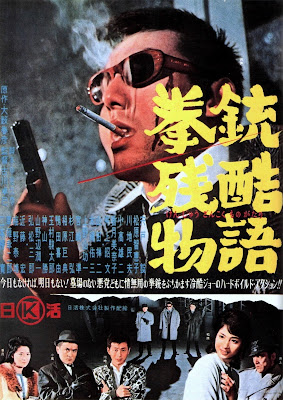
Cruel Gun Story Poster

Cruel Gun Story (1964) Takumi Furukawa’s fast-paced noir thriller features Jô Shisido as Joji Togawa, a career criminal freshly sprung from prison. Against his better judgment, he accepts a challenge to lead a small team to rob an armored car carrying 120 million yen. When he’s betrayed by the mob boss who hired him, he plots his revenge. Joji approaches his work with ice-cold precision, but has a soft spot for his disabled sister. Shisido is perfect as a criminal with a strict code of honor, maintaining his integrity in a world typified by double crosses and other dirty dealings. 

Rating: ***½. Available on DVD (part of the Criterion Eclipse series Nikkatsu Noir)
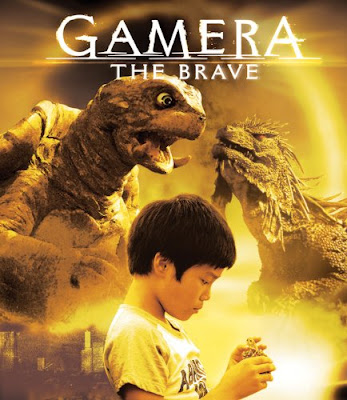
Gamera the Brave Poster

Gamera the Brave (2005) The latest Gamera flick to date might irritate some hardcore fans accustomed to the exceptional ‘90s trilogy, but I enjoyed this intentionally lower-key, kid-friendly outing. Instead of picking up where the trilogy left off, it’s a reboot of sorts harkening back, in spirit, to the original series of films with the giant turtle, when he was the friend of all children. A young boy, Toru (Ryô Tomioka) discovers an egg sitting atop a glowing red crystal, and takes it home (you can probably guess the rest). This version of Gamera is a smaller, gentler (And dare I say, cuter?) version of the eponymous kaiju hero. It’s somewhat of a letdown that he fights a rather generic enemy, but the human characters (particularly Toru’s father, Kousuke) are fairly well fleshed out. While it’s not exactly the sequel most of us wanted, it’s diverting enough.           

Rating: ***. Available on Blu-ray, DVD and Amazon Prime

Dead Sushi Poster

Dead Sushi (2012) Keiko (Rina Takeda), a budding young sushi chef, runs away from home after she tires of her father’s criticism. She takes a job as a server at an inn, which is hosting a company retreat. Unbeknownst to Keiko, the deposed company founder, seeking revenge against his former teammates, turns his experimental serum on their sushi, with deadly consequences. Writer/director Noboru Iguchi keeps everything suitably over the top (if you’re familiar with some of his other work, including Machine Girl and Robogeisha, then you likely know what you’re in for). Expect lots of tasteless sight gags (with an occasionally clever joke thrown in, for good measure) and a surprising amount of heart. You might never look at sashimi the same way again. 

Rating: ***. Available on Blu-ray, DVD and Tubi

Monster Seafood Wars Poster

Monster Seafood Wars (2020) A young biochemist develops a substance that will make animals grow to gargantuan proportions, resulting in an ordinary octopus, squid and crab transforming into kaiju. While they threaten the population of Japan, they have an unintended side effect – they’re also delicious. Writer/director Minoru Kawasaki’s (The Calamari Wrestler, Executive Koala) applies his signature goofy, no-budget approach to his kaiju tale. It’s a couple of notches below his best, but it’s not without its moments. It never takes itself too seriously, gently poking fun at tokusatsu movies, while embracing them. The pacing, however is inconsistent, and the story (which is probably a bit too deadpan for its own good) could have used a few more jokes. 

Rating: **½. Available on Blu-ray, DVD and Amazon Prime


Saturday, January 22, 2022

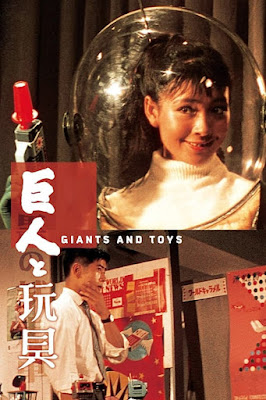
Giants and Toys

Giants and Toys Poster

(1958) Directed by Yasuzô Masumura; Written by Yoshio Shirasaka; Based on the novel by Takeshi Kaikô; Starring: Hiroshi Kawaguchi, Hitomi Nozoe, Hideo Takamatsu, Michiko Ono; Available on Blu-ray and DVD

Rating: **** 

“You’re behind the times. You don’t understand the age of media. Listen, modern people are worse than babies. Worse than dogs. Why? Because they don’t think. They work like slaves in the day, get drunk and play pachinko at night. Or they listen to the radio, or watch TV. When do they have time to think? Their heads are empty. That’s where we come in. We’ll hammer our message into their heads over and over again, ‘Delicious caramel, World Caramel. World, World, World!’ Then every time they see a pack, they’ll automatically buy it. Do you get it now? We can control them with radio, TV and movies. We can make the masses think and feel whatever we want. The media is the dictator, the emperor of the modern age!” – Ryûji Gôda (Hideo Takamatsu)

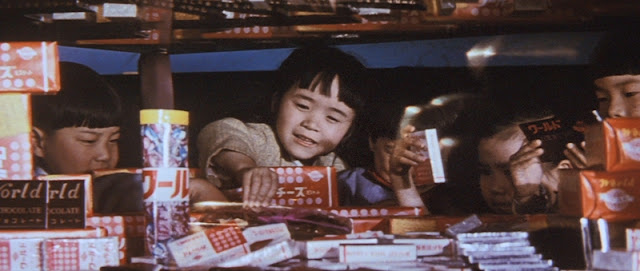
Kids and candy

When most people think of the most significant and influential names in Japanese cinema, the usual suspects are bandied about. One overlooked filmmaker who merits more attention is Yasuzô Masumura.* Despite his prolific creative output throughout the ‘50s, ‘60s, and ‘70s, many of his films (with a few notable exceptions) remain unseen in the West. Masumura established himself as a formidable creative force with his vicious satire, Giants and Toys (aka: Kyojin to Gangu), skewering Japan’s changing landscape in the realm of business, and as an emerging economic superpower. 

* Fun Fact #1: Masumura’s educational background in Law, Literature and Philosophy informed his unique vision. He further honed his craft, studying film in Italy at the prestigious Centro Sperimentale di Cinematografia.

Masami and Nishi

Eager young college graduate Yôsuke Nishi (Hiroshi Kawaguchi) lands a publicity job for World Confectionary, which is embroiled in a fierce competition between rivals Giant Chocolate and Apollo Drops.* He wants to impress his boss Ryûji Gôda (Hideo Takamatsu) at any cost, which includes grooming a young, rough-around-the-edges woman to be the company’s new spokesmodel. Meanwhile, he takes a romantic interest in Masami Kurahashi (Michiko Ono), who works for Apollo, but his intentions are less than sincere. Likewise, Masami proves to be just as capricious as her boyfriend. Between whispering sweet nothings, they press each other for details about the latest marketing campaigns in their respective companies. The rivalry carries over to his friendship with college buddy Tadao Yokoyama (Kôichi Fujiyama), who shills confections for Giant. 

* Fun Fact #2: In Takeshi Kaikô’s original story, the company names were, respectively: Samson, Hercules, and Apollo.

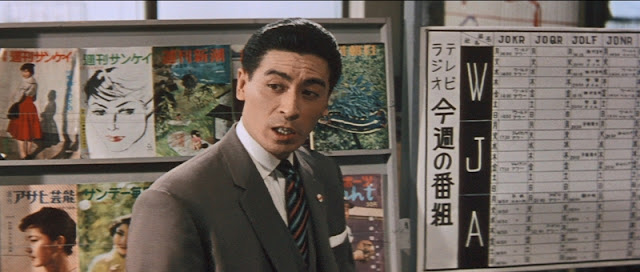
Goda and Nishi

At the age of 38, Gôda (Hideo Takamatsu) is an ambitious, upwardly mobile executive, who’s old before his time. He runs himself ragged, neglecting sleep in favor of his work, and popping pills to keep himself going. He neglects his wife Suzue (Hiroko Machida), the daughter of his superior, whom he married for strategic reasons, rather than matters of the heart. As his career continues its upward trajectory, his health spirals down to the point where he coughs up blood on his promotion letter. He purveys an ethos of success at any cost, which trickles down to his subordinate, Nishi.

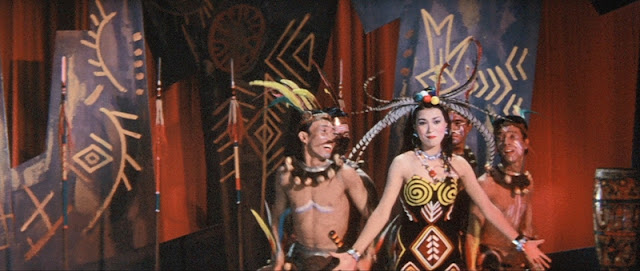
Kyoko

Hitomi Nozoe plays the bubbly ingenue Kyôko Shima, who seems an unlikely poster girl for a candy company, with her rotten teeth. Her cute, unpolished exuberance catches the eye of Gôda, however, who sees her potential. Thus begins her Pygmalion-like transformation, as she quickly becomes an overnight celebrity. Along with her rapid ascension in the public’s consciousness, her entire tone changes, as she transitions from an amiable, unpretentious girl from the slums, to a self-absorbed, quasi-sophisticate. Nishi doesn’t buy her instant celebrity status, aware of the half-life of a fickle public and the ephemeral nature of fame. He tells Nozoe it’s only a matter of time before someone takes her place, but she’s self-aware, enjoying the ride while it lasts (“So what? I don’t mind being a puppet or a toy. As long as I’m having fun, that’s enough.”). 

* Fun Fact #3: While their onscreen characters shared a contentious relationship, co-stars Kawaguchi and Nozoe married in 1960.

Goda

Giants and Toys playfully equates modern business to feudal Japan. One sequence hammers home the metaphor, with shots of the three candy company banners waving high. Their employees go into battle, developing strategies of attack and defense, with spies around every corner. When the main factory of a rival company burns down, an older World executive calls for bushido, the ancient samurai spirit of honor among adversaries. He’s summarily dismissed by his colleagues as naïve and old fashioned. No one in the film is entirely trustworthy or above compromising their integrity. Honesty only brings you so far, everyone has an ulterior motive, and no one is above selling out. Lies, betrayal, and subterfuge are simply part of the game. Gôda’s speech about how easily the general public are manipulated is downright prophetic. Advertising is all about creating a need for something that didn’t exist before, doing the thinking for people. Choice is an illusion. Giants and Toys also takes a cynical stance toward relationships in the context of the film, which appear solely transactional in nature – rather than what you can do for someone else, it’s about what you can get from them.

Kyoko

Cinematographer Hiroshi Murai’s candy-colored presentation is only appropriate for a story about rival confectionary companies. The garish, saturated colors underscore the exaggerated onscreen antics. Amidst the humor, Giants and Toys has a serious message about the new disposable culture. In Kyôko’s case, she’s nothing more than the flavor of the month, pre-packaged and rammed down the public’s collective throat, like the candy her company sells – sweet on the surface, and just as insubstantial. Cutthroat business tactics are an accepted fact. Masumura applied similar themes, adopting a darker tone with his Black Test Car (1962). Compared to the later film, Giants and Toys tells its story in broader, breezier strokes, making the themes more accessible (not to mention a lot more fun). With its breakneck pace and rapid-fire dialogue, Giants and Toys deserves to be re-discovered. The film’s strikingly contemporary commentary on fame, consumer culture and business remains as relevant today as it was in 1958, making this a true classic. 


Sources for this article: Arrow Blu-ray commentary by Irene González-López; “In the Realm of the Publicists,” video essay by Earl Jackson, Jr.; Yasuzô Masumura biography on Fantomas Blind Beast DVD, by Earl Jackson, Jr.

Tuesday, January 11, 2022

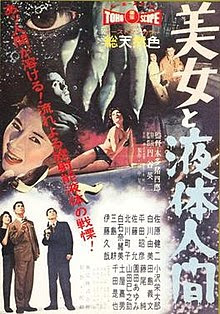
The H-Man

The H-Man Poster

(1958) Directed by Ishirô Honda; Written by Takeshi Kimura; Story by Hideo Unagami; Starring: Yumi Shirakawa, Kenji Sahara, Akihiko Hirata, Eitarô Ozawa Koreya Senda and Makoto Satô; Available on Blu-ray and DVD 

Rating ***½  

“Take a look at this logbook from the ship Ryujinmaru. First, six men on deck fell victim to the radiation. The remaining men on the ship fell, hopelessly, before their transformed shipmates. If any of the victim’s psyches are preserved, it’s very possible that they tried to come to Tokyo. A liquid organism created by an H-bomb test with the mind of a human. I suppose you could call it an H-Man.” – Dr. Maki (Koreya Senda)

H-Man

Although most film fans likely associate Ishirô Honda with his Showa era kaiju flicks, there’s a number of stand-alone titles in his filmography worthy of your attention. Upon its release in the U.S., The H-Man was unfairly maligned as a rip-off of The Blob. While both films debuted in 1958, Honda’s film actually predated the American movie by several months, and beyond some superficial similarities, differs widely in story and tone. Honda skillfully blends two strange bedfellows, film noir and science fiction, to create a unique experience.* Following the heels of Gojira (1954), The H-Man continues exploring the deleterious effects of radiation on humankind. Only 13 years after the catastrophic events in Hiroshima and Nagasaki, and with American atomic testing in the South Pacific in full swing, the threat of nuclear annihilation was fresh on the minds of the Japanese public. 

* Fun Fact #1: the realistic street sets were recycled from Akira Kurosawa’s Drunken Angel (1948)

Tominaga and Masada

When small-time criminal Misaki (Hisaya Itô) vanishes in the middle of a drug deal, he leaves behind a pile of empty clothes and a big mystery. While police inspector Tominaga (played by Akihiko Hirata, who appeared as Dr. Serizawa in Gojira) takes a prosaic approach to the evidence, professor Masada (Kenji Sahara) pursues a more fantastical explanation for the disappearance. Both men are at odds with each other, as the eager young Masada and the skeptical police official butt heads. Masada suspects that there could be a link between Misaki and a fishing vessel that strayed into a nuclear testing zone in the South Pacific. Tominaga and Masada seek out Misaki’s girlfriend, nightclub singer Chikako Arai (Yumi Shirakawa), who might hold the key to solving the puzzle.

Chikako

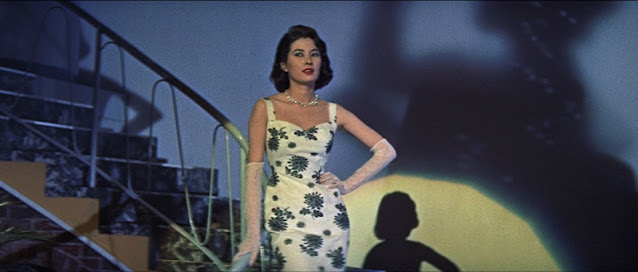
Chikako serves as the film’s nominal femme fatale, although her character seems to promise more smolder than she delivers. She performs two English-language numbers at the nightclub, frequented by cops and criminals alike, but spends most of the movie badgered by the police, slapped around by two-bit hoods, or at the mercy of Masada and his lab team. Other times, she’s reduced to fainting at the appropriate moments (four times, by my count), although one could argue it’s a physiological reaction to radiation exposure. Chikako doesn’t share a lot of chemistry with Masada (okay, pun intentional), and Masada doesn’t really seem to be her type, but we’ll just take it on faith that their attraction transcends any preconceptions of compatibility.   

Sailors Onboard Derelict Vessel

Honda’s secret weapon in The H-Man was lighting technician Tsuruzô Nishikawa, whose bold lighting solutions contributed to the moody, shadow-filled look of the film. In the film’s best scene, told in flashback, a pair of hospitalized sailors recall their experience, exploring a seemingly abandoned fishing vessel. As they probe the eerie darkened corridors, illuminated by a solitary lantern, it gradually dawns on them that they’re not quite as alone as they once thought. The filmmakers are careful not to reveal too much all at once, letting our minds fill in the blanks about what lurks in the shadows. We’re left with one of the most memorable images, as the sailors gaze upon the decks of the derelict ship one last time, with its remaining occupants emitting a spectral green glow.

Victim of the H-Man

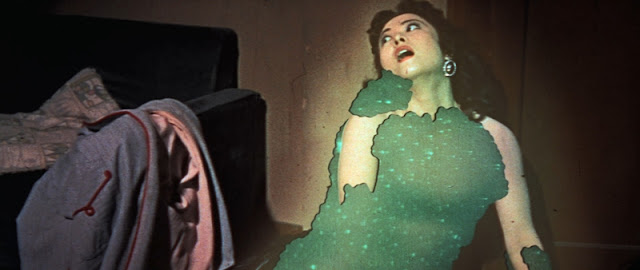
The H-Man is eye-opening in several respects, offering more for the viewer’s senses, compared to the rather chaste American genre output of the time. This is especially evident in the nightclub scenes, where dancers in skimpy outfits gyrate to jazz riffs. The film includes some suitably icky Grand Guignol flourishes, graphically depicting the unfortunate humans that come into contact with liquid entities. The effects are simple but effective, as bodies crumple and dissolve while they’re absorbed by green goo.* Another brief scene features a gunshot victim, replete with visible bloody bullet holes. 

* Fun Fact #2: To create the goopy green slime, the filmmakers employed a compound that was commonly used for cosmetic applications, made from blue-green seaweed.

Dancer Victim

The H-Man* is best appreciated as an exercise in mood and style, rather than a full-blown crime movie. The mechanics of the plot prove to be little more than a red herring, designed to distract us from the film’s radioactive menace. The theme of body transformation and concept of an abandoned ship concealing a terrible secret would be explored (and arguably improved upon) several years later, with 1963’s Matango (also written by Takeshi Kimura), but H-Man’s slimy glowing adversaries stand out as a unique addition to the Toho sci-fi canon. 

* Random thought: Considering the film’s drug-trafficking subplot, I suppose “H-Man” could also refer to heroin. 


Source for this review: Ishiro Honda: A Life in Film, From Godzilla to Kurosawa, by Steve Ryfle and Ed Godziszewski, with Yuuko Honda-Yun

Friday, December 31, 2021

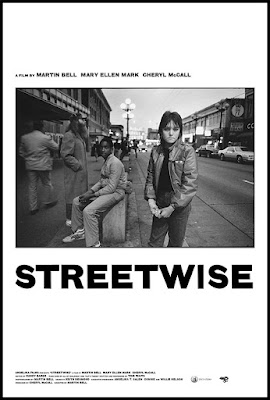
Streetwise


Streetwise Poster

(1984) Directed by Martin Bell; Starring: Erin (“Tiny”) Blackwell, “Rat,” DeWayne Pomeroy, Lou Ellen “Lulu” Couch, Patrice Pitts, Kimberly Marsh; Available on Blu-ray and DVD

Rating: ****

“The idea was to enter the world of these kids, to figure out the relationships between each other, and also between them and their parents – the ones that occasionally kind of visited their parents…” – Martin Bell (from 2021 Criterion commentary)

Tiny with Other Street Youth

Years before I moved to the Seattle area, the Emerald City had captured my imagination and awe. Nestled along Puget Sound, with the Olympic Peninsula to the west, and the Cascades to the east, it possesses its own unique charm, melding a modern metropolis with breathtaking natural scenery. Perhaps because of its fortuitous location, or its rugged individualistic spirit, Seattle has long held its reputation (deserved and undeserved) as one of the most “livable” cities in the U.S. Beneath its glossy postcard exterior, however, another story was begging to be told.* Literally around the corner from one of the city’s most famous tourist attractions, the Pike Place Market, there is a parallel world that most people choose to ignore. Shot over a period of 55 days by director Martin Bell and his crew, Streetwise is an unflinching look at life on the street in downtown Seattle for several teenagers. 

* Fun Fact: Streetwise was based on the Life magazine story, “Streets of the Lost,” by Mary Ellen Mark and Cheryl McCall, who collaborated with Bell for the film.

Pat and Tiny

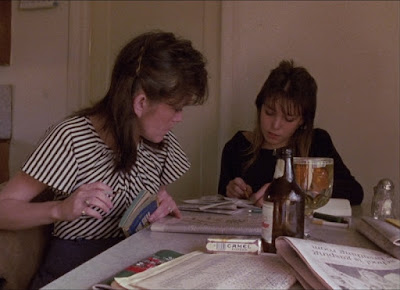
14-year-old Erin Blackwell, better known as “Tiny,” emerges as the film’s nominal star. It’s difficult to hear her describe her work as a prostitute, followed by a scene where she accepts a ride with an elderly client. Sadly, we get the impression this isn’t something anomalous, but a typical day in her life. Unlike many of the other kids in the film, her mother Pat (who works as a waitress at a greasy spoon), is still in her life. Tiny comes home intermittently, where she shares a contentious, chaotic relationship with Pat. Watching the two interact, it’s easy to confuse who’s the grownup and who’s the parent. The most horrifying aspect is her mother’s frank admission that she doesn’t disapprove of her source of income. Indeed, she seems genuinely impressed by her daughter’s claim that she made $200 in one day. Pat simply shrugs it off, saying, “It’s just a phase she’s going through right now.” In another scene, when Tiny attempts to speak with her mother, Pat curtly replies, “Don’t bug me, I’m drinking.” While the street becomes Tiny’s maladaptive escape, booze is Pat’s primary mode of detachment, at the expense of her daughter. It’s clear that Tiny seeks attachment and stability in her life, but she’s trapped in a vicious cycle, typified by neglect and loneliness. She speaks about wanting to have a baby, but for now her little dog serves as a surrogate.

Rat

“Rat,”* a 14-year-old boy, subsists on the day-to-day grind of hustling pedestrians for spare change. He lives in an abandoned building with “Jack,” a 20-something drifter, who’s the closest thing to an authority figure. From Jack, he learns to subsist from eating out of dumpsters, and riding the trains. While lacking formal education, he possesses an innate intelligence, seeming to intuitively know how to work every angle. In one of his most clever scams, which he demonstrates for the camera, he orders a pizza at a restaurant, pretending the phone booth he’s calling from is his home address. When no one claims the pizza, they discard it in the dumpster, and he retrieves it. When he describes his estrangement from his parents (who live in Sacramento) it’s apparent that he doesn’t like being attached to anyone or anything for too long. He forms a brief bond with Tiny, but their relationship is doomed from the start.   

* Fun Fact #1: the memorable opening scene where Rat jumps off of a tall bridge into a river, 200 feet below, wasn’t shot in Seattle, but in his home town of Sacramento, California, on the Rainbow Bridge (as a re-enactment).  

Lemar and DeWayne

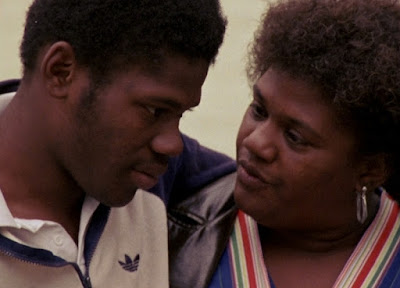
One of Streetwise’s most tragic stories belongs to 16-year-old DeWayne Pomeroy. Small for his age and malnourished (as a visit to a local free clinic confirms), he’s forced to live on the streets when his father Lemar is incarcerated for an arson conviction* Meanwhile, his mother is out of the picture. When he visits Lemar in prison, his father plays the part of the concerned parent, fearing that his son is going to end up like him. With limited options remaining for DeWayne, and nowhere left to turn, his future remains hazy. 

* Fun Fact #2: According to Bell, Lemar was charged with arson after burning an ice cream truck.

Patrice with Mother

Several other young people, while lacking in overall screen time, make a big impression.* Lou Ellen Couch (aka, “Lulu”)** serves as a fearless protector for many of the younger, more vulnerable kids on the street. Because of her appearance and sexual orientation, she’s often a target for derision, but she doesn’t let the scorn of her detractors deter her from helping others. Patrice Pitts is full of swagger as a would-be pimp, and small-time hustler (in one amusing scene, he confronts a street preacher, questioning his intentions). When his mother and grandmother pay him a visit in a parking lot, the façade of alpha male posturing melts away, and we see him regress before our eyes. Fast-talking Kim (whom Bell described as “volatile”), puts on a hardened false front, estranged from her adoptive family, but we see the desperation set in as she arranges “dates” with anonymous male clients.    

* Not-So-Fun-Fact: One of the teenagers briefly featured in the film is Roberta Hayes, who was murdered by Gary Ridgway (better known as the “Green River Killer”). 

** Fun Fact #3: The film’s title comes from a line spoken by Lulu, who sagely opines that to live on the street, you have to be “streetwise like a motherf***er.”

Rat and Jack

Considering the deplorable situations the youths in Streetwise endure, the obvious question is where does objective detachment end for the filmmakers, and why didn’t they attempt to intervene at some point? The answer is complicated, fraught with ethical gray areas. In order to get the stories and images in his film, Bell and his crew gained unprecedented access to the young people and their tumultuous lives, which required earning the confidence of their subjects. Bell’s explanation was that “it was their life,” and he didn’t want to put them in greater danger. Unfortunately, the story of these kids isn’t unique to Seattle, but prevalent in every major city. It’s an uphill struggle, fighting poor nutrition, inadequate (or no) healthcare, and the omnipresent hazards of living on the street. The only conclusion is that the system has failed them. When one of the teens prominently featured in the movie died by suicide while in custody at juvenile hall, the film crew (in the process of editing the film) flew back for the funeral, providing a poignant, all-too-familiar conclusion. The death is another terrible statistic, a casualty of life on the street, and another individual with potential, snuffed out long before his time. Streetwise is a heartbreaking, unforgettable collection of stories, which will stick with you long after the film has ended.


Monday, December 27, 2021

Documentary December Quick Picks and Pans

The Wonderful, Horrible Life of Leni Riefenstahl Poster

The Wonderful, Horrible Life of Leni Riefenstahl (1993) Ray Müller’s fascinating documentary delves into the life of pioneering filmmaker/Nazi sympathizer Leni Riefenstahl, who made the notorious propaganda film Triumph of the Will (1935). Now age 90 (at the time of this film), Riefenstahl looks back at her career, while discussing her present-day creative pursuits. Despite the three-hour glimpse into her life, she remains something of a mystery, thoughtful and reflective, yet staunchly unrepentant about her past. It’s a disturbing portrait of an undeniably talented but morally bankrupt artist, who refuses to equate her films with making a political statement or acknowledge her role in creating a propaganda tool. Despite her well-documented complicity with the Nazis, she denies any wrongdoing, claiming that she had no knowledge of the extent of their atrocities. What emerges is a nuanced profile of an artist that goes beyond black and white depictions, neither condemning nor condoning its subject. Instead, we’re left with the disconcerting notion that evil is something not quite tangible, but no less damaging.  

Rating: ****. Available on DVD


Don't Think I've Forgotten Poster

Don’t Think I’ve Forgotten: Cambodia’s Lost Rock and Roll (2014) Director John Pirozzi chronicles the rise and fall of rock music in Cambodia in this compelling, often heart-rending story (told through interviews with friends, relatives, and surviving performers). We learn about performers such as Sinn Sisamouth, Pen Ran, and others who rose to notoriety in their home country, only to find that their music was outlawed once the Khmer Rouge came into power in 1975. The film presents us with a good primer on a largely unknown music scene that was nearly erased from existence. Most importantly, it’s a history lesson that’s not discussed enough in the west, about a country that endured a tug-o-war between superpowers, only to be torn apart by an oppressive regime and genocide.

Rating: ****. Available on Kanopy and Tubi

Eadweard Muybridge: Zoopraxographer Poster

Eadweard Muybridge, Zoopraxographer (1975) While it only runs a brief 59 minutes, this profile of pioneering photographer, Eadweard Muybridge’s most notable accomplishments never seems too long, nor too short. Narrated by Dean Stockwell, the film covers the creative life of Muybridge, who started out on a more conventional route with landscapes and portraits, before making his claim to fame – motion studies of animals and people. Over the years, Muybridge refined his painstaking process, involving custom-made equipment and three batteries of multiple cameras. While the man himself remains an enigma, filmmaker Thom Andersen lets the photographer’s work speak for itself.   

Rating: ****. Available on DVD and Kanopy

Grass Poster

Grass: A Nation’s Battle for Life (1925) Years before they made a smash with King Kong (1933), filmmakers Merian C. Cooper and Ernest B. Schoedsack traveled with Marguerite Harrison to document the nomadic Bakhtiari people’s migration to more fertile lands in Iran. We witness the tribe’s incredible resilience, as they endure their arduous 48-day trek over snowy mountains and traverse the perilous Karun River, with 50,000 people and 125,000 animals. The spectacular photography underscores the vastness of their endeavor, as they battle the elements and odds for a better way of life. 

Rating: ****. Available on DVD and Kanopy

Happy Happy, Joy Joy Poster

Happy Happy, Joy Joy – The Ren & Stimpy Story (2020) Ron Cicero and Kimo Easterwood explore the world of Ren & Stimpy’s troubled creator, John Kricfalusi, chronicling the animated show’s tremendous popularity. We hear from many of the animators and colleagues who worked with Kricfalusi to create the highly influential Nickelodeon show. Cicero and Kimo don’t shy away from the unsavory details behind the scenes, with the staff being subjected to the creator’s exacting vision and verbal abuse, or his megalomaniacal tendencies (which eventually caused him to be fired from his own show). It’s an engrossing look at the collaborative nature of producing a hit animated show, along with the hours of pain and suffering that go into creating it. Cicero and Easterwood acknowledge Kricfalusi’s lasting contribution to animation, while never letting him off the hook about his transgressions (including a relationship with an underage fan/aspiring animator), which brought his career to a halt.

Rating: ****. Available on Blu-ray, DVD and Kanopy


The Final Member Poster

The Final Member (2010) Jonah Bekhor and Zach Math’s entertaining film shines the spotlight on Sigurður Hjartarson, who runs the world’s first phallological museum, in Iceland. Hjartarson has acquired a comprehensive collection of specimens from numerous species (from hamsters to sperm whales), but securing one from a human has eluded him, so far. Now, it’s down to two candidates: Páll Arason a 95-year-old Icelandic explorer (and self-professed lady’s man), and Tom Mitchell a 60-year-old American (who named his penis “Elmo”), who’s willing to part with his member while he’s still alive. It’s a race against time to see who will donate first, in this often very funny, and occasionally poignant meditation on mortality and leaving one’s mark. 

Rating: ***½. Available on Blu-ray, DVD, Hulu and Kanopy 


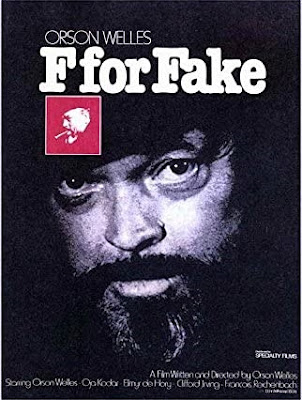
F for Fake Poster

F for Fake (1973) Director Orson Welles’ final film (that he personally completed) is an examination of con artists. Welles examines the career of infamous forger Elmyr de Hory, who created works of art virtually indistinguishable from the real thing. His exploration leads to de Hory’s biographer, Clifford Irving, a successful con artist in his own right, who passed off a fabricated biography of Howard Hughes as fact. It’s Welles at his most playful, performing sleight-of-hand magic tricks, and discussing his early career, namely his biggest con, the infamous War of the Worlds radio broadcast in 1938. F for Fake raises the question, what’s truly authentic if you can fool the so-called experts? 

Rating: ***½. Available on Blu-ray and DVD

Happy People Poster

Happy People: A Year in the Taiga (2010) Co-directors Dmitry Vasyukov and Werner Herzog (with narration by Herzog) follow a group of trappers who live in the remote village of Bakhtia, and hunt in the Taiga region of Siberia. It’s a vast, unforgiving landscape, typified by harsh winters, and only accessible by boat (in the spring and summer months) or helicopter. The trappers live simply, without most modern conveniences, enduring the four seasons with pragmatic resolve. “Happy” is a relative term, however, as we learn about the plight of the region’s indigenous people who are slowly vanishing, along with their customs and artwork. While the film never quite captures Herzog’s signature touch, his sober narration serves as our guide to this story of survival and perseverance. 

Rating: ***½. Available on DVD, Kanopy and Tubi

Heavy Metal Parking Lot Poster

Heavy Metal Parking Lot (1986) The title says it all. In 1986, documentarians John Heyn and Jeff Krulik took a video camera to the Capital Center arena in Maryland, to observe fans waiting for a Judas Priest concert (many of whom appear to be in various states of inebriation). It’s only a scant 16 minutes, but that’s long enough to encapsulate a moment in time when there was nothing more important than hanging out with your best buddies and rocking out to your favorite band. Part of the short film’s charm is imagining whatever became of the (ahem) colorful individuals interviewed. 

Rating: ***. Available on DVD and YouTube


Sunday, December 12, 2021

My Winnipeg


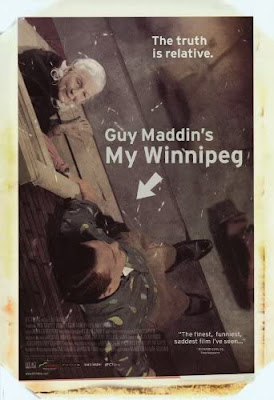
My Winnipeg Poster

(2008) Written and directed by Guy Maddin; Dialogue written by George Toles; Starring: Ann Savage, Darcy Fehr and Louis Negin; Available on Blu-ray and DVD 

Rating: **** 

“I had long been dreaming about my city, Winnipeg, that it didn’t seem to have a place in anyone’s mythology, not even in Winnipeggers… To me, by mythologizing, I don’t mean lying or telling the truth, or exaggerating or anything. I just meant embedding the stories of this city in emulsion, that’s all. And that to me meant, once something was in emulsion, it was mythologized.” – Guy Maddin (from 2014 interview with Robert Enright)

Guy Maddin's "Family"

What makes a documentary a documentary? Is it recording a moment in time or recollection, relying on strict adherence to facts? Or is it searching for another kind of truth? Guy Maddin’s unconventional documentary, My Winnipeg, consisting of part fact, part fabrication, is at once a love letter and condemnation of his home town, touted by the filmmaker as the coldest city on earth.* The mostly black and white film combines archival footage with modern reconstructions of events, seamlessly blending history, autobiography, and fantasy, into one poetic stew. Instead of a stuffy account of past events, filled with creaky talking head interviews, Maddin lets the imagery lead the way. The director, himself, provides the film’s droll narration, lending a sense of scope and grandeur to his city. With his authoritative, yet congenial tone, we get the sense that he’s winking at us at every turn. 

* Fun Fact #1: While Winnipeg has been known to reach some truly frigid temperatures, it’s not quite the coldest major city on earth. Those honors go to Yakutsk, in Russia.

Winnipeg Railroad Yard

A recurrent theme is the confluence of things, natural and artificial. Within the heart of Winnipeg lies a junction of the Red and Assiniboine Rivers known as The Forks, which he equates with his mother’s lap. Beneath these rivers, according to a First Nations myth, reside two subterranean rivers, which meet in a similar fashion. Maddin compares these junctions to the city’s great railroad yard, a transportation hub for Canada’s trains. Likewise, a complex network of unofficial back streets crisscross the city (allegedly a source of dispute among two rival taxi companies). The metaphor of worlds within worlds is taken a step further, with the Sherbrook public pool, and its three distinct levels.* 

* Fun Fact #2: According to Maddin, "In the movie, I dreamed there are actually three levels to Sherbrook Pool – that's how deeply I felt that facility rooted itself in our city's collective memory." (excerpted from 2013 Winnipeg Free Press article, “Many Woes at Sherbrook Pool,” by Jen Skerritt)

Ledge Man

In one of the film’s more audacious elements, actors portray members of Maddin’s family, notably including Ann Savage* as his elderly mother. Younger actors were cast to play Maddin’s siblings, circa 1963, so they could re-enact events embedded in his memory. Maddin’s deceased father plays a small part, albeit a silent one. In a morbidly absurd touch, he claims that his father’s body was exhumed and re-buried under the floor, now present as a lump under the rug. Even his long-dead family dog has a stand-in, played by his girlfriend’s pug, Sparky. My Winnipeg is filled with hilarious interludes, presented as fact, such as the alleged long-running television show, Ledge Man, supposedly the only show produced in Winnipeg, typified by melodrama and hammy acting. His mother (the fictional one) stars in the production, which has run for the past fifty years, talking the titular ledge man down every episode. 

* Fun Fact #3: Film noir fans may recognize Savage as Al Roberts’s (Tom Neal) surly traveling companion Vera, in Detour (1945). Her scenes were shot in Los Angeles. Sadly, it proved to be her final role, as she died from complications due to a stroke, shortly after filming.

If Day

Somehow, Maddin manages to make real events seem like fiction, and fake events appear like fact. His description of “If Day” demonstrates how a real event, from an outsider’s perspective, might look like fiction. In 1942, the city shut down for a mock invasion by the Nazis (actually thousands of Rotary Club volunteers in borrowed Hollywood costumes), to simulate their town besieged by hostile invaders. We learn that the entire charade was ultimately a ploy to sell war bonds. As an adjunct to “If Day,” Maddin opines that “What if?” becomes a driving question that preoccupies Winnipeg residents. Another story that might be true, but is too steeped in urban legend to be certain, concerns the 100-year-old Arlington Bridge, originally designed by a British firm to span the Nile River in Egypt. Allegedly built to the wrong specifications, it was sold to the city of Winnipeg for a bargain price. Maddin describes how the bridge dreams of spanning the Nile, occasionally popping a girder now and then, in petulant defiance of its adopted home. His beloved Winnipeg Arena, former home of the Winnipeg Jets, and the Maroons before them, now destined for the wrecking ball, becomes the stuff of fact and fiction. He claims to have been born in the changing room, and later served as a towel boy, admiring the players’ bodies from the visiting Soviet team. He describes an underground team of elderly ex-professional hockey players, who stage matches in the dilapidated arena. In another flight of fancy, he describes an incident, many decades ago, when a herd of horses became trapped in the icy waters of one of the rivers. Young lovers stroll through the macabre display of frozen horse heads – a weird sort of aphrodisiac, presented as a possible catalyst for the city’s baby boom. 

Strolling Among the Frozen Horse Heads

Throughout the film, an actor portraying a younger version of Maddin (Darcy Fehr) rides an imaginary train leaving town. We’re never sure if he leaves, and in the end, it doesn’t matter. The point is that wherever we go, we ultimately carry our home town with us. Instead of slavish dedication to the facts, Maddin injects artful embellishments for his tale to reach mythological proportions. It’s not quite the truth, nor is it complete fabrication, but something in between. Anyone who’s lived sufficiently long enough in their respective home town can appreciate Maddin’s My Winnipeg. It’s a playfully ambivalent relationship, born of frustration and deep affection. 

Wednesday, December 1, 2021

Rififi


Rififi Poster

(1955) Directed by Jules Dassin; Adapted by Jules Dassin; Based on the novel by Auguste Le Breton; Starring: Jean Servais, Carl Möhner, Robert Manuel, Janine Darcey, Claude Sylvain, Robert Hossein, Marcel Lupovici and Jules Dassin (as Perlo Vita); Available on Blu-ray and DVD 

Rating: ****½  

“There was a passage in the book that had to do with a robbery, which was to finance a greater project, and I seized upon that to build a screenplay around it, and make it a high point in the film. …Many people asked me why silence, because there’s not a word spoken for a long time, and I said these are professional guys who work in silence. Noise is an enemy…” – Jules Dassin

Viviane's Musical Number

Jules Dassin didn’t invent the heist film, but he perfected it with Rififi (aka: Du Rififi Chez les Hommes), which depicts the perfect crime, only to see everything fall apart. The heist is only the beginning of this noir-drenched* tale, which explores the self-destruction and collateral damage caused by a life of crime. The film’s title (also heard as a jaunty nightclub song, performed by Magali Noël as Viviane) is French slang for a tough guy, or perhaps more accurately, the swagger that goes along with the tough guy persona.** American-born director Jules Dassin, a victim of the blacklist, adapted Auguste Le Breton’s novel,*** providing a counterpoint to the characters’ hyper-masculine exploits. 

* Fun Fact #1: In order to create the proper tone, Dassin chose to shoot the film entirely on cloudy days, much to the irritation of the producers. 

** CORRECTION: According to my Twitter pal Jean-Paul Audouy (@jpaudouy): "Rififi means “violent fight” and by extension the damages caused by a fight."

*** Fun Fact #2: After reading Dassin’s adaptation, Le Breton was reportedly displeased, asking the director point-blank, “Where is my book,” while placing a gun on his desk. Dassin managed to smooth things over with the fiery tempered writer (who seemed to fashion himself after the hard-boiled characters in his book), and eventually became friends.

Tony, Mario & Jo

 Middle-aged thief Tony le Stéphanois (Jean Servais) is released from prison after serving five-years of his sentence, taking the rap for Jo (Carl Möhner), a younger man. Jail has left its mark on Tony, as evidenced by his chronic cough. Meanwhile, his girlfriend Mado (Marie Sabouret) has left him for another man, shady nightclub owner/kingpin Pierre (Marcel Lupovici). He reconciles the loss in the worst possible way, by taking her jewelry and beating her (thankfully, this is depicted off-screen). Reluctant at first to plunge back into his former life, he ultimately decides to assist Jo and his scheme to knock off the jewelry store Mappin & Webb.* Along with Jo, he joins Mario (Robert Manuel), a flashy-dressing lock picker, and Cesar le Milanais (played by director Dassin, under the pseudonym Perlo Vita), a womanizing safe-cracker. Prefiguring the longer heist sequence, the scene where Cesar cases the jewelry store is wordless. In the scene that follows the thieves meticulously plan every aspect of the impending robbery, timing the nearby traffic, accessing the location in relation to the other businesses, and rehearsing the operation, down to the slightest detail. 

* Fun Fact #3: Dassin recalled how the filmmakers didn’t expect to receive a positive response, when they asked Mappin & Webb if they would mind being featured in the film. To Dassin’s surprise, they enthusiastically consented.

Opening the Safe

Rififi’s claim to fame is indisputably the 30-minute heist sequence, presented from start to finish without dialogue or music.* It’s the antithesis to what we’ve come to expect from directors who would want to fill the space with superfluous chatter (I’ll refrain from naming any names). Instead, we’re left to observe the well-orchestrated operation,** as Tony and company move in synch with each other like an elaborate dance (as if to underscore this imagery, Cesar wears ballet slippers during the heist). As the scene plays out, it becomes evident how speech would be an extraneous distraction. A thick undercurrent of tension fills the void, allowing the audience to focus on the little details of the team’s precision efforts.   

* Fun Fact #4: According to Dassin, the film’s composer, Georges Auric, created music for the 30-minute sequence (at the insistence of the producers). After playing the film with and without music, Auric agreed with Dassin that it was better to keep things silent. 

** Fun Fact #5: Apparently, Dassin was a little too spot-on with some of the heist’s details, reportedly spawning a series of copycat robberies in multiple cities, where Rififi was shown.

Surveying the Goods

The following scene provides insight into the thieves’ possible futures, as they sit around a table, surveying the goods. For such a sizable haul (worth 240 million francs), their dreams are disproportionately mundane. Mario hopes to spend the money on various hotels, trying out the beds with his wife. In a similar vein, Cesar plans to continue his womanizing lifestyle. Jo, on the other hand, wishes to spend his cut on his young son, Tonio (Dominique Maurin), presumably to shelter him from falling into the same life of crime. Tony, the most seasoned of the bunch, is unsure about what he will do. He’s grown accustomed to a life of crime, which has become his trap. For him, there is no other way of life.

Tony & Jo

The group’s diminutive dreams, prove to be short-lived, when Pierre deduces who perpetrated the theft. Their downfall seems almost pre-ordained, brought on by Cesar’s vanity and Mario’s carelessness. For his part Jo is blinded by thoughts of making a better life for his son, concluding that the means justify the ends. He fails to ponder the consequences that affect his family, when Pierre orders his thugs to kidnap Tonio. Whether he gets his child back or not, he’s lost in the eyes of his wife, who views him as nothing but a common criminal who sold out his family.  

Tonio & Tony

One of Rififi’s most salient themes is the loss of innocence, personified by Jo’s son. Dressed as a cowboy, he waves his toy gun around, in a playful mimicry of the tough guys on both sides who brandish the real thing. To a group of hardened thieves, it’s serious business, but to a five-year-old, it’s all a big game. At its heart, Rififi is a bleak condemnation of criminal culture – a nowhere road of toxic masculinity and misplaced pride, where stereotypical posturing and misogyny is de rigeur. Rather than glorifying career criminals, it teaches us even the best laid plans eventually lead down a destructive path, from which there is no return and no hope of redemption.