Sunday, January 4, 2015

Memories


(1995) Directed by Kôji Morimoto (“Magnetic Rose”), Tensai Okamura (“Stink Bomb”), Katsuhiro Ôtomo (“Cannon Fodder”); Written by Satoshi Kon (“Magnetic Rose), Katsuhiro Ôtomo (“Stink Bomb” and “Cannon Fodder”); Original stories by Katsuhiro Ôtomo; Starring: Shigeru Chiba, Hisao Egawa, Kayoko Fujii, and Hideyuki Hori;
Available on DVD

Rating: ****

“What I wanted to make was a film with tension, like a tornado storming through your life.” – Katsuhiro Ôtomo (excerpt from


Well, what do ‘ya know? 2014 has come and gone, which means only one thing: time for another round of Japan-uary goodness. One of the tricky things about planning a theme month is ensuring there’s some balance in the titles covered. As a result, I’ve made a conscious decision to scale back my coverage of anime, despite the fact that I’m a big fan. Considering the relative paucity of anime titles I’ve covered over the past couple of years, however, I thought it was only proper to kick off the month with Memories.


My love affair with anime started 25 years ago when I was introduced to Katsuhiro Ôtomo’s Akira. The film was my gateway drug, which made me aware of the potential to tell mature, visually inventive stories in a medium traditionally reserved for more juvenile fare in the United States. More than any other anime film, Akira inspired me to actively seek out the works of Miyazaki, Takahata, Hosoda and many others. Memories re-introduced me to Ôtomo, and solidified his place as one of the art form’s best. Originally envisioned as separate video projects, the three segments (based on stories by executive producer Ôtomo) were expanded into a feature-length theatrical release.


The Kôji Morimoto-directed first segment “Magnetic Rose” is a mood piece, which owes a huge debt to Alien. The astronauts are depicted as blue-collar, working-class stiffs, who regard space exploration as simply another means to a paycheck. In response to a distress signal, the crew members of a deep space salvage mission encounter a derelict spacecraft. The cavernous interior springs to life as the astronauts enter the craft, revealing the ornate living quarters of an early 21st century opera singer. The tomblike derelict begins to act out her whims as a jilted lover, attempting to ensnare the lonely astronauts through their emotions. One explorer, a young playboy, becomes the object of the singer’s affections, a surrogate for her long-dead boyfriend, while (in a nod to Solaris) the other astronaut reunites with a deceased loved one. “Magnetic Rose” ties in closely with the film’s title, presenting memories as a double-edged sword, alternately a comfort and a trap. Memories enable us to revisit the things we found most enjoyable in life, but can also bog us down in grief, replaying traumatic events that can never have a different outcome. 


The second segment, “Stink Bomb,” is lighter in tone, although it deals with the unpalatable subject of biological warfare. When meek pharmaceutical company employee Nobuo Tanaka accidentally ingests a powerful bio-weapon (thinking he’s taking fever pills), he creates a noxious cloud that wipes out anyone in his vicinity, but paradoxically causes flowers to bloom. The classic “shaggy dog” story continues to escalate, exacerbated by the klutzy main character, oblivious of his actions. Tanaka’s affliction could be likened to his status as a social outcast. Because he doesn’t have a family or girlfriend, he’s presented as a bit of an oddball, toxic to others around him. Compared to the other two segments, “Stink Bomb” is the most instantly accessible, grounded in the present, in a recognizable setting, and with a sympathetic main character. It’s also the weakest segment, showing the telltale signs of a short story stretched thin to the breaking point.  


Memories ends on a strong note with the brilliant third segment, “Cannon Fodder,” directed by Ôtomo. It’s the shortest of the trilogy, but packs a wallop, depicting a militaristic society perpetuating an interminable war against an unseen enemy. We follow a day in the life of a family who exist to feed an insatiable war machine. A father goes to work as a cannon loader, and a mother toils in a munitions factory, while their son dreams of a day when he can command one of the huge guns that protect his city. “Cannon Fodder” is packed with visual details of a totalitarian city state that echo our own society: communist-style propaganda posters extol the virtues of labor, announcements employ a double letter ‘S’ (an obvious allusion to the Nazi SS), and the television news program continues to tout meaningless victories. The city itself is a steampunk nightmare, bristling with gun turrets from every home, and dominated by pistons and turning gears. The residents exist in service to the machinery, as opposed to the other way around. The society’s infrastructure is based on perpetuating a lie, where no one stops to question the validity of their mindless rituals. In one scene, the child asks his father who they are fighting, but the father only responds that he’ll understand when he gets bigger.


Each of the distinct science fiction stories in Memories stand alone, but together form an impressive anthology. We are treated to visions that reinforce and condemn humanity’s darker tendencies, compelling us to reflect on where we are headed as a species. Memories affirms anime’s ability to tell an engaging narrative on a vast, diverse palette beyond the confines of live action productions.

Sunday, December 28, 2014

December Quick Picks and Pans: David Lynch Month


Wild at Heart (1990) This film, studded with numerous references to The Wizard of Oz, is a road movie as only David Lynch could tell it. Nicolas Cage, channeling Elvis Presley, is ne’er do well Sailor Ripley, and Laura Dern is his girlfriend, Lula Fortune. Together, they set out on the highway toward California. Diane Ladd (Dern’s real-life mother) plays Lula’s deranged mother, Marietta, who would like nothing more than to see Sailor dead. Writer/director Lynch has assembled an impressive supporting cast, including Harry Dean Stanton as a love-struck private investigator, J.E. Freeman as a sociopathic hitman, Crispin Glover as Lula’s mentally unstable uncle, and Willem Dafoe as small-time criminal Bobby Peru (sporting some truly hideous teeth). Filled with surreal comic touches and even a dash of whimsy, Wild at Heart is Lynch at his most playful.

Rating: ****.  Available on DVD


Lost Highway (1997) Set amidst a film noir backdrop, Lost Highway toys with notions of reality and fantasy. Bill Pullman plays jazz musician Fred Madison, who’s accused of murdering his wife Renee (Patricia Arquette). The story takes an abrupt shift as the incarcerated musician inexplicably changes into Pete Dayton (Balthazar Getty), a mechanic for a mob boss (Robert Loggia). Things get dicey when Pete falls for the crime lord’s girlfriend Alice (also played by Arquette). A shadowy figure (Robert Blake, in his last film role to date), who could be a figment of Fred’s imagination, lurks in the background. Lost Highway is at once disorienting and engaging, sucking the audience into a mystery with no apparent solution. We’re never sure if Fred and Pete (or Renee and Alice) exist in separate realities, or if one is imaginary.   

Rating: *** ½.  Available on DVD.


Mulholland Drive (2001) With its labyrinthine plot and exploration of the seamy underbelly beneath the glamour of Hollywood, Mulholland Drive is the product of an artist at the top of his form. It’s also an exercise in frustration, as it requires us to examine clues that may or may not add up. When aspiring actress Betty (Naomi Watts) discovers a mysterious woman (Laura Elena Harring) living in her aunt’s apartment, she’s determined to piece together the stranger’s identity. Lynch’s surreal mystery is fascinating to look at and mull over, yet distancing. Despite the considerable praise that’s been heaped on the film over the years, I contend it’s the director’s most overrated title. It’s difficult to articulate what exactly doesn’t work for me, but the purposely convoluted story makes this more of an exercise in confusion, rather than a satisfying cinematic experience.

Rating: ***.  Available on DVD


Inland Empire (2006) I fear that I’ve failed some sort of David Lynch fan litmus test with Inland Empire, which raises some intriguing concepts, but is tedious to sit through. Lost Highway and Mulholland Drive, together with this film complete a loose trilogy about the dark side of Los Angeles. Laura Dern portrays Nikki Grace, an actress who becomes immersed in her latest role. The line between reality and fantasy blurs as the details of her fictional on-screen affair appear to parallel events in her off-screen life. The film weaves together several stories, with Nikki acting out several roles she’s presumably played in the past. Lynch seems to suggest that by adopting different roles, actors inhabit different realities, but with a running time of nearly three hours, Inland Empire wears out its welcome. Also, as a result of being shot on videotape, it looks cheap and visually flat compared to Lynch’s previous efforts.

Rating: ** ½.  Available on DVD

Wednesday, December 24, 2014

On the Fence: Dune


(1984) Written and directed by David Lynch; Based on the novel Dune, by Frank Herbert; Starring: Kyle MacLachlan, Sean Young, José Ferrer, Linda Hunt, Jürgen Prochnow, Kenneth McMillan, Brad Dourif, Jack Nance and Sting;

Available on Blu-ray and DVD.

Rating: ** ½

“There’s something wrong with that movie… I don’t really know what it is, and I’m not certain you could ‘fix’ it. It’s just so big, you know, and there’s so much there. A lot of it I like, but a lot of it I don’t like. It’s just got problems…” – David Lynch (excerpt from 1986 interview with Tim Hewitt, David Lynch Interviews, edited by Richard A. Barney)


As the year draws to a close and David Lynch Month winds down, it seems the ideal time to inaugurate a new semi-regular feature, “On the Fence.” Since this blog’s inception, I wanted to cover movies that I’m perennially conflicted about, and continue to fascinate and frustrate me over the years. One such film that has fostered such ambivalence is 1984’s Dune, which has cultivated a 30-year love-hate relationship.


Frank Herbert’s seminal science fiction story followed a rocky path on its journey from book to movie, with a series of false starts. After a proposed film with David Lean as director fell through, Alejandro Jodorowsky attempted to bring Dune to the big screen in the mid-70s, assembling an impressive team of artists, filmmaking professionals and actors. When Jodorowsky failed to secure investors in the project, another attempt was made, led by producer Dino De Laurentiis and then-unknown director Ridley Scott. When this third effort failed, De Laurentiis managed to pick up the pieces and successfully mount a production, with relative newcomer David Lynch at the helm.


Lynch had graduated from the low budget Eraserhead, to the modestly budgeted The Elephant Man, and was suddenly thrust into a $40 million production with a team of 1,700 personnel. The finished product went on to garner predominantly negative reviews and lukewarm audience response. Lynch has been reluctant to talk about Dune and its shortcomings in detail, but unlike the preceding two films, he didn’t have final cut.  Although Lynch has provided little insight into the shortcomings of the film, it’s clear that Dune was antithetical to what he did best, crafting smaller, more personal projects, rather than big budget, grand scale productions.


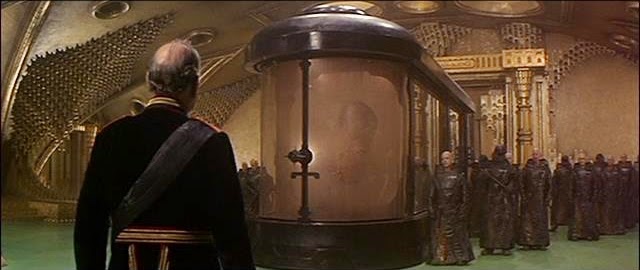
Despite the film’s many faults, Dune has quite a bit going for it, engaging the eyes and ears (if not the heart). The massive ornate sets, such as the Emperor’s throne room, are impressive, creating a sense of time and place. Similarly, a host of intricately detailed matte shots provide scale, successfully transporting the viewer into another world.  Bob Ringwood’s inventive costume designs do a nice job establishing the characters, from the regal Atreides family to the treacherous Harkonnens. Carlo Rambaldi’s creature effects bring the leviathan sandworms of Arrakis and slug-like Guild Navigator to life. Brian Eno’s “Prophecy Theme,” provides an appropriately epic sweep to the story.


Unfortunately, not all of the visuals are quite up to snuff. A shot depicting the Guild Navigator floating through space resembles Terry Gilliam’s Monty Python animation. While some of the model work is effective (the spice harvester), some look particularly shoddy (the ornithopter*). Possibly the biggest offense takes place during a key scene when our hero Paul Atreides (Kyle MacLachlan) mounts a huge sandworm. Instead of marveling at the immensity of the creature, we’re treated to a laughable shot of him riding the sandworm as if it were a surfboard.

* Anyone who’s read a description or seen an artist’s rendering of the insect-like ornithopter, as described in Herbert’s novel, could only be disappointed by the gold, blocky device with stubby immobile wings that ended up onscreen.


The story remains a mess, with such a complicated list of characters and lexicon that a cheat sheet was provided to audience members upon the film’s release. Even after repeated viewings, I still can’t keep everyone straight. Much of the dialogue is awkward, with its over-reliance on expository dialogue to explain the extensive background details. The studio execs must have hedged their bets by tacking on hokey narration by Princess Irulan (Virginia Madsen), to further explain what was going on. As Paul continues his self-discovery and ascension to messiah status, the story becomes increasingly muddled, and one gets the distinct impression that key points in the source material were skipped over. Although I was fortunate enough to read the novel prior to watching Dune, I can only imagine how baffling all of this must have seemed to anyone who had no knowledge of the book or storyline.


At the time Dune was released, MacLachlan was criticized for being a bland lead, but that seems a trifle unfair, considering that most of the cast acted in a similarly wooden, humorless manner. On the opposite end of the spectrum, Sting creates one of the most egregious displays of scenery chewing as Paul’s nemesis, Feyd Rautha (“I will kill him!”). Another questionable choice is the film’s depiction of the chief antagonist, Baron Harkonnen (Kenneth McMillan). As presented here, with his bloated body and boil-covered face, he’s arguably one of the most repulsive villains in cinematic history. Considering Lynch’s penchant for the grotesque, I suppose it was his intent to illustrate how decadent and corrupt the character was, but the effect is consistently off-putting and distracting.  


And yet, despite all of the aforementioned transgressions, I find it impossible to condemn this film. It’s an experience that’s mostly great to look at, but leaves me hollow; a mixed bag, rather than a complete failure. As I’ve mentioned before, I doubt that Jodorowsky’s proposed version of Dune would have fared much better than Lynch’s film in the end, collapsing under the weight of its ambitions. Maybe it’s impossible to produce a definitive version of Herbert’s story, and Lynch’s version was the best possible outcome at the time. There will always be a divide between our expectations and the finished product. Anything would likely pale in comparison to the story that’s played out in the cinema of our collective imaginations.

Tuesday, December 16, 2014

Classics Revisited: The Elephant Man


(1980) Directed by David Lynch; Written by: Christopher De Vore, Eric Bergren and David Lynch; Based on the books The Elephant Man and Other Reminiscences by Frederick Treves and The Elephant Man: A Study in Human Dignity by Ashley Montagu; Starring: John Hurt, Anthony Hopkins, Anne Bancroft, John Gielgud and Freddie Jones

Available on Blu-ray and DVD

Rating: **** ½

“People are frightened by what they don’t understand. And it’s so hard to understand, even for me, because my mother was so beautiful.” – John Merrick (John Hurt)


Considering that his only prior feature-length film to date was Eraserhead, David Lynch seemed an unlikely choice to helm a major studio production such as The Elephant Man. Perhaps just as odd was the pairing of Lynch with producer Mel Brooks and his production company, Brooksfilms Limited, to bring the decidedly grim tale of Joseph Merrick (John Merrick in the film) to the big screen. While this cooperative venture surely raised an eyebrow or two, the end result suggests that strange bedfellows could yield exceptional results. In retrospect, it’s difficult to imagine any other director handling the material as well, deftly merging art and popular entertainment. The Elephant Man is at once familiar and novel, with its conventional biopic plot, juxtaposed with the sort of unique surreal flourishes that one would come to expect from Lynch. While it’s definitely accessible, a closer examination reveals it’s not so far removed from Lynch’s previous effort. Both films deal with deformity, isolation and otherness, set amidst an industrial backdrop


It would be easy to veer on a tangent about what doesn’t match up between Merrick’s real life versus the character’s reel life, but that would be missing the point. More relevant, is how The Elephant Man addresses the subject matter. As a work of fiction based on real people and events, the film encapsulates “civilized” society’s less than civil response to Merrick’s affliction. Lynch chooses a stylized approach that favors an expressionistic interpretation over slavish devotion to the details of Merrick’s life. In the dreamlike opening scene, we catch of glimpse of Merrick’s alleged origins, as his mother is knocked down by an elephant. Of course, it’s    nothing more than sideshow ballyhoo, but the scene as presented here is organic to the story, as myth intersects with reality.


Freddie Francis’ cinematography, shot in gorgeous black and white, creates the perfect backdrop to tell Merrick’s story. We’re immersed in a hellish depiction of industrial age England, dominated by shadows and gaslight. Francis’ lens dwells lovingly on 19th century machinery, filthy alleyways and a seedy circus sideshow. This inhospitable environment is accompanied by John Morris’ effective score, which evokes a dark carnival. The score also introduced many to Samuel Barber’s classical piece, “Adagio for Strings,” providing an appropriate somber mood. Lynch contributed to the sound design, transforming Victorian-era London into a living organism, with the clamor of factories and steam engines coursing through its veins.


Christopher Tucker developed the unforgettable makeup by studying the real Merrick’s bone structure and death mask. As John Merrick, John Hurt is unrecognizable beneath the extensive makeup, but his performance shines through. Born with an incurable, disfiguring disease, Merrick is the object of scorn and revulsion by greater society, and     reduced to slavery as the star attraction in a traveling freak show. Hurt does a commendable job conveying an individual whose life is overwhelmed by abject misery. Through eye movement, gestures and limited speech, he manages to create a portrait of physical and mental pain that would be unendurable for most. The mere act of sleeping becomes a life or death struggle, as Merrick must remain propped up by a mountain of pillows to support the weight of his head.

 
Anthony Hopkins plays the virtuous (and ambitious) Dr. Frederick Treves, who rescues Merrick from his abusive handler Bytes (Freddie Jones). Treves initially takes Merrick’s reticence as a sign of diminished cognitive capacity, but soon discovers an intelligent, thoughtful human being lying beneath the horribly distorted exterior. On the other hand, while Treves’ motives seem superficially noble, the film raises the question whether or not he’s really much better than Bytes. In the course of moving from the circus to the hospital, Merrick transitioned from one form of exploitation to another. He’s simply become fodder for a higher class of gawkers. Although Treves arguably risked his professional reputation to serve as Merrick’s advocate, he had everything to gain by his munificence.


It’s easy to see why The Elephant Man appealed to David Lynch’s sensibilities, with its grotesque themes, depiction of unfathomable suffering, and struggles for identity. It represented one of the rare moments in cinema when the material and the artist were perfectly suited for one another. Despite a conventional narrative, the film could be called subversive by virtue of the fact that it introduced mainstream audiences to Lynch and his singular vision. It was unusual enough to attract the art house crowd, yet engaging enough to appeal to those with less esoteric tastes. This deeply affecting tale could be called a David Lynch movie for people who claim they don’t like David Lynch movies (I remember seeing this with my parents in the theater, so yes, it’s the perfect Lynch film to watch with your mom). Like all good films, The Elephant Man taps into some universal truths. It affirms the best and worst of human nature: the depths that some people will sink to denigrate others who are different, as well as the heights that others will take to rise above ignorance and hatred.