Sunday, June 30, 2024

Southeast Asian Cinema Month Quick Picks and Pans

The Traveling Circus Poster

The Traveling Circus (1988) In this underseen drama from director Linh Viet, a rag-tag traveling circus visits an impoverished rural Vietnamese village, despite the protests of the village elder. Skeptical of the unwanted outsiders, the starving residents have little need for frivolity or entertainment when they’re trying to survive. A young boy becomes smitten by one of the performers, a woman who performs a magic trick that makes rice appear. He longs to know the secret so he can feed his malnourished younger sister and the rest of the village. Filmed in black and white (which lends to the sense of immediacy), The Traveling Circus is a simply told but devastating tale of desperation and misplaced belief. Largely unknown outside its native country, this film deserves to reach a wider audience 

Rating: ****½. Available on DVD

ROH Poster

ROH (aka: Soul) (2019) Director/co-writer Emir Ezwan’s atmospheric debut feature, set in a Malaysian jungle, creeps under your skin from the first reel and never unleashes its grasp. A single mother (Farah Ahmad) and her two children Along and Angah (Mhia Farhana and Harith Haziq) eke out a meager existence in their isolated hut. Their lives are changed forever when they encounter a young girl wandering the jungle alone. Her presence and subsequent death become a harbinger of terrible things to come for the family. A mysterious old woman (June Lojong) who lives nearby offers her assistance against the evil presence that looms about. Signs point to an enigmatic lone hunter (Pemburu), searching for the missing girl. ROH doesn’t rely on cheap scares or flashy special effects, but relies on light, shadow, and the ambient sounds of the jungle (accompanied by a minimalist score) to create a relentless and overwhelming sense of dread. Bad omens abound, and nothing is quite what it seems. 

Rating: ****. Available on DVD, Tubi and Shudder 

Marlina the Murderer in Four Acts (2017) Set in a remote rural Indonesian town, director/co-writer Mouly Surya’s spaghetti western-inspired story (accompanied by a Ennio-Morricone-influenced score) of revenge is a portrait of quiet courage under extreme adversity. A man appears at the widow Marlina’s (Marsha Timothy) modest farmhouse, calmly proclaiming that he and his men (who are about to arrive) will take her livestock and forcibly have sex with her. This doesn’t sit well with our plucky protagonist, who poisons his men and decapitates their leader. She sets off (carrying the severed head) with an abused pregnant friend to report the incident to the police, who appear less than sympathetic. Mouly Surya’s film provides a matter-of-fact commentary on misogynistic society, where the consequences for the victims are worse than the perpetrators. At its heart is Marsha Timothy’s intense performance as a woman who refuses to passively adhere to social conventions at her expense. 

Rating: ****. Available on DVD 


Ode to Nothing Poster

Ode to Nothing (2018) Middle-aged Sonya (Pokwang) leads a dreary day-to-day existence, tending to her failing small-town family business, a funeral home. With too-few customers to keep afloat and a cruel landlord constantly breathing down her neck, she and her estranged father face eviction. Her life unexpectedly changes when an anonymous old lady’s corpse is dropped off by two men. While waiting for someone to claim the body, the corpse becomes Sonya’s surrogate mother and confidant – a temporary salve for her pervasive loneliness. Ode to Nothing is a heartbreaking meditation on quiet despair and invisibility in an uncaring society.    

Rating: ****. Available on Blu-ray

Alone Poster

Alone (2007) Co-directors Banjong Pisanthanakun and Parkpoom Wongpoom return with the follow-up to their debut film, Shutter (2004), a twisted tale of retribution from beyond the grave. When Pim (Marsha Wattanapanich) learns that her mother has suffered a devastating stroke, she reluctantly returns to Thailand with her boyfriend to settle affairs. As she stays in her childhood home, the past comes back to haunt her in the ghostly form of her once-conjoined twin sister Ploy (who died when they were separated). This unsettling story of survivor’s guilt and unrequited love will keep you in suspense throughout. 

Rating: ***½. Available on DVD (region 3)


Silip - Daughters of Eve Poster

Silip: Daughters of Eve (1985) Set in a small, isolated seaside village in the Philippines, director Edward Perez paints a picture of desire, longing and cruelty. When free-spirited Selda (Sarsi Emmanuelle) returns home, it sends the insular community into a tailspin, especially her sexually repressed sister Tonya (Maria Isabel Lopez). A fractured, contentious love triangle brews between Selda, Tonya and Simon (Mark Joseph) a brash hunter, leading to a tragic climax. This example of Filipino “Bold” cinema (roughly analogous to Japanese “Pinky” film) can be difficult to watch at times, with its brutality and frankness, but its exploration of the dark side of human nature will stick with you. 

Warning: The opening scene, featuring the (real) slaughter of a cow is quite disturbing, as well as later scenes of (simulated) sexual assault. 

Rating: ***½. Available on Blu-ray and DVD

Motel Mist Poster

Motel Mist (2016) Writer/director Prabda Yoon focuses on the bizarre activities surrounding a Bangkok love motel, where anonymous people go to fulfill their wildest desires or simply drop out of society. The patrons include a middle-aged man with an abusive streak and a former child actor who believes he’s being controlled by aliens. Meanwhile, a love-starved motel clerk lives vicariously by spying on the activities of the guests. This quirky, well-acted character study is full of surprises throughout, leading to a fittingly unusual ending.   

Rating: 3 ½ stars. Available on DVD, Midnight Pulp and Tubi

Sunday, June 16, 2024

Mystics in Bali


Mystics in Bali Poster

(1981) Directed by H. Tjut Djalil; Written by Jimmy Atmaja; Based on the novel Leak Ngakak by Putra Mada; Starring: Ilona Agathe Bastian, Yos Santo, Sofia W.D., W.D. Mochtar, and Debbie Cinthya Dewi; Available on DVD 

Rating: ***½ 

“Cathy, voodoo or any other black magic is nothing compared to this Leak magic. According to what I’ve heard, the Leak is the most powerful of all magic.” – Mahendra (Yos Santo) 

Shaman

“There are some things people weren’t meant to know” is a popular theme of many horror films, often involving a naïve westerner poking their nose where it doesn’t belong.  Of course, anyone who’s watched more than a few movies of this type knows exactly where it’s going. While its central theme and plot are familiar, director H. Tjut Djalil’s Mystics in Bali takes a decidedly Southeast Asian spin on familiar material, incorporating Indonesian folklore into the mix.* As a pure horror film, it represented a departure for Indonesian cinema, which previously adopted Bollywood’s “kitchen sink” approach (with a mélange of slapstick comedy, drama, and musical numbers). Intended as a breakout film for the export market, Mystics in Bali featured an approach that would appeal to the tastes of Western audiences. 

* Fun Fact #1: Due to the subject matter, which incorporated authentic Balinese beliefs and practices, filming was moved from Bali to nearby Java, to avoid upsetting the locals.

Leak Master

Cathy Kean (Ilona Agathe Bastian)* is an inquisitive young American woman visiting Bali, Indonesia, as research for her book on different forms of black magic. Through her friend Mahendra (Yos Santo), she learns about a powerful form of Indonesian black magic known as Leak (Pronounced “Le-ack”).* Mahendra arranges a meeting with a Leak master (Sofia W.D.) who appears as a hideous crone, but subsequently agrees to take on Cathy as her disciple. Naturally, there is a steep price to acquire this forbidden knowledge, as Cathy unwittingly pays with her body and soul. Employing her mastery of the dark arts, the ever-cackling sorceress (who sounds something like the Cryptkeeper in Tales from the Crypt) borrows Cathy’s head (yep, you read that right) to do her bidding. Cathy’s head detaches (with entrails dangling underneath) and flies around, searching the countryside for the blood of potential victims.** She’s bound by the Leak master to take the lives of three people, so the witch can become all-powerful and immortal. Now it’s up to Mahendra and his uncle Machesse (W.D. Mochtar), a mystic, to set things right, setting the stage for an ultimate battle between good and evil. 

* Fun Fact #2: Ilona Agathe Bastian wasn’t an actress but a German tourist who happened to be at the right place at the right time. A wife of one of the producers convinced Bastian to extend her stay by several weeks so she could appear in the movie. To date, this remains her one and only film role. 

** Fun Fact #3: The Leak (or Kuyang) isn’t strictly confined to Indonesian folklore, but has several counterparts throughout Southeast Asia, including: Thailand (Krasue), Cambodia (Ahp), Vietnam (Ma lai), and others.

Mahendra and Cathy

Cathy and Mahendra are clearly more than just friends, but within the confines of the movie they enjoy a chaste relationship. Considering the gory, anything-goes nature of the film, the conspicuous restraint the filmmakers demonstrated with regard to the two leads suggests it was due more to censorship concerns than anything else. (Mild Spoiler Alert) We only learn toward the end of the film that the young woman stalking Mahendra and Cathy is Mahendra’s jealous ex-girlfriend. When we learn of her connection with Mahendra, it almost seems out of left field. I can only speculate that the original, longer cut of the film fleshed out this character a bit more.

Cathy's Disembodied Head

Compared to American cinematic standards, the special effects are crude, but once we’re in the thick of things, it ceases to matter. The transformation sequences (when Cathy and the Leak master turn into pigs, and later into snakes) have a creepy, otherworldly quality that transcend any technical or budgetary limitations. But the animal transformations are only appetizers for the main course. Arguably, the movie’s raison d'être is revealed when Cathy’s head separates from her body, becoming its own entity. It’s not an especially convincing visual (the video-based effects don’t quite synch up with the film stock, and the flying head just looks like a mannequin head on a wire), but it still creates an uncanny experience, leaving our collective imaginations to fill in the blanks.

The Leak Master Wields Her Power

Initial plans to market Mystics in Bali as a “breakout” Indonesian film geared to Western audiences backfired, when it failed to find adequate international distribution. Outside of its native Indonesia, the film only made it to Japan as a theatrical release. Home video and word of mouth eventually gave the movie a new set of legs, especially with its DVD release in 2007. It’s been unfairly maligned as “cheesy” or goofy by some reviewers, but that overlooks the cultural significance of the film, which reflected the Balinese culture and superstitions. Those spoiled by the technical wizardry of Western cinema, with its emphasis on photorealistic effects and slick production values, might find Mystics in Bali too rough around the edges, but that’s missing the point. Instead, Mystics in Bali asks you to suspend your disbelief and consider there are forces much greater than ourselves in the world – forces that deserve reverence and above all, caution.   


Sources for this article: “Mystics in Bali & the Indonesian Exploitation Movie,” by Pete Tombs (essay from Mondo Macabro DVD); “Krasue,” Wikipedia entry: Krasue 


Friday, May 31, 2024

May Quick Picks and Pans


Stone Poster

Stone (1974) For those who weren’t there at the time (and I think that covers most of us), director/co-writer/co-star Sandy Harbutt gives us a taste of the Australian biker culture of the early ‘70s. The title refers to the main character (played by Ken Shorter), an undercover cop, who infiltrates biker gang, “The Gravediggers,” to investigate a series of killings of their members. Harbutt does a nice job depicting their gritty, freewheeling lifestyle. They live by their own rules, preferring to live on the fringes of society, instead of the 9 to 5 world. Stone becomes entranced by their scene, but can never quite be one of them. The film features some very good performances, including Harbutt as Undertaker, the gang’s leader, as well as many real bikers as extras. Hugh Keays-Byrne (Mad Max and Mad Max: Fury Road) steals the show as the hedonistic Toad.   

Rating: ***½. Available on Blu-ray, DVD and Tubi

Arena Poster

Arena (1989) This low budget direct-to-video (at least in the U.S.) sci-fi action flick with big ambitions is as superficial as a bowl of sugary kids’ breakfast cereal, but diverting enough. Set on an intergalactic space station, Paul Satterfield stars as Steve Armstrong, a man who aspires to compete in what has become an aliens-only fighting match. Besides the fact that a human hasn’t competed in the ring in 50 years, he must contend with a crime boss and his toadies. Probably the film’s biggest distinction is that it featured three actors who would go on to star in two prominent ‘90s sci-fi series: Claudia Christian (Babylon 5) as Armstrong’s manager Quinn, and Armin Shimmerman and Mark Alaimo (Deep Space Nine) as the antagonists. The not-so-special effects and flimsy sets are nothing to write home about, but the unique creature designs are kind of fun. If nothing else, it’s easy to see the potential for this to be remade with a bigger budget.   

Rating: ***. Available on Prime Video and Tubi  

Ruby Poster

Ruby (1977) Piper Laurie stars as fading has-been Ruby Claire, in director Curtis Harrington’s supernatural drama. When her gangster boyfriend is shot down (shown in the opening flashback scene), he vows revenge against the men who betrayed him. Flash forward 16 years later, with Ruby reminiscing about old times and running a backwoods drive-in theater. Leslie (Janit Baldwin), her special needs daughter, becomes the conduit for her deceased father’s spirit, as he exacts revenge against those who wronged him. The bodies pile up in a hurry, although the authorities never seem to snoop around. Laurie’s slightly unhinged performance is the only reason to see this near miss that never quite coalesces. 

Rating: ***. Available on Blu-ray, DVD and Midnight Pulp


The Monster of the Opera Poster

he Monster of the Opera (1964) In director/co-writer Renato Polselli’s middling horror movie, a theater troupe is terrorized by a centuries-old vampire and his curse. He’s drawn to Giulia (Barbara Hawards), a dancer whom he believes to be his reincarnated lover (who also damned him to a life of vampirism). There’s some nice black and white cinematography, particularly with an opening dream sequence, but little else to recommend this one. It’s too bad The Monster of the Opera is mostly bark and little bite, filled with boring dance numbers, endless bickering, and more diaphanous negligees than a Jean Rollin film. 

Rating: **. Available on DVD and Midnight Pulp

The Incredible 2-Headed Transplant Poster

The Incredible 2-Headed Transplant (1971) Bruce Dern stars as Roger, an enterprising young doctor experimenting with grafting second heads on animals. He longs to find a human test subject, and sees the perfect opportunity fall in his lap – transplanting the head of an escaped serial killer on the body of a giant mentally challenged man (you can probably guess this isn’t a brilliant idea before the murderous rampage ensues). Pat Priest plays his neglected wife Linda, who passively endures her husband’s shenanigans, and Casey Kasem co-stars as Ken, a colleague who suspects something unsavory is afoot. This movie makes the thematically similar The Thing with Two Heads (1972) look like a classic by comparison. 

Rating: *½. Available on Blu-ray, DVD and Tubi


Thursday, May 16, 2024

The Fabulous Baron Munchausen


The Fabulous Baron Munchausen Poster

(1962) Directed by Karel Zeman; Written by: Karel Zeman, Jirí Brdecka and Josef Kainar; Adapted from works by Gottfried August Bürger, Rudolph Erich Raspe and Gustave Doré; Starring: Milos Kopecký, Rudolf Jelínek, Jana Brejchová, Karel Höger, Rudolf Hrusínský, Jan Werich, Eduard Kohout and Bohus Záhorský; Available on Blu-ray and DVD 

Rating: ****


Baron Munchausen

“My one wish was to get the right idiom for my plan: to capture the surreal world of Baron Munchausen. I wanted this romantic fantasy to be unleashed from mundane reality, so I used imagery resembling prints from the period. At the same time, I decided to treat color like a painter on a canvas. I put it only where it was necessary.” – Karel Zeman (from Blu-ray featurette, “Why Zeman Made the Film”)

A hearty thanks to Rebecca from Taking Up Room and Gill from Realweegiemidget Reviews  for hosting the It’s in the Name of the Title Blogathon, spotlighting movie titles that feature their respective characters’ names. I’m proud to discuss, for your consideration, Karel Zeman’s aptly named The Fabulous Baron Munchausen (1962).

Baron Munchausen on a Seahorse

Since Rudolf Erich Raspe anonymously published his fictionalized account of Baron Munchausen’s* adventures in 1785, the exploits of the famous spinner of tall tales have enchanted and captivated readers. Raspe’s original work spawned a number of spinoff books, plays, radio shows, and of course, motion pictures. Munchausen became the subject of several silent-era films (including Georges Méliès 1911 short, “The Hallucinations of Baron Munchausen”). Sadly, many of the early short films are presumed lost, but arguably the most noteworthy cinematic examples are three feature-length films, released in 1943, 1962, and 1989, respectively. The infamous 1943 German version, The Adventures of Baron Munchausen, was made under the watchful eye of Hitler’s propaganda minister Joseph Goebbels (intended as a morale booster). While not overtly pushing a Nazi agenda, for many (including this reviewer) it’s impossible to separate the movie from its notorious origins and the monstrous regime that launched it. Terry Gilliam’s lavish, big-budget 1989 version, also titled The Adventures of Baron Munchausen gained its reputation as a troubled production, riddled with cost-overruns. Bookended between these versions was Czech filmmaker Karel Zeman’s The Fabulous Baron Munchausen, his third feature (after 1955’s Journey to the Beginning of Time and 1958’s The Fabulous World of Jules Verne (aka: Invention for Destruction). As with his previous movies, Baron Munchausen employed his knack for combining live action with animation. 

* Fun Fact #1: Yes, Baron Munchausen was a real person. Munchausen, the character, was based on the real-life Hieronymus Karl Friedrich von Münchhausen, a retired German military officer, who was known for regaling anyone who’d listen with wild stories of his exaggerated and imaginary exploits.

Baron Munchausen, Princess Bianca, and Tonik

The opening scene finds the eponymous Baron (Milos Kopecký) traveling to the moon, where he encounters characters from Jules Verne’s From the Earth to the Moon, as well as (for some reason) Cyrano de Bergerac. He meets an astronaut named Tonik (Rudolf Jelínek), and believing him to be a resident of the Moon, decides to take him on a tour of Earth. Their first stop is Turkey, where they meet the despotic Sultan (Rudolf Hrusínský).  Much to the Sultan’s chagrin, Munchausen and Tonik are smitten by Princess Bianca (Jana Brejchová),* who’s being held against her will. Thus begins a nominal love triangle, but it’s clear that Bianca only has eyes for Tonik. Although initially peeved at the princess’ preference for Tonik, the Baron’s jealousy doesn’t last long – after all, he only has one true love, himself. They hastily make their escape, with the Sultan’s army nipping at their heels. They’re rescued by a Dutch trading ship, but after they face the wrath of the vengeful Sultan’s navy, they’re cast adrift in the open ocean, where they’re subsequently swallowed by a giant fish. Their quixotic journey continues across the globe guided by the Baron’s indomitable wit and boundless imagination. 

* Fun Fact #2: According to film writer Michael Brooke, at the time the film was released, Brejchová was more popular in her native Czech Republic than her husband, renowned director Milos Forman.

Giant Fish and Pyramids

As a self-taught animator,*/** Karel Zeman honed his techniques with each project, working through the myriad challenges of his films like mathematical equations. Using Gustave Doré’s artwork as a template, his paper cutout animation resembles book illustrations that leapt off the pages. His signature blending of live action and animation creates a fairy tale look. Particularly impressive is a tracking shot through the Sultan’s palace, arranging multiple cardboard planes to create a three-dimensional space. He also frequently used split-screen techniques, combining live actors with paper cutouts in the background or foreground. The effects are delightfully old-fashioned, giving Zeman’s film a charm that can’t be compared to modern efforts. It's not about seamless integration of the imagery, but indicative of a different filmmaking tradition that favors creating fanciful visuals over hyper-realism. While I’m not going to initiate a debate about which approach is “better,” the analog, mostly in-camera effects never fail to entrance. Created by a small team of dedicated craftspeople, The Fabulous Baron Munchausen possesses a handmade quality that can’t be duplicated by a bunch of people clicking away on computers. 

* Fun Fact #3: Zeman learned about the mechanics of animation by studying a “Felix the Cat” cartoon frame by frame. 

** Fun Fact #4: Despite his early artistic predilections, Zeman’s father forced him to attend business school.


The Baron Rides a Cannonball

Amidst the high fantasy, Karel Zeman reveals a sense of humor worthy of a Warner Brothers cartoon. In one terrific gag, the Baron and Tonik attempt in vain to break down some double doors in the Sultan’s palace, only to watch Princess Bianca effortlessly open them. When Tonik innocently steps on a rug in the Sultan’s throne room, he unwittingly triggers a swarm of spears. And on the Dutch trading ship even the ship’s figurehead enjoys taking a brief smoke break. Along with these playful flourishes, the film presents a satire on the human condition. While in the presence of the mercurial Sultan, Baron Munchausen speaks the “language of high diplomacy” (consisting of musical harmonica sounds) as a means of communication.

Inside the Belly of the Fish

In The Fabulous Baron Munchausen, Karel Zeman takes you to imaginary places that never existed, but you somehow wish they did. His approach to visuals is distinctly different compared to his contemporary Ray Harryhausen, but the end results are just as mesmerizing. Zeman’s version of Baron Munchausen argues that imagination and fantasy are more powerful than knowledge – and in the context of the distinctly engaging visuals, who could disagree? While Zeman left an indelible impression with his film, there’s something about Munchausen that transcends generations and bears repeating. Who knows when or where the next iteration of the indomitable Baron will take us, but one thing’s for certain: you can’t keep a good fibber down.


Sources for this article: “Why Zeman Made the Film” Blu-ray featurette; “Baron Munchausen; Facts and Fibs,” by Michael Brooke; Film Adventurer Karel Zeman (2015 documentary)


Tuesday, April 30, 2024

Strange Invaders


Strange Invaders Poster

(1983) Directed by: Michael Laughlin; Written by Michael Laughlin and Bill Condon; Story by Michael Laughlin, Bill Condon and Walter Halsey Davis; Starring: Paul Le Mat, Nancy Allen, Diana Scarwid, Louise Fletcher, Michael Lerner, Kenneth Tobey, and June Lockhart; Available on Blu ray and DVD 

Rating: ***½

Suspicious Townspeople

“I think my teachers and my friends always struck me as being alien, and of course growing up in the Midwest, I felt that the towns I knew and grew up in were inhabited by aliens.” – Michael Laughlin

“All right, I will tell you one thing. We have an agreement with them. We’ve known about them for a long time. They provide us with certain advantages, and we provide them a place to live. But it hasn’t been easy. We haven’t had much choice at all…” – Mrs. Benjamin (Louise Fletcher)

One of the great mysteries is whether or not we’re alone in the cosmos. Is Earth truly “a grand oasis to the big vastness of space,” as astronaut Jim Lovell once stated, or is it nothing special – just one of many planets in the universe where intelligent life has flourished? Depending on which side of the coin you favor, Drake’s Equation estimates there’s anywhere between one (the Earth) and one million planets capable of supporting intelligent life (quite a substantial range), whereas Fermi’s paradox takes a less optimistic stance about why we haven’t heard from intelligent life. Of course, there could be a third option: maybe they’re really good at hiding. Depending on whom you ask, however, they may already be here. Strange Invaders* was director/co-writer Michael Laughlin’s second collaboration with screenwriter Bill Condon, after Strange Behavior (1981).** Filmed mostly around Toronto and the surrounding suburbs (standing in for Midwestern America), Strange Invaders presents a post-modern spin on the ‘50s alien invasion template. 

* Fun Fact #1: Strange Invaders started off as Cat People (not to be confused with the 1942 original with the same name or the 1982 remake) featuring catlike creatures disguised as humans. By the time the film reached production, the filmmakers replaced cats with aliens. 

** Fun Fact #2: Laughlin and screenwriter Bill Condon planned a series of movies with “Strange” in the title. Sadly, the third film, The Adventures of Phillip Strange (also penned by Condon), never reached production.

Mothership and Flying Saucer

In the prologue, set in 1958, extraterrestrials descend upon the ordinary small town of Centerville, Illinois, replacing the residents with their own. Paul Le Mat plays entomologist Charles Bigelow,* who teaches at Columbia University in New York City.** Things get weird in a hurry after his ex-wife Margaret (Diana Scarwid) drops in unexpectedly with their daughter, Elizabeth,*** leaving him in charge of her care. Margaret declares she must make a trek to her home town of (you guessed it) Centerville, but her solemn demeanor implies it’s more than a short trip. When she seemingly vanishes without a trace, Bigelow decides to investigate for himself. Centerville appears to be isolated in time, with its vintage cars and townspeople who dress as if the ‘50s never ended. If the suspicious town folk weren’t enough, it becomes painfully clear that he’s unwelcome when his dog goes missing and his car suddenly explodes. Upon his return to New York, he tries to convince a skeptical government official Mrs. Benjamin (Louise Fletcher) that aliens have arrived. He teams up with tabloid reporter Betty Walker (Nancy Allen) and an institutionalized former Centerville resident, Willie Collins (Michael Lerner), to uncover the truth about Centerville.   

* Fun Fact #3: The role was originally created for Strange Behavior’s star, Michael Murphy, but when the producers at Orion came onboard, they considered Michael Keaton before finally hiring Le Mat. 

** Fun Fact #4: The campus exteriors were shot at the real Columbia University, which was Condon’s alma mater. 

*** Fun Fact #5: Elizabeth was played by Laughlin’s real-life stepdaughter, Lulu Sylbert.

Betty and Bigelow

Paul Le Mat* is a good choice to play the film’s everyman protagonist. His natural acting style sets the right tone, not showy, but entirely believable – the audience can relate to his growing bafflement over the increasingly odd occurrences. As a scientist, he’s searching for a rational explanation, but as a person, he can’t ignore what he’s witnessed. There’s a nice little endearing moment between father and daughter (with both occupying opposite sides of the frame) in which Elizabeth calls out the scientific names of her father’s specimens, and he identifies them with their common names. It’s a short scene that at once establishes their unique relationship and Bigelow’s passion for his chosen profession. Speaking of relationships, Nancy Allen hits the right notes as much more than the requisite love interest. Smart, charming and cynical, Betty confesses she made up the story for entertainment value, although there’s a figment of intrigue surrounding the photo that accompanied her story. She humors Bigelow, but in the same breath, she’s attracted to him and his sincerity. She’s forced to re-evaluate her grip on reality when she faces the prospect of experiencing first-hand a situation that sprung from one of her headlines. 

 "Inconceivable!"

It's fun to play “spot the character actor” in a cast full of character actors, many from genre favorites. In a direct nod to the film’s ‘50s B-movie heritage Kenneth Tobey co-stars as a boarding house proprietor with a sinister aura. Bobby “Boris” Pickett (of “Monster Mash” fame) appears briefly as Betty’s editor. And Lost in Space fans, rejoice: Strange Invaders features two alumni from Irwin Allen’s landmark, albeit goofy sci-fi series – June Lockhart, as Bigelow’s mother, and Mark Goddard as a police detective. Also watch for actor/playwright/New York fixture Wallace Shawn as Betty’s landlord, an unfortunate victim of the aliens.

Alien Orbs

From her first appearance, it’s apparent that something’s a bit awry with Biglow’s ex-wife, Margaret. Things are made abundantly clear (Minor Spoiler) when we learn that Centerville might be her home town, but her birthplace is somewhere among the stars. Naturally, this begs the question: she must have had a really convincing disguise, considering she and her human husband conceived a child together. Or was this part of their experiment, to determine if humans and the alien species were biologically compatible? Biological suitability issues aside, their dissolved marriage is a fitting metaphor for couples that fail to communicate properly. It sometimes seems that many couples are from different planets (the whole Venus and Mars thing), but in this case it’s quite literal.

Alien Removes Disguise

Despite a budget of only $5 million the filmmakers made the most of it, with practical makeup effects that continue to impress, 40 years later. The aliens’ disguises appear to be an organic extension of their faces, instead of a lifeless mask that falls away. Their stretchy, goopy ersatz visages add an uncanny element to the film. Likewise, the sparingly employed optical effects enhance the story. In the opening scene, a shot of a cigar-shaped alien mothership emerging from the clouds is suitably dreamlike and almost painterly. Some of the budgetary concessions are less effective, requiring an elevated suspension of disbelief. Similar to Earth vs. the Flying Saucers (1956), the labyrinthine assortment of pipes and other industrial equipment in Toronto’s underground waterworks stand in for the aliens’ laboratory complex, and an ordinary observatory serves as the interior of the alien spacecraft.

Newspaper Headline

The aliens’ 25-year mission to evaluate Earth (presumably as a as a base for colonization or worthiness as a fledgling member of some galactic alliance) is decidedly murky. Your guess about their ultimate purpose is as good as mine. (More Spoilers) Their true intentions are never ascertained, since no sequel ever surfaced, leaving us with an open-ended conclusion in which they return to whatever planet they came from (Perhaps Earth wasn’t worth the trouble?). There are so many unanswered questions we’ll never resolve, but a little mystery isn’t necessarily a bad thing. Strange Invaders is a clever film that successfully walks the line between loving tribute to the B-genre films of the ‘50s and a post-modern response to Cold War paranoia. While critical response was generally positive, it didn’t make any waves at the box office, and despite being a staple on cable in the ‘80s, seems to have fallen by the wayside in recent years. What better time then, to rediscover and enjoy another hidden little treasure that takes a novel spin on an old formula?


Sources for this article: DVD commentary by Michael Laughlin and Bill Condon; “All of You On the Good Earth,” by Michael Carlowicz, NASA Earth Observatory, “Are We Alone? The Search for Intelligent Life in the Universe,” by Laurence Tognetti, Astronomy 


Wednesday, April 24, 2024

Alien Invasion April Quick Picks and Pans

I Come in Peace Poster

I Come in Peace (aka: Dark Angel) (1990) Detective Jack Caine (Dolph Lundgren) is a cop who plays by his own rules (Sound familiar?). When his old partner is killed in a drug bust gone bad, he’s forced to work with a young hotshot FBI agent (Brian Benben) to investigate a mysterious series of murders. The culprit is a seven-foot-tall alien (Matthias Hues) who tells his victims “I come in peace.” He shoots up his victims with heroin and extracts the resulting endorphins from their brains (as a kind of designer drug for the intergalactic set). In addition to the human cops, he’s also being pursued by one of his own (Jay Bilas). There’s nothing new plot-wise or with the characters (simply transplant the usual buddy cop formula), but it’s a nicely paced cinematic equivalent of fast food, chock-full of cheesy synth music and more mullets than you can throw a case of Aqua Net at. 

Rating: *** stars. Available on Blu-ray, DVD and Tubi 

The Golden Bat 

The Golden Bat (aka: Golden Ninja) (1966) When evil aliens divert a planet’s trajectory so it will collide with Earth, it’s up to a top-secret UN-led organization to thwart their plans. All seems lost until the team members revive a 10,000-year-old mummy from Atlantis (Osamu Kobayashi). With his eyeless skull and mouth frozen in a permanent rictus, he looks more like the product of someone’s nightmares than a superhero. On the other hand, the villain resembles a cuddly plush toy, which only goes to show that looks aren’t everything. Good dumb fun. 

Rating: ***. Available on DVD, Plex and Tubi 


Seedpeople

Seedpeople (1992) One of the many direct-to-video offerings from Full Moon Pictures (a name not typically associated with quality), Seedpeople is a blatant rip-off of Invasion of the Body Snatchers, but a fairly enjoyable one. In the sleepy town of Comet Valley ancient excavated meteorites turn out to be giant seed pods. Malevolent alien creatures emerge, enslaving the town’s residents. A visiting geologist (Sam Hennings) teams up with the local crackpot (Bernard Kates) to battle the alien scourge. The story is relayed in flashback (like Body Snatchers) by the geologist, including the events he wasn’t in (!). In a nice nod to the source material, there’s a scene that features what looks suspiciously like Bronson Cave. 

Rating: ***. Available on Blu-ray, DVD, Prime Video, and Tubi 


Invasion Poster

Invasion (1965) Edward Judd stars as Dr. Mike Vernon, a burnt-out emergency room physician, whose humdrum routine is thrown into disarray when an unusual patient (Ric Young) arrives in his hospital. The strange man is being pursued by two others of his kind, enroute to a prison planet (they were diverted to Earth when their spaceship suffered a malfunction). The alien leader, played by Yôko Tani (from First Spaceship on Venus), leads a search for the missing prisoner, although she doesn’t seem to be very good at her job. Things get tense when the hospital is surrounded by a magnetic shield, raising the temperature and preventing anyone from entering or exiting the area. Invasion’s meager budget belies its title (three extraterrestrials and a puny spacecraft hardly makes for a convincing threat), and it’s more talky than action-packed, but its biggest flaw is the extremely dubious choice of casting Asians as “aliens” among a predominately Caucasian cast. Skip it. 

Rating: **. Available on Blu-ray and DVD  

Zontar - The Thing from Venus Poster

Zontar: The Thing from Venus (1967) Director/co-writer Larry Buchanan’s cheapo remake of the cut-rate It Conquered the World (1956) somehow manages to make the original film look like a classic in comparison. Dr. Curt Taylor (John Agar) tries to dissuade his friend Keith Ritchie (Tony Huston) from collaborating with an alien creature with murky intentions. Agar tries his best with what he has to work with, but it’s a lost cause, considering the lackluster performances from everyone else involved (just try enduring the terrible “comic” relief with two soldiers). The briefly seen extraterrestrial Zontar, and its flying creatures, which wouldn’t pass muster for the clearance bin of a Spirit Halloween store, look like they were slapped together from whatever scraps the filmmakers had lying around. Although I can’t recommend this flick in good conscience, it’s good for some unintentional laughs, depending on your level of inebriation. 

Rating: *½. Available on DVD and Tubi 

Invasion of the Girl Snatchers_Poster1a

Invasion of The Girl Snatchers (aka: The Hidan of Maukbeiangjow) (1973) In this alleged sci-fi/ horror/comedy from director Lee S. Jones Jr., a private investigator works with the feds to ascertain the mysterious disappearances of several women. It turns out they’re being abducted by a religious cult, where their minds are taken over by alien beings (which are never shown). Watch and wince as the characters incessantly run around, getting tied up and untied, accompanied by a bunch of irritating folk songs that have nothing to do with the story. According to the Psychotronic Video Guide, this was released only because the producer made a bet that it wouldn’t gross any money. I feel sorry for anyone who might have paid to see this. 

Rating: *½. Available on DVD and Tubi


Saturday, April 13, 2024

Without Warning


Without Warning Poster

(1980) Directed by Greydon Clark; Written by Lyn Freeman, Daniel Grodnik, Bennett Tramer and Steve Mathis; Starring: Jack Palance, Martin Landau, Tarah Nutter, Christopher S. Nelson, Cameron Mitchell, Neville Brand, Sue Ane Langdon, Ralph Meeker and Larry Storch; Available on Blu-ray and DVD 

Rating: ***

I’m elated to participate, once again, in Brian Schuck’s (from Films Beyond the Time Barrier) “Favorite Stars in B Movies” blogathon. Be sure to check out all of the great entries! Today’s offering for Alien Invasion April is the little B-movie that could, Without Warning, featuring two Oscar winners and one nominee.

Showdown with the Alien

“…Makes perfect sense to me. They start out here in the country, they establish a foothold, and after they get us, they move in on the cities. That way they got a base to fight from. I’ll be damned if they get me without a fight. They’re not gonna get Sergeant Fred Dobbs easy. Not this time.” – Fred Dobbs (Martin Landau) 

With a handful of notable exceptions (Forbidden Planet, 2001: A Space Odyssey), science fiction movies were once considered strictly B-movie fare before Lucas and Spielberg changed the landscape forever with their mega-budget spectacles. Amidst this paradigm shift, however, there was still a place for cheaper drive-in pictures. Director Greydon Clark’s ultra-low-budget sci-fi thriller Without Warning* was produced in December 1979 and released in Spring 1980. Shooting took place over a three-week period, in and around the Paramount Ranch area in Agoura Hills, California. Clark and crew adopted Halloween’s (1978) formula, with a sci-fi twist: a silent killer from outer space stalks and kills a group of unsuspecting teenagers. The film also appeared under the alternate title, It Came Without Warning, which especially sounds like the ‘50s B-movies that provided its inspiration.   

* Fun Fact #1: The budget was reportedly $150,000, half of which went to Palance and Landau’s salaries.

Four Friends on a Camping Trip

The opening scene sets the tone, when an awkward father/son hunting trip goes horribly wrong. The action shifts to four “teens” (played by actors well into their 20s) heading for a weekend of camping and frivolity. While refueling their van at a remote gas station, they encounter the creepy proprietor, Joe Taylor (Jack Palance). As is always the case, they ignore his warning to stay away from the local lake. It soon becomes apparent (surprise, surprise) that they’re being stalked by someone or something – a realization that becomes painfully clear when two of the teens, Sandy and Greg (Tarah Nutter and Christopher S. Nelson) stumble upon a shack where their dead companions are hanging on hooks. After a hasty retreat, they make their way to a nearby bar, where Greg’s story is met with skepticism by the patrons – except for Fred Dobbs (Martin Landau)*, a paranoid Vietnam veteran with an axe to grind. The situation takes a turn for the worse when Dobbs attempts to take matters into his own hands. Meanwhile, an unseen assailant is lurking about in the woods, searching for its next victim. 

* Fun Fact #2: According to Nutter, she screamed so loudly during the shack scene that the walls, which were made of flimsy cardboard-like material, collapsed, necessitating a quick rebuild. 

** Fun Fact #3: Landau’s character was named after Humphrey Bogart’s character from Treasure of the Sierra Madre (1948). Like his namesake, he becomes more unhinged as the movie progresses.

Alien

Despite the miniscule budget, Greydon Clark took steps to make his movie look like a more expensive production. His ace-in-the-hole was renowned cinematographer Dean Cundey (in his fifth and final collaboration with Clark), who was fresh off his work with Halloween (1978). Cundey utilized hand-held Steadicam shots to simulate the alien’s point of view, and employed a fog machine to provide a reflective surface for the night shots. Keeping in mind the production’s limitations, Clark wisely chose not to reveal the alien until much later in the film. Instead, its presence is implied through shadows and its signature weapon,* floppy flying creatures (resembling something like a cross between a pancake and a sand dollar)** that immobilize its victims. Only Taylor, a seasoned hunter, has the presence of mind to do something about the pesky flying parasites, while everyone else in the movie just passively allows them to suck their blood. The alien***/**** was played by 7-foot-2-1/2-inch performer Kevin Peter Hall, who would go on to play Harry from Harry and the Hendersons, as well as the titular creature from Predator (which is frequently compared to this film for its many similarities). 

* Fun Fact #4: In the original script, the alien used a bow and arrows. 

** Fun Fact #5: Closeups of the flying creatures were shot during post-production, in Clark’s garage, with a three-person crew. 

*** Fun Fact #6: The alien head was created by Rick Baker. 

**** Fun Fact #7: The trumpet of an elephant was used for the alien’s final screech.

Greg, Sandy and Taylor

There’s some nice chemistry between Nutter and Nelson, who hold their own against veterans Palance and Landau. Although Sandy starts out as the typical screaming damsel in distress, she shows some backbone by the end of the film, during the final confrontation. While obviously attracted to her, Greg manages to keep his hormones in check long enough to do the right thing and provide emotional support to the visibly traumatized Sandy.

Taylor with Pickled Flying Creature

Jack Palance and Martin Landau seem to be enjoying themselves, playing characters that are, respectively, crazy and crazier. The more we learn about Taylor, the saner he becomes. He believes Sandy and Greg, but with a healthy dose of skepticism. It becomes clear that he knows about the alien and its habits, but he’s a loner, used to doing things his way, without the input or interference of other people. In typical Palance fashion, he hisses his lines with conviction with a self-aware gleam in his eyes. Dobbs, on the other hand, wants an audience, no matter how deranged his ramblings might sound. His paranoia reaches a zenith when he suspects Greg and Sandy are aliens that have assumed the shape of humans. Landau nearly crosses the line into self-parody with his over-the-top performance, yet he somehow reins his role in just enough to remain credible.

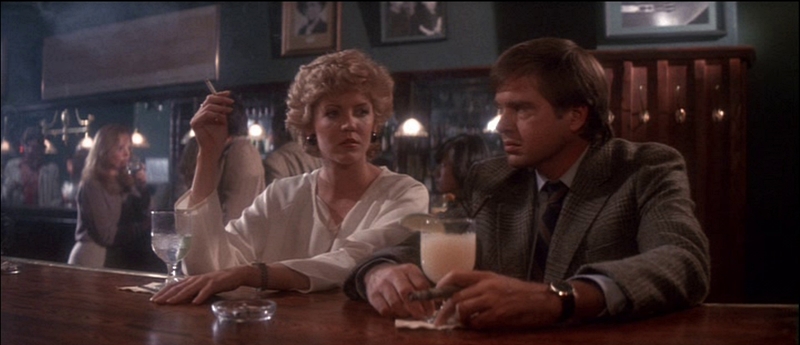
Bar Regulars with Bartender

Besides the headliners, the cast of Without Warning is a who’s who of veteran character actors. Cameron Mitchell (who becomes the film’s first victim) appears as a macho, alpha male father on a hunting trip with his reluctant 20-something son. Ralph Meeker (in his final film role) and Neville Brand add some color as a pair of bar patrons, and Sue Ane Langdon enjoys some brief time in the spotlight as Aggy, the spunky bartender. Larry Storch (F-Troop) provides a little comic relief as a befuddled scout master.* Besides the old pros, there’s veteran-actor-to-be David Caruso, in one of his first film roles, as a horny teenager (guess how he ends up).   

* Fun Fact #8: According to Clark, one of the crew members volunteered her son’s scout troop for the movie.

Frank Dobbs

Without Warning wouldn’t be a proper B-movie without the requisite genre clichés, including a cat appearing from nowhere to provide a jump scare, someone saying “This place gives me the creeps,” a vehicle that inexplicably fails to start, and a virginal final girl. In the unintentionally hilarious final confrontation, try not to facepalm as the alien gives the surviving protagonists every opportunity to destroy it, conveniently standing motionless while Sandy fiddles with a detonator. For his part, Taylor forgets everything he’s learned about hunting, running out in the open, yelling “Alien! Alien!” As silly as it can be at times, it’s fair to acknowledge that Without Warning walked so Predator could run. Sure, it’s as rough around the edges as origami made by kindergarteners, but that’s part of its charm. This was made quickly and on the cheap. The fact that it’s entertaining as well is only icing on the bloody cake.


Sources for this article: Blu-ray commentary by Greydon Clark; Featurette: “Greg and Sandy’s Alien Adventures: interviews with Actors Tarah Nutter and Christopher S. Nelson”; Featurette: “Independents Day with Dean Cundey”; Featurette: “Producers vs. Aliens: Interview with Co-writer/Co-Producer Daniel Grodnik”