Monday, October 10, 2022

The Legend of Hell House

The Legend of Hell House Poster

(1973) Directed by John Hough; Written by Richard Matheson (based on his novel, Hell House); Starring: Roddy McDowall, Pamela Franklin, Clive Revill, Gayle Hunnicutt and Roland Culver; Available on Blu-ray and DVD

Rating: ****

Dr. Lionel Barrett (Clive Revill): "Is there anything you’d care to tell us?" 

Benjamin Fischer (Roddy McDowall): "What’s to tell? The house tried to kill me; it almost succeeded."

The Belasco House

While there’s no shortage of haunted house movies, good ones are a scarce commodity. To show ghosts or not to show ghosts, that is the question (my apologies to the Bard). There’s a constant push-pull between suggesting and showing supernatural phenomena. Both are valid approaches, in the right hands. On one end of the spectrum is Robert Wise’s masterful adaptation of Shirley Jackson’s The Haunting of Hill House, which proves it’s not what you see, but what you think you see that’s terrifying. In the opposite direction lies William Castle’s 13 Ghosts (1960) – its whole raison d'ĂȘtre is about seeing the spirits (hence, the “Ghost Viewer” gimmick). Somewhere near the Haunting side of the spectrum resides director John Hough’s* The Legend of Hell House,** based on Richard Matheson’s 1970 novel, Hell House. Hough admired Robert Wise’s restrained touch in The Haunting (1963), and wanted to create that same level of atmosphere, relying on suggestion above visual thrills. Transplanted from the novel’s New England setting to the British countryside, The Legend of Hell House was filmed at Wykehurst Place*** in Bolney, West Sussex, England (the same location where 1972 productions All the Colors of the Dark and Demons of the Mind were also shot). 

* Fun Fact #1: According to Hough, among the movies he’s directed, the following titles are his favorite (listed in order): The Legend of Hell House (1973); Dirty Mary, Crazy Larry (1974); and Escape to Witch Mountain (1975). 

** Fun Fact #2: This was the second outing with producer Albert Fennell and star Pamela Franklin, who both worked on another landmark ghost film, The Innocents (1961). 

*** Fun Fact #3: Only the exterior of the Gothic Revival mansion appears in the film. The interiors were shot on a set in Elstree Studios. Hough noted that rooms on the set were much larger than the rooms in the actual house.


Florence Tanner, Ben Fischer, Ann Barrett, and Dr. Barrett

Dr. Lionel Barrett (Clive Revill), a physicist, is challenged by elderly millionaire Mr. Deutsch to assess the veracity of alleged supernatural activity in the infamous Belasco House. Known as the “Mount Everest of haunted houses,” the imposing mansion was built by eccentric millionaire Emeric Belasco, known as the “roaring giant.” The house became the epicenter for all manners of debauchery (“Drug addiction, alcoholism, sadism, bestiality, mutilation, murder, vampirism, necrophilia, cannibalism, not to mention a gamut of sexual goodies. Shall I go on?”). Barrett intends to find the secret of Hell House, and with the aid of his custom-built machine, rid the place of its malevolent energy once and for all. Along with his wife Ann (Gayle Hunnicutt), Barrett brings along two psychics, Ben Fischer (Roddy McDowall) and Florence Tanner (Pamela Franklin), to provide a counterbalance to his inquiry. Despite his rational, empirical-based approach, he soon discovers that he’s not immune to the house’s influence.

Ann and Lionel Barrett

Dr. Barrett is so smugly confident in his scientific approach, he’s unwilling to accept any interpretations that don’t conform to his narrow definition of supernatural phenomena. He includes Fischer and Tanner, seemingly only to downplay or ignore their observations. His device serves as an extension of his ego (something his character shares with Belasco), with his anticipated success merely an opportunity to gloat over his colleagues – a triumph of science over the unexplained.

Ann Barrett

Although not a formal member of Barret’s research team, his wife Ann (Edith in the novel) is more than a passive participant. An ardent supporter of her husband’s career, she’s blindsided by the strange goings-on in the Belasco house. Her character is alternately frustrating and sympathetic. She defines herself by his accomplishments, but she’s little more to him than an appendage. Their relationship is typified by a scene where he deflects her offer for help with his machine, condescendingly intimating that it’s beyond her understanding. Meanwhile, she represses her own ambitions and desires, which the house exploits. Her sexual frustrations come to a head when she tries in vain to seduce Fischer.   

Florence Tanner

If Dr. Barrett represents the exploration of the tangible, Florence Tanner is his philosophical antithesis. Tanner views her mediumship not as a mere profession, but a spiritual calling, based in her feelings and beliefs. She describes herself as a psychic medium, but as she gets closer to what she believes to be the answer (or perhaps steered further from the truth), her psychic gifts become physical. Despite her colleagues’ doubts, Tanner persists in the belief that she’s in contact with Emeric Belasco’s deceased, eternally tortured son Daniel. Much like Barrett, her unshakable belief that she’s on the right path proves to be her undoing.

Benjamin Fischer and Ann

Benjamin Franklin Fischer (Roddy McDowall) is a burnt-out once child prodigy (known for his unparalleled talent for detecting and manifesting psychic phenomena). He carries a heavy burden – of the last team of psychic researchers to investigate the house, he was the only one to make it out alive. Now, he’s a broken man, dubious of Barrett’s convictions, and the doctor’s blind faith in his machine (“You do not fight this house.”). Still traumatized by his past experience in the Belasco house, he purposely holds back, reluctant to open himself up to the forces that dwell within. McDowall’s superb performance anchors the film, as a man grappling with his inner demons, torn between self-protection and facing the trauma that nearly destroyed him.

Dr. Barret, Ann, Ben Fischer, and Florence Tanner

A common thread running throughout the film is a clash of differing philosophies, between the obstinate, unwavering Dr. Barrett’s adherence to science, versus Tanner and Fischer’s reliance on the intangible as their evidence. To Barrett, the house’s disturbances can be attributed merely to electromagnetic radiation, the residual, unfocused energy from Belasco and his guests, but to Tanner and Fischer, there is an unseen intelligence at work. Who’s right and who’s wrong? Without spoiling the films conclusion, Richard Matheson (who adapted his own novel for the screenplay) provides a case to support both points of view, where Dr. Barrett and Florence are at once refuted and vindicated.

Ben Fischer

The filmmakers utilize a barrage of traditional, albeit effective, devices to create an atmosphere of unease: whispered voices, shaking tables, creepy lighting, and inventive camerawork.* An early electronic score by Delia Derbyshire and Brian Hodgson further contributes to an otherworldly, disconcerting experience. Of course, none of these elements would matter if the actors weren’t up to snuff, but the excellent cast rise to the task. It’s a mostly faithful adaptation of the novel that occasionally pulls its punches (the film version does away with the sexual tension between Florence and Ann), but ultimately captures the main themes of the source material. I can excuse a somewhat underwhelming ending (which attempts to wrap things up into a neat box), because it’s what The Legend of Hell House gets right that sticks with us. It’s unnerving and spooky, with as much to say about the here and now, as with the spirit world. As with all great stories about hauntings, it’s not about the dead, but the living, and the baggage they bring along.   

* Fun Fact #4: According to Pamela Franklin, Hume was a perfectionist, who enjoyed experimenting with different lighting equipment. He allegedly took so much time setting up the shots that the crew started hiding his lights.


Sources for this article: Shout Factory DVD commentary by Pamela Franklin; “The Story of Hell House: An Interview with John Hough”; Hell House, by Richard Matheson


Friday, September 30, 2022

September Quick Picks and Pans


The Spiral Staircase Poster

The Spiral Staircase (1946) This superior gothic suspense film from director Robert Siodmak (based on the novel Some Must Watch, by Ethel Lina White) is short on plot but heavy on character, and dripping with atmosphere. Dorothy McGuire plays Helen, a young mute woman who might be next on a serial killer’s list. George Brent and Gordon Oliver are stepbrothers at odds with each other, and Ethel Barrymore appears as Mrs. Warren, a feisty bedridden matriarch. Elsa Lanchester almost steals the show as Mrs. Oates, a plucky housekeeper. It’s slow burn, leading to an explosive finale inside a shadowy old mansion (where the majority of the movie takes place). It’s a nail-biting experience, anchored by McGuire’s riveting performance and a cast of eccentric supporting characters. 

Rating: ****. Available on Blu-ray and DVD


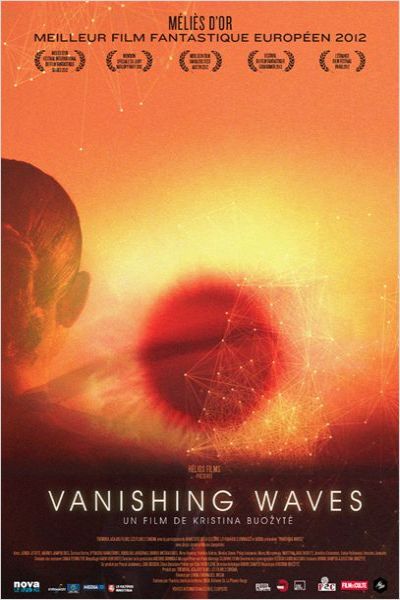
Vanishing Waves Poster

Vanishing Waves (2012) Co-writer/director Kristina Buozyte’s Lithuanian science fiction thriller plays like a more cerebral version of The Cell (2000). An emotionally stunted researcher, Lukas (Marius Jampolskis), participates in an experiment to access the brain waves of Aurora (Jurga Jutaite), a comatose patient. As he delves deeper into Aurora’s fantasy world, Lukas becomes infatuated with her, much to the detriment of his girlfriend, Lina (Martina Jablonskyte). Lukas and Aurora seem to share a strange symbiosis, as their bond becomes increasingly emotional Meanwhile, he attempts to keep his relationship a secret from his colleagues. It’s a brooding, sometimes frustrating, meditation on science, love and ethics, that will likely captivate some and alienate others. 

Rating: ***½. Available on Blu-ray, DVD and Kanopy


Hercules in the Haunted World Poster

Hercules in the Haunted World (1961) Drector Mario Bava takes a shot at sword and sandal movies with this mildly entertaining entry into the long-running series about the mythical Greek strongman. Hercules (Reg Park) and his pal Theseus (George Ardisson) travel to the underworld, in search of the golden apple, which will purportedly restore Hercules’ betrothed, Deianira, back to good health. Unfortunately, there’s push-back from the god Pluto when Theseus attempts to escape the underworld with the god’s daughter, Persephone (Evelyn Stewart). Christopher Lee also appears, as devious, would-be ruler Lico. Considering what was probably a very tight budget, the film looks great, bathed in bold reds and greens, with some inventive set design.    

Rating: ***. Available on Blu-ray, DVD and Kanopy

Night of the Big Heat Poster

Night of the Big Heat (aka: Island of the Burning Damned) (1967) With the presence of director Terence Fisher, along with Peter Cushing and Christopher Lee, you would be led to believe this low-budget British film came from Hammer. Unfortunately, it’s a talky exercise, missing the spit and polish of that legendary production company. Lee plays a scientist, researching a potential alien invasion, and Cushing is a small-town country doctor. An inordinate amount of time is spent on a love triangle between a cocky author (Patrick Allen), his wife (Sarah Lawson), and mistress (Jane Merrow). It’s a big disappointment when we finally catch a glimpse of the aliens (which resemble glowing, pulsing lumps), as well as the abrupt, deus ex machina ending, but the movie has its moments. 

Rating: ***. Available on Blu-ray (Region B), DVD and Tubi

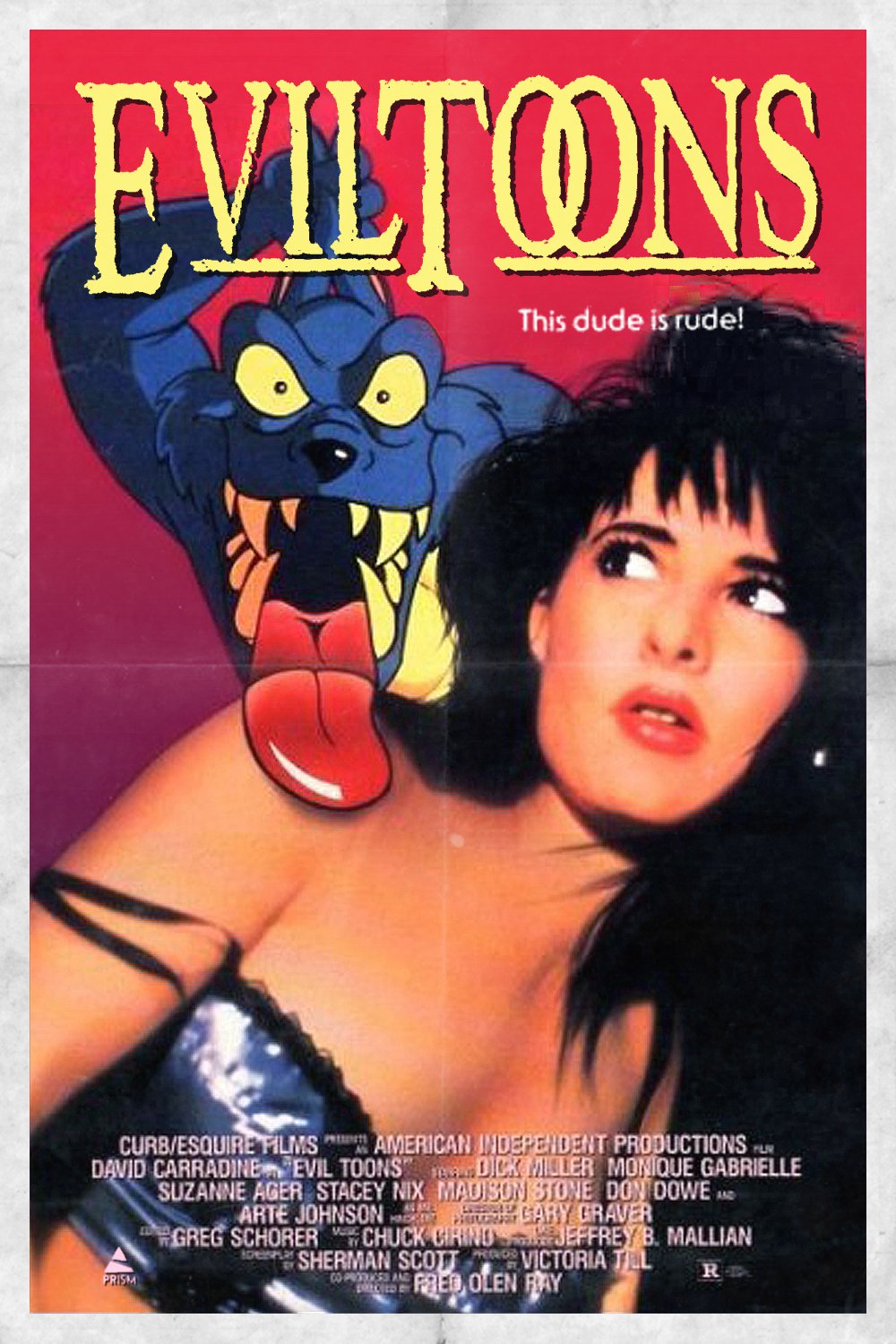
Evil Toons Poster

Evil Toons (1992) – First of all, don’t expect toons in this direct-to-video T&A fest from Fred Olen Ray, obviously intended to ride the coattails of Who Framed Roger Rabbit. There's only one (crudely animated) cartoon character in the whole flick, and he barely has any screen time. Four nubile women (in various states of undress) are hired to clean up a dusty old house. One of them encounters an ancient book that looks suspiciously like Evil Dead's Necronomicon, becoming possessed by a malevolent creature. Even bit parts by veteran actors Dick Miller (as their gruff boss Burt), Arte Johnson (as Mr. Hinchlow, a pervy neighbor), and David Carradine (as Gideon Fisk – some sort of mystical guy), can’t save this painfully dumb movie from itself. Just say no. 

Rating: *½. Available on Blu-ray and DVD


Monday, September 26, 2022

The Day of the Locust


The Day of the Locust Poster

(1975) Directed by John Schlesinger; Written by Waldo Salt; Based on the novel by Nathanael West; Starring: Donald Sutherland, Karen Black, William Atherton, Burgess Meredith, Geraldine Page, Richard Dysart and Billy Barty; Available on Blu-ray and DVD 

Rating: ****½  

Big thanks to Paul from Silver Screen Classics for hosting the Classic Literature on Film Blogathon. Be sure to check out all the posts from this exceptional blogging event!

Hollywood Premiere

“When I saw the first cut of the film, I knew it was going to be controversial, but I was very proud of it – and still am, incidentally. I realized that maybe the casting of Karen Black as Faye was fatal, but I felt that we had a really interesting and extraordinary film which by no means was going to be popular.” – John Schlesinger (from 1978 interview, “I Both Hate and Love What I Do”: An interview with John Schlesinger, by Michael M. Riley) 

“The central vision of the novel (The Day of the Locust), ‘The Burning of Los Angeles,’ comes from a poem that West wrote in 1932…My view was much more directly political. I saw Hollywood as the center of propaganda for the great American dream.” – Waldo Salt (from 1973 interview with Tom Buckley, The New York Times)

Hollywood success stories are the myth that keeps packing audiences in the theater. Movie-goers seem to have an insatiable appetite for stories about someone down on their luck (often depicted by a plucky heroine) who suddenly makes it big. A Hollywood failure story is something else. Directed by John Schlesinger (Midnight Cowboy), and written by Waldo Salt (adapted from Nathaniel West’s short novel), The Day of the Locust strips back the glossy Tinsel Town veneer, to reveal its true, unglamorous nature. It begins with the Hollywood dream, before abruptly devolving into a nightmare. Amidst a few bright spots, the cast of characters is predominately an assortment of has-beens, hopefuls, and never-weres.  

Tod Hackett

Tod Hackett (William Atherton) is a promising young artist working on the bottom rung of the motion picture business, circa 1938. He lives in a rundown apartment building, The San Bernardino Arms (“The San Berdoo”), populated by a host of characters involved directly or tangentially to show business. He’s obsessed by his neighbor, would-be starlet Faye Greener (Karen Black), who lives with her elderly, ex-Vaudevillian father Harry (Burgess Meredith). She regards him as a friend, but he desperately wants their relationship to be more than that. Another frequent visitor of the San Berdoo is quick-tempered Abe Kusich (Billy Barty), a little-person actor turned part-time hustler.

Faye Greener

As Faye Greener, Karen Black* encapsulates the tone of the picture – a glamorous exterior that belies the ugliness underneath. In West’s book, Faye was only 17. The fact that Black was twice her character’s age only makes her character more pathetic. Faye (sporting a Harlow-esque platinum blonde hairdo) dreams of superstardom, taking the odd extra and bit parts in the hopes of landing her big break. In the meantime, she’s prepared to live a lifestyle beyond her means, and doesn’t care who she has to step on in the process. She’s the textbook definition of a self-dramatist, never missing an opportunity to hog the spotlight from everyone in her vicinity. Faye speaks with the affectations and ersatz sophistication of someone who can only mimic the celebrities she idolizes. She’s acts as if she’s constantly on stage, to the point where we never know who the real Faye is. Her syrupy sweet façade frequently lapses with moments of rage and abject cruelty. While she toys with Tod’s affections, she finds a willing mark in naĂŻve Midwest transplant Homer Simpson (Donald Sutherland). 

* Fun Fact #1: Schlesinger auditioned several actresses for the role of Faye, including Raquel Welch, before eventually deciding on Karen Black. According to the director, he chose Black because, “There’s something about Karen Black, excellent actress though she is, that convinces you she wouldn’t succeed.”

Homer Simpson

Donald Sutherland intrigues and repels as the perpetually bewildered Homer Simpson,*/**/*** a man who seems profoundly uncomfortable in his own skin. One of Homer’s trademark behaviors (which Sutherland perfectly replicated from the book) is that he can’t seem to control his fidgeting hands. If his hands are in a continual state of motion, Homer himself appears to be frozen in a state of indecision and unfulfilled longing (In his first attempt to win Faye’s favors, he drops a bouquet and runs). While he regards Faye with unconditional adoration, to her, he’s only a meal ticket – one in a long line of people she’s used and discarded. Homer proves that everyone, however, has their boiling point. When he finally snaps, 40 years of repressed desires and rage are released in one terrible display. 

* Fun Fact #2: Was Nathanael West’s Homer the inspiration for the eponymous patriarch of The Simpsons television show? Its creator, Matt Groening, provided conflicting views, first attributing the character to his father, before conceding that Homer Simpson was in fact derived from West’s book. Which story is true? The world may never know. 

** Fun Fact #3: Sutherland stated that it was “one of my favorite roles, because I played him exactly as I was, aged 13.” (2005 Guardian interview by John Patterson) 

*** Fun Fact #4: In order to look the part of his oversized character, the 6’ 4” Sutherland gained 40 pounds.

Harry Greener

The Day of the Locust lays bare the wide chasm between the haves and have-nots. Amidst the established Hollywood royalty, everyone else is chasing the elusive dream of fame, or gasping on the fumes of their former lives. One of the few success stories in the film is wealthy screenwriter Claude Estee (Richard Dysart), who stages elaborate parties at his sprawling estate.* On the other end of the spectrum is Faye’s father Harry (Burgess Meredith), a one-time star of the stage and screen, is now reduced to peddling his homemade shoe polish door-to-door, performing his song and dance routine to anyone who pays attention. Much like his daughter, his behaviors are little more than an elaborate ruse. Further down the stepladder of fame are fringe dwellers Earle Shoop (Bo Hopkins), and Miguel (Pepe Serna), who stage cockfights for small-time stakes. 

* Fun Fact #5: If Claude’s mansion looks familiar, it’s none other than Frank Lloyd Wright’s “Mayan House,” which famously appeared in The House on Haunted Hill (1959).

William Castle Cameo

The film underscores the human cost of motion picture production. In one scene depicting the Battle of Waterloo,* the elaborate set collapses, resulting in multiple injuries. The producer’s reaction, much to Tod’s dismay, is to sweep it under the rug and move on. Human life, especially the lives of extras, is especially cheap. The film’s climax, set during a gala Chinese Theatre premiere, contains visuals worthy of a horror movie, when the mass of fans quickly becomes a mob. The crowd that arrived to feed off the fame of celebrities turns against itself, thirsting for blood and destruction. The scene reaches an apocalyptic crescendo with Hollywood literally in flames, mimicking Tod’s painting, “The Burning of Los Angeles.” The crowd of people has transformed into an unblinking sea of pallid gray faces, their mouths paralyzed in a perpetual wail.   

* Fun Fact #6: The Waterloo film’s director is played by William Castle, in a brief cameo.

Hollywood in Flames

Schlesinger and Salt effectively captured the damning tone of Nathanael West’s novel. While The Day of the Locust is rife with compelling performances and an uncompromising vision, it’s easy to see why this didn’t fare well with critics or the box office. Even by the gritty standards of ‘70s cinema, this is bleak stuff. It doesn’t give us anyone to root for, depicting a Hollywood where no one is left untainted (Tod, who would probably be the protagonist in most other films, nearly rapes Faye in a fit of jealousy). It’s a grim reminder that you don’t rise to the top without getting your hands dirty, which also follows for those that sink to the bottom.


Sources for this article: “I Both Hate and Love What I Do”: An interview with John Schlesinger, by Michael M. Riley, Literature/Film Quarterly, Spring 1978; “Total Recall – Donald Sutherland,” by John Patterson, Guardian (2005); “Waldo Salt Recalls The Day of the Locust,” by Tom Buckley, The New York Times, Friday, December 7, 1973; “Behind the Scenes of The Day of the Locust,” by Kenn Rand 

Thursday, September 15, 2022

Kenny & Co.

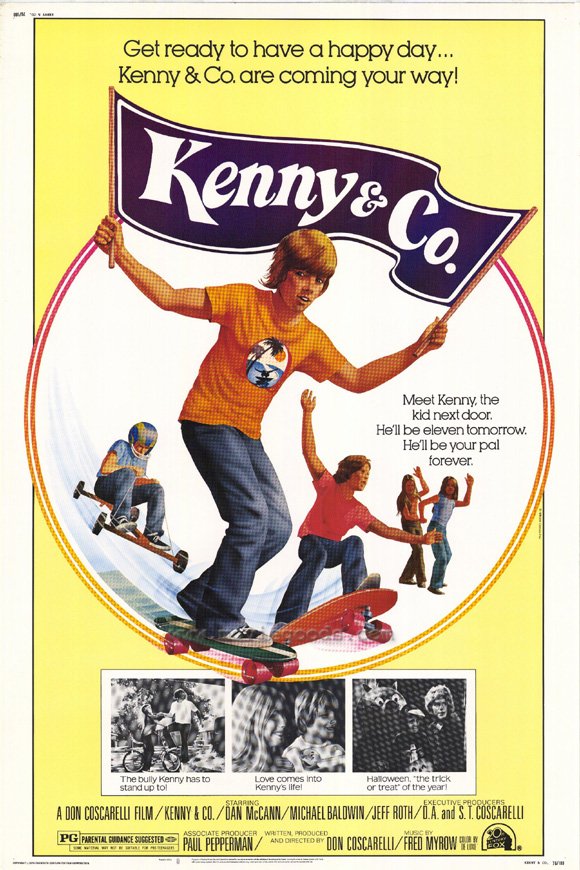
Kenny & Co. Poster

(1976) Written and directed by Don Coscarelli; Starring: Dan McCann, A. Michael Baldwin, Jeff Roth, Ralph Richmond and Reggie Bannister; Available on DVD (Out of print) 

Rating: **** 

Note: This is an expanded version of a capsule review that originally appeared in June 2011.

“Sure, there would be a neighborhood bully and a love interest for Kenny, but my true goal was to convey what everyday life was like for a normal boy of twelve as he was growing up. For kids, adults and their actions are simply incomprehensible. I wanted to show that.” – Don Coscarelli (from True Indie, by Don Coscarelli)

Kenny and Doug

Being a kid has never been easy, with every generation staking claim to having the most arduous (and, alternatively, the greatest) experience growing up. As a Gen-Xer, my formative years were distributed between the ‘70s and ‘80s so I declare bragging rights for both decades. Although the kids in Kenny & Co., circa 1976, were a few years older than me, the scenes and dialogue consistently struck a chord with my own recollections of that peculiar and sporadically tumultuous time. If you ever wondered what being a kid in‘70s-era Southern California was like, this is probably as close as you’re going to get, short of a documentary from the period or a time machine.

Mr. Donovan and class

Writer/director Don Coscarelli was only 21 when he directed his second movie (preceded by Jim, the World’s Greatest). Filmed in Long Beach, California, around the same neighborhood where he grew up, Kenny & Co. was his (sort of) tribute to The 400 Blows (although I’d wager Truffaut never watched Kenny & Co.). Coscarelli and associate producer Paul Pepperman incorporated several incidents from their own childhood into the story. Coscarelli’s parents’ house became the base of operations for the film, as well as the location for several scenes. It was a true family affair, with his father Dac producing, his mother Kate (who also starred as Kenny’s mother and cooked for the film crew) handling makeup and production design by, and costumes by his sister Anne. In low budget fashion, many of the crew members had multiple roles (in addition to directing, Coscarelli handled the cinematography and editing).

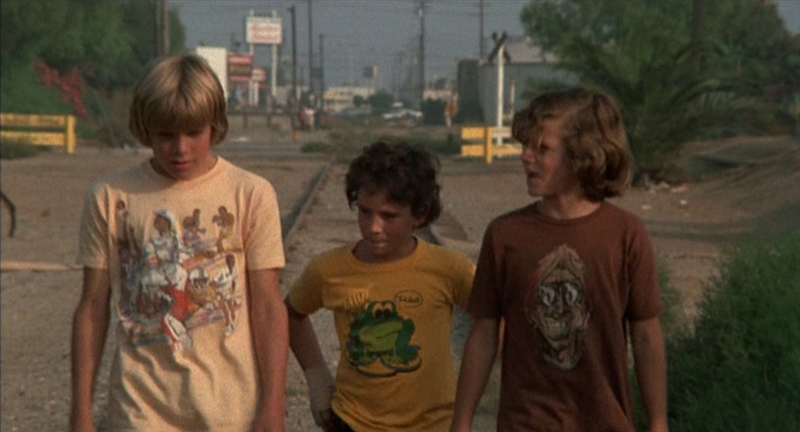
Kenny, Sherman and Doug

Kenny (played by Dan McCann, in his first and only role) is an average pre-teen who hangs around with his best friend Doug (Michael Baldwin), and by default, the klutzy, fifth-wheeling kid from across the street, Sherman (Jeff Roth).* His elementary school teacher, Mr. Donovan (played by Coscarelli regular, Reggie Bannister),** is the kind of teacher everyone wishes they had – easygoing, and not too old or jaded to remember what it was like to be that age. Naturally, it wouldn’t be a proper film about childhood if there wasn’t some adversity, which comes in the form of hulking bully Johnny Hoffman (Willy Masterson), who’s roughly the size and shape of a male silverback gorilla. 

* Fun Fact #1: When Jeff Roth tripped over the camera during his audition, Coscarelli knew that they had found the perfect Sherman. 

** Fun Fact #2: Kenny & Co. featured several performers who would appear in Coscarelli’s better-known follow-up, Phantasm. In addition to Baldwin and Bannister, the cast included Kenneth V. Jones (the first victim of the flying silver ball) as Kenny’s irascible baseball coach Mr. Soupy, Terrie Kalbus (the spooky girl in Mike’s neighborhood), as Kenny’s first crush, and Ralph Richmond (the bartender in Phantasm) as Doug’s prankster father, Big Doug.

Doug, Sherman and Kenny in Halloween Costumes

While a movie that isn’t driven by plot might be considered a deficit in some circles, it works beautifully for Kenny and Co. Instead, the film is comprised of vignettes, bracketed by Halloween night, and tied together by Kenny’s earnest narration. The result is consistent with the murky waters of our memories, which tend to be episodic in nature, rather than a coherent linear narrative. The performances by the kids (many of whom were not professional actors) are refreshingly natural. McCann (whom Pepperman spotted at a school carnival) is perfect as the easygoing everykid, Kenny, with his sweet but not saccharine demeanor. Roth never fails to amuse as Sherman, with his puppy-dog eyes and naĂŻve charm (he desperately wants to be one of the guys, who consider him more of a mascot than a peer). One of the few professional actors was Michael Baldwin,* standing out from the pack as Kenny’s fearless pal, Doug. 

* Fun Fact #3: Baldwin’s father, Gerard, was an animator/director who worked on several shows, including The Bullwinkle Show and The Jetsons.

Sherman with Girly Magazine

Despite being a little rough around the edges (or perhaps because of it), Kenny & Co. captures some of the greater truths about being a kid. Sure, there’s some artistic license along the way (most of us probably aren’t lucky enough to witness our childhood bully’s comeuppance), but what Kenny & Co. especially gets right are the little moments – stupid pranks, goofing around, and generally doing things that would give any parent heart palpitations. In one scene, the kids peruse the centerfold in a girly magazine that Sherman pilfered from his dad’s bedroom, leading to a conversation about how babies are made. Sherman’s ridiculously misguided notions about human biology, contrast sharply with Doug’s matter-of-fact answer. In another scene, Kenny and Doug drop their dummy “Otis” in the street,* just to observe the baffled motorists’ reactions. To their dismay, a pair of grown-ups promptly abduct Otis and dump him in their trunk, a cruel reminder that adults aren’t always trustworthy. 

* Interesting Fact: In a case of life imitating art, my oldest son copied their prank, fashioning a dummy out of old clothes, and placing it in the middle of a busy parking lot. Thankfully, no one took his “Otis” away.

Kenny with Bob

For a movie that’s predominately a comedy there are some unexpected somber moments, including one of the most heartbreakingly honest depictions of losing a beloved pet that I have seen in any movie. Along with his parents, Kenny accompanies his dog Bob on his final trip to the vet. As explained by his father, they’re doing the right thing to ease their dog’s suffering, but nothing about it seems right or fair. When they exit the exam room, the camera pans across the photos on the wall, and the other pets in the waiting room (presumably for routine check-ups). It's a mixture of emotions – grieving over the loss, and envying the owners whose pets are still alive. For many kids, it’s their first encounter with death, and a harsh rite of passage. In another scene Kenny asks his father about what happens when you die. Instead of providing some trite, sugarcoated answer, his father responds that he doesn’t know – far from the comforting words his son probably expected. The only false note comes later, when Kenny and Sherman witness a (presumably) fatal auto accident. Compared to the scene with the dog, it seems extraneous, and out of step with the rest of the film. Mercifully, Coscarelli balances these darker moments with silliness,* keeping things from becoming too glum. It also serves as a reminder that Kenny is nothing, if not resilient.    

* Fun Fact #4: Coscarelli knew he was onto something, after seeing audiences jump during a scene when a monster appears in a spooky garage. Coscarelli commented that the desire to evoke that same sort of reaction inspired him to make Phantasm.

Johnny Hoffman and Kenny

In his DVD commentary, Coscarelli lamented the fact that 20th Century Fox tried to market the film as a kids’ movie, when he suspected that its true audience would be adults, reminiscing about their childhoods. As it turned out, he was spot-on with his assessment (although I believe kids would find much to relate to in the film). Considering the distributor’s lackluster job promoting Kenny & Co., it’s unsurprising that it fared poorly at the American box office. Oddly enough, the movie became a big hit in Japan (where it was retitled Boys Boys/Kenny and Friends). Despite its brief moment of glory, Kenny & Co., like its star, McCann, faded into obscurity. As far as many Coscarelli fans are concerned, his career started with Phantasm, but Kenny & Co. deserves its own little renaissance. Unlike most of Coscarelli’s other films, which have wound up on just about every home video format, there was only one DVD release of Kenny & Co. (Jim, the World’s Greatest, has yet to appear on DVD or Blu-ray). The promising young director would go on to more polished and ambitious projects, but nothing has quite matched the degree of humor and heart found in this sophomore effort. The Anchor Bay DVD is long out of print, with no Blu-ray in sight, but if you can get your hands on a copy, it’s a trip down memory lane worth taking. 


Sources for this article: Anchor Bay DVD commentary; True Indie, by Don Coscarelli


Thursday, September 1, 2022

Werewolf Month Quick Picks and Pans


Moon of the Wolf Poster

Moon of the Wolf (1972) At times, this made-for-TV movie from director Daniel Petrie (based on a novel by Les Whitten) feels a bit like an extended Night Stalker episode. Set in rural Louisiana, the focus is on story, not effects. It starts as a murder mystery, which gradually shifts to horror. When a woman’s body is found savagely mauled, Sheriff Whitaker (David Janssen) attempts to narrow down the list of suspects, including the victim’s brother. While the locals blame wild dogs, the real culprit is something much more terrifying – a loup-garou (basically a Cajun version of a werewolf). Petrie wisely holds back from revealing the creature for most of the film (the makeup by Thomas and William Tuttle resembles a restrained version of Lon Chaney Jr.’s Wolf Man). It’s worth a look for the supporting cast alone (including Bradford Dillman, Barbara Rush, and Royal Dano). 

Rating: ***½. Available on DVD


The Werewolf Poster

The Werewolf (1956) An amnesiac (Steven Ritch) wanders into a small California mountain town. Mayhem ensues shortly afterwards, when his appearance coincides with several grisly (offscreen) murders. It takes the film nearly a half-hour to introduce the two scientists responsible for turning the man into a werewolf, under the auspices of improving society. It’s all appropriately moody and atmospheric, but falls short as a horror film. As much as I enjoyed the genre elements, this little slice of werewolf-noir probably would have been better off focusing on the psychological ramifications of a man on the run from himself. 

Rating: ***. Available on DVD


I Was a Teenage Werewolf

I Was a Teenage Werewolf (1957) Michael Landon (channeling James Dean from Rebel Without a Cause) stars as Tony Rivers, a teen with a terminal beef against authority figures and rules. After one too many run-ins with the law, he’s placed under the care of an unscrupulous psychiatrist (Whit Bissell), who makes him his unwitting pawn (What informed consent?). Using hypnotherapy, the psychiatrist hopes to re-start the human race, by regressing his test subject a million years or so. With shaky science like that, what could possibly go wrong? Plenty, we soon discover, when Tony becomes a bloodthirsty, rampaging werewolf. It might be worth a look, for the goofy premise alone. Surprisingly, you can’t find this on DVD or streaming with the regular services, but you can probably catch it on YouTube (for now). 

Rating: **½. Available on: YouTube


Dr. Jekyll vs the Werewolf Poster

Dr. Jekyll vs. the Werewolf (1972) Paul Naschy returns as cursed Polish nobleman Waldemar Daninsky, who’s doomed to turn into a werewolf when the moon is full. Hoping to find a possible cure for his affliction, he travels to London, where he meets the grandson of Dr. Jekyll. The good doctor’s latest experiment (based on his grandfather’s work) involves a serum that turns Daninsky into Mr. Hyde (not a great tradeoff). Where or how he suddenly sports a Victorian-era cape in swinging ‘70s England is never explained. Unless you’re equating the title with the doctor’s struggle to find a cure for Daninsky’s lycanthropy, it’s a bit of a letdown – don’t expect any knock-down, drag-out, slugging action between the two. For Naschy enthusiasts only. 

Rating: **½. Available on DVD and Tubi

She-Wolf of London Poster

She-Wolf of London (1946) Hmm… Talk about bait and switch! Not really a sequel to 1935’s Werewolf of London, this tepid thriller is a little too classy for its own good. Most of the attacks are offscreen, and the “werewolf” is just a shrouded figure. June Lockhart plays Phyllis Allenby, a young woman harboring a family curse. She becomes the primary suspect in a series of vicious murders, but has no recollection of committing them. Despite the title, don’t go in expecting to see werewolves. It’s a serviceable murder mystery, but as a horror film it falls woefully short. Lumping it together with the other Universal Wolf Man movies is nothing more than wishful thinking.   

Rating: **½. Available on Blu-ray and DVD


Frankenstein Meets the Wolf Man Poster

Frankenstein Meets the Wolfman (1943) The Universal house of horror was showing cracks in the foundation by the time this sort-of sequel to The Wolf Man was released. Lon Chaney Jr. returns as the eternally tortured Lawrence Talbot (it turns out he was only mostly dead), searching for an end to his misery. Bela Lugosi plays Frankenstein’s monster – an odd casting choice, considering Lugosi’s reservations about playing the creature in the first place. Seeing Lugosi (barely recognizable behind the makeup) shamble around like a drunken zombie and grunting seems like a self-fulfilling prophecy. Chaney does his best as Talbot, but there’s nothing new about the character. There’s an unnecessary musical sequence, presumably to pad out the film’s running time, and the final showdown is perfunctory at best. It’s nice seeing Maria Ouspenskaya reprising her role as Maleva from The Wolf Man, but her character isn’t given much to do except to be treated like a pariah by the ignorant local villagers. Watch House of Dracula or House of Frankenstein instead. 

Rating: **½. Available on Blu-ray and DVD


Silver Bullet Poster

Silver Bullet (1985) The eponymous “Silver Bullet” refers to the main character Marty’s (Corey Haim) souped-up wheelchair (Is that thing even street legal?) and, of course, the traditional means of dispatching a werewolf. Based on Stephen King’s novella Cycle of the Werewolf, and adapted by King* himself, it’s surprising that most of the roles are so two-dimensional, but a couple of performances manage to shine through. Gary Busey plays Marty’s irresponsible uncle (Hmm… Does life imitate art, or vice versa?), and Everett McGill is excellent as the creepy Reverend Lowe. Unfortunately, the movie suffers from an inconsistent tone, bland leads, and substandard makeup effects.   

* Fun Fact: Don Coscarelli was originally slated to direct the film, but constant disagreements with producer Dino De Laurentiis led to his dismissal from the project. The producer, however, did take Coscarelli’s suggestion to have King write the screenplay (from True Indie, by Don Coscarelli).

Rating: **½. Available on Blu-ray and DVD

The Rats Are Coming! The Werewolves Are Here! Poster

The Rats Are Coming! The Werewolves Are Here! (1972) Another micro-budget wonder from writer/director/producer Andy Milligan features lots of talky scenes with expository dialogue, delivered with an odd cadence (In other words, it’s unmistakably a Milligan film). A Victorian-era family of British werewolves are thrown into upheaval when the youngest daughter marries an outsider (thinking their offspring might break the family curse). The old house that serves as the primary setting lends some veracity to the production, but any suspension of disbelief is nullified by the lead actress’ blue eyeshadow, and a scene where two characters walk by a modern soda advertisement. In the end, the best thing about it is the eyebrow-raising title. The rest? Well… Did I mention it’s a Milligan film? Watch at your own peril. 

 Rating: **. Available on DVD (Out of print) and Tubi


Werewolf Woman Poster

Werewolf Woman (1976) In this sleazy Italian horror/thriller from writer/director Rino Di Silvestro, Annik Borel plays Daniela, a woman unable to form relationships with men. She channels the past life of her lookalike ancestor, who was burnt at the stake. She soon follows in her predecessor’s footsteps, luring and killing men by tearing at their throats. The misogynistic story attempts to link Daniela’s past sexual trauma with her psychosis, making no attempt to portray the character in a sympathetic light. Instead, the camera lingers on her body as a sex object, while she’s regarded as a savage animal that deserves to be destroyed. Do yourself a favor and skip this genuinely unpleasant experience. 

Rating: *½. Available on Blu-ray, DVD and Tubi


Sunday, August 28, 2022

Announcing the Devilishly Delightful Donald Pleasence Blogathon


Donald Pleasence Blogathon

When Gill from Realweegiemidget Reviews asked me if I was interested in co-hosting a blogathon devoted to the one and only Donald Pleasence, how could I resist? Who else but Mr. Pleasence could be a Bond villain, a blind POW, a Soviet conspirator, William Hare (of the notorious duo Burke and Hare), and a determined psychiatrist, all with equal conviction? Friend or foe, the infinitely versatile character actor was always committed to his craft.

Dr. Loomis, Halloween

Since the blogathon will take place Halloween week, you’re more than welcome to cover any of his horror roles, but don’t forget his many other non-horror characters, as well. You might choose to review one of his films, do a retrospective of his filmography, or cover one aspect of his career (such as his enduring role as Dr. Loomis in the Halloween series). There are no limits to the possibilities.

Dr. Michaels, Fantastic Voyage

Of course, you’re not just restricted to blog posts about Pleasence. Feel free to send us links to your YouTube video, podcast, black-light velvet paintings – wherever your creative impulses take you. Not sure where to start? With acting credits, according to IMDB, there’s bound to be something that will strike your fancy. Check out a list of his roles here. 

SEN, THX-1138
 

What: The Devilishly Delightful Donald Pleasence Blogathon


Who: Hosted by Gill Jacob and Barry P. 


Where: Realweegiemidget Reviews & Cinematic Catharsis


When: October 28-30, 2022 


How: Please read the rules below, and send me your post request (review, podcast, etc…) via email (barry_cinematic@yahoo.com), Twitter (@barry_cinematic), or by commenting below. You may also contact Gill by commenting on her post, or through her blog’s Contact Me page. (Be sure to include your preferred name, along with your blog’s title).

Priest, Prince of Darkness
 

The Rules…

1.     You may review ANY of his film or TV appearances. Or if you want to review books or topics about him that’s fine with us as well.

2.     Because Mr. Pleasence has such a large number of appearances in his filmography, NO DUPLICATE MOVIE OR TV SHOW TITLES WILL BE ALLOWED. If a specific title has already been claimed, you may only include that title if it’s part of a list or retrospective review. If you choose to write about Donald Pleasence, tell us what your topic will be. We won’t accept posts that are uncomplimentary or disrespectful to him.

3.     Review choices may be requested as a comment on this page or you may contact me through the methods listed above.

4.     Add your Twitter username so we can promote your post.

5.     A full list of blogs and review choices will be posted on a separate page, and updated regularly.

6.     Only original, never-before-published posts will be accepted.

7.     Limit TWO blog posts per participant, please.

8.     Send a link of your post(s) to me or Gill on one of the days of the blogathon. Note: We will be publishing all links on both blogs.  

9.     Please also note: Gill and I have already claimed the following titles below:

Gill at Realweegiemidget Reviews – Telefon (1970)

Barry at Cinematic Catharsis – Circus of Horrors (1960)


One more thing: 

If you plan to participate, or just want to show your support, please grab one of the following banners to display on your blog:


We’re looking forward to seeing your submissions!