Monday, August 12, 2019

A Boy and His Dog


(1975) Written and directed by L.Q. Jones; Based on a novella by Harlan Ellison; Starring: Don Johnson, Susanne Benton, Jason Robards, Tim McIntire and Hal Baylor; Available on Blu-ray, DVD and Amazon Prime

Rating: ****

“I’m getting the hell out of here. I wanna see Blood again. I wanna get in a good straightforward fight with some son of a bitch over a can of beans. I gotta get back in the dirt so I feel clean!” – Vic (Don Johnson)

“The picture gives you a choice. The choice: Do you live above ground with these people, or do you live below ground in Topeka?” – L.Q. Jones (from Shout Factory Blu-ray commentary)

Prior to A Boy and His Dog, most cinematic depictions of future society imagined an idealistic, gleaming city. More often than not, there was something explicitly dystopian, but the future civilization appeared as if it had been freshly unwrapped. In L.Q. Jones’ film, based on a novella by Harlan Ellison, all the gloves are off, depicting a bleak, inhospitable Earth, left barren after a global nuclear war. When Ellison failed to produce a complete screenplay, Jones took the chore upon himself – the results are quite faithful to the original story. Even the notoriously cantankerous Ellison, who bristled at previous attempts to adapt one of his favorite stories,* was generally pleased with the results (read on for a couple of notable exceptions).

* Fun Fact #1: Before being produced as an independent production, Ellison’s story was considered by three major studios. According to L.Q. Jones, one of the studios wanted Don Siegel to direct.

Vic and Blood roam the post-apocalyptic landscape in a buddy movie like no other. They enjoy a symbiosis of sorts, communicating without words and keeping each other company. Blood the dog (played by Tiger and voiced by Tim McIntire), bioengineered for super intelligence and telepathic communication,* can detect trouble from far away. Vic (Don Johnson),** on the other hand, relies on his brute strength to keep them safe. They scour the land for sustenance, while avoiding vicious warlords and deadly radioactive mutants called “screamers.” One evening, while taking in an old movie, Blood spots a woman disguised as a “rover,” (the term for scavengers like Vic, who roam the surface). Quilla June (Susanne Benton), a resident of the “downunder” (an underground city) is introduced into their dyad, enticing Vic with sex. Vic is taken off his guard when she whacks him over the head, but leaves a souvenir behind – a card key. Despite Blood’s admonitions that it’s little more than a ruse, Vic decides to pursue her, descending into the subterranean city of Topeka.

* Fun Fact #2: Ellison angrily objected to one studio’s suggestion that they would make the dog’s mouth move.

** Fun Fact #3: In the original story, Vic was 15 years old, which would be problematic, considering the events that take place in the film. In the film, he’s approximately 18 (Johnson was 25 at the time the film was shot).
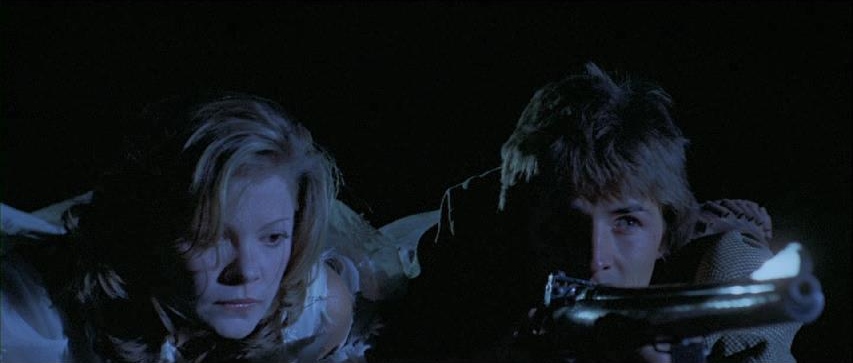

A Boy and His Dog reinforces how cheap human life has become, distilled to its bare essentials. Strength and subjugation are the new paradigm. Survival takes precedence over respect, with social progress sliding back a century. Women have become second-class citizens* – a commodity to be used and discarded. Sex is something to be enjoyed by men and endured by women. Quilla June provides a sharp counterargument to the new norm (a point made abundantly clear in the original story). Her forthright demeanor and assertiveness frighten Vic, who’s accustomed to taking what he wants, when he wants it.  

* Fun Fact #4: One of the more troubling aspects for the film, according to Ellison, were some misogynistic comments, spoken by Blood in the original cut. Ellison raised the $1,500 necessary to change some of the words.

The underground society of Topeka values preservation of the status quo above all else. The residents with mime-painted faces and rosy cheeks put on a façade of cheerfulness amidst the oppressive, sterile environment. They’re safe from the chaos above, trapped in a stagnant Norman Rockwell-inspired bubble. The city is a bastardized vision of Americana, featuring Sousa music playing incessantly over loudspeakers, a barbershop quartet, and picnics in the park. Free thought or dissent is shunned, in a world that Anthony from the Twilight Zone episode “It’s a Good Life” might have endorsed. Their version of progress is for the resident women to produce viable offspring, with some help from Vic. A Boy and His Dog presents two extremes: a choice between anarchy and fascism. On the surface, the closest things to government are roving gangs and warlords. In Topeka, there is the illusion of peace, which comes at the expense of personal freedom. Given the choice, many of us would probably take our chances topside.

* Fun Fact #5: The Goldstone Deep Space Communications Complex stands in for the upper levels of the subterranean city. The complex appeared several years previously in Ice Station Zebra (1968).


The film takes a dim view of humanity. It’s no accident that the most noble creature in the film is a dog. By far, the smartest, most rational character is Blood*/** He’s a good deal smarter than Vic, who admits he wouldn’t last very long without the skills of his canine companion. The thread that consistently links all the humans in A Boy and His Dog is their amorality. Vic isn’t particularly likable, but we root for him, nonetheless. He’s a package deal with Blood. Blood, on the other hand, serves as his conscience, attempting to keep him from stepping too far out of line. Quilla June operates predominately out of self-interest. It’s only when her goals converge with Vic that they reach anything resembling cooperation. Down in Topeka, Lou Craddock (Jason Robards) heads an elite group of town leaders, who impassively cast judgment on the city’s residents, making life or death decisions like they’re handing out traffic tickets. If anyone becomes too much of a problem, they’re sent to the farm (a euphemism for execution).

* Fun Fact #6: According to Jones, Tiger, the animal actor, was almost nominated for a best supporting actor Oscar for his performance as Blood.

** Fun Fact #7: In order to make Blood appear more ferocious in one scene, the filmmakers used false teeth, much to the dog’s disdain.

A Boy and his Dog features an unconventional dynamic, in which the canine is clearly in charge. The last line of the film ends on a sardonic note, punctuated by a twisted last line (Ellison objected, but was overruled by Jones). The film provides a grim reminder that love doesn’t necessarily conquer all, but self-preservation reigns supreme. A Boy and His Dog is one of the highlights of 1970s science fiction films (in a decade distinguished by many notable examples), and a must-see for enthusiasts of post-apocalyptic films.

* On a side note, if you have the Shout Factory disc in your clutches, I recommend watching the supplemental conversation between Jones and Ellison, playfully bickering about their artistic differences. It’s 50 minutes well spent.

Thursday, August 1, 2019

Short Take: Not of This Earth


(1957) Directed by Roger Corman; Written by: Charles B. Griffith and Mark Hanna; Starring: Paul Birch, Beverly Garland, Morgan Jones, William Roerick, Jonathan Haze and Dick Miller; Available on DVD (Out of print)

Rating: ***½

“Throwing in some tongue-in-cheek humor paid off: the picture took in close to $1 million in rentals. It was a definite turning point because it proved that mixing in some offbeat humor only increased the appeal of science fiction.” – Roger Corman (excerpt from How I Made a Hundred Movies in Hollywood and Never Lost a Dime, by Roger Corman, with Jim Jerome)

Roger Corman Month has illustrated the diverse output of the producer/director (The Intruder, The “Poe Cycle,” etc…), whose resume spans far beyond drive-in schlock. Sometimes, however, all you want is drive-in schlock, and Corman’s got you covered. Not of This Earth* was shot in two weeks for under $100,000, and released on a double bill with Attack of the Crab Monsters.
           
* Fun Fact #1: According to the DVD commentary, the title sequence was by animator Paul Julian, who worked on the Oscar-nominated short “The Tell-Tale Heart” (1953), and provided the voice of the Roadrunner in the Warner Brothers cartoons.

An anemic human-like alien, Paul Johnson (Paul Birch),* comes from the war-torn planet of Davanna on a mission to determine the viability of using human blood as a means of preserving his dying species. He conveniently outlines his six-step plan for world domination, using a secret communication/teleportation device hidden behind a panel in his den. The fifth phase is the “conquest, subjugation and pasturing” of the “subhumans” (aka: Earth people) for their blood. If their blood isn’t viable, the sixth phase involves obliterating the Earth (I’m guessing he compared notes with Marvin the Martian). Any way you slice it, humanity is screwed. If his plan works, we’re only there to provide a constant blood supply. If it doesn’t, kaboom!  

* Fun Fact #2: Paul Birch was the original Marlboro Man, debuting in the mid-50s.

Beverly Garland does a nice job as Nadine Storey, Johnson’s plucky live-in nurse. She’s smart, funny, and doesn’t take any guff from anyone, especially Jeremy (Jonathan Haze), Johnson’s handsy ex-con personal assistant. Birch is memorable as the emotionless Paul Johnson, who fries people’s brains with his eyes. Birch was replaced halfway through production by Lyle Latell, who had similar features (of course, wearing a hat and dark glasses helped). Depending on which version of events you believe, Birch was fired from the production due to his problems with alcoholism or walked off the set, because he was required to wear cloudy contact lenses that caused severe discomfort. Corman stalwart Dick Miller (credited in the film as Richard Miller) makes a lasting impression in his short but memorable role as door-to-door vacuum cleaner salesman Joe Piper. Miller ad-libbed his dialogue, based on his prior experience as a door-to-door salesman (“Hey, man, you wanna purchase, you purchase, you don’t wanna purchase, you don’t purchase.”).  

Corman gets the most for the money in Not of This Earth, even when the effects are less than convincing. It’s hard not to snicker at the briefly seen flying umbrella creature, dangling from a fishing line (designed by Paul Blaisdell who also created the silly but distinctive pickle monster that terrorized Beverly Garland in 1956’s It Conquered the World), but it has a certain DIY charm. Not of This Earth was remade not once, but twice, in 1988, featuring Traci Lords as Nadine, and again in 1995, with Michael York as Paul Johnson. The film, with its simple yet venerable premise, lends itself to low budget interpretations. The original version successfully incorporated themes of Cold War paranoia and fear of nuclear obliteration into an entertaining drive-in flick. Perhaps it’s ripe, once more, for another generation to discover and re-tool for current salient issues.

Sources: DVD commentary by Tom Weaver, John Brunas and Mike Brunas; How I Made a Hundred Movies in Hollywood and Never Lost a Dime, by Roger Corman, with Jim Jerome

Monday, July 29, 2019

Roger Corman Month Quick Picks and Pans


The Haunted Palace (1963) Although the title is based on a poem by Edgar Allan Poe, it isn’t really a part of Corman’s Poe Cycle, but an adaptation (by Charles Beaumont) of H.P. Lovecraft’s “The Case of Charles Dexter Ward.” This slow-moving, atmospheric movie features fine performances by Vincent Price, Deborah Paget and Lon Chaney, Jr. Price plays a dual role as Joseph Curwen, burned at the stake for practicing witchcraft, and his heir, Charles Dexter Ward. After the prologue, the story picks up 100 years later, when Ward takes possession of his estate, and in turn is possessed by his ancestor’s spirit. It doesn’t take long before Curwen is up to old tricks. The Haunted Palace looks great, with good production values, costumes and nightmarish makeup of the village’s mutated residents. The only downside is a motionless monster in a pit (its features are obscured by blurring) that looks like it was hastily constructed by Corman’s team out of whatever materials they had lying around.

Rating: ***½. Available on Blu-ray (Region B) and DVD


Frankenstein Unbound (1990) Roger Corman’s last (to date) directorial effort has an intriguing concept (based on a novel by Brian Aldiss) and an excellent cast, but the execution is as clumsy as the titular creature. John Hurt plays Buchanan, a scientist from 2031, who creates a space/time rift. He’s accidentally transported back to 1817 Geneva, Switzerland, where Dr. Victor Frankenstein’s (Raul Julia) creation is running amuck, leaving a trail of death. Meanwhile, Mary (soon to be) Shelley, Lord Byron and Percy Shelley (played by Bridget Fonda, Jason Patric, and Michael Hutchence of INXS fame) take up residence in a nearby lakeside chateau. The film attempts to connect the dots between the “real” Frankenstein creation and Mary’s literary work to be, drawing parallels between Frankenstein’s creation and Buchanan’s invention. There are some good performances from Hurt, Julia and Fonda, but the film is hampered by an unsympathetic monster, and it tries to juggle too many characters and elements. The Geneva setting looks fine, and there’s a cool (albeit impractical) future car, but the future world (with its plasma globes and mediocre matte paintings) fails to impress. Even if the film as a whole doesn’t quite gel, it merits a look for the premise alone.

Rating: ***. Available on DVD  


War of the Satellites (1958) If nothing else, this movie deserves a look for another rare starring role for Dick Miller (doing his best to suppress his Bronx accent) as Dave Boyer, an astrophysicist. His colleague, program leader Dr. Van Ponder (Richard Devon) is under the influence of unseen aliens who want to stop human space exploration before it begins. Susan Cabot also co-stars as scientist Sybil Carrington. The earnest story recalls the earlier Hammer film Spaceways (1953), although the bad guys are aliens instead of communists. Even for a Corman film, War of the Satellites looks cheap, with poor special effects and cut-rate production design (the spaceship chairs look like they came right out of a furniture showroom). Even if the film can’t quite visualize its ambitions it might be worth checking out, for a game cast, which also includes Corman regulars Bruno VeSota and Beach Dickerson, as well as Corman himself, in an uncredited cameo as a ground control technician.

Rating: **½. Available on DVD


Gas! – Or It Became Necessary to Destroy the World in Order to Save It (1970) Cindy Williams, Talia Shire (credited as Tally Coppola) and a pre-Harold and Maude Bud Cort headline Corman’s post-apocalyptic satire. The U.S. Army accidentally releases an experimental gas in Alaska, killing everyone over the age of 25 (Roger Corman based the premise on the Jack Weinberg quote, “Don’t trust anyone over 30.”). It’s too bad the world that’s left, with its new factions, isn’t much better than the one they left behind. Corman’s film, with its Dr. Strangelove ambitions, falls far short of Kubrick’s film. The would-be farce is short on laughs, but has a few fun moments. The best is a chopper-riding Edgar Allan Poe and his girlfriend Lenore, riding the American southwest and commenting about life and death (I think Corman missed the boat by not choosing to focus on these two alone). It’s a near miss that might have worked if screenwriter George Armitage (who continued to write the script during production) had the luxury of fleshing out the story.

Rating: **½. Available on Blu-ray, DVD and Amazon Prime


The Trip (1967) You can’t fault this essentially plotless film for false advertising (featuring a script by Jack Nicholson), which consists of Peter Fonda experiencing an LSD trip for 90 minutes. Bruce Dern serves as guide during his peripatetic journey, with Susan Strasberg as his estranged wife. Members of the cast, which also includes Dennis Hopper, reportedly took LSD prior to making the film, along with producer/director Roger Corman (Would this count as method directing?). While I can’t vouch for the veracity of the results, there’s some interesting, trippy imagery, including period costumes and nightmarish imagery cribbed from Corman’s Poe films, pondering birth, death, and everything in between. Perhaps I missed the point, but it all gets tedious after a while, and doesn’t amount to much.

Rating: **½. Available on Blu-ray and DVD


The Last Woman on Earth (1960) Roger Corman’s post-apocalyptic film was shot on location in Puerto Rico and written by Robert Towne (who would go on to much bigger and better things). According to Corman, Towne was cast in the film so he could continue to work on the screenplay during production. A global catastrophe occurs in which oxygen momentarily disappears, presumably killing everyone except for three people who were scuba diving at the fateful moment. Now they’re stuck on the island, trying to decide their next move. The initially civil relationship devolves into a love triangle between millionaire Harold Gern (played by Corman regular Antony Carbone), his depressed wife Evelyn (Betsy Jones-Moreland) and his attorney Martin Joyce (Towne). Even at 71 minutes, the material seems to have been stretched to the breaking point, consisting of endless bickering between the three characters, and debate about staying or leaving the island. The cop-out ending, re-affirming the sanctity of marriage, rings hollow, considering the considerable discord between the two characters. Skip it, unless you have a masochistic streak.

Rating: **. Available on DVD and Amazon Prime


Creature from the Haunted Sea (1961) In this Corman quickie, charter boat captain Renzo Capetto (Antony Carbone, who resembles a low-rent Key Largo-era Bogart), and his thugs plan to double cross a Cuban general transporting stolen gold during Castro’s revolution. The would-be farce features unfunny comic bits and obnoxious characters, including a loathsome henchman (Beach Dickerson) who speaks in animal sounds. The big plot twist concerns Capetto’s scheme to create a sea monster hoax, except the monster turns out to be real. The googly eyed title creature, which looks like an aquatic Cookie Monster, was reportedly cobbled together for a $150 budget. They overspent.  

Rating: *½. Available on Amazon Prime