Monday, October 21, 2013

October Quick Picks and Pans – Horror Month 2013


The Flesh Eaters (1964) Jack Curtis, known predominantly for his voice work in the Speed Racer cartoon, directed this independent sci-fi/horror hybrid that’s a cut above the usual drive-in fare of the era.  An alcoholic starlet and her personal assistant (played by Rita Morley and Barbara Wilkin) secure the services of charter pilot Grant Murdoch (Byron Sanders) and his seaplane.  Due to inclement weather, they’re forced to land short of their Rhode Island destination, and end up on a secluded beach.  The only other inhabitant is marine biologist Peter Bartell (Martin Kosleck), who turns out to be a Nazi scientist conducting a series of covert experiments.  Bartell’s creation, tiny glowing life forms that seek out and devour skin, soon gets out of control.  The Flesh Eaters is a simply told but effective fright flick with some surprisingly gory makeup effects for the time.  Added together, this makes the film essential viewing.

Rating: *** ½. Available on DVD.


The Funhouse (1981) What can I say?  I’m a sucker for dark carnival films.  True to its title, much of Tobe Hooper’s horror flick takes place in the titular carnival funhouse, where four unsuspecting teens are trapped with a hideous creature.  The Funhouse was a troubled production that didn’t get a lot of love from critics, and doesn’t garner the same level of affection that some of Hooper’s other efforts received.  It takes a while to get going, and character development is weak (probably the product of haphazard editing), but it makes up for its deficiencies with a pervasive menacing atmosphere and some excellent, creepy cinematography.  The Rick Baker-designed mutant fits in nicely with some of the sideshow oddities that we witness earlier in the film (and foreshadow its appearance).  It’s all fairly predictable as we watch the teens, who unwisely decide to spend the night in the funhouse, and proceed to get picked off one by one.  There are a few decent scares along the way, however, and some eccentric performances by the sideshow people (including Kevin Conway in three separate roles).  With a little more work, The Funhouse could have been great, but instead, it’s merely adequate.  While this isn’t exactly a glowing endorsement, this film could serve as an acceptable addition, if not a headliner, for an all-night Halloween horror marathon.

Rating: ***.  Available on Blu-ray and DVD


Mulberry Street (2006) Not to be confused with the Dr. Seuss story And to Think That I Saw It on Mulberry Street, director/co-writer Jim Mickle’s Mulberry Street is a tall tale in its own right.  The meager $60,000 budget probably wouldn’t have covered the catering fees for a typical big-budget Hollywood production, but Mickle managed to present a moderately compelling story about an epidemic on the streets of New York City.  Most of the story takes place in a tenement house, where its residents contract a disease from mutant rats.  It’s surprising that the horror elements are the least effective aspect of this film.  Confusing and disorienting attack scenes, presented in quick cuts, attempt to hide the ridiculous premise that residents bitten by mutant rats are transforming into hybrid human/rat creatures.  Mulberry Street’s biggest strength is in the human drama, which normally gets the short end of the stick in most modern horror flicks.  In one affecting scene, a female soldier with a scarred face (Kim Blair) hides her face from another woman sitting across from her on a commuter train.  Although Mickle did a much better job of blending drama and horror with his follow-up, Stake Land, his earlier film might be worth a look if you lower your expectations.

Rating: ***.  Available on DVD
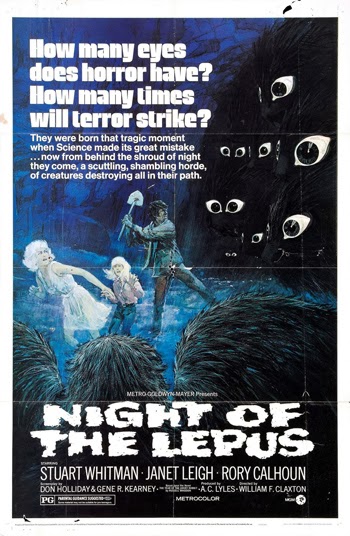

Night of the Lepus (1972) The 1970s was a decade typified by nature-run-amok environmental horror films, when everything that could walk, crawl, fly or swim was out to kill us.  Night of the Lepus presented one of the unlikeliest of culprits – giant killer bunnies.  As silly as this appeared, the film’s biggest problem is that it takes itself so seriously.  Despite the acting talents of Janet Leigh, Rory Calhoun and DeForest Kelley, it’s difficult to tell the cardboard characters apart from one another.  Since the people and supersized rodents never occupy the same frame, we have no sense of scale.  Instead, we’re treated to multiple scenes with reaction shots of terrified humans, interspersed with shots of rabbits hopping around.  It’s too dull to work as an unintentional comedy, and even with a running time of 88 minutes, it’s a tad overlong.  Maybe the best thing that can be said about the movie is that it was ahead of its time.  Night of the Lepus seems to envisage the Syfy channel’s endless lineup of preposterous mutant animal invasion flicks by several decades.  If that was the case, the filmmakers were downright prescient.

Rating: **.  Available on DVD.


Pumpkinhead (1988) It’s been nearly 25 years since I first watched Stan Winston’s directorial debut.  After giving this another look, my opinion hasn’t changed.  No one can deny the late Mr. Winston’s genius for stunning creature effects, or his ability to bring our collective nightmares to life.  His myriad contributions to horror, fantasy and science fiction films provided me countless hours of enjoyment.  I do, however, question his abilities as a director and storyteller with this tepid horror flick – a movie built around effects, rather than the other way around. 

Lance Henriksen stars as Ed Harley, a grief-stricken father, who wants retribution after his son is killed by a careless dirt bike rider.  Enlisting the aid of a local witch, he helps summon a demonic revenge creature, known only as Pumpkinhead, and the dirt biker and his pals are picked off one by one.  Once the creature’s rampage begins, the film could have been over in less than five minutes.  Instead, we’re treated to a series of pointless, drawn-out sequences, as the monster vanishes and re-appears for no apparent reason.  Pumpkinhead disappoints on many levels.  Truth be told, the monster is not his best creature effects work.  Its enlarged head and skeletal body seem derivative of the xenomorph and alien queen from Alien and Aliens (no surprise, considering his contributions to the latter film).  The film is a bit of a cult classic in some circles, but it seems like a case of misplaced affection, which overlooks Winston’s other, superior contributions to genre cinema.

Rating: **.  Available on DVD and Netflix Streaming.


Sleepaway Camp (1983) This feeble wannabe slasher film from writer/director Robert Hiltzik plays like an unholy mash-up of Meatballs and Friday the 13th.  The setting is a dismal summer camp in upstate New York that bears more resemblance to a gulag than a place of recreation.  The film meanders from one scene to another in a plotless haze, where nerds get hassled by jocks and people die.   The closest thing to a central storyline follows a brooding mute girl named Angela (Felissa Rose), who’s courted by one of the “good” kids.  There’s some unintentional humor, due in part to the atrocious acting, but there’s nothing compelling enough to warrant sitting through a bunch of tedium to arrive at a mildly clever twist ending.    

Rating: **.  Available on DVD.


Bio-Zombie (1998) This Hong Kong horror comedy about zombies created through biological warfare is a slapdash effort that’s neither scary nor funny.  Most of the male leads are unlikeable, and the female characters are dim or passive.  While I have nothing against movies that break the rules, Bio-Zombie doesn’t bother to stay consistent.  Sometimes the zombies attack humans, and sometimes they attack one another.  The makeup effects are bottom of the barrel, with wounds that appear stuck on, and heads and limbs that break off too easily.  The action takes place in a semi-deserted mall that seems to have only four stores, although the climax features throngs of zombies trudging through the mall’s parking garage.  A complete waste of time.

Rating: * ½.  Available on DVD.

Saturday, October 12, 2013

The Once Over Twice: Killer Klowns from Outer Space


(1988) Directed by Stephen Chiodo; Written by Charles Chiodo, Edward Chiodo and Stephen Chiodo; Starring: Grant Cramer, Suzanne Snyder, John Allen Nelson and John Vernon; Available on Blu-Ray and DVD

Rating: *** ½

“…we tried to take every circus motif, every clown gag, and give it a perverse twist.”
– Stephen Chiodo

Are clowns funny, or are they scary?  Nine out of ten people would probably pick the latter.  That other 10%, well… you probably don’t want to know them.*  For the purposes of this review, I’m siding with scary.  But why are they so nightmare inducing?  There are a number of theories floating around to explain the causes behind coulrophobia, the fear of clowns – ask several people and you might get very different responses.  I’ll opine it’s due to a combination of factors: freakishly oversized features, pallid white skin and distorted expressions.  Their disturbing appearance, coupled with childlike behavior (from someone who’s presumably an adult), creates mixed signals for children and fosters deep seated anxieties that last a lifetime.

* Not based on a statistically valid survey, so don’t bother searching for it. 


Killer Klowns from Outer Space * skewed the funny versus scary debate for good, with its hybrid horror, sci-fi and comedic approach.  It takes a decidedly comedic stance, while helping us realize our worst fears about clowns as harbingers of malevolence, rather than mirth.  Their presence instantly evokes John Wayne Gacy instead of Bozo.  Effects maestros the Chiodo brothers, Stephen, Ed and Charles co-wrote the script, and shared the division of labor for their apocalyptic concept of alien clown invaders.  Stephen was tasked with directing, Ed co-produced, and Charles handled production design.  Exteriors were shot in Santa Cruz, California, and back in the Chiodo brothers’ soundstage for interior scenes.

* The original title was Killer Klowns, but the filmmakers were concerned that their movie would be regarded as a slasher flick.


The Chiodo brothers’ movie is a loving tribute to 1950s sci-fi (particularly the alien invasion sub-genre), but includes nods to other genre flicks.  By far, the most heavily referenced film is 1958’s The Blob.  The early scenes mirror the earlier movie, as two young lovers (Grant Cramer and Suzanne Snyder) witness a fiery meteorite, and an old hermit (Royal Dano, in a role obviously modeled after Olin Howland’s take in the seminal movie) discovers the invaders.  As the monstrous clowns begin their invasion, and abduct townspeople, the lovers must contend with disbelieving police.  Also similar to The Blob, they find a reluctant ally in Officer Dave Hanson (compare to Lieutenant Dave in The Blob), played by John Allen Nelson.  Forbidden Planet is the template for one key shot, when our protagonists observe the cavernous interior of the clowns’ circus tent-shaped spacecraft.   In another scene, the film lampoons one of Hitchcock’s most iconic scenes.*

* Regarding the film’s unique riff on Psycho, Stephen Chiodo commented, “We wanted to do for the toilet what Alfred Hitchcock did for the shower.”


The Chiodo brothers make the most of their paltry $2 million budget, with clever special effects and set designs.  The spaceship interior appears as if the filmmakers had more to work with, consisting of modular pieces that could be re-arranged to create various rooms and passageways.  While the clowns themselves are obviously people walking around in suits, the designs are distinctive.  At once fanciful and scary, Charles Chiodo and his effects crew somehow manage to skirt the line between goofy and threatening.   The filmmakers pulled out all the stops to take an unsettling spin on clown tropes, with ray guns that encase people in cotton candy cocoons, popcorn that sprouts into dangerous creatures and balloon dogs that come to life.  The hellish circus mood is enhanced by John Massari’s carnivalesque, synthesizer-laden score and punk band The Dickies’ fun title song.


Several characters in Killer Klowns from Outer Space were modeled after the Chiodo brothers’ childhood friends, including protagonist Mike Tobacco (Grant Cramer) and bumbling ice cream vendors the Terenzi brothers (played by Michael Siegel and Peter Licassi).  Veteran character actors (including the aforementioned Royal Dano) helped round out the cast, notably everyone’s favorite bad guy, John Vernon, as the hateful police officer Curtis Mooney. 


Although Killer Klowns from Outer Space has gained a loyal cult following over the years, it remains a love it or hate it affair, depending on whom you speak to.  The haters seem to have missed the point entirely, with the film’s quirky blend of horror and comedy.  The Chiodo brothers’ tongue-in-cheek tribute to alien invasion flicks of their childhood proudly wears its B-movie sensibilities on its ruffled clown sleeves.  As far back as 2001, with their DVD commentary, the Chiodo brothers indicated they were working on a sequel, but it wasn’t until earlier this year that The Return of the Killer Klowns fromOuter Space in 3D  was officially announced, with original star Cramer attached, but few details were released.  If the sequel ever becomes unstuck from development hell, however, I can’t imagine it will have half of the charm of the original (I expect it will eschew at least some of the practical effects for CGI), but I remain hopeful.  My advice to those who’ve never experienced the Chiodos’ movie: don’t think about it too much.  Shut up, turn your brain off, and enjoy some Killer Klowns.

Sunday, October 6, 2013

The Once Over Twice: The Others


(2001) Written and directed by Alejandro Amenábar; Starring: Nicole Kidman, Alakina Mann, James Bentley, Christopher Eccleston, Fionnula Flanagan;

Available on Blu-Ray and DVD


Rating: **** ½


“There are things your mother doesn't want to hear. She only believes in what she was taught. But don't worry. Sooner or later... she'll see them.  And everything will be different.” – Mrs. Mills (Fionnula Flanagan)


Horror Month officially starts with one of my favorites, Alejandro Amenábar’s The Others.  Amenábar’s old-fashioned ghost tale is one of the best in recent memory, and he achieves it without flashy special effects or cheap scares.  The mounting suspense can be likened to a tightly wound clock spring that slowly unravels.  Little by little, the secrets locked inside are released, although we might not like what we find. 


The Others is anchored by Nicole Kidman’s tremendous performance as family matriarch Grace Stewart.  She’s lives alone with her two children on a sprawling estate in the British Isles, awaiting her husband’s return from the war.  Amidst uncertainty, she endeavors to maintain a sense of order through her regimented lifestyle and strict adherence to biblical teachings, which she foists upon her children.  Adding to the isolation is her need to keep the house as dark and quiet as possible, in an effort to control her chronic migraines and her children’s exposure to light.  Keeping all the windows covered and the children shrouded in darkness is a metaphor for her efforts to shut out anything that contradicts her limited world view. In spite of the odd occurrences in her household (strange voices, slamming doors, etc…), she persists in clinging to her rigid belief system.  While she refuses to entertain alternative explanations, it’s evident from the early scenes that she’s barely holding everything together.  To think otherwise would be to compromise the foundation of her entire belief system.  Kidman handles her character with depth and a nuanced approach, as Grace gradually migrates from a stance of knowing to not knowing.  It’s a tribute to Kidman’s portrayal that her character rises above being simply a tyrannical control freak.  Even when her worst traits are revealed, and she remains sympathetic.


Alakina Mann and James Bentley play siblings Anne and Nicholas Stewart.  Both suffer from a rare photosensitive condition (xeroderma pigmentosum), which necessitates their isolation from the outside world, since exposure to sunlight is fatal.  Despite their mother’s assertions to the contrary, the children are aware something else lurks in the darkness with them.  Only Anne, along with the head housekeeper (Fionnula Flanagan), is willing to confront the reality of the family’s situation, or address what no one else dares to speak.  Anne is locked in a constant battle with Grace, frustrated by her mother’s dismissal of her perceptions as nothing more than fantasy.


Writer, director and score composer, Amenábar wears all hats effectively, keeping a pervasive sense of dread, while leading up to devastating conclusion.  Similar to The Haunting and The Innocents, he relies on shadows and suggestion to spin his tale, rather than the usual assault on our senses that’s become the solution of lazy filmmakers.  Light and darkness become characters in their own right.  In an interview, Amenábar commented that he was “playing with light as though it’s water.”  The Others earns many of its chills not by making us jump, but through the quiet buildup of tension, as in one effective scene, when Grace discovers an old black book filled with death portraits from the late 1800s.  While it’s not essential to have a surround system to enjoy this film, the aggressive use of surround channels in a few key scenes (one concession to modern filmmaking) is a nice little touch that sets the viewer further on edge. 


The Others rewards on subsequent viewings, with clues that are laid out from the beginning scenes that all is not quite as it seems.  The climax, which I wouldn’t dare give away, is a reverse of the usual conceit found in most ghost films.  It all leads up to a powerful and unsettling dénouement, arriving at an uneasy closure.  Neither the audience members, nor the characters, are off the hook.  The Others is a throwback to older ghost films, where simplicity is imperative.  Amenábar understands one of the keys to creating an effective ghost tale – what you don’t see is far more frightening than what you see.  A dozen years after its release, The Others hasn’t lost its power to thrill.  It’s the best of its kind in a couple decades, and qualifies as a modern classic.