Saturday, November 27, 2010

November Quick Picks and Pans


A Bucket of Blood (1959):  You can accuse Roger Corman of many things, but you can’t say he isn’t prolific.  This quickie was filmed in just five days, but it’s a surprisingly entertaining, wicked satire on modern art.  Corman regular Dick Miller (who coincidentally became a regular for Corman protégée Joe Dante) appears in a rare starring role as Walter Paisley, a ne’er-do-well working as a busboy in a beatnik coffee house frequented by the town’s culturati.  Paisley gains overnight success as an avant-garde artist with his moribund, life-sized sculptures -- or are they just sculptures?   His first work, aptly named “dead cat,” is the end result of the accidental demise of his landlady’s cat, which sets the stage for further artistic experimentation as he moves from animal to human subjects.  The Walter Paisley character almost seems to foreshadow Peter Seller’s role as Chauncey Gardener in Being There, in that both characters are simple-minded men who are perceived as geniuses by the cultural elite.  Of course, it’s a given that Chauncey Gardner never had Paisley’s homicidal tendencies.  Bucket of Blood asks us to question what really constitutes art, and if public perception is ultimately more important than authentic talent.  Great fun! Rating: ****.  Available on DVD and Netflix Streaming.


Splice (2009): A good film that could have been much better, Splice starts out strong but gets undermined by unsympathetic main characters, and a formulaic third act.  Director Vincenzo Natali (Cube) maintains an uneasy, disturbing atmosphere throughout that’s evocative of David Cronenberg’s more provocative work (especially The Fly).  Adrien Brody and Sarah Polley are genetic researchers (and partners) who have created two synthetic life forms, Fred and Ginger, the product of splicing DNA from several different animals.  Encouraged by the apparent success of their new creations, they decide to take things a step further, creating a new life form that incorporates human DNA.  Needless to say, this raises some ethical and moral issues as things abruptly spiral out of control as they try to deal with the new life they’ve created.  The ethics became muddled by the end largely on account of the dubious choices of the leads, and I was left without a sympathetic character.  I eventually felt distanced from everything that was going on, as the plot simply degenerated into another monster-on-the-loose movie.  One of Splice’s strong points, however, is Delphine Chanéac’s performance as Dren (“nerd” spelled backwards, hmmmm), playing a human-like creature that is equal parts naïve, unpredictable and dangerous.  At times, Splice’s reach exceeds its grasp, but it still manages to raise some intriguing themes.  Primarily, as our knowledge advances to the point that we have the capability to develop life forms of increasing complexity what is our responsibility to that life? 
Rating: ***.  Available on DVD and Blu-Ray  

Predators (2010): Director Nimród Antal’s first feature-length effort was the excellent Hungarian language film Kontroll, set in the dark underworld of the Budapest subway system.  Based on this earlier film, I was convinced that he had an eye for action and was more than up to the task of directing an ensemble piece such as Predators.  My expectations were lowered a notch after Predators received mixed reviews from critics and fans, but I ended up pleasantly surprised by the end result.  Predators borrows some ideas from an earlier, unfilmed script by producer Robert Rodriguez, and continues from the storyline of the first film as if the 1990 sequel and dreadful Alien vs. Predator detours in the franchise never existed.  With the exception of the alien planet setting, Predators doesn’t strive to break any new ground, but stands as a worthy successor to the original 1987 movie as a solid sci-fi action flick.  The cast includes Adrien Brody (Is this Adrien Brody month?), Alice Braga, Danny Trejo and Laurence Fisburne as trained killers who are now the prey on an alien planet.  Brody’s character is marginally analogous to Arnold Schwarzenegger’s “Dutch” in the first film, but Brody wisely avoids trying to duplicate that role.  With the exception of a frustrating ending that’s not much of an ending, I have few reservations recommending this to anyone looking for a good, mindless popcorn flick. 
Rating: *** ½.  Available on DVD and Blu-Ray.


The Human Centipede (First Sequence) (2009): Watching Tom Six’s The Human Centipede seemed more like a dare than a legitimate movie watching experience.  The cardboard characters serve mainly as set pieces for the ickiness that transpires.  Ashley Williams and Ashlynn Yennie are two obtuse American tourists who wind up lost while on the way to a party somewhere in Germany, and wouldn’t you know it?  When they decide to look for help after their rental car blows a tire, they end up at the doorstep of a secluded house whose sole resident is a mad doctor, played enthusiastically by Dieter Laser (doing his best Udo Kier impression).  This happens to be a terrific coincidence for the doctor, who has been longing to find suitable subjects for his experiment of combining three humans into a single organism.  Somehow, he manages to kidnap an unsuspecting Japanese tourist and bring him back to his home to complete his creation. The Human Centipede is a veritable laundry list of stupid people doing stupid things.  To catalogue their dumb choices would require a full-length review, and I’ve already devoted too much space to this cinematic dropping.  I’d like to think that there’s some bigger message here, but I can’t imagine what it would be.  Instead of sly social commentary Six just goes for the gross-out, carrying the one-note gimmick of three people surgically grafted together to predictable and disgusting ends, with little style, no substance and no sense of fun.  Apparently, Tom Six has already planned a completely unnecessary sequel, The Human Centipede II (Full Sequence), involving not three, but twelve unwilling subjects.  Oh, joy...  I can’t say that The Human Centipede is the worst movie I’ve seen, but it’s fairly wretched. Why the extra ½ star, you might ask?  Well, it does deliver on its premise, so I suppose that’s something.  Rating: *½.  Available on DVD, Blu-Ray, and Netflix Streaming.


Wednesday, November 17, 2010

Winnebago Man


(2009) Directed by Ben Steinbauer; Starring: Jack Rebney, Ben Steinbauer;
Available formats: DVD and Hulu

Rating: ****


Schadenfreude, or taking pleasure from others’ misfortunes, has arguably been the underlying basis for the success of numerous viral internet videos. Witness the success of the "Star Wars Kid," "Star Wars Trumpet Solo," or the dubious popularity of America’s Funniest Home Videos, which feature an average schmoe falling into an embarrassing predicament. We love it when someone does something amazing, but we love it even more when someone screws up in a big way. The relative anonymity of the web has afforded us the luxury to watch people we don’t know, captured at their worst possible moment. Thanks to the advent of You Tube and other similar websites, something that might have been witnessed by a handful of people can now be shared with thousands or millions, turning the videos’ subjects into instant unwitting celebrities.  In the case of the Star Wars Kid, this unsolicited notoriety resulted in the subject’s personal shame and merciless derision from others.  In other instances, the subject of the video might go about his or her daily life, blissfully unaware of the phenomenon that has grown around their unfortunate blunder. The documentary Winnebago Man attempts to explore the unlikely celebrity created by one such video.


Winnebago Man’s video in question is a compilation of “found” outtakes from a 1989 Winnebago motor home promotional video, in which the befuddled spokesman, Jack Rebney, issues forth with an unprecedented string of profanity-laden outbursts as he repeatedly blows his lines and misses his cues. The original tape of outtakes from the promotional video was copied repeatedly over the years, and passed off from one person to another like a treasured heirloom in a secret society, gaining notice from found footage aficionados and the Hollywood elite. Eventually, the clip wound up on You Tube, graduating from an underground in-joke to a mainstream internet meme.


                 Jack Rebney in his natural element. Warning: Definitely NSFW!

There was something about this video that transcended the simple label of schadenfreude. We are not simply laughing at this intensely frustrated man, but there is something universal that we can all identify with, as if all of our failures, our pent up tensions and feelings of inadequacy were contained in this one glorious expression of the Id run rampant. There’s something compelling in the purity of his uncontained ire. We laugh because we’ve all been there at one point in our lives, even if we’ve never expressed ourselves with such conviction before. Based on Rebney’s protracted rant, some dubbed him the “angriest man in the world.”  How could he possibly live up to this expectation? Documentarian Ben Steinbauer sought to find out the true story of the man behind the video. What did Rebney think about all of his accidental fame? What was he doing now?  Was he still alive?


Initially, the trail is very thin, with only a few scant clues to lead to his current whereabouts. Steinbauer hired a private investigator to find Rebney, but the search yielded little, except for several PO Boxes listed under his name. After sending some inquiries to the PO Boxes, Steinbauer finally gets a bite, discovering that Rebney is alive and presumably well, and reluctantly willing to talk. The now 76-year-old Rebney is leading a reclusive existence in a trailer on a secluded Northern California mountaintop with his dog Buddha. In sharp contrast to his Winnebago video persona, he seems happy and serene in his solitary life  His initially calm personality turns out to be a bit of a ruse, as later on his other, more cantankerous self emerges, like a vulgar Wizard of Oz revealed behind the curtain.

Rebney is scholarly, intelligent, articulate, and a man of deep convictions. He has largely shunned society, retaining only a few close friends.  With the exception of his computer he has little use for most technology, and seems to be content to live out the rest of his life in a remote town. We learn that he worked in New York and Los Angeles for several decades in the field of broadcast news, and that his spokesperson gig for Winnebago was at the tail end of his career. We are left with two opposing portraits: an old man who has found peace with the world and wishes to live out his final days in solitude, versus a deeply reflective man who is highly critical of modern society and the political tide that has washed over the country. His ambivalence is exemplified by his contempt for the internet and most people, contrasted with a desire to be heard by those who would listen. When he finally gets to meet some of his fans, they are met with a strange mixture of irascibility and reverence. He seems to love an audience, yet abhor the mob mentality.


One area that Winnebago Man falters is not in its subject, Jack Rebney, but in its narrator/director, Steinbauer. He’s clearly frustrated with Rebney because he will not cooperate with his questioning, refusing to reveal anything about his childhood or failed marriage. Steinbauer argues that people will be more willing to accept Rebney’s views in the present if they are aware of his past. Steinbauer does not seem to be interested in meeting Rebney with respect for the here-and-now, and appears to be disappointed because the man does not conform to his expectations. There is a conflict of personal agendas, with Steinbauer the documentarian looking for a willing subject and Rebney just wanting to be understood. Consequently, we only see a rough sketch of the present-day Jack Rebney, with little insight into his beliefs or values. It’s possible that some of these details were left on the cutting room floor, and Rebney’s personal views were deemed beyond the scope of the documentary, but these details could have helped to uncover the real human being that existed beyond the caricature.  


Ultimately, Winnebago Man has more to say about who we are than who Jack Rebney is. We are left with an incomplete story, the rest of which will likely never be known. The person that we’ve concocted in our mind’s eye can never quite compare to the real one. Our celebrities are never what we imagine them to be.  Maybe the message of Winnebago Man is something else, something more telling about the nature of fame and our identity. It’s a little sad that Rebney will be remembered for his tirade, not for his thoughts. How much of fame involves someone who did not need or want an audience, but found it anyway? Amidst this portrait of an enigmatic hermit we are left with some unsettling truths: we are not always masters of our own destiny, and we are not in control of how we will be remembered.

Sunday, November 14, 2010

Hardware


(1990) Written and Directed by Richard Stanley; Starring: Dylan McDermott, Stacey Travis, John Lynch, Iggy Pop (voice); Available formats: DVD, Blu-Ray                      

Rating: **1/2

The label “cult classic” gets thrown around a bit too liberally these days, often being applied to virtually every film from decades past with quirky content and a miniscule budget.  Some films such as the Evil Dead 2, Killer Klowns from Outer Space, or Night of the Creeps, have earned their cult status through memorable lines, iconic scenes, or sheer ingenuity.  Despite the fact that Hardware doesn’t really possess any of these traits, it has managed to gain a loyal following over the years.  I wasn’t terribly impressed during its initial release on video 20 years ago, but I decided to give it another look.  After all, times and opinions change.  Sadly, I was left with the same underwhelming feeling the second time around. 

Hardware is set in a dystopian future America, sometime after a worldwide nuclear war.  Everyone is concerned with how much radiation they’ve absorbed, the air and water are polluted, most seem to be subsisting off of some sort of government assistance, and the U.S. government is taking measures to limit the population.  These themes are more window dressing than anything else, and never get fully explored. 


Hardware opens promisingly enough, with a lone scavenger walking an arid, desolate landscape that could just as well be the surface of Mars instead of a scorched Earth.  He picks through some scattered debris, looking for anything worth selling, and finds a robot head resembling a human skull.  Mo, played by Dylan McDermott, purchases the head from the scavenger.  Instead of re-selling the head to a local merchant, he decides to bring it back to his girlfriend Jill as a Christmas present, figuring she’s an artist and she’ll know what to do with it.  Makes perfect sense, right?  Apparently, the gambit paid off for Mo, judging by what follows in the next scene.  I can only speculate that the robot head must possess some aphrodisiac properties.  After their MTV-inspired lovemaking, she incorporates the head into her latest sculpture, along with a few Cajun blackened Barbie dolls for good measure.  Voila! Instant pop art!  Little did they know, however, that the robot could reconstruct itself from the odds and ends lying around Jill’s apartment, thus continuing its imperative to kill everything in its path.


Her voyeuristic neighbor, played by William Hootkins, is quite possibly one of the most repulsive characters in film history.  To merely call him a pervert does not begin to describe how vile he truly is.  In fact, I’d venture to guess that he’d probably disgust other perverts.  It’s either brilliant casting or an attempt to distance the audience, but Hootkins just exudes creepiness from every pore -- you can even see it glistening on his face.  He’s like a composite of every stereotypical sex offender that’s ever been depicted: chubby and balding with a greasy ponytail, and mascara-rimmed eyes.  His favorite pastime appears to be incessantly watching Jill in various states of undress through the telescopic lens of his camera, and clicking away.  When he’s not spying on her, he’s making obscene phone calls in his spare time.  Oh, and did I mention that he sings, too?  Although the lyrics are surprisingly bereft of vulgarity, they are mind numbingly stupid.  What has been heard cannot be unheard.  If you watch Hardware, be prepared to have this little ditty stuck in your brain for the next week.  Consider yourself warned!  His death at the hands of the rogue robot can only be described as a mercy killing.

We soon learn that the robot head belongs to an experimental government Mark 13 drone, the most efficient killing machine devised yet.  Hardware’s version of not-so-subtle social commentary amounts to the killer robot’s head decorated with stars and stripes, but that’s about as deep as the commentary gets.  The refusal to dig any deeper takes Hardware away from its art house sci-fi pretensions, and shows its true colors as a relatively pedestrian technology on the loose story with nothing really new to say.   What we’re essentially left with in the second half of the movie is a story about an unstoppable machine that mercilessly kills its victims.  Hmmm… Where have we seen that scenario before?  We are also treated to scenes of view through the robot’s infrared eyes that seem suspiciously like the creature vision from Predator. 


I can certainly appreciate what the filmmakers have done here with a low budget, creating a robot that looks deadly enough, although the Mark 13 seems incredibly lethargic for something that’s supposed to be the ultimate killing machine.  Jill’s apartment does not appear to be the most spacious piece of real estate, yet it takes forever to chase her.  It was obvious that the robot’s issues with mobility were largely due to the film’s budgetary restrictions, rather than a conscious effort of the filmmakers.  Unfortunately, because of these limitations, the cat and mouse pursuit seems more implausible rather than tense.  Action is sporadic, limited to a handful of sets.  If it had been handled the right way, it might have added a claustrophobic feel, but even this seems a hit-and-miss affair.  One particularly clumsy scene involves one of the characters making a perfectly timed jump through two malfunctioning hydraulic doors as if it were part of an 80s era video game. 

There are a few bright spots, such as Iggy Pop’s voice work as the radio personality Angry Bob – what little there is of it.  He manages to infuse some life into the proceedings, however briefly, with some welcome sardonic commentary on the current state of his society.  Alas, if only there had been more of these moments, rather than the cameo we’re stuck with.  You’re left thinking, “Hey, that was Iggy Pop!”  His voice could have served as an integral presence in the movie (think Stephen Wright’s somnambulistic-sounding DJ from Reservoir Dogs, for instance), rather than an afterthought. 

The look of Hardware reveals Stanley’s music video roots.  Even if no one has anything worthwhile to say, he can construct a pretty scene.  There’s also some good cinematography and moody atmospheric elements and artful use of color.  All of this is backed by generous doses of industrial/synth music.  The Apocalypse has a good beat, and you can dance to it.  Who knew? 


In the end, there are some good elements that do not add up to a satisfying whole.  It’s a nice attempt that probably could have been a whole lot better if it didn’t try so hard to emulate other movies.  Hardware is one of those films that I really wanted to like despite its many flaws, but it ultimately falls flat.  I’m sure there are a lot of worse ways to spend 90 minutes than to watch Hardware, but that doesn’t exactly mean it’s a worthwhile viewing experience.  If nothing else, Richard Stanley proves that you don’t need a lot of money to make a movie full of tired clichés or half-baked ideas. 


Thursday, November 4, 2010

House (aka: Hausu)


(1977) Directed by Nobuhiko Obayashi; Starring: Kimiko Ikegami, Kumiko Ohba, Yôko Minamida; Available formats: DVD & Blu-Ray                      

Rating: ****

From the land that invented weirdness comes the über-oddity, House (Not to be confused with the 1986 House, starring the Greatest American Hero himself, William Katt).  This Japanese import turns up the WTF meter to overload, with 88 minutes of pure, unadulterated insanity.  Is it a horror movie, a comedy, or a musical?  Maybe it’s all of those things, none of them, or something more.  Okay, so what the hell is it?  Well, if someone put a gun to my head, I’d have to say it was a horror film, but that label doesn’t begin to do justice to what has just transpired.  Various genres are merely colors in the director’s paintbrush, to be applied generously when the script dictates – lather, rinse, repeat.  House is not a movie that will inspire apathy.  Viewers will either love it or hate it.  I suspect it will frustrate many and be strangely rewarding to others, but it’s unlikely that you will see this and not have an opinion.  The creators of House probably never intended to cater to mass appeal. 

The central characters of House are seven (presumably) high school-aged girls.  Not unlike the Seven Dwarves, all of them are archetypes, characterized in broad strokes by their names: Gorgeous, Fantasy, Prof, Melody, Sweet, Kung Fu, and Mac.  Taken individually, they’re two-dimensional stereotypes, but I’d venture to guess that they were intended to be viewed as a whole, representing different aspects of Gorgeous’ personality.  Hey, this ain’t the Seven Samurai.  Nope, with the exception of the aptly named Kung Fu, no one even has any fighting skills to speak of.  Admittedly, the symbolism of the last name on this list is a bit of a mystery.  Mac’s claim to fame is that she likes to eat a lot.  Were the filmmakers referring to the Big Mac – flagship sandwich of the McDonald’s chain and fast-food pariah for health advocates everywhere?  Was this a not-so-subtle commentary on the westernization of Japan?  Was McDonald’s even a concern in 1977-era Japanese culture?  The world may never know.  Before I plunge even further into the deep end with socio-cultural exploration, I’d better return to the review at hand (Take a deep breath, exhale, and relax.  There now, doesn’t that feel better?).  The girls decide to embark on a trip to Gorgeous’ aunt’s house, far away from the problems of the big city.  A subplot involves Gorgeous, whose father has decided to remarry after her mother died eight years ago.  This thread is brought up early and ignored for most of the film, only to be picked up in the final few minutes.

The director, Obayashi, came from the world of television advertising, and it shows.  Pacing is frenetic and often visually striking, utilizing optical effects, animation, and location shots mixed with obvious sets to emphasize mood and setting.  Scenes seem to flit around with a weird kind of kinetic energy, like a five-year-old on Red Bull.  He employs quick cuts and a bold “everything-but-the-kitchen sink” approach to his visual style, throwing it all out there and seeing what sticks, and making impressions in short bursts.  It’s almost as if he felt that he only had one shot at making a motion picture, and decided to use everything in his arsenal.  To borrow a quip from Mystery Science Theater 3000, “It has all the coherence of a fever dream,” but somehow this makes sense in the context of the film.  Once you get into the rhythm as the scenes unfold, the dream logic implores us to “stop making sense,” as David Byrne would likely attest.

The only thing remotely conventional about House was the roughly linear narrative, with a discernible beginning, middle and end.  A plot synopsis would be deceptively simple: seven friends take a trip to an aunt’s spooky house, and strange things start to occur.  The plot, however, is almost certainly not the point.  You have no idea what’s going to happen next.  There are elements of the typical horror movie clichés, as one by one, the girls succumb to awful ends, but that’s where House’s resemblance to a standard horror film begins and ends.  Perhaps it’s best described as a dream on film, rather than anything else.  The only thing that comes even remotely close would be The Happiness of the Katikuris by Takashi Miike, with the same odd blend of family drama, broad comedy and horrific elements and non-sequitur lapses into musical interludes.  If this sounds more like a weather report than a movie review, then you’re getting the picture.

House lends itself to multiple interpretations.  The seven friends and their chaotic encounters could be seen as an allegory for the coming of age.  Gorgeous’ animosity towards her soon-to-be stepmother is evocative of the Elektra complex, the flipside of Sigmund Freud’s Oedipal complex.  Whatever your interpretation, it’s one weird trip.  Would I recommend this movie?  Well, it probably depends on your tolerance for ambiguity, incoherence and downright lunacy, but the less you know about it the better it will be.  I’ve never been to Tokyo Disneyland, but in my mind’s eye this is what a trip through the Japanese version of the Haunted Mansion would (or at least should) look like, if we existed in an alternate dimension.  If you’re willing to check your expectations at the door and just go with what unfolds, then you’ll have a good time.  Give it a try… You’ll thank me (or curse me) later!


Saturday, October 30, 2010

Top 10 Halloween Movies

The following films, in my self-aggrandizing opinion (would that be IMSAO?), are the perfect mood-setters for this great holiday.  The list is in no particular order, with the exception of Halloween, which should be at the top of anyone’s list.  I apologize in advance if I’ve left one of your faves out:


  1. Halloween (1978) – Often imitated, never duplicated… yada, yada.  John Carpenter had the good sense to quit while he was ahead, handing the directorial reins for the inevitable string of successors to other less capable filmmakers.
 

  1. Trick ‘r Treat – The one that almost got away (see my review from 10/11).  This one’s a soon-to-be perennial favorite that was tailor-made for the season.


  1. Frankenstein (1931 version) – Allegedly Boris Karloff’s monster caused some audience members to faint during his appearance.  That sounds a little suspect, but makeup man Jack Pierce’s creation is arguably one of the most recognizable Halloween characters of all time. 
 

  1. Bride of Frankenstein – Even better than the first one.  It’s everything a sequel should be: atmospheric, tragic, funny and subversive (see Gods and Monsters for some unofficial background).  Not to be missed!
 

  1. It’s the Great Pumpkin, Charlie Brown – Not really a “movie” in the strictest sense, but Halloween wouldn’t seem the same without it.  Clocking in at a brisk 25 minutes, it’s a great palate cleanser for the feast of other Halloween films represented in this list.
 

  1. The Nightmare Before Christmas – An all-purpose October-December favorite (Yep, this one can serve double duty as a Christmas movie), and your best choice for stop-motion Halloween mayhem.  I’d take this any day over the annoying Mad Monster Party.
 

  1. Nosferatu (1922 version) – Bela Lugosi was great in Dracula, but Max Schreck wrote the book on creepiness as the title character.

  1. Dracula (1931 version) – A little slow for today’s audiences perhaps, but what it lacks in action it makes up in mood and Bela Lugosi’s star-making performance.


  1. Night of the Living Dead (1968 version) – The one that started the zombie craze.  The black-and-white version is the only one to get.  Colorization must die! 
 

  1. Halloween III: Season of the Witch – I’ve already expressed my misguided affection for this one.  Watch for it on another upcoming list. 
Have a safe and happy Halloween! 

Thursday, October 28, 2010

October Quick Picks and Pans

Today’s post marks the debut of a soon-to-be regular feature, Quick Picks and Pans.  It’s three reviews for the price of one, now in convenient, fun-size form!


Dr. Terror’s House of Horrors (1965): Revisiting one’s childhood isn’t always the best thing, but here’s one that manages to deliver the goods, for the most part.  When I was a kid, Dr. Terror’s House of Horrors seemed to play on TV every year, and I always tried to catch it when it was on.  Oddly enough, this is unavailable on DVD, but I was fortunate enough to catch this on Netflix streaming.  Peter Cushing, Christopher Lee, Michael Gough and Donald Sutherland star in this classy Amicus production full of low-key thrills.  Consisting of five different stories of varying degrees of quality, it’s still one of the best horror anthology movies out there.  During the course of a train voyage, Dr. Terror foretells the fates of his fellow train passengers on a dark and foreboding night.  My two favorite segments as a kid, and coincidentally as an adult, are the stories about a killer plant that terrorizes one household and Michael Gough’s disembodied hand that goes out for vengeance against caustic art critic Christopher Lee.  Although the effects are primitive by today’s standards and the stories are a little uneven, Dr. Terror’s House of Horrors succeeds by managing to be reasonably scary and fun.  Just don’t scrutinize it too much, and you’ll have a good time.  Rating: ***½.  Available through Netflix streaming only.


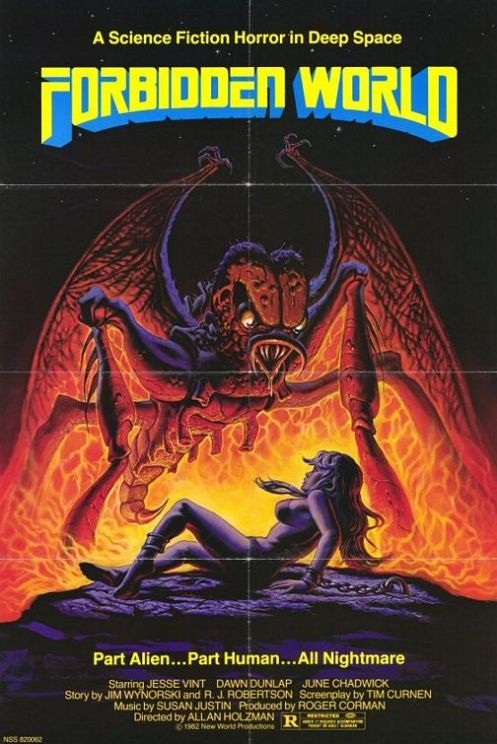
Forbidden World (1982): Did you know that decades before the current green revolution, producer Roger Corman was already invested in the practice of recycling?  Forbidden World consists of sloppy seconds from other then-current Corman productions, including Battle Beyond the Stars and Galaxy of Terror, unabashedly lifting shots and sets from both.  According to behind-the-scenes interviews, the filmmakers consciously set out to make a rip-off of Alien.  They succeeded, without the pesky annoyances of story, credible acting, coherence, or real scares.  The best I can say about it is it wasn’t boring.  Forbidden World is chock full of gratuitous violence and nudity, which isn’t necessarily a bad thing, mind you, if the rest of the movie is fun.  Even these elements are squandered, however, thanks to vapid, unlikable characters and scenes that seem voyeuristic rather than sexy.  Corman exploitation can be fun if viewed in the right light (notably Deathrace 2000, Piranha), but this one left me cold.  Stupid plot, stupid characters and terrible sets (think corridors made of empty cardboard egg cartons and Styrofoam fast-food burger packages) add up to one dismal experience.  Similar to Galaxy of Terror, the stories behind the scenes are much more compelling, so if you rent it, be sure to check out the “making of” documentaries.  You’ve been warned!  Rating: **.  Available on DVD and Blu-Ray.


Dark Night of the Scarecrow (1981): Here’s an oddity -- a TV movie that manages to be genuinely suspenseful, atmospheric, and engaging.  The net has been buzzing about this recently rediscovered film, so I decided to take a look.  I wasn’t disappointed.  Larry Drake (Darkman) plays a mentally challenged man wrongfully accused of a brutal attack on a young girl.  Four friends capitalize on an opportunity to make him a scapegoat, and decide to take matters into their own hands, only to suffer the consequences of their actions. You’ll likely recognize some familiar faces in this production, especially Charles Durning (Tootsie, The Muppet Movie) in a role he was born to play – A creepy, sociopathic mailman with a dark secret who will stop at nothing to protect his secret.  It’s engaging stuff, definitely a cut above the usual sub-standard fare that passed for entertainment in the days before HBO and Showtime.  How they managed to get this one past the network programmers of the day is beyond me, but I’m glad they did.  Highly recommended!  Rating: ****. Available on DVD.


Monday, October 25, 2010

Bubba Ho-Tep


(2002) Written and Directed by Don Coscarelli; Based on a short story by Joe Lansdale; Starring: Bruce Campbell, Ossie Davis, Ella Joyce, Reggie Bannister; Available formats: DVD                      

Rating: ****

Elvis and JFK team up to defend their present-day East Texas rest home from a soul-stealing Egyptian mummy.  Huh?  Don Coscarelli (Phantasm, Beastmaster) takes this twisted premise, courtesy of writer-extraordinaire Joe Lansdale, and runs with it, creating a movie that defies easy categorization.  It’s a horror movie that’s also a comedy, which just happens to be a drama about old age.  It’s three, count ‘em, three treats in one!   Similar to Trick ‘R Treat (reviewed previously), Bubba Ho-Tep was barely released theatrically, but has gained a cult following on home video.  Unlike Trick ‘R Treat, however, it was easy to see what a challenge the film company had trying to market this movie to a jaded 18-to-34 demographic used to youthful protagonists and frenetically paced action scenes.  From the beginning, it was clear that this was never going to be blockbuster material.

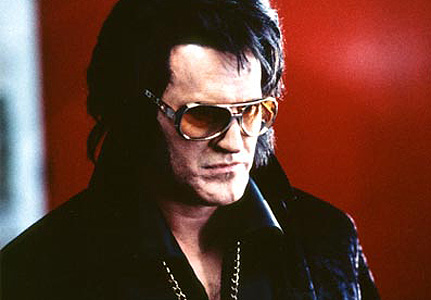
Bruce Campbell (The Evil Dead films, among many) plays the role of a lifetime as an elderly Elvis Presley, spending his golden years in a dingy East Texas rest home.  But Elvis died in 1977, right?  Wrong.  You see, years ago, Elvis tired of the trappings of success, and decided to switch places with an Elvis impersonator, Richard Haff.  Unfortunately, as the result of an unfortunate trailer park accident, his contract with Haff burned up, so there was no way to substantiate his claims.  It was Haff who died in Graceland in 1977, leaving the real Elvis Presley to continue on as an impersonator, until he suffered an accident that led to a broken hip, and eventually into a rest home. 


The late Ossie Davis (Do The Right Thing) plays John F. Kennedy – yes, you read that right.  It turns out, if his story is to be believed, that he did not actually perish in the assassination attempt in Dallas in 1963, and that he isn’t truly African-American, but his skin was “dyed” this color to keep him out of the way.  You’re never certain if it’s an act, delusion, or the real thing.  Even Elvis seems skeptical, but he goes along with the story anyway.  They form an uneasy alliance to fight an Egyptian mummy who has turned up in East Texas, due to another bizarre turn of events.


The idea of an aging Elvis could have been simply played for laughs in the hands of less skilled filmmakers, but Campbell manages to pull off a performance that’s funny and surprisingly touching at times. You feel genuine pathos for his present condition, as he reflects on his changed life and withered body.  In true Lansdale fashion, there’s an inordinate amount of emphasis on the current state of his male member, but it’s a potent (pun intended) metaphor for everything else that’s gone wrong in his life.  Elvis reflects on his past as someone who once had it all in terms of money and fame, and is now looking back, wondering where it all went, and what the value of it was in the first place. 

Coscarelli does a great job of capturing Lansdale’s signature style, employing liberal applications of scatological humor to mask the main characters’ physical and mental pain.  The locker room humor is only a façade for deeper issues that lie underneath.  While you are laughing at the situations and Elvis’ deadpan narration, this does not serve to denigrate his character, but makes him seem more human.  The script navigates a fine balance of illustrating the inherent absurdity of Elvis and JFK’s dilemma while never patronizing them.  They function in the story as human beings rather than simple comic foils.

One of the overarching themes of Bubba Ho-Tep is how elderly members of our society are often marginalized and forgotten.  Early in the film, we watch as the daughter of a recently deceased rest home resident rummages through her father’s few remaining possessions, discarding anything that doesn’t appear to have any monetary value.  The residents of the rest home are little more than feeble children to be tolerated by the listless, dismissive staff -- society’s burden left to die.  No one seems to have much use for them anymore, and the residents have little use for life.  Elvis and JFK capitalize on their dire circumstances to do something worthwhile one last time.

Unbeknownst to the rest home’s residents and oblivious staff, a recently re-animated Egyptian mummy has begun his nocturnal rampage, feeding on the souls of the weak and elderly.  The method by which the mummy obtains and subsequently disposes of these fresh souls can only be described as Lansdalian.  Elvis and JFK realize that the mummy will not stop unless someone takes a stand to prevent their fellow seniors from providing an endless supply of souls for the mummy.  They covertly devise a plan to defeat the undead threat, and in the face of danger, both protagonists discover a renewed sense of vitality.  


As a sort of back-handed compliment, some reviews have emphasized how Bubba Ho-Tep differs from “conventional” horror films, warning those who are looking for quick scares or tons of gore to stay away.  I tend to think that most people who seek out this film know what they’re getting into, and if they don’t they might be in for a pleasant surprise.  Bubba Ho-Tep is certainly unconventional, but it rewards viewers with a funny, creepy, and surprisingly thoughtful movie that puts a new spin on the whole Elvis Presley/JFK mythos.  Don’t expect anything, just watch.