Sunday, March 23, 2014

Classics Revisited: Creature from the Black Lagoon


(1954) Directed by Jack Arnold; Written by Harry Essex and Arthur Ross; Starring: Richard Carlson, Julia Adams, Richard Denning, Whit Bissell and Nestor Paiva; Available on Blu-ray and DVD

Rating: ****

“The creature was violent because he’s provoked into violence.  Inherent in the character is the statement: we all have violence within, and if provoked are capable of any bizarre retaliation.  If left alone and understood, that’s when we overcome the primal urges that we’re all cursed with.” – Jack Arnold (excerpt from Tom Weaver’s DVD commentary)


Ever since my blog’s inception, I intended to review Creature from the Black Lagoon, but life and other projects had a way of intervening. The title creature was one of my primary influences, and could just as easily have been my avatar (I briefly considered Robby the Robot as well), before I decided upon Peter Lorre as my official mascot.  Although I’m just getting around to discussing the creature (or “gill man”) now, his importance in monster movie history can’t be denied.  Better late than never, I finally pay my respects to the last great classic Universal monster.


Creature from the Black Lagoon* was originally filmed and projected in 3D.  While the 2D images from my Blu-ray** copy (the disc includes 2D and 3D versions) look stunning, it’s one of the few times I wished I had a 3D TV to appreciate the movie as the filmmakers originally intended.  At one time, the filmmakers planned to shoot this in color, but the crisp black and white cinematography adds a layer of mystery to the movie.  Also, despite being separated from its Universal horror brethren by two decades, the absence of color helps it fit in with its predecessors more seamlessly.  Shot on two coasts (the above-water scenes were shot in the Universal Studios backlot in California, while the  underwater scenes, with a different cast, were shot in Florida) and edited together, the combined footage create the illusion that all the scenes originated from the same place. 

* The film went through a number of titles during development, including The Pisces Man and Black Lagoon.

** Nitpickers take note: the screen shots provided here are from the DVD, which was issued several years back.


The creature’s appearance is distinctly human, but different enough to give audiences the creeps.  Even by today’s standards, the suit effects hold up; a remarkable testament to practical effects.  Although no one would ever describe him as cute and cuddly, the creature remains sympathetic due to his identifiable human traits.  He just does what he does, existing in isolation, until humans encroach upon his environment.  The creature was brought to life, by Ricou Browning in the underwater scenes and Ben Chapman in above water scenes.  According to film historian Tom Weaver’s commentary, while Bud Westmore is credited for the creature’s distinctive design, in reality he had little, if anything, to do with it.  Instead, the creature’s form, which went through several iterations, was the result of many skilled individuals on Westmore’s team, including the initial design work by Milicent Patrick, and head sculpture by Chris Mueller.    


The film features a terrific composite score by three (uncredited) composers, Hans J. Salter, Herman Stein, and a very young Henry Mancini.  Each handled different components of the movie, to set the tone, ranging from playful, to romantic, and horrific.  Stein contributed some of the more strident components, including the famous three-note gill man theme.


With all due respect to my blog’s mascot, this film concerns another form of mad love.  Early in the film, we witness a love triangle between the two male lead characters, David Reed (Richard Carlson) and Mark Williams (Richard Denning), his publicity seeking boss.  At the apex of the triangle is the fetching Julia Adams as their assistant, Kay Lawrence.  It doesn’t take a scholar in Freudian theory to decode the phallic imagery of Denning wielding a speargun throughout the picture.  To be fair, the ubiquitous presence of his speargun was likely a conscious effort by the filmmakers to exploit the 3D process, but added an unintended subtext to the scenes.  As a result of losing Kay to his subordinate, he takes out his aggression on the creature, fueled by his perceived impotence.  The creature becomes another participant in this love triangle (love square?), when he discovers Kay.  In a scene that would be echoed 21 years later in Jaws, we share in his voyeuristic pursuit, watching her frolic in the lagoon, unaware of the danger that lurks below.  Once he’s caught a glimpse of Kay, he’s determined to claim her for himself.  What he hopes to do with her is probably best left to our imagination.


Creature from the Black Lagoon spawned two inferior sequels: Revenge of the Creature and The Creature Walks Among Us, which continued the saga of the gill man but didn’t have the impact of the original.  Over the years, the idea of a remake has been thrown about, but nothing has amounted to much.  I’m not a big fan of remakes, but I was intrigued to learn about a proposed 3D remake by producer John Landis in 1982, which would have featured makeup effects by Rick Baker and Arnold at the helm once more.   The material still has potential with the right combination of cast and crew, but it will be difficult, nigh impossible, to top the original creature design.  60 years onward, Creature from the Black Lagoon still captivates and inspires.

Sunday, March 16, 2014

The Hound of the Baskervilles


(1959) Directed by Terence Fisher; Written by: Peter Bryan; Based on the Novel by Sir Arthur Conan Doyle; Starring: Peter Cushing, André Morell, Christopher Lee, Marla Landi and Francis De Wolff.  Available on DVD.

Rating: *** ½

“I don’t know how he did it, short of being a juggler, but he seemed to be able to have 10 to 18 things in the air at the same time… I used to despair.  I used to say to him, ‘Do you really have to do all that?’” – Christopher Lee (on co-star Peter Cushing’s performance, from Actor’s Notebook: Christopher Lee)


When the incomparable Fritzi of Movies Silently announced her Sleuthathon, there was no question I wanted to discuss Hammer Films’ production of the Sherlock Holmes story, The Hound of the Baskervilles.  So, what’s a Sherlock Holmes flick doing smack in the middle of Monster March, you might ask?  I might answer, “It’s my own damn blog.  I can do whatever I want,” or something similar, but that would be rude, and you’d be justified in looking elsewhere for your movie blog fix.  The truth is, the mystery surrounding an old curse and a demon dog that haunts the moors, along with the Hammer pedigree seemed adequate justification.  Heck, who am I foolin’?  Anytime I get an excuse to review another Hammer film, I’m there!  Okay, meandering intros aside, let’s get to the movie…


The Hound of the Baskervilles represents Hammer’s sole Sherlock Holmes outing, with Peter Cushing as the persnickety sleuth and André Morell as his loyal friend/colleague Dr. Watson.  Co-star Christopher Lee takes a break from his villainous roles as Sir Henry Baskerville, heir to the Baskerville fortune and next in line to fall victim to the eponymous hound.  In the prologue, set in the mid-18th century, we witness the contemptible behavior of wealthy landowner Sir Hugo Baskerville (David Oxley), as he tortures a servant and murders his daughter, and ultimately meets his untimely (but not unwarranted) end.  This sets the stage for a family curse about a hound of hell that roams the moors, looking to claim the next Baskerville.  When the current owner of the Baskerville estate, Sir Charles, is found dead, his friend Dr. Richard Mortimer (Francis De Wolff) calls upon Sherlock Holmes for assistance to prevent the death of Sir Charles’ heir, Sir Henry (Christopher Lee).


Cushing’s mannered, erudite performance suggests a mastermind who is always in control of a situation, meticulously planning each move in advance, like a grand chess match.  While his methodology might appear rash to the uninitiated, there is a method to his apparent madness.  He values facts and logic above all else (“There’s nothing unusual about using one’s eyes.”), paying heed to the insignificant things that no one else would notice.  Morell presents a convincing portrayal as Watson, Holmes’ loyal sidekick, providing an everyman perspective for the audience to relate to.  Lee is the antithesis of Holmes as Sir Henry, who’s caught up in the machinations of a plot he’s unable to control.  Holmes rational, composed demeanor in the face of adversity is illustrated by Sir Henry’s confrontation with a giant spider.*  

* According to Lee, “A lot of people have complimented me on the amazing performance I gave in that scene, and it wasn’t a performance at all.  It was totally real.  It’s a real spider.  It really happened, and I was appalled.” (from Actor’s Notebook: Christopher Lee)


Although this is partially due to the source material, The Hound of the Baskervilles drags in the middle.  Holmes is in the introductory sequence, and disappears for most of the first half (a purposeful omission by Sir Arthur Conan Doyle).  In an unusual turn, Watson is left to begin the investigation.  Also, it’s a bit curious that Hammer chose to begin with The Hound of the Baskervilles, since this story was not among the first of the Holmes adventures.  On the other hand, it’s not too surprising to surmise why executive producer Michael Carreras chose this to be the first film, considering the subject matter, and banking on the horrific elements to tie in with Hammer’s growing reputation for horror.  The excellent performances and impeccable production design, however, offset most of the film’s deficits (including the title canine’s eventual, disappointing appearance).


While Hammer’s version of The Hound of the Baskervilles is perhaps not the finest example of Sherlock Holmes committed to celluloid, it’s a respectable effort, which deserved better than the middling reviews and tepid audience response of the time.  It’s easy to imagine this film to have been the first of a series of Hammer Sherlock Holmes films, which had the potential of rivaling the production company’s other long-running Dracula, Frankenstein and Mummy series. Instead, we have this solitary, albeit flawed example of what could have been.  Both Cushing and Lee would go on to portray the famous sleuth in other productions, including one by director Fisher (the German production of Sherlock Holmes and the Deadly Necklace), suggesting their natural affinity for their role.  More than half a century later, subsequent productions of The Hound of the Baskervilles prove Doyle’s creation lends itself to multiple interpretations.

Tuesday, March 11, 2014

The Once Over Twice: Fido


(2006) Directed by Andrew Currie; Written by Andrew Currie, Robert Chomiak and Dennis Heaton; Starring: K’Sun Ray, Billy Connolly, Carrie-Anne Moss, Dylan Baker and Henry Czerny; Available on DVD.

Rating: ****

“I know when you’re a kid, you feel things.  A lot of…things.  But you have to get over that.” – Bill Robinson (Dylan Baker)


Don’t get me wrong.  I love zombie movies, but even the most die-hard enthusiast of the genre would probably concede the market’s become oversaturated over the past decade.  With this in mind, it’s easy to get jaded by (ho-hum), yet another zombie flick, but Fido brings something new to the mix.  While it won’t win any awards for gore, or the most carnage-filled scenes, it’s aiming for something a little more insidious.  Director/co-writer Andrew Currie’s film is a clever satire, viewed through the lens of 1950s Americana.  Under the guise of a simple, heartwarming tale of a boy and his zombie, Currie and co-writers Robert Chomiak and Dennis Heaton (who is also credited with the original story), skewer social conservatism, unswerving fealty to authority, and sexism. 


In the black-and-white prologue, presented in the style of a vintage school film, we’re brought up to speed about the alternate-reality 1950s depicted in the film.  After a space-borne pathogen caused the dead to rise, the nations of Earth banded together to prevent a worldwide zombie apocalypse.  Thanks to special collars (which have an unfortunate tendency to malfunction) developed by the omnipresent Zomcon, the zombies’ desire for human flesh has been suppressed.  Relegated to a sort of socially acceptable slavery, the zombies are used to perform menial tasks.  Owning one, or several, has become a status symbol.


Elementary school student Timmy Robinson (K’Sun Ray, aka: Kesun Loder) isn’t so sure about this new paradigm.  He’s the only one in his school who seems to question anything, not the least of which is: are the zombies alive or dead?  Timmy’s mother Helen (Carrie-Anne Moss) maintains a picture-perfect home in the suburbs for his oblivious,* emotionally distant father Bill (Dylan Baker), who’s obsessed with arranging funerals for his family, and golfing with his buddies.  Their life is thrown into turmoil when Helen, in her attempt to keep up with the neighbors, brings home a zombie servant.  Zombie-phobic Bill is less than enthused about the new arrangement.

* Moss’ real-life pregnancy was written into the story, which only helps underscore Bill’s refusal to notice anything that occurs around him.  When she finally reveals her condition to him, the only thing he can think to say is, “I just don’t think on my salary I can afford another funeral.”


The family zombie, whom Timmy names Fido, is played by Scottish comedian Billy Connolly (in a brilliant comic performance analogous to Peter Boyle in Young Frankenstein).  Instead of dialogue, he relies on body language, groans and facial contortions to get his point across.  One of the film’s ironies is that Fido pays more attention to Helen and Timmy, and displays more genuine emotion.  In one key scene, when Bill can’t be bothered to dance with Helen, Fido assumes his place as her partner.  In another scene, reminiscent of Lassie, Fido runs for help when Timmy is in danger.


Currie extends the zombie metaphor in various ways.  In the Technicolor 50s apple pie society of Fido, it’s more important to be concerned about what others think and maintaining conformity above all else, than being an individual.  Humans prevailed over the undead, but not without a cost.  Amidst the idyllic setting, a cold war is raging.  Society must remain ever-vigilant for the next batch of zombies, with citizens patrolling the streets.*   In exchange for our new-found creature comforts, we’ve given up our freedom.  The only cost is our identity.  There’s little difference between the cold husbands, dutiful wives and their undead counterparts.  The new norm is a death-obsessed society, living in fear, exemplified by Bill and the authoritarian Zomcon representative Mr. Bottoms (Henry Czerny).  Instead of cowboys and Indians, Timmy’s bed sheets and curtains are decorated with soldiers and zombies. 

* Currie modeled the Zombie Scouts after a combination of boy scouts and Hitler youth.


Fido strikes just the right comic tone, while retaining the integrity of the zombie films that precede it.  The filmmakers insert liberal doses of social commentary, but keep it from getting heavy handed by subverting the darker elements under a kitschy luster.  Like a clean shot to the brain, the film’s themes hit the intended target.  If you can forgive my pun, Fido proves the zombie genre still has a lot of life left in it.

Tuesday, March 4, 2014

Classics Revisited: Alien


(1979) Directed by Ridley Scott; Written by Dan O'Bannon; Starring: Tom Skerritt, Sigourney Weaver, Veronica Cartwright, Harry Dean Stanton, John Hurt, Ian Holm and Yaphet Kotto;

Available on Blu-ray and DVD

Rating: *****

“…Giger’s designs were an especially unique experience for the audience.  The world had simply never seen anything like that before.” – Ridley Scott (from his introduction to H.R. Giger’s Film Design)


When I decided to devote an entire month to monster movies, I knew there was only one choice* to kick things off.  It’s impossible to gauge what a profound impact Alien had on the science fiction landscape and unsuspecting audiences when it was unleashed in 1979.  Although some families would have questioned the logic of my brother, nine years my senior, taking his impressionable pre-teen younger brother to a matinee of the film, I’m eternally grateful for the experience, even though it resulted in a few restless nights, sitting up in bed and wondering what was lurking in the dark.  35 years after its introduction to my consciousness (and unconscious), it forever shaped my cinematic tastes and penchant for exploring the darker recesses of the human psyche.  I witnessed the literal and figurative birth of a creature so unlike anything that preceded it, that most attempts to copy or improve on the elegance of the original design have fallen flat. 

*Okay, maybe I considered a couple others, but let’s not quibble over technicalities.


Director Ridley Scott described his science fiction/horror hybrid as “Ten Little Indians in The Old Dark House.”  While this might be oversimplifying the film a bit, it’s essentially a space-bound haunted house story, in which a mostly unseen assailant picks off the residents one by one.  According to Scott, he was fifth in line to direct the film.  Coming from the world of advertising, he was an unknown quantity, having directed only one other feature film to date (The Duellists).  We’re fortunate he got the chance to prove himself with Alien, establishing his flair for atmosphere.  Although some might accuse him of favoring style over substance, in Scott’s case, the style becomes the substance. 


The story focuses on the crew of the space tug Nostromo, en route to Earth, as they are awakened from hibernation to investigate a signal from an alien planet.  You don’t have to be familiar with the film to guess that nothing good can come from discovering the source of the signal.  Once they arrive on the foreboding otherworldly landscape, their fate is sealed.  Scott employed the conflicting styles of Ron Cobb and H.R. Giger to visualize the human and alien worlds.  Giger’s surrealist sensibilities were perfect for creating the ancient derelict alien spacecraft and its cargo, while Cobb designed the spaceship Nostromo, and its remarkable “lived in” interiors and cramped corridors.  Their contradictory styles worked well for the film, representing the known versus the unknown.

* Cobb and screenwriter Dan O’Bannon worked together on John Carpenter’s debut effort, Dark Star, which could be regarded as a dress rehearsal for their work on Alien


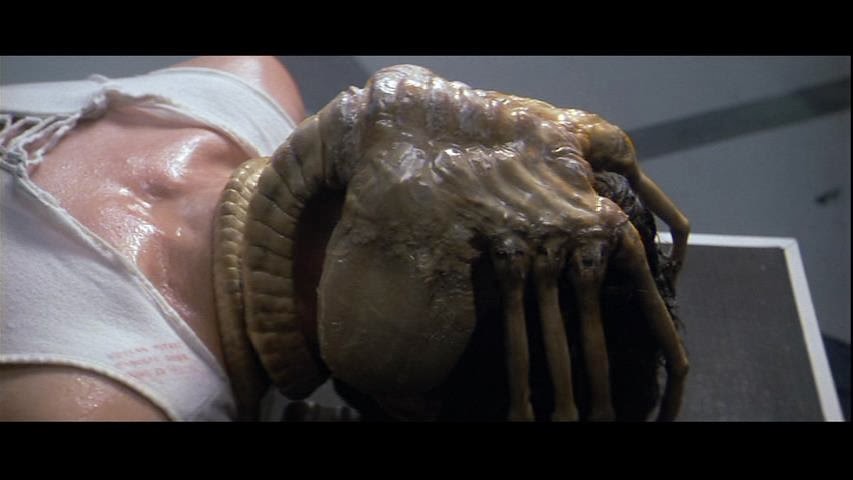
Much of Alien’s enduring impact can be ascribed to the beautiful and disturbing art designs of Swiss artist Giger.  Viewing a work by Giger does anything but invite apathy, with its jarring themes and Freudian imagery.  Alien remains the best realization of his art on film.  His obsession with biomechanics, the melding of organic with the inorganic, was a perfect launching point for the title creature (based on his Necronom IV and V paintings), with its phallic head and tongue laden with teeth.  Likewise, the derelict spacecraft is rife with yonic* imagery, with its rounded entrances and damp, curved interiors.  As a kid, I didn’t fully comprehend what I was looking at, but in some subliminal way I felt its influence creep into my brain.  One of the film’s most stunning images is the “space jockey,” an enormous extraterrestrial pilot fossilized in its chair, with a hole in its chest, and ribs bent outward.  We never find out where it came from, or how long it was sitting there.  Like the monolith in 2001: A Space Odyssey, it’s an enigma; one of the most tantalizing mysteries in modern science fiction cinema.**  Each stage of the creature’s reproductive cycle represents some terrible, violative process: the crab-like facehugger that emerges from a leathery egg and the parasitic chestburster are mimicry of birth.  The creature’s final, part-insectile/part-reptilian stage is a bastardization of the human form.

* The female equivalent of “phallic.” (Yeah, I Googled it.)

** Scott toyed with the mythos that was established in Alien, with his semi-prequel Prometheus, which unwisely attempts to provide explanations. 


For all its innovation, Alien employed some decidedly low-tech effects as well, including Scott’s hands in surgical gloves inside the alien egg to simulate the movement of the facehugger, along with sheep and cow offal to simulate the inner workings of the egg.  The appearance of the final creature was achieved through a combination of animatronics courtesy of Carlo Rambaldi,* and a man in a suit (the seven-foot, two-inch tall Bolaji Badejo).  With his “the less you see the better” approach, Scott took pains not to reveal too much, to avoid the creature appearing as simply a person in a costume.    

* I’ve always been amused by the fact that Rambaldi was also responsible for the benevolent aliens in Close Encounters of the Third Kind and E.T.: The Extraterrestrial.


Continuing a theme, which O’Bannon explored half a decade before with Dark Star, Alien presents the antithesis of the sterile environments favored by many of the space-themed films that preceded it.   The Nostromo crew members are not an elite group of space explorers, but a team of working class stiffs, collecting a paycheck for their exploits, as exemplified by Yaphet Kotto and Harry Dean Stanton as crusty ship mechanics Parker and Brett.  Alien also represented a departure from many earlier science fiction films with its introduction of a new kind of heroine, Ripley (Sigourney Weaver).  She’s more than a match for her shipmates, remaining rational and pragmatic in the face of chaos.  Instead of waiting to be saved, Ripley must take charge of the situation to confront the monster head-on, while standing at odds with Captain Dallas (Tom Skerritt) and a science officer (Ian Holm) who’s as cold and unfathomable as the alien creature.


Alien works on many levels with its explicit and implicit psychological themes, and Lovecraftian overtones about an ancient evil with an order of intelligence we could scarcely understand.  It gnaws at our collective psyche like a shared nightmare we can’t escape.  30+ years after the creature’s debut, the film series shows no sign of stopping, inspiring a host of rip-offs in the 80s, James Cameron’s separate-but-equal follow-up, Aliens, and two other sequels (the less said, the better), the abysmal Alien vs. Predator crossover flicks, and the misguided prequel, Prometheus.  None of these incarnations can dilute the impact of the original film, however, with its introduction of a creature that never fails to send shivers down my spine.