Showing posts with label Space. Show all posts

Saturday, May 28, 2022

Battle Beyond the Stars

Battle Beyond the Stars Poster

(1980) Directed by Jimmy T. Murakami; Written by John Sayles; Story by Anne Dyer; Starring: Richard Thomas, Darlanne Fluegel, John Saxon, Robert Vaughn, George Peppard, Sybil Danning, Sam Jaffe and Morgan Woodward; Available on Blu-ray and DVD 

Rating: ***½ 

This post is part of the Corman-verse Blogathon, hosted by Yours Truly and Gill Jacob from Realweegiemidget Reviews. Be sure to check out all the terrific posts from an esteemed bunch of participants!

Sador's Ship Arrives on Akir

“It not only got very good reviews but it was commercially successful in the United States and overseas, and I think to a large extent it was the characters, it was the differentiation, the individuality.” – Roger Corman (from DVD commentary with John Sayles)

“It was a playground, and Roger let us experiment.” – Alex Hajdu, Assistant Art Director (from “Shoestring Space Opera”)

A long time ago in a galaxy, far – hold the phone. Let’s back up a moment… A long time ago, in a land not too far away, Roger Corman assembled a group of unknown but talented young professionals to create a space opera on his own terms. Screenwriter /Corman-protégé John Sayles drew from the same well as Star Wars, particularly Seven Samurai (1954), as its inspiration, but The Wizard of Oz (1939) provided another template. Budgeted at $2 million (a paltry sum by Hollywood standards), Battle Beyond the Stars was Corman’s most expensive production to date. Penny-pinching Corman made sure he got a return on his investment, however, repurposing many elements in the film in other New World productions (obviously he was into recycling, long before it was in vogue). The informative Blu-ray commentary by producer Corman and writer Sayles is like a mini film school, providing us a lesson in low budget movie making.

Friendly Ships Assemble

Corman hired Jimmy T. Murakami* (who was looking to break into directing live-action features) to helm the picture. For the most part, Corman stayed out of the way, although he reportedly directed one scene, featuring many of the principal characters together. Although it took several months to get all the pieces in place, Battle Beyond the Stars was shot during a brisk five-week shooting schedule, using a converted lumberyard in Santa Monica, California for the studio. New sets were constructed as quickly as they were torn down, which required filming some scenes when the paint was still wet.  

* Fun Fact #1: The Japanese/American animator is probably best known for directing the famous 1969 Tootsie Roll Pop commercial (originally known as “Mr. Cow”), featuring an owl that attempts to answer the age-old question, “How many licks does it take to get to the center of a Tootsie Roll Pop?” Over half a century later, it still appears on TV from time to time, albeit in truncated form.

Akir

The list of behind-the-scenes crew members reads like a who’s who of Hollywood filmmakers. 20-something James Cameron, who was promoted to art director on the production, provided the intricately detailed models (according to Corman, Cameron could describe the purpose of every bump and nook on his spacecraft). His team included effects maestros Dennis and Robert Skotak, as well as Alec Gillis. Corman’s assistant production manager, Gale Anne Hurd went on to a hugely successful producing career. Young James Horner provided the score, and an uncredited Bill Paxton worked on set construction. It’s interesting to note that all of these individuals worked with Cameron in subsequent films.

Shad's Ship

Sayles wanted the ships to look distinct, so you could distinguish which character piloted them. Thanks to Cameron and his team, each space vehicle delivers on that requirement. According to Dennis Skotak (responsible for miniature design and construction, along with his brother Robert), each ship reflected the personality of the characters. He wanted a different look, compared to Star Wars, where he felt that “everything came from the same factory.” As anyone accustomed to New World’s stable of genre films can attest, many of the space battle scenes look awfully familiar, re-purposing models and effects footage.

Sador

The story opens on a familiar note, with the despotic Sador* (played with relish by John Saxon) delivering an ultimatum to the meek inhabitants of the planet Akir (an obvious nod to filmmaker Akira Kurosawa): join him or die. Sador (with a name like that, you just know he’s up to no good), ravages one civilization after another, reducing them to cinders with his interstellar convertor (basically a Death Star clone). He doesn’t want to raid their crops or take their food; true to his control-freak nature, he only wants to dominate them. Sure, it’s the sort of role that Saxon could probably do in his sleep, but he appears to be having a blast playing a tyrant, so who’s complaining? Why Sador chooses to go away (leaving a couple of incompetent stooges to guard the planet), so the Akir denizens have time to enlist a private army against him, we’ll never know. Shad (Richard Thomas) sets off in his curvy space ship (uh huh, it has boobs), along with sassy computer “Nell” (Lynn Carlin), in a desperate search for individuals* who will fight. 

* Fun Fact #2: Sayles wanted the seven mercenaries Shad enlists to be from different species. Part of the script-writing process involved thinking about the various cultures and philosophies of the various alien races.

Cowboy Meets Shad

Among the first off-worlders Shad encounters is Nanelia (Darlanne Fluegel). Bored with her life on a space station, with only her cyborg father Dr. Hephaestus (Sam Jaffe) and androids for companions, she’s eager to join him in his quest. Next in his encounters, is the affable Cowboy (George Peppard). His laid-back persona belies his willingness to fight in a pinch. (A Confederate flag on his spaceship is a bit over the top, though, even for this movie – the less said, the better). Of course, he’s empowered by a helping or two of liquid courage, with a handy belt-mounted gizmo that dispenses booze and ice (because whiskey flasks are so 20th century). Nanelia convinces the lizard-like Cayman (Morgan Woodward) to join the fight. He has an axe to grind against Sador, who wiped out his species, making the enemy of his enemy his friend.

Gelt

The most enigmatic mercenary is Robert Vaughn as Gelt (the Yiddish word for “money”), a reprisal of sorts, of his role from the Seven Samurai remake The Magnificent Seven (1960). He laments that he has amassed a vast fortune, but has nowhere to spend it, so the prospect of a decent meal and place to sleep without watching his back seems inviting to him. In a movie full of black-and-white characters, he provides a healthy dose of ambiguity. As a gun for hire who works for the highest bidder, it’s implied that he’s worked for both sides of the fence.

Nanelia and St. Exmin

St. Exmin (played by Sybil Danning, who’s known her way around several Corman films) belongs to a warlike race known as the Valkyrie. For her people, the thrill is in the fight. Her creed is to “live fast, fight well, and have a beautiful ending.” (a riff on John Derek’s famous quote from 1949’s Knock on Any Door, “Live fast, die young, and have a good-looking corpse.”).* St. Exmin’s eye-catching, gravity-defying costume** undoubtedly fueled many adolescent-male fantasies back in the day. Danning proves to be more than just eye candy, providing a spunky presence. While initially being an annoyance to Shad, she proves her worth in battle.*** 

* Fun Fact #3: According to Sayles, he based her character on the Native American Dog Soldiers, who found honor in death. 

** Fun Fact #4: It should come as no surprise to anyone that the costumers had a difficult time keeping Danning’s (ahem) assets contained. According to co-star Thomas, her costume was prone to quite a few wardrobe malfunctions. 

*** Fun Fact #5: Look for an oops(!) just before the hour-and-25-minute mark, inside St. Exmin’s ship. In the left corner of the frame, behind her seat, you can spot a member of the film crew crouching down.

Nestor

Among the most unique species Shad encounters is Nestor, a collective intelligence comprised of multiple humanoid forms. Each body is a cell in a much larger organism, experiencing everything that each unit senses. Nestor’s deadpan sense of humor is a nice little touch. When one samples a hot dog that Cowboy is preparing, he (or more accurately, his spokesman) comments, “There’s no dog in this.” 

* Fun Fact #6: If one of the Nestor (Nestors?) looks familiar, he’s played by prolific character actor Earl Boen, best known as the sleepy criminal psychologist in the first three Terminator movies.

Help Arrives on Akir

James Horner’s marvelous, sweeping music score (one of his earliest) fits the subject matter perfectly. Think of this as his prototypical blockbuster score, which takes the film to a different level. Many elements and cues are recognizable in subsequent movies. The score elevates the visuals, to the point where any deficits are scarcely noticed. Ever-cost-conscious Corman, recognizing the value of what he heard, re-purposed the soundtrack for other New World trailers, and for at least one film, 1985’s Barbarian Queen, virtually recycled the entire score (Alas, Horner’s composition could only do so much for substandard material).

Onboard Caymen's Ship

Corman and crew could only do so much with the budgetary restrictions, resulting in some obvious cost-cutting measures. The effects team avoided depictions of the ships landing and taking off, which would have required pricey effects. The camera people refrained from panning, which would reveal the size limitations of the sets (with one notable exception – the expansive control deck of Sador’s ship required an entire sound stage). Much like the original Star Trek series, the little community on Akir represents the entire planet’s civilization, thus requiring a healthy suspension of disbelief. In a scene depicting a ground battle with Sador’s army, the antagonists are conveniently channeled through one subterranean corridor so they can be ambushed.

The Night Before the Battle

Corman makes no apologies about jumping on the Star Wars train with his little space epic that could, Battle Beyond the Stars. The difference, however, is in the details, especially Sayles’ witty script, which never takes itself too seriously. Horner’s score and Cameron’s effects work also go a long way to make the most of things. It’s a popcorn movie, not in the derogatory sense, but in the best possible way. This isn’t meant to be a cerebral exercise like Solaris or 2001: A Space Odyssey. It’s fun over substance, told in broad strokes, and sometimes that’s all you need.   


Sources: Shout Factory Blu-ray commentary by Roger Corman and John Sayles; “His Name was Shad,” 2011 interview with Richard Thomas; “Shoestring Space Opera,” 2011 featurette; How I Made a Hundred Movies in Hollywood and Never Lost a Dime, by Roger Corman, with Jim Jerome; “How They Painted Samurai Jack Plus: the secret history of the Tootsie Pop commercial (and global animation news),” Animation Obsessive, Nov. 7, 2021 


Sunday, May 22, 2022

The Right Stuff


The Right Stuff Poster

(1983) Written and directed by Philip Kaufman; Based on the book The Right Stuff by Tom Wolfe; Starring: Sam Shepard, Scott Glenn, Ed Harris, Barbara Hershey, Dennis Quaid, Fred Ward, Veronica Cartwright, Lance Henriksen, Harry Shearer and Jeff Goldblum; Available on Blu-ray and DVD

Rating: *****

“I wanted to make a film about – where the main character was something called ‘The Right Stuff.’ It was a quality that was mysterious, that manifested itself in every scene of the film. It was sort of a spirit…” – Philip Kaufman (from 2020 interview at Cinémathèque – Paris)

First of all, a big thanks to Rebecca from Taking Up Room for hosting the Aviation in Film Blogathon, a celebration of flight and flicks. This week, I take a look at one of my unabashed favorites, The Right Stuff. While I don’t have an official top ten list of all-time favorite movies, if I did, this would certainly occupy a spot.

The Mercury 7 Astronauts

Writer/director Philip Kaufman handled the unenviable task of adapting Tom Wolfe’s captivating book (serialized in Rolling Stone magazine), which chronicled the story of the original Mercury 7 astronauts, along with the test pilots who crawled so they could run. Kaufman keeps many threads running throughout his film, and does an admirable job of avoiding them getting tangled. Much more than a stuffy chain of events, The Right Stuff focuses on some of the many unique, colorful individuals who made space flight possible. Levon Helm’s folksy narration bookends the film, evoking images of the Old West, as it relates to the unexplored frontier of space.

Sputnik

Set amidst the backdrop of the Cold War, the U.S. and U.S.S.R. were engaged in a battle for supremacy of the skies: the Space Race. Despite America’s supposed technical superiority over Russia (One NASA engineer remarks, “Our Germans are better than their Germans.”), they lag behind the achievements of the Soviets, with Sputnik and Yuri Gagarin. The desperate urgency to catch up is encapsulated by a hilarious and horrifying montage of failed rocket tests. Considering the risks and rewards involved, the freshly minted astronaut program required a new type of person.

Chuck Yeager in the X-1

Two parallel stories run throughout the film – It’s as much about test pilot Chuck Yeager (expertly portrayed by actor/playwright Sam Shepard)*/** as it is about the Mercury 7 astronauts. Kaufman’s wife reportedly spotted Shepard in a bar, and insisting that he was perfect for the role. While Shepard was reluctant to play Yeager at first, Kaufman persisted in pursuing him until he eventually settled into the role. In retrospect, Shepard was the ideal choice. Yeager anchors the film, with his “can do” attitude and no-nonsense approach. Yeager’s laid-back, fearless persona belies the nature of his extremely hazardous profession, typified by a high pilot mortality rate (The ominous presence of a minister, played by Royal Dano, looms like a harbinger of death throughout the film). The film begins in 1947, when Yeager breaks the sound barrier in his rocket-powered Bell X-1, nicknamed “Glamorous Glennis,” after his wife (played by Barbara Hershey). While he paved the way for the astronauts, he wasn’t considered a suitable candidate, because he didn’t fit NASA’s profile, which required a college degree. Instead, he carries on as he always had, stretching the capabilities of experimental aircraft. In a climactic scene, pursuing the elusive world altitude record in a souped-up F-104 Starfighter, he briefly reaches the edge of space, before hurtling down in an uncontrolled spin. At once, the scene signifies his determination to push the boundaries, as well as a reminder that for him, space remains just out of reach.   

* Fun Fact #1: The real Chuck Yeager served as a technical consultant, and appeared in the film as a bartender at Pancho’s, a favorite hangout for test pilots at Edward’s Air Force Base. 

* Fun Fact #2: According to Kaufman, Yeager and Shepard didn’t initially hit it off (Yeager reportedly told the director, “This guy ain’t me.”), but eventually became friends during the production. On the other hand, Yeager took an instant shine to Barbara Hershey, who portrayed his wife, Glennis, referring to her by character’s name. 

** Fun Fact #3: Beeman’s Gum is featured prominently in the film, as Yeager reportedly chewed a stick during each flight. Besides being a favorite of pilots, the gum originally contained pepsin, which allegedly calmed the stomach.


John Glenn on TV

Before they ever flew into space, the Mercury 7 astronauts already enjoyed their celebrity status, to varying degrees. Scott Glenn portrays Alan Shepard who enjoys a good joke, but is nothing but serious when it comes to his profession. The late, great Fred Ward excels as gruff Virgil I. “Gus” Grissom, proving number two is the worst spot. After the fanfare and celebration following Shepard’s flight, Grissom’s ends in near disaster when the hatch on his capsule blows prematurely. Instead of a ticker tape parade or a meeting with the President, he’s treated to an inquiry by doubting NASA officials. Ed Harris’ charismatic interpretation of John Glenn* comes across as an overgrown yet amiable boy scout (part of Kaufman’s direction to Harris – smile more), giving us a hint of the astronaut who would become a politician. Gordon Cooper (Dennis Quaid) comes across as a cocky goofball, with a tendency to sleep when things are at their most tense. 

* Fun Fact #4: According to co-producer Robert Chartoff, “Ed Harris walked into the office, and we looked at him and couldn’t believe that such a person existed. He was not only a wonderful actor but looked so much like John Glenn. And of course we looked at each other and said, ‘Oh my God, this is the guy we want.’ I said to Phil (Kaufman), ‘Please, don’t let this guy get hit by a car. At least, not until after the picture is made.’” (Excerpt from Wired.com article)

Argument Between the Astronauts

In one key scene, the pressures of being in the public eye reach a boiling point as the astronauts argue with each other about their responsibility as role models, versus how they conduct their private lives. Shepard and Glenn almost come to blows over their difference of opinion, but just as things are about to get out of hand, they find a united cause. NASA wants to send a chimp up in space, and it becomes clear to the astronauts that they’re held in the same regard. It all comes to a head when they confront the arrogant NASA engineers, who view the astronauts as nothing more than an occupant in a remote-controlled vehicle of their design (“a redundant component”). As pilots, the astronauts scrutinize the prototype capsule with skepticism (windowless, with no hatch they can open from the inside, or control in the event of a system failure). It’s a clash between the hands-on, practical approach of the astronauts (“We want a window.”) and the arrogant, book-smart engineers (“This is the way it is.”).

The NASA Recruiters

Amidst the drama, there are so many terrific comic moments. Harry Shearer and Jeff Goldblum (who largely improvised their lines), appear as two bumbling government recruiters, who court test pilots for the hazardous job. After his launch is delayed for hours, and he’s bolted into his cockpit, Alan Shepard declares that he has to urinate. Unfortunately for Shepard, no one considered this contingency for a supposed 15-minute flight, which sparks a fierce debate between the engineers and astronauts about what peeing in his spacesuit might do to his spacecraft. In an earlier scene, also with Shepard, he’s confronted by a Latino orderly with the ramifications of using a racist impression during a particularly vulnerable moment.

Annie Glenn

Kaufman had such a monumental task balancing Yeager’s story, with the ensemble work of the seven astronauts that it’s inevitable some of the Mercury 7, notably Scott Carpenter (Charles Frank), Wally Schirra (Lance Henriksen), and Deke Slayton (Scott Paulin) are relegated more to the background (for more on these three, I suggest checking out Wolfe’s book). While Kaufman spends significantly less time on the wives of the astronauts, the actresses’ performances shine through, speaking to the wives’ strength and resolve in the face of uncertainty. Trudy Cooper (Pamela Reed) reaches her wit’s end, following her husband Gordon from base to base, and remaining forever in his shadow. John Glenn’s wife Annie (Mary Jo Deschanel) refuses to appear on national TV with Vice President Lyndon Johnson (Donald Moffat), due to a stutter (much to the indignation of Johnson). Veronica Cartwright (as Betty Grissom) shares one of the film’s most heart-wrenching scenes with Fred Ward, sharing their anguish and bitterness about their unfair treatment by NASA officials.

Chuck Yeager and the NF-104

So what exactly is “The Right Stuff?” It’s that indefinable quality to push the envelope,* and embrace a challenge rather than step away from it. Just because so-called experts said breaking the sound barrier couldn’t be done, didn’t mean that it was an impossible task for Yeager. It’s unwavering resolve under pressure when most individuals would give up – a reliance on wits and fearlessness. A common trait found among Yeager and the astronauts is that they’re all adrenaline junkies, driven to be the best and the fastest (Gordon Cooper asks his wife, “Who’s the best pilot you ever saw,” and subsequently answers his own question. “You’re looking at him.”) In an early scene, the NASA recruiters invite Scott Carpenter to consider joining their dangerous program, which prompts the response, “Count me in.” When John Glenn is informed that his Mercury spacecraft will be launched by the more powerful, albeit unpredictable Atlas rocket, he doesn’t hesitate to step up to the challenge.

* Not so Fun Fact: Unfortunately, during filming, Joseph Svec, a stuntman, was killed filming a parachute drop, when his chute failed to open. 


The X-1

The excellent performances are matched by the brilliance of the visuals, thanks to cinematographer Caleb Deschanel’s superb camerawork and effects supervised by Gary Gutierrez. The action sequences are kinetic and visceral, punctuated with moments of visual poetry. The sound barrier is imagined as a demon that lives in the sky. A deftly applied mixture of editing, effects and photography place us squarely in the cramped cockpit of the X-1 with Chuck Yeager. Sparks in the Australian outback are juxtaposed with mysterious “fireflies” that surround John Glenn’s capsule, Friendship 7. The most iconic shot of the film is a slow-motion sequence, depicting the Mercury 7 astronauts walking side-by-side in full gear, which has been copied and parodied in countless movies (think Monsters, Inc.).

Gordon Cooper

The Right Stuff achieves the virtually impossible task of de-mythologizing the original astronauts, as it preserves the mythos surrounding them. Although Kaufman juggles so many characters,* the end results appear almost effortless. The film features uniformly exceptional ensemble work by a talented cast of (then) mostly unknowns. Bill Conti’s soaring score equally plays a vital role, lends the right amount of gravitas to the visuals. Despite a runtime of nearly three-and-a-quarter hours, it never seems too slow or too long, but just right (at least to this reviewer). It’s one of the fastest three hours you’ll ever spend. In an age when manned rocket launches have become almost passé, and no longer hold the public’s attention the way they once did, it’s important to remember the bold few who paved the way for everyone who followed. The Right Stuff is so much more than a history lesson, it’s a testament to the human spirit, as well as a grand piece of entertainment. 

* Fun Fact #5: According to Kaufman, there were 134 speaking parts. 


Sources: “Punch a Hole in the Sky: An Oral History of TheRight Stuff,” by Alex French and Howie Kahn, Wired.com; Interview with Philip Kaufman at Cinémathèque – Paris, 2020 


Wednesday, September 30, 2020

Space Month Quick Picks and Pans


Aniara (2018) In the near(ish) future, Earth has suffered one ecological disaster after another, prompting a mass exodus to Mars. A massive luxury spaceship (with an interior that seems to have been designed by Ikea) ferrying a group of would-be colonists embarks on its three-week journey to Mars. Disaster strikes, however, when an emergency course correction results in a breach in the ship’s reactor, forcing the craft to dump its nuclear fuel to prevent another catastrophe. The change in direction sends the giant spacecraft hurtling in the wrong direction, without the means to turn around. The rest of the film follows the passengers and crew over the next several years, as they vacillate between hope and despair, attempting to comprehend their new reality on a voyage without end. This thoughtful Swedish science fiction film from writer/directors Pella Kågerman and Hugo Lilja is a darkly existential science fiction with a fatalistic streak (Director Claire Denis explored similar themes in High Life, released the same year). It’s thought-provoking stuff, but undeniably bleak. Warning: you might need a hug after watching this.

Rating: ****. Available on Blu-ray, DVD and Hulu

Cosmic Voyage (aka: Cosmic Journey) (1936) This fun silent Soviet film from director Vasily Zhuravlyov balances hard science with whimsical adventures. Set in the near future of 1946, a determined inventor (Sergey Komarov) plans a journey to Earth’s satellite in his giant rocket. Despite efforts from his detractors to derail the mission, he travels to the moon with his assistant (Ksenia Moskalenko) and an eager boy scout (or the Russian equivalent) in tow. They encounter weightlessness along the way, and explore the rocky lunar surface. Cosmic Voyage features some impressive visuals (including stop-motion animation to depict their lunar adventures), which rival the imagery in Things to Come (also from 1936). It’s a thoroughly charming excursion, which never takes itself too seriously. Good fun.  

Rating: ***½. Available on DVD and YouTube


Prospect (2018) Writer/directors Christopher Caldwell and Zeek Earl’s space western starts as a tale of survival and greed, but morphs into something more. Damon and Cee (Jay Duplass and Sophie Thatcher), a father and daughter prospector team, land on a forest moon, and must contend with toxic dust and hostile competitors, also looking to strike it rich. When he meets his untimely demise, Cee must survive on her own, forming an uneasy alliance with Ezra (Pedro Pascal of The Mandalorian fame) an enigmatic, soft-spoken prospector. Prospect does a lot on a small budget (reportedly in the neighborhood of $3 million), with good use of location shots (filmed in in Washington State’s Hoh rainforest) and some decent CGI (used sparingly). The performances, especially by Thatcher and Pascal, are uniformly solid. At its heart, it’s a simple tale that reminds us that people are not always who they seem to be, and companionship can come from the unlikeliest of places.

Rating: ***½. Available on Blu-ray, DVD, Hulu and Kanopy


In the Dust of the Stars (aka: Im Staub der Sterne) (1976) This groovy offering from East Germany’s DEFA Studios needs to be seen to be believed. Cosmonauts respond to a distress signal, but when they arrive on the planet TEM 4, their host denies anything’s wrong. He does his best to distract the puzzled space travelers (with funky, drug-filled parties and interpretive dancing) to hasten their departure, although one crewmember suspects their minds have been tampered with. This would be a great midnight movie candidate thanks to the plethora of weird hairstyles and bizarre costumes, some (ahem) interesting dance moves, and a cartoonishly evil leader (who looks like a dead ringer for Airplane’s Stephen Stucker). Pacing issues bog the movie down a bit, but it’s worth a look just to see how wacky movies could get behind the Iron Curtain.

Rating: ***. Available on DVD (Out of print) and Kanopy


Supernova (2000) This space obtusity suffers from an identity crisis. Is it an action thriller, a space-based romance, a brooding character study, or a cerebral science fiction tale? The infamously troubled production (director Walter Hill was fired, and credited as Thomas Lee) juggles all of these elements, but handles none of them well. A sociopathic survivor from a mining outpost brings a glowing whatsit that might be the end to humanity onboard a deep-space rescue ship. The movie never fully explores the ramifications of the alien artifact. Instead, it spends most of its time with a predictable cat and mouse plot and trying to make us believe that James Spader and Angela Bassett (both dependable actors) are attracted to each other. The lack of chemistry between the leads is just endemic of the rest of the cast and filmmakers, who just seem to be going through the motions.

Rating: **. Available on Blu-ray and DVD

Queen of Outer Space (1958) A rocket ship’s planned rendezvous with a space station is thwarted when the station is annihilated by a death ray. To avoid certain destruction, the crew (clad in costumes pilfered from Forbidden Planet) divert their rocket ship and crash land on Venus, where they encounter a civilization ruled by women. Based on the sexist attitudes and behavior of the astronauts, it’s easy to see why Venusian society shunned men. Inexplicably, many of the Venusians find them irresistible. There’s kitsch appeal, thanks to the goofy plot and the casting of Zsa Zsa Gabor as the leader of a revolt, but that only takes you so far. Technicolor and Cinemascope can’t save this one from being a groan-worth bore. You’re better off watching one of the many genuine genre classics from the era (take your pick).

Rating: **. Available on Blu-ray and DVD.


War Between the Planets (aka: Il Pianeta Errante) (1966) Catastrophes on Earth are linked to a rogue planet that’s flying through the solar system, creating a destructive “wind” in the vacuum of space (don’t break your brain trying to make sense of it). The insipid narration doesn’t do this movie any favors, and far too much celluloid is wasted on a dull love triangle with an uncharismatic lead, played by Giacomo Rossi Stuart (although his hair is quite a special effect). At virtually the last minute, when a team of astronauts attempt to destroy the alien planet, they discover that it’s a vast living thing. Sadly, this admittedly intriguing concept is never fully explored. Instead, we’re tormented by more drama between characters we don’t care about.

Rating: **. Available on Amazon Prime and Tubi


Cat-Women of the Moon (1953) Here’s another entry in the curious lost-civilization-of-outer-space-Amazons sub-genre. This time four men and a woman embark on a perilous voyage to the moon. Once they’re in space, navigator Helen Salinger (Marie Windsor) somehow finds time to pull out her hairbrush and a compact. She’s stuck in the middle of a love triangle between the gruff commander and a trigger-happy astronaut, who believes in shooting first (with a revolver that has unlimited ammunition) and forgetting to ask questions later. Meanwhile, her mind is controlled by a society of moon women in black leotards. They exert their feminine whiles to influence the other crew members so they can steal the Earth ship and take over the planet. It’s one small step for space movies, one giant leap backward for positive women’s roles. Don’t bother.

Rating: *½. Available on DVD and Tubi

Sunday, September 20, 2020

Lifeforce


(1985) Directed by Tobe Hooper; Written by Dan O’Bannon and Don Jakoby; Based on the novel Space Vampires by Colin Wilson; Starring: Steve Railsback, Mathilda May, Peter Firth, Frank Finlay and Patrick Stewart; Available on Blu-ray and DVD

Rating: ***½ 

 “…It’s about relationships. About the relationship between men and women, and how that can turn. It can be about how there can be a dominance in a relationship, how it can flip-flop back and forth, and it had all of those incredible things that I grew up wanting to see…” – Tobe Hooper (from 2013 DVD commentary)

“…as I was a dancer, I was used to have (sic) a special relationship with the body – it was a work instrument, I was not into anything provocative. I was just a dancer. So that maybe is the reason they chose me, because I was not using the body in terms of seduction.” – Mathilda May (from 2013 interview, “Dangerous Beauty”)

Note: This review refers to the longer “International Cut,” which includes additional footage, expands on the story, and restores Henry Mancini’s original score.

Mention Lifeforce, and the first thing that likely springs to mind for most folks are the scenes depicting a certain young French actress walking around au naturel. While those sequences certainly leave an (Ahem!) lasting impression, there’s much more to the film than that. Look beneath the surface trappings of gratuitous nudity, gory makeup and glowy special effects, and you’ll find a movie that isn’t afraid to ask the big questions. Director Tobe Hooper was approached by Cannon Films’ Menahem Golan to adapt Collin Wilson’s 1976 novel Space Vampires* into a big budget (for Cannon, at least) film. The British-based, 120-day shoot required the use of EMI-Elstree studios Stage 6 (referred to as the Star Wars stage), and utilized some of the top effects people of the day, notably, John Dykstra of Star Wars and Star Trek: The Motion Picture fame.

* Fun Fact #1: The film originally shared the same title as the novel, but Hooper recalled “there was an allergic reaction to what was considered a B-title.”


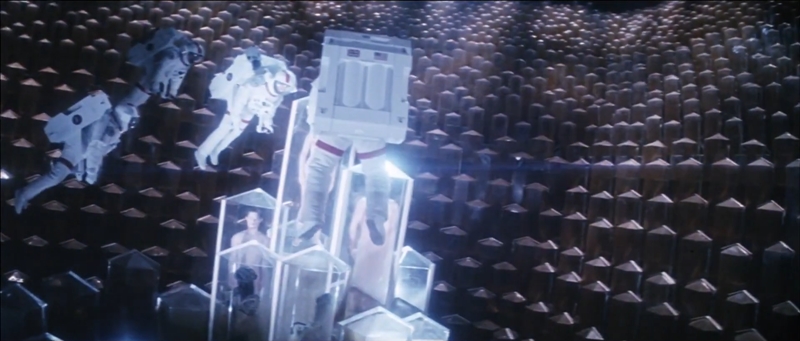
 During a joint NASA/ESA mission to intercept Halley’s comet, Col Tom Carlsen (Steve Railsback) of the spaceship Churchill and his crew pick up something extraordinary: a massive alien ship in the tail of the comet. The commander decides to divert the mission to the mysterious spacecraft, which upon closer inspection has an organic appearance. As Carlsen and his fellow astronauts make their brief foray* into the ship’s cavernous hulk, they encounter the desiccated floating bodies of large bat-like creatures. Another chamber yields a more surprising discovery, with what appear to be three humans (one woman and two men)** entombed in crystalline sarcophagi. The ship returns to Earth, with the three bodies and alien remains in tow, but meets with calamity along the way. A rescue crew reaches the Churchill in Earth orbit, only to find the interior and astronauts charred beyond recognition. Somehow, the residents of the clear coffins appear to be unscathed from the fiery accident, and are brought to terra firma for further scrutiny. Before you can say “bringing them back to Earth was a terrible idea,” the humanoids escape their containers, and proceed to feast on the life energy of every hapless person they encounter. We soon learn, however, that Carlsen also avoided destruction on the Churchill, utilizing the ship’s escape capsule*** in the nick of time. British authorities take Carlsen into custody, as he harbors the secret about what occurred on the doomed mission, and may possess the key to stopping the rampage of the space vampires.

* Fun Fact #2: To simulate the astronauts floating in space, Hooper and company utilized the same team responsible for the flying rig used in Superman: The Movie (1978).

 ** Fun Fact #3: Billy Idol was originally approached to play one of the male space vampires, but when casting plans fell through, the filmmakers brought in Chris Jagger (Mick’s younger brother) for the part. 

 *** Side Note: Considering the crew’s size, the escape pod (which conjured images of the tiny space capsule from the 1965 schlock-fest Monster a Go-Go), seems ridiculously small. Apparently designed for one lucky astronaut, it begs the question: How would they decide who lived and who died?


 If there’s a solitary raison d'être for Lifeforce, it’s French actress Mathilda May, who commands attention whenever she’s on screen. May was cast after an exhaustive worldwide search (Hooper claimed approximately 50 actresses auditioned for the part)* for someone who would play a role that demanded excessive nudity.** May’s background as a professional dancer proved especially invaluable in her depiction of an alien presence, with her precisely controlled movement. She mesmerizes whenever she’s on the screen, conveying the right balance of otherworldly beauty and subtle menace. To the men who encounter her, she’s a siren – they’re powerless to resist her charms, even though meeting her won’t end well. She establishes an inextricable bond with Carlsen, which horrifies and tantalizes him in equal parts. She’s an ideal construct culled from his vision of an ideal woman, illusory and unobtainable (“I am the feminine in your mind.”).

 * Fun Fact #4: According to Hooper, Olivia Hussey was among the actresses considered for the role. Some male actors that were considered for various other characters included Klaus Kinski, Terrence Stamp, and John Gielgud.

** In his DVD commentary, Hooper glibly stated, “It was like her costume.” 


Instead of focusing on Col. Carlsen’s obsession, I wish it had spent more time with Dr. Hans Fallada (Frank Finlay), a clear nod to Professor Quatermass in the Hammer films and BBC adaptations. Fallada is fascinated by the alien visitors and their implications. He opines that the creatures visited Earth long ago, giving rise to the vampire folklore and legends. It’s an intriguing story element that could have been developed further, rather than concentrating on tracking down the rogue vampires. The clunky middle act gets bogged down with Carlsen assisting British agents led by SAS agent Colin Caine (Peter Firth). No one questions his histrionics in his zeal to find the female space vampire, who’s jumped to a new body. Inexplicably, he’s given free rein to slap around a woman (Nancy Paul) suspected of harboring the malevolent vampire’s spirit and abuse sanitarium director Dr. Armstrong (Patrick Stewart), who has also been afflicted.


Unlike some traditional vampire films, the vampire rules are inconsistent. It’s unclear whether direct contact or mere proximity are necessary for a spirit to jump from body to body. The original three vampires, while insatiable, don’t appear to weaken rapidly, whereas the infected humans wither away at an accelerated rate, becoming the “walking shriveled” (Hooper’s term). Also, why does the female vampire possess a sexual magnetism toward men, but the male vampires don’t seem to have a similar effect on women? Taking this a step further, why couldn’t the vampires have had a similar mesmeric effect towards people of the same sex? With the exception of a brief kiss between two men (which is a bit of cheat, since one is inhabited by the female vampire’s spirit), the film restricts itself to heterosexual attraction, and overwhelmingly appeals to the male gaze. This limits the myriad possibilities of sex as lure, restricting the implicit theme to a superficial “women are scary”


The $25 million Cannon production was met with mostly mixed to negative reviews when it was first released, no thanks in part to the butchered U.S. version (at distributor Tri-Star’s insistence). Lifeforce has since gained a loyal following, not simply because of Mathilda May’s inimitable presence, but its wildly ambitious story. It boldly suggests something extraterrestrial in origin influenced human history and folklore, inhabiting our myths and fears. The climactic scene of mass pandemonium on the streets of London is reminiscent of the dénouement to Quatermass and the Pit (1967), which shares similar themes. At the same time, the story isn’t nearly as focused as Quatermass, but it’s a noble effort nevertheless. Lifeforce manages to balance some heady ideas with some good old-fashioned exploitation, creating an entertaining mix. It didn’t play it safe. If only more genre films would follow its lead. 

Saturday, March 14, 2020

The Man Who Fell to Earth


(1976) Directed by Nicolas Roeg; Written by Paul Mayersberg; Based on the novel by Walter Tevis; Starring: David Bowie, Buck Henry, Candy Clark, Rip Torn and Bernie Casey; Available on Blu-ray and DVD

Rating: ***

“I think that probably one of the things that Nick (Roeg) identified with me was that I was definitely living in two separate worlds at the same time. My state of mind was quite fractured and fragmented, but I didn’t really have much emotive force going for me, so it was quite easy for me not to relate to those around me.” – David Bowie (from Criterion DVD commentary)

Thanks to Gill from Realweegiemidget Reviews, for inviting me to join the Pop Stars Moonlighting Blogathon, where pop singers try out their acting chops. Today, I’m taking a look at David Bowie’s feature film acting debut in director Nicolas Roeg’s hallucinatory science fiction parable, The Man Who Fell to Earth.


Nicolas Roeg’s film roughly follows the plot of Walter Tevis’ 1963 novel, chronicling the exploits of Thomas Jerome Newton (David Bowie), the lone representative of a dying race, bearing the gift of technological advancement. The film traces his rise and subsequent fall, ultimately descending into alcoholism and malaise. As in the book, the film references Bruegel’s painting “Landscape with the Fall of Icarus,” which serves as an apt metaphor for Newton’s ambitious, albeit doomed mission.  


David Bowie is suitably cast as the displaced alien, establishing the singer/songwriter*/** as a unique and magnetic acting presence. Although Bowie doesn’t quite match the description of his character in the novel (described as extremely tall, with curly white hair),*** his slender build, unnaturally orange hair and tentative movements lend him an otherworldly appearance. When Newton looks or reacts to something, he appears to be experiencing it for the first time. Bowie anchors the film, which would have been diminished without him.  

* Fun Fact #1: According to Bowie, he mistakenly assumed he was composing the music for the film’s soundtrack. Although his songs were not used in the film, they eventually formed the basis for his “Low” album (the cover art uses a still from the movie).

** Fun Fact #2: According to the DVD commentary, Bowie’s real-life chauffeur appears in the film as Newton’s driver.

*** Fun Fact #3: In the DVD commentary, Roeg commented that he originally considered casting author Michael Crichton for the role of Thomas Newton, due to his height (6’9”).


While filled with many high points, one of the book’s deficits was its lack of diversity, with regard to women or people of color playing significant roles. The filmmakers address this disparity somewhat. Bernie Casey appears (in an underwritten supporting role) as government official Peters, who launches an investigation of Newton and his shadowy business dealings. Compared to her character in the novel, Mary-Lou (Candy Clark) is given more to do, but she comes across as whiny and strident. Since this is a Roeg film, you can bet it’s going to be sexually charged, and it doesn’t disappoint on that level. However, consummating the relationship between Mary-Lou and Newton seems to be a misstep. It transforms their union into something very human, significantly changing the meaning in the context of the story. They share a platonic relationship in the novel, which seems more logical, considering Newton’s physical limitations. Keeping their distance sexually makes a powerful statement, reinforcing how isolated and alone he feels, stranded on Earth.

* Fun Fact #4: Watch for Apollo 13 astronaut James Lovell, who appears as himself in a scene that reveals Newton’s spaceship project.


Compared to many technology-laden science fiction films, Roeg adopts a minimalist approach. Many details about Newton and his accomplishments are left to your imagination, lending some weight to the interpretation that Newton’s extraterrestrial nature is more a state of mind than a fact. We catch brief glimpses, however, with a revolutionary new spherical music format,* a camera with self-developing film, or a nearly completed spaceship, sitting on a launchpad. The lack of gadgetry could also be attributed to budgetary limitations, which encouraged the audience to indulge in their collective imagination. We never see how Newton arrives on Earth, although there are a few shots of his beleaguered family on his home planet, wandering around a desert wasteland, riding in a weird A-frame monorail vehicle covered in carpet samples.

* Random Thought: Despite the fact that World Enterprises (Newton’s company) produces a superior audio format, why doesn’t it appear in record stores? Then again, perhaps the movie was more prescient than I originally thought, predicting hipsters’ endless obsession with vinyl.


The Man Who Fell to Earth is easy to admire, but hard to love. While the film exhibits moments of visual and thematic brilliance, it’s an overlong, self-indulgent, emotionally distant exercise, which keeps the audience at arm’s length. Too many times, I felt like an alien observing behavior and events from a detached perspective. It’s easy to feel for Newton’s plight, but it’s hard to become too invested in Newton or the other self-absorbed characters. It’s not a bad film, just a tedious one, worth seeing at least once for Bowie’s performance.

Thursday, October 10, 2019

Scared Sh*tless in the ‘70s


“I am a man of fifty-two years that is still dealing with his first ten years of existence. I am trying to recuperate from those first ten years.” – Guillermo del Toro (from 2016 interview by Keith McDonald and Roger Clark, Guillermo del Toro, At Home with Monsters)


So many of us spend X amount of dollars and fruitless hours, trying to get back something they can never regain, watching discs or streaming their favorite movies and shows from yesteryear. I’m here to tell you, however, that it’s not the fond memories, but the moments that creep you out that are truly the gift that keeps on giving. I spent my precious pre-teen years in the ‘70s, cementing my lifelong love of horror and sci-fi, but of course, you can’t make an omelet without breaking a few eggs. In a feeble attempt to re-experience the nightmares, I put each of my top offenders to the test. So, grab your favorite beverage, pull up a chair, and sit back while I take you on a brief tour of childhood trauma lane:


Frankenstein (1931) One of my earliest memories of watching a horror movie wasn’t in the theater, but on the small RCA TV in my parents’ bedroom, viewed furtively through my fingers. Frankenstein’s monster was certainly an imposing spectacle for five-year-old me, but that wasn’t the half of it. It was Mae Clark’s (playing Dr. Frankenstein’s bride to be) screams as Boris Karloff’s creature takes her by surprise, that induced the shivers.  


Does it hold up?

As a classic of horror cinema, of course. Is it still scary? Not so much. Jack Pierce’s signature makeup and Boris Karloff’s sympathetic portrayal are a winning combination for sure, but today the Frankenstein creature seems more worthy of our pity than revulsion.


Terror from the Year 5000 (1958) In the dim, cobwebby recesses of my memory, I vaguely recall a horror show on KTLA in the early ‘70s, Monster Rally, hosted by Seymour (Larry Vincent) that was my oldest brother’s favorite. I only remember bits and pieces of the show, since I was usually asleep by the time it came on. One fateful evening, I popped out just in time to watch a scene in which a man in a lab coat was puttering around in a laboratory. He adjusted a dial on some beeping equipment, watching a tall, windowed chamber, while delving into mysteries we weren’t supposed to know (you know the drill). Something goes wrong, and a screeching lady bursts out of the chamber, embarking on a one-woman rampage.


Does it hold up?

Are you kidding? Looking at the scene now, it’s tough to get in the head of my younger self. Clad in a sequined unitard, the object of my childhood fright looks more like an escapee from a second-rate Vegas act than a fugitive from the future. Once again, it was probably the screeching, more than anything, that set me off (Hmm… I see a pattern emerging). The movie was later mocked on Mystery Science Theater 3000, which makes me a bit sad, because for little old me, Terror from the Year 5000 was pure terror in the suburban family room. Note: Getting a good quality screen shot from this movie is about as likely as getting a decent shot of bigfoot (Hence, the cryptid-quality pic that you see above. Let your mind fill in the blanks.).


Live and Let Die (1973) My earliest movie theater memory involved the drive-in, watching Roger Moore’s debut as Agent 007. Of all the bewildering sights and sounds in the film, the sequence that stood out was Baron Samedi’s (Geoffrey Holder) voodoo ritual, with his maniacal laugh and skull-like visage. I watched him (or more accurately, his simulacrum) rise out of the graveyard, only to witness James Bond shoot him in the head, blowing off half his skull, and watching the eyes roll back. I couldn’t distinguish between the fake Baron Samedi and the one played by Holder. I couldn’t process what I thought I saw, although it didn’t seem to affect Samedi, who appeared in subsequent scenes.


Does it hold up?

It’s still kind of a weird scene, but it doesn’t have the same effect. I can understand why the whole switch-and-bait thing with real versus fake Samedi would be confusing to my developing five-year-old mind, but scary? Not really. You gotta love Holder’s hearty laugh, though.


Jaws (1975) I still have vivid memories of seeing this at the dear departed Van Nuys drive-in. I got my first shock in the opening scene, where Chrissie’s (Susan Backlinie) moonlight skinny dip takes an unexpectedly fatal turn. The biggest fright, however, was reserved for later, when Matt Hooper (Richard Dreyfuss) discovers Ben Gardner’s head bobbing up through a hole in his submerged fishing boat.


Does it hold up?

Damn right. The Ben Gardner jump scare has become a one-trick pony with multiple viewings. In contrast, the visceral opening scene still haunts me. Quint’s (Robert Shaw) speech about the Indianapolis probably sounded like “blah, blah, blah” to seven-year-old me. Now, it chills me to the bone, as a sobering reminder that it’s not what you see, but what you don’t see, that frightens the most.


Coma (1978) By the latter part of the ‘70s, my (significantly) older brothers were already in college, doing their own thing. This left my parents without someone to watch me (a babysitter would have been out of the question, in their minds). Invariably, I saw quite a few movies in the theater that I probably wasn’t prepared to see (Coming Home, from the same year springs to mind, but that’s for another time and another discussion). A few scenes that freaked me out involved medical procedures, partially dissected corpses, organ harvesting, partially nude coma patients hanging on wires, and watching someone smothered by an avalanche of cadavers – heavy stuff for any 10-year-old (mind you, this was PG).


Does it hold up?

Decades after my initial viewing, the film holds up surprisingly well. Director Michael Crichton (working from a novel by Robin Cook) crafted a pretty solid medical thriller, filled with intrigue and shocks aplenty. The scene where Geneviève Bujold’s would-be assassin get buried under a pile of cadavers is still unsettling. Thanks to this film, what really sticks with me are the existential fears of going into surgery, and not knowing if you’ll wake up. And with increasing population and rising medical expenses partnered with corporate greed, the idea of a large-scale organ-harvesting operation doesn’t seem so far-fetched.


Alien (1979) With multiple sequels, prequels and crossovers, it’s hard to imagine that when the first movie came out, there wasn’t anything else quite like Alien. Swiss surrealist H.R. Giger’s otherworldly biomechanical designs were like nothing else I had seen before. I cringed at the scene where Kane (John Hurt) unwisely peered into an activated alien egg, followed by his famous demise in a later sequence. Thinking about the creature in its final form, with its vaguely insectile, skeletal appearance, kept me awake at night, wondering what was lurking in the shadows, waiting to grab me. 


Does it hold up?

Hell yes! The original remains creepiest. Giger’s artwork, steeped in phallic and yonic imagery, has stood the test of time. Ridley Scott’s film hits all the right notes, and no quantity of inferior sequels (Aliens excluded) nor attempts to explain away the origin of the creatures can diminish the impact of the initial film.


SIDE NOTE: The last three examples feature William Shatner. What is it about Shatner that merits his appearance three times in this piece (in all fairness, the first scene of the three I reference only has Shatner in a peripheral)? I honestly can’t say. Perhaps someone can help me analyze my deep-seated trepidation that comes with Shatner’s screams. I’ve never found Shatner himself particularly frightening, although his face indirectly contributed to the creation of the Michael Meyers mask, so there’s that.  


Star Trek: The Motion Picture (1979) Yes, you read that right. Star Trek: The Motion Freaking Picture. The first film, based on the original TV series has a reputation for being visually spectacular, having an unforgettable Jerry Goldsmith score, and (at least to some) being kind of dull. There is, however, one scene that disturbed me to the core. While the recently refurbished starship Enterprise is being rushed back into service, the transporter malfunctions, killing two crewmembers. We only see indistinct, distorted images in the transporter room, but the thing that got me the most were the weird, high-pitched screams. When Admiral Kirk asks about the status of the poor crewmembers, he’s told, “What we got back didn’t live very long.” My mind was left to fill in the sordid details – all this from a G-rated film (thank you 1970s MPAA).


Does it hold up?

Say what you want about the movie’s languid pace or derivative storyline, the film still has its virtues (watch for a future review). And 40 years later, the transporter accident scene hasn’t lost its power to unnerve me. The idea that a device could tear someone apart on the atomic level and (hopefully) re-assemble the pieces, a sort of death and re-birth, never fails to give me the creeps.  


The Outer Limits, “Cold Hands, Warm Heart” (1964) Yes, everyone seems to mention “The Zanti Misfits” as their nightmare-fodder of choice, but for me, it was the episode “Cold Hands, Warm Heart.” Shatner plays Col. Jeff Barton, an astronaut who just returned from a perilous one-man journey to Venus. He encounters a terrifying event while descending into the planet’s atmosphere, with a hideous creature reaching out to him.


Does it hold up?

Well… I can appreciate the results, keeping in mind the show’s low budget, coupled with pressure to deliver a new monster every week. On the other hand, what freaked me out as a kid, an obvious puppet on strings, doesn’t quite have the same impact now. Something that occurred to me while revisiting the episode after several decades, was how this was a thinly veiled exploration of PTSD, its effects on the traumatized individual, and the impact on the people around them. Outside of Barton’s puzzled wife, he had a conspicuous lack of a support network. Hey, if that isn’t scary, I don’t know what is.


Star Trek, “The Man Trap” (1966) A hideous creature that drains the salt from people’s bodies attacks Captain Kirk (once again, it’s something about his agonized cries that sold it). The alien monster was the stuff of nightmares to my young eyes, looking something like an overly hirsute Morlock, with dead eyes and oversized sucker hands.  


Does it hold up?

My recollection of the episode, obscured by a fog of muddy memories, led me to believe that the salt monster had a lot more screen time than it actually does. It’s only briefly seen at the end, since it spends most of the film disguised as one human or another. It remains one of the original series’ most effective creatures, although I can’t help but feel sad for it, as the last of its kind.