Saturday, December 2, 2023

The Hammer-Amicus Blogathon IV – Day 2 Recap

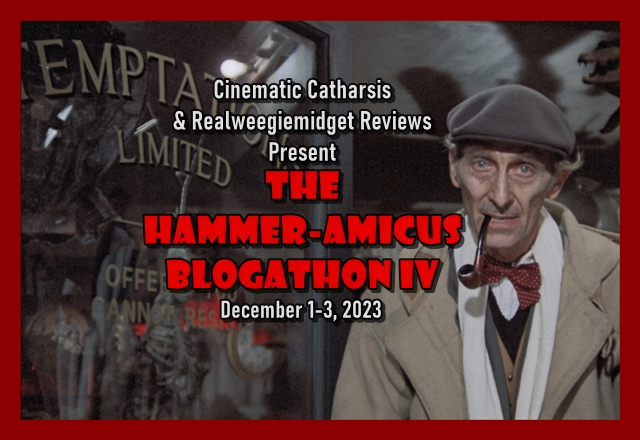
Hammer-Amicus Blogathon IV Banner - Twins of Evil

We’re back for Day 2 of the Hammer-Amicus Blogathon IV, hosted by Yours Truly and Gill from Realweegiemidget Reviews. Today, we have another batch of eclectic posts for your reading pleasure. Oh, and please excuse my tardiness if you haven’t received a comment from me yet. You should be hearing from me soon.

The Abominable Snowman

Don’t worry if you’re running a bit late! We’ll be sure to post your link on Day Three or (just confirmed) Bonus Day 4. Post a comment below, email me at barry_cinematic@yahoo.com, Twitter (@barry_cinematic), Instagram (barry_cinematic), or by commenting below. You may also contact Gill by commenting on her post, or through her blog’s Contact Me page.


Tales from the Crypt

Here are today’s offerings...  and be sure to check out the posts from Day 1, and stay tuned for Day 3!


A Hammer Film Production

Paranoiac Poster

What’s that behind you? Never fear, it’s only John from Tales from the Freakboy Zone discussing Paranoiac (1963).


The Woman in Black 2 Poster

Andrew from Maniacs and Monsters is back in black with TheWoman in Black 2: Angel of Death (2014).

Dracula Has Risen from the Grave

Rise and shine with Jack Seabrook’s (from Bare Bones E-Zine) look at Dracula Has Risen from the Grave (1968). 

Nightmare Poster

Don’t be afraid to check out Nitrate Glow’s review of Nightmare (1964).


The Engelsfors Trilogy

Kevin, aka: The Grump of Horror looks at books – specifically The Engelsfors Trilogy


The Viking Queen Poster

Holger Haase from Hammer and Beyond spends some quality time with The Viking Queen (1967).  

The Witches Poster

Sit a spell with Eddie Harrison from Film Authority as he reviews The Witches (1966).


The Gorgon Poster

You’d better not avert your eyes from Dan Stephens’ (from Top 10 Films) take on The Gorgon (1964). 


The Reptile Poster

…And don’t slither away before reading my review of The Reptile (1966).


Amicus Productions


The Skull Poster

I hear your noggin, but you can’t come in. Check out Black Cats and Poppies’ take on The Skull (1965). 


Hey, daddy-o, don’t be a drag. Hang with cool cat Terence Towles Canote from A Shroud of Thoughts, as he comments on It’s Trad, Dad! (1962). 


The Reptile

The Reptile Poster

(1966) Directed by John Gilling; Written by John Elder; Starring: Noel Willman, Ray Barrett, Michael Ripper, Jennifer Daniel, Jacqueline Pearce, John Laurie and Marne Maitland; Available on Blu-ray and DVD. 

Rating: ***½ 

First of all, congratulations are in order for my superb co-host, Gill Jacob from Realweegiemidget Reviews, for co-hosting a fourth (!) edition of the Hammer-Amicus Blogathon, delving further into the wealth of cinematic delights from both esteemed production companies. Be sure to check out all the wonderful posts! 

The Reptile Lurks in the Shadows

“Mr. Spalding, I was a professional seaman, and I too, have knocked around the world a bit, but I’ve seen things that your logic could not explain away.” – Tom Bailey (Michael Ripper) 

“It was hell… I spent a couple of hours in makeup every morning. I could only shoot every other day because taking it off would leave my skin so raw. I wasn’t comfortable in that at all.” – Jacqueline Pearce (excerpted from Hammer Glamour, by Marcus Hearn)

Charles Spalding

As any music enthusiast would likely attest, the B-side can be just as intriguing, if not more so, veering in directions that would be unthinkable for a potential hit single. Intended to be the second film on a double bill with Rasputin the Mad Monk (1966), The Reptile is a second feature that’s anything but secondary. It was the last in a series of four films that were shot back-to-back (preceded by Dracula: Prince of Darkness, Rasputin the Mad Monk, and Plague of the Zombies), as part of producer Anthony Nelson Keys’ cost-cutting experiment.* Production started only a week after shooting for Plague of the Zombies ceased. Bernard Robinson’s lavish set design (employed on a shoestring) cleverly concealed the film’s low-budget origins.*** Director John Gilling claimed to have rewritten John Elder’s** script “…more or less as I went along,” but the Shout Factory Blu-ray commentary seems to suggest otherwise, stating there has been no proof of Gilling’s reworking of the original script.

* Fun Fact #1: Of the four films, only The Reptile finished under budget, for the paltry sum of £100,599. 

** Fun Fact #2: John Elder’s story was originally pitched to Universal in 1963 as The Curse of the Reptiles. When it finally reached production in 1965 under Hammer, budgetary constraints necessitated paring things down to one monster. 

*** Fun Fact #3: The gothic country house Oakley Court (built in 1859) stood in for Dr. Franklyn’s mansion. If you’re feeling a sense of déjà vu, your brain isn’t deceiving you. It’s been featured in several other productions over the years, including The Curse of Frankenstein (1957), The Vampyres (1974), and The Rocky Horror Picture Show (1975). 
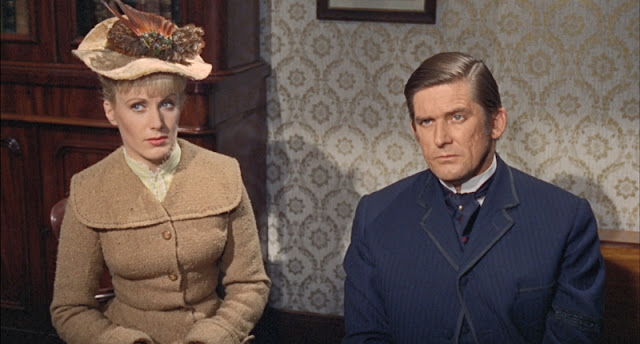
Valerie and Harry Spalding

After the untimely death of his brother Charles (David Baron), Captain Harry Spalding (Ray Barrett) and his wife Valerie (Jennifer Daniel) inherit the elder Spalding’s modest estate, Larkrise. They arrive in the village to an icy reception from the suspicious residents, who fear “the black death,” which has claimed a handful of other lives. Only barkeep Tom Bailey (Michael Ripper) extends a hand of friendship to the perplexed couple. They soon encounter theologian Dr. Franklyn, who’s settled in the sleepy Cornish village after traveling in the Far East. He lives with his reclusive daughter Anna (Jacqueline Pearce), holding dominion over her… but why? The answer could be Captain Spalding’s undoing.
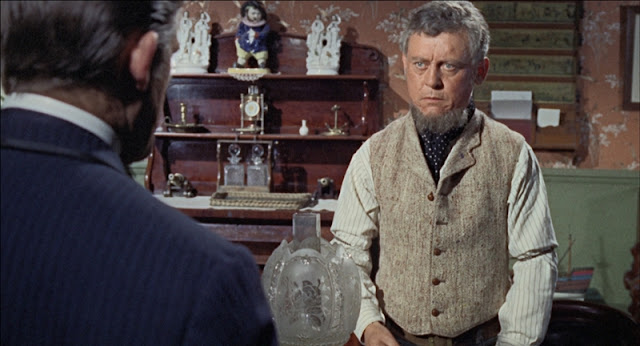
Tom Bailey

Our main protagonists, Harry and Valerie, are about as vanilla as you can get. If you want any spice, look no further than the exemplary supporting performances, especially by Hammer’s Swiss Army Knife in residence, Michael Ripper, as pub owner Tom Bailey.* In most other movies, it would be a thankless, insubstantial role, but Ripper imbues the part with depth, warmth and unexpected humor – a testament to his formidable talent. Tom shows Spalding and his wife compassion when most of the villagers turn their backs, and becomes the hero Spalding couldn’t be. To her credit, Valerie (Jennifer Daniel) is a stronger female character, compared to most other Hammer heroines of the period. Instead of shrieking in hysterics, she remains calm in the face of adversity. Despite the danger, she rises to the challenge on multiple occasions. When her husband is envenomated, she promptly treats his wound, and ventures in his place to the perilous Franklyn residence. 

* Fun Fact #4: Ripper biographer Derk Pykett commented, “It’s a role that could have easily been overplayed, or gone by hardly unnoticed. But the Rip plays the role perfectly, with just the right amount of humor and dread that makes barkeep Tom Bailey a memorable character.”

Mad Peter

John Laurie provides another noteworthy supporting performance as “Mad” Peter,* the town eccentric. He’s at once beloved by the townsfolk but written off because he’s a nonconformist (seeing and hearing what others ignore). While he provides some much-needed levity to the film, he much more than comic relief. It’s too bad he’s afforded so little screen time, because he almost deserved his own movie. 

* Side Note: I couldn’t help but speculate if Mad Peter was the ancestor of another cinematic doomsayer, Crazy Ralph from the first two installments of the Friday the 13th Franchise.

Dr. Franklyn

Dr. Franklyn (Noel Willman) is the most enigmatic character, initially unlikeable but ultimately sympathetic. We eventually come to learn what a terrible burden he carries, with no means of righting the wrongs he’s committed. Haunted by his indiscretion after traveling to Borneo to pursue the mysteries of an elusive cult, the Ourang Sancto, Franklyn, now a puppet of the mysterious Malay (Marne Maitland), is responsible for his daughter’s present condition,

Anna Franklyn

Jacqueline Pearce, probably best known today for her role as the scheming villainess Servalan in the TV show Blake’s 7, will likely surprise some viewers, playing such a sensitive, tragic figure as Anna Franklyn. She endures a seemingly uncurable affliction: undergoing a transformation into a deadly snake woman. Kept in isolation by her father, she longs for companionship, keeping a room full of small animals as “pets.”* Her relationship with Dr. Franklyn is best described as contentious. In one scene, she plays the sitar for her guests, Captain Spalding and Valerie, only to have it unceremoniously smashed over the fireplace by her father. 

* Fun Fact #5 (MINOR SPOILER): Pet lovers will be relieved to know that Valerie’s adorable kitten featured in the beginning of the film does not become reptile food, but survives the (literally) fiery conclusion.

Anna as The Reptile

Roy Ashton used care when applying Pearce’s reptile makeup, which she didn’t tolerate well (he claimed the actress was claustrophobic). The makeup might appear crude* by today’s standards, but it does the job. Anna, in reptile form,** is genuinely scary as depicted, emerging from the shadows or in quick cuts, compensating for the limitations of the makeup. The dreadful effects of the Reptile’s venom are manifested in three progressively hideous stages, with the skin of the victims turning black and green, blood running from their eyes, and froth foaming at the mouth. 

* Fun Fact #6: Ashton used papier mâché for the shed skin Dr. Franklyn discovers in his daughter’s bed. 

** Fun Fact #7: After being unimpressed by some of the rushes (raw, unedited footage) of Jacqueline Pearce in makeup, Hammer ordered re-shoots (something almost unheard of for the thrifty production company).
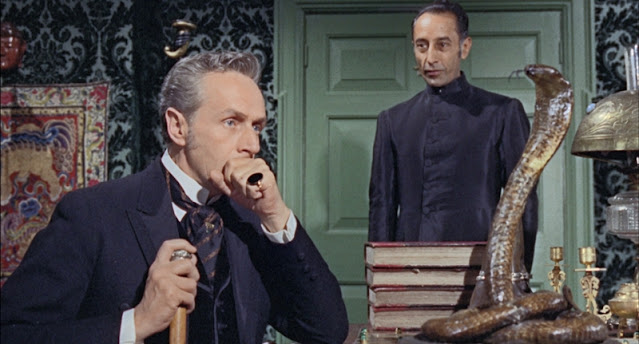
 

Dr. Franklyn and The Malay

The Reptile’s theme about a threat from the East, is undeniably steeped in xenophobia, with a curse by an Eastern shaman, known only as “The Malay” (Marne Maitland). While the film sets up Dr. Franklyn as the victim, he imposed himself on a culture that didn’t want him there (“…my research into the primitive religions of the East”), unfortunately resulting in his daughter paying an unfathomable price. The filmmakers were sure to keep The Malay as one-dimensional as possible, so he appeared unsympathetic and more monstrous than the creature he helped create. He poses as Franklyn’s servant, but the reverse is true, with Franklyn inextricably indebted to the strange man. It’s only a smoke screen, however, to distract us from a greater truth. Franklyn, a colonial, was an interloper in an indigenous society he didn’t respect and knew little about.

Valerie, Capt Spalding and Tom

The Reptile transcends its second-billing leanings, ingeniously obscuring its low-budget origins, and veering in unexpected directions (such as Tom Bailey’s heroism). It also stands apart from many other Hammer horror films, featuring an original creature that was created for the movie, and not a retread of a Universal property. One of the Blu-ray commenters asserted that it wasn’t much of a mystery who the eponymous creature was, but I don’t think that was ever the point. It’s simply an entertaining, and frequently scary yarn, perfect for Saturday matinees and rainy days.


Sources for this article: The Hammer Story, by Marcus Hearn and Alan Barnes; The Hammer Vault, by Marcus Hearn; Hammer Glamour, by Marcus Hearn; Hammer Films: The Unsung Heroes, by Wayne Kinsey; Micheal Ripper: Unmasked, by Derek Pykett, Shout Factory Blu-ray Commentary by Steve Haberman, Ted Newsom, and Constantine Nasr

The Hammer-Amicus Blogathon IV Banner


Friday, December 1, 2023

The Hammer-Amicus Blogathon IV is Here! Day 1 Recap


Hammer-Amicus Blogathon Banner - Torture Garden

Welcome to the first day of the Hammer-Amicus Blogathon! My co-host Gill (from Realweegiemidget Reviews) and I were blown away by the number of signups (35!), which only proves (after a one-year hiatus with Hammer-Amicus) that absence truly makes the heart grow fonder. We’ve got something for everyone in Day One’s posts, but first, some housekeeping…

The Hound of the Baskervilles

If you plan to participate but you’re not quite ready, never fear, we’ll post your link on days two or three (and rumor has it there could be a fourth bonus day for the fashionably late). Post a comment below, email me at barry_cinematic@yahoo.com, Twitter (@barry_cinematic), Instagram (barry_cinematic), or by commenting below. You may also contact Gill by commenting on her post, or through her blog’s Contact Me page.

Paranoiac

Be sure to watch out for tomorrow’s batch of posts. Enjoy!


Hammer Film Productions


The Plague of the Zombies Poster

Forget calling an Uber. Join Terence Towles Canote as he takes The Devil Rides Out (1968) for a spin.    

Madhouse Poster

You’d have to be daffy to pass on Kristina’s (from Speakeasy) review of Madhouse (1974). 


The Vampire Lovers

Virginia DeBolt from Old Ain’t Dead considers The VampireLovers (1970).  


The Plague of the Zombies

Andrew Wickliffe from The Stop Button entrances us with his take on The Plague of the Zombies (1966).  


The Psychopath 

Joey from The Last Drive-In invites us to spend a night with The Psychopath (1966).  


Bad Blonde Poster

Man Bait Poster

Quiggy from The Midnite Drive-In serves us a delectable double feature of Hammer noir, with Bad Blonde (1953) and Man Bait (aka: The Last Page) (1952). 


Taste the Blood of Dracula - Ralph Bates

The one and only Gill from Realweegiemidget Reviews discusses Ralph Bates’ career at Hammer (including an introduction by actress Judy Matheson). 


An Amicus Production


The Terrornauts Poster

Space out with Greg Wilcox from Destroy All Fanboys as he explores The Terrornauts (1967). 


Saturday, November 25, 2023

November Quick Picks and Pans


Murder, My Sweet Poster

Murder, My Sweet (1944) Dick Powell plays Raymond Chandler’s enduring private detective, Philip Marlowe, in a plot that involves an ex-con (Mike Mazurki), his missing girlfriend, and some stolen jade. Marlowe becomes unwittingly embroiled in a triangle between a rich elderly magnate (Miles Mander), his trophy wife Helen (Claire Trevor) and his daughter Ann (Anne Shirley). Director Edward Dmytryk maintains a breakneck pace throughout, with smart dialogue and gobs of intrigue, cut with a healthy dash of humor. Being taken for a ride has seldom seemed so enjoyable. 

Rating: ****. Available on Blu-ray and DVD

Too Late for Tears Poster

Too Late for Tears (1949) An unhappy married couple, Jane and Alan (played by Lizabeth Scott and Arthur Kennedy), bickering on a lonely highway find their lives turned around when a valise filled with $60,000 in cash ends up in their laps. After successfully evading the intended recipient, they debate about what to do with their new windfall – report it to the police or keep it. It soon becomes apparent that Jane has other plans for the money, until the owner of the money (Dan Duryea) tracks her down. Lizabeth Scott is at her icy best, as a woman who will stop at nothing to keep herself wrapped in luxury. 

Rating: ****. Available on Blu-ray, DVD, Prime Video and Kanopy


The Strange Woman Poster

The Strange Woman (1946) This not-quite-noir by director Edgar Ulmer is set in early 1800s Bangor, Maine, when it teetered on the precipice of becoming a boomtown. The ever-radiant Hedy Lamarr stars as Jenny Hager, an enigmatic young woman haunted by her father’s poor reputation. She sets out to make a name for herself, manipulating men and women alike with her wiles, eventually assuming control of her deceased husband’s business empire. While she climbs the rungs of the social ladder, she remains a contradiction, ruthless, but with a strong philanthropic streak. Much like its main character, the film sends a mixed message, with its morally conflicted main character, demonized by judgmental and self-righteous townspeople. 

Rating: ***. Available on DVD and Prime Video


The Crimson Cult Poster

The Crimson Cult (aka: Curse of the Crimson Altar) (1968) Despite a stellar cast (featuring Boris Karloff, Christopher Lee, Barbara Steele and Michael Gough), this meandering supernatural thriller never quite gets unstuck from neutral. Robert Manning (Mark Eden), an antiques dealer, investigates the whereabouts of his missing brother, which leads him to the Morely estate, presided over by the family patriarch (Christopher Lee). While staying at the mansion, he falls for Morley’s niece, Eve (Virginia Wetherell), who shares a direct lineage to her infamous ancestor Lavinia (Barbara Steele). Boris Karloff co-stars (and spends the movie looking physically uncomfortable) as Morley’s neighbor, Professor John Marsh. This Tigon production, directed by Vernon Sewell, displays a few moments of almost Hammer-level gothic atmosphere, but suffers from poor pacing, a weak story, and a painfully bland lead. 

Rating: **½. Available on Blu-ray (Out of print) and Tubi 


Terminus Poster

Terminus (1987) This French-German co-production, directed by Pierre-William Glenn, plays like a pastiche of other postapocalyptic movies, while struggling to say something new. Karen Allen appears as Gus, the driver of a computerized truck who participates in a dangerous game, traveling through a perilous route full of hostile inhabitants. Jürgen Prochnow co-stars in a triple role as a totalitarian leader with an orange wig (“Sir”), a mad scientist (“Doctor”), and a rival truck driver. The truck and its artificial intelligence brain was invented by lab-created child prodigy Mati (Gabriel Damon), who has an ulterior motive for his game. Allen, who’s featured prominently in the credits, has relatively little screen time, and Prochnow looks like he’d rather be in something else. It’s a disappointing mishmash of half-baked ideas with little focus.   

Rating: **. Available on DVD, Prime Video and Tubi


Wednesday, November 1, 2023

Horror Month Quick Picks and Pans


The Collingswood Story Poster

The Colingswood Story (2002) The suspense gradually builds in this surprisingly effective microbudget film (shot on Hi-8 tape) from writer/director Michael Costanza. The story is told entirely through the webcam feeds of two 20-somethings in the pre-Zoom, dial-up internet days. After hearing some ominous ramblings from an online psychic (Diane Behrens), Johnny (Johnny Burton) fears his out-of-state girlfriend Rebecca (Stephanie Dees) might be in mortal danger. Johnny learns that the Collingswood, New Jersey house where she’s renting a room was once the site of several grisly murders, perpetrated by a member of a satanic cult. The restrictive sets, defined by the webcams, create a palpable sense of immediacy. The Collingswood Story proves less is often more, maintaining a disturbing atmosphere despite the absence of special effects or elaborate makeup. 

Rating: ***½. Available on Blu-ray, DVD, Prime Video and Tubi

Seeding of a Ghost Poster

Seeding of a Ghost (1983) This Shaw Brothers Category III movie, directed by Kuen Yeung, helped stretch the boundaries of Hong Kong cinema. A cab driver (Phillip Ko) unwittingly interrupts a practitioner of black magic, resulting in a curse on himself and young wife. When she’s brutally attacked and killed by two young men, he employs the services of the reluctant shaman to awaken her ghost. Revenge is swift, but he learns too late that employing the dark arts has a terrible price. Seeding of a Ghost is an experience you won’t soon forget, entertaining and icky in equal parts. 

Rating: ***½. Available on Blu-ray and DVD (Both out of print)

Curse of the Undead Poster

Curse of the Undead (1959) Here’s a real 1950s oddity, a vampire western. Dr. Carter (John Hoyt) and his family are bullied by Buffer (Bruce Gordon), an unscrupulous landowner muscling in on their ranch. When Carter dies under dubious circumstances, his hotheaded revenge-seeking son is gunned down by Buffer. Drake Robey (Michael Pate), a mysterious gunslinger with an aversion to sunlight, offers his protection to the grieving daughter, Dolores (Kathleen Crowley), who’s now the sole owner of the ranch. Meanwhile, a preacher (Eric Fleming) tries to convince Dolores her life is in danger after he learns Robey’s dark secret. I can’t imagine how audiences accustomed to standard westerns received this unusual ahead-of-its-time hybrid.*

* I can’t help but wonder about the still largely untapped potential for horror westerns. 

Rating: ***½. Available on Blu-ray and DVD


Maniac Poster

Maniac (1980) Joe Spinell (who also co-wrote the screenplay and co-produced) stars as Frank Zito, a lonely, mentally unstable middle-aged man who preys on unsuspecting women. He murders them for their scalps, which he brings home to dress his mannequins’ heads. He befriends a beautiful fashion photographer (Caroline Munro) who seem oddly smitten by his awkward charms. Director William Lustig’s film is unabashedly sleazy and in poor taste, yet strangely captivating, anchored by Spinell’s unnerving performance. You might want to take a long shower after watching this.   

Rating: ***½. Available on Blu-ray, DVD, Prime Video and Tubi 


Lamb Poster

Lamb (2021) Director/co-writer Valdimar Jóhannsson’s Icelandic folk horror movie is a quiet rumination on parenthood and belongingness. A childless couple, Maria and Ingvar (Noomi Rapace and Hilmir Snær Guðnason) spend their lonely days tending to their farm. Their lives are transformed forever when one of their ewes gives birth to a sheep-human hybrid. They accept the strange creature as their daughter, but tensions rise when Ingvar’s elder brother comes to live with them. It’s an oddly compelling film, featuring some good acting and intriguing themes, but it’s marred by a limp third act that sputters to an end. It comes close to saying something profound, but just misses the mark. 

Rating: ***. Available on Blu-ray, DVD and Kanopy 

Mary, Mary, Bloody Mary Poster

Mary, Mary, Bloody Mary (1975) Cristina Ferrare stars as the title character, a young woman traveling to Mexico who enjoys painting and a macabre pastime (stabbing her victims and drinking their blood). She meets a man (David Young) along the way, and they seem to hit it off, but her homicidal tendencies get in the way. While she grapples with her impulses, someone else is committing a series of similar murders and a tenacious police inspector is snooping around. Compared to director Juan López Moctezuma’s previous and follow-up efforts (The Mansion of Madness and Alucarda), this tepid thriller seems positively subdued. 

Rating: ***. Available on Blu-ray, DVD and Tubi

Frightmare Poster

Frightmare (1983) When their favorite horror star dies, some over-enthusiastic members of a horror film appreciation society do what any sensible fan would do: break into his mausoleum and steal his corpse. But the once dead Conrad Radzoff (Ferdy Mayne) returns for one last performance when his grieving wife conducts a ritual to revive his body. Mayhem and murder ensue. Frightmare, which borrows extensively from Children Shouldn’t Play with Dead Things, teaches us the predictable lesson that we’re better off not messing with forces we don’t understand, but it has its inspired moments. Mayne is amusing as the conceited, fading star, and Jeffrey Combs appears as one of the misguided fans.   

Rating: ***. Available on Blu-ray, DVD, Prime Video and Tubi


Anatomy Poster

Anatomy (2000) Paula (Franka Potente), a promising medical student, secures an exclusive opportunity to study at an elite medical school in Heidelberg. Her dream turns into a nightmare when she realizes the cadaver on her dissecting table is a young man she helped on a train. The discovery prompts her to conduct her own research, which in turn uncovers a secret society hiding among the faculty and students. As she delves deeper into mysteries she wasn’t meant to uncover, Paula learns that her newly acquired knowledge could mean her doom. This schmaltzy German production, obviously influenced by Coma (1978), lacks the suspense or subtlety of the earlier film, and the bombastic soundtrack doesn’t do it any favors. 

Rating: **½. Available on DVD and Tubi


Mom Poster

Mom (1989) A reclusive man (Brion James) who happens to be a cannibalistic demon rents a room from an unsuspecting elderly woman (Jeanne Bates). Before you can say, “I’m shocked, shocked. I never saw that coming,” he turns the old lady into one of his own, with the same taste for human flesh. Her bland 30-something son (Mark Thomas Miller) tries his best to dissuade her, but he can only do so much to quell her urges. It’s a fine premise for a horror comedy (similar material was handled in Evil Dead 2 and Dead Alive), however, it’s played straight from start to finish, making this a chore to sit through. You’ve been warned. 

Rating: **. Available on DVD (Out of print), and Tubi


Bloodthirsty Butchers Poster

Bloodthirsty Butchers (1970) What if low-budget filmmaker Andy Milligan made his own Sweeney Todd movie? Well, wonder no more… Shot in England, the costumes (likely pilfered from the local community theater group) are a mishmash from different eras, and the plot is incoherent. Lead actor John Miranda looks a bit like a low-rent Peter Cushing, but without the acting chops. Perplexingly, Milligan chooses to focus mostly on the peripheral characters and their boring lives, loves and squabbles, instead of the human meat pies (arguably, the raison d'être of a Sweeney Todd film). As with many flicks from Milligan’s oeuvre, your mileage may vary. 

Rating *½. Available on Blu-ray (Included in The Dungeon of Andy Milligan box set), DVD and Tubi


Monday, October 23, 2023

The Cabinet of Dr. Caligari


The Cabinet of Dr. Caligari Poster

(1920) Directed by: Robert Wiene; Written by Carl Mayer and Hans Janowitz; Starring: Werner Krauss, Conrad Veidt, Friedrich Fehér, Lil Dagover and Hans Heinrich von Twardowski; Available on Blu ray and DVD 

Rating: ****½ 

“Ladies and gentlemen, Cesare the somnambulist will answer all your questions. Cesare knows every secret. Cesare knows the past and sees the future. Judge for yourselves. Don’t hold back, ask away!”      –Dr. Caligari (Werner Krauss)

Dr. Caligari and Cesare

Modern horror films owe a debt of gratitude to The Cabinet of Dr. Caligari, which has been encoded in the DNA of virtually every genre title that followed. Likewise, it’s a safe bet that Tim Burton’s movies wouldn’t have been the same without the influence of this landmark film and its distinctive visuals. I can’t substantiate how it must have also influenced the goth look, but we’ll just chalk it off to the collective unconscious (and dedicated fans of silent horror). Some of the most enduring films stem from Germany’s Weimar Era, a vibrant period for cinema, typified by a new generation of filmmakers who pushed the envelope visually and thematically. Director Robert Wiene’s* The Cabinet of Dr. Caligari ** made a big splash when it debuted in February 1920, with its mind-bending story and dream world made real.    

* Fun Fact #1: Although some dispute the veracity of this claim, many assert that Fritz Lang was originally chosen to direct the film, but was otherwise occupied with the production of The Spiders (1919/1920). 

** Fun Fact #2: In the early ‘30s, while in self-imposed exile from Germany, Wiene planned to direct a sound remake of The Cabinet of Dr. Caligari, starring Jean Cocteau as Cesare. Due to illness and the inability to secure funding for the project, the remake never became a reality.

Alan, Jane, and Franzis

In the opening scene, set in an asylum for the mentally ill, Franzis (Friedrich Fehér) relates to a fellow patient how he came to be in his current predicament. Cut to the sleepy village of Holstenwall, where mesmerist Dr. Caligari petitions the town clerk (who sits in a cartoonishly tall chair) to display his novel attraction at the annual fair. The star of Caligari’s show is Cesare (Conrad Veidt), a somnambulist, who resides in a coffin-like wooden box (forget about the ethics of transporting a person like a piece of luggage). Supposedly gifted with clairvoyance, Cesare awakens only on his master’s command. Franzis convinces his lifelong friend (and rival for the affections of the comely Jane Olsen) Alan to indulge in frivolity and accompany him to the fair, where they stumble upon Caligari’s exhibit. A fun day out turns into a nightmare when Alan asks Cesare how long he’ll live, prompting the reply, “To the break of dawn.” Unfortunately for Alan, the prophecy proves to be true, as he’s later discovered, murdered in his bed. Under the direction of the diabolical Caligari, Cesare is commanded to obey his every whim, which includes eliminating anyone who displeases him. The town falls into a panic as the residents wonder who the next victim will be. Devastated by his friend’s violent death, and fearing for Jane’s (Lil Dagover) life, Franzis tasks himself with tracking down Caligari and bringing the mad doctor to justice. His search leads him to an insane asylum, where Caligari resides as the institution’s director. This discovery sends Franzis into a tailspin, as he (and the audience) questions his grip on reality.

Cesare Carrying Jane

The film’s aesthetic choices (courtesy of production designers Walter Reimann, Walter Röhrig and Hermann Warm), often cited as a prime example of German expressionism, depict a world comprised of impossible landscapes, skewed angles (what would the ‘60s Batman TV show be without this movie?), and ominous shadows. In a conscious effort to stray from realism, there isn’t a rectangular door or right angle in sight. Conrad Veit, as Cesare, with his tall, lanky frame, gaunt appearance, and skin-tight dark clothing, almost seems an extension of the architecture. He’s little more than an automaton, programmed to follow Caligari’s twisted whims.

Cesare Holds Knife While Jane Sleeps

Sigmund Freud opined that dreams were the “royal road to the unconscious.” The film is a waking nightmare, with its uniquely twisted version of reality. But within the artificial world of Caligari, we confront the darker impulses that lie within ourselves. Who, in our darkest moments, hasn’t had an intrusive thought about acting out something that would be otherwise unconscionable? If we had an agent to carry out our unsavory impulses, our hands, if not our conscience, would remain clean. The Cabinet of Dr. Caligari also reflects our collective anxieties about losing our faculties to distinguish reality from fantasy. Who is the puppeteer and who’s the puppet master? Caligari pulls Cesare’s strings, but who manipulates Franzis? It’s revealed that the doctor isn’t the real Caligari, but an ardent student of his research. Amidst his own research he concludes, “You must become Caligari” (which also became the film’s advertising slogan) if he is to understand Caligari.

Cesare and Caligari

Much like the film’s overall visual aesthetic, the story is told in broad strokes, from the perspective of Franzis, an unreliable narrator. The Cabinet of Dr. Caligari keeps us on edge from moment to moment, until we (like the characters in the film) can no longer trust our perceptions. Are we to take Franzis’ account at face value regarding the director of the asylum, or are his recollections merely the elaborate delusions of a disordered mind? Signs point to the latter, but the final shot of Caligari suggests otherwise. Either way, it’s a discombobulating experience, guiding us on the kind of uncanny journey that only horror can take us. Once watched, The Cabinet of Dr. Caligari is never forgotten – leaving an indelible mark after playing in the toybox of our minds.


Sources for this article: Beyond Caligari – The Films of Robert Wiene, by Uli Jung and Walter Schatzberg; The Haunted Screen, by Lotte H. Eisner; “Suggestion, Hypnosis, and Crime,” by Stefan Andriopoulos (from Weimar Cinema, edited by Noah Isenberg); Caligari: How Horror Came to the Cinema (2014 documentary)