Tuesday, February 19, 2013

Classics Revisited: Harold and Maude


(1971) Directed by Hal Ashby; Written by Colin Higgins; Starring: Ruth Gordon, Bud Cort, Vivian Pickles and Charles Tyner; Available on Blu-ray, DVD and Netflix Streaming

Rating: **** ½

“I haven't lived. I've died a few times.” – Harold

It’s interesting to note a common thread running through several of the films that I have chosen for this column.  Many were not favorites with audiences or critics at the time they were released, but eventually found their audience.  What was considered a misstep became highly regarded after the fact.  Of all the films I’ve covered, Harold and Maude is perhaps the toughest sell on account of its premise – a 20-year-old man falls in love with an 80-year-old woman.  Taken at face value, it’s probably enough to stop most filmgoers dead in their tracks.  That’s unfortunate, since anyone dismissing the film without looking beneath the surface would miss a deliciously witty, dark comedy that’s ironically life-affirming.


Bud Cort shines in his career-defining role as the lugubrious Harold.*  His pallid complexion (which becomes increasingly lifelike as he interacts with Maude), somnambulistic demeanor and wide-eyed expressions stand out in every scene.  He drives an old hearse, attends funerals for recreation and stages several elaborate suicides – all of which is an effort to thwart his long-suffering mother’s (Vivian Pickles) attempts to integrate him into the rest of the world.  His preoccupation with death is a conscious ploy to disengage from society, as he summarily turns away each of the potential mates she has selected for him.  Harold’s tendency to tune out, rather than tune in is at the root of his fascination with death.  It’s easier to play dead than suffer the travails of life. 

* Fun fact: A surprising list of names were considered for the role of Harold.  According to producer Charles B. Mulvehill, Elton John was approached for the film, but he wasn’t interested.  Ultimately, director Hal Ashby auditioned six actors, including Bud Cort, Richard Dreyfuss and Bob Balaban.


If Harold’s mother represents conformity, then Maude (Ruth Gordon) exists as her polar opposite.  The 75-year-old Gordon provides the film’s other standout performance, exhibiting more energy than many actors half her age.  While others (including Harold’s mother) strive to blend in with society, Maude lives to stir the pot.  A brief shot, where a Nazi concentration camp tattoo is revealed on her arm, provides some insight into her motivations and her shadowy European past.  Maude has experienced more pain and tragedy in her life than she can stand, and has since rejected the awful memories and negativity that can only serve to tarnish the present.  She chooses to live life as a free spirit, beyond judgment and conventional morality.*  Maude finds a kindred spirit in Harold, their relationship kindled by their mutual love of funerals.  She facilitates Harold’s emergence into a new identity, as he eschews his false one. 

* Fun fact number two: Despite her character’s penchant for driving off in other peoples’ cars, Gordon herself did not drive.


Cat Stevens’ (aka: Yusuf Islam) lively soundtrack deserves special mention.  His songs are such an integral part of Harold and Maude, that it’s impossible to imagine the film without them.  While he didn’t create a whole soundtrack from the ground up (most of the songs were cobbled together from two of his then recent albums, with a couple of new ones thrown in), the songs are seamlessly woven throughout the scenes.  The infectious “If You Want to Sing Out, Sing Out,” will dwell in your head (in a good way) for days.


So what about the big pink elephant in the room – Harold’s love affair with Maude?  Yes, there’s implied sex (mercifully left to our imagination), but the film isn’t really about that, but two souls enjoying an intense, albeit brief, convergence.  Their relationship is handled discretely and at its core, what they share together is actually quite sweet. 


Ashby originally wanted Harold to kill himself at the end, which would have been the antithesis of everything that led up to that point.  By the film’s conclusion, Harold has established a new, more authentic identity.  He remains a singular presence, rather than a pre-programmed drone.  Harold and Maude’s themes resonate as strongly today as they did when the film debuted.  Through Harold and his bumpy transgression, we’re reminded that facing the inevitability of life is as important as facing the inevitability of death.

Monday, February 11, 2013

Cinematic Dregs: Super Mario Bros.


(1993) Directed by Annabel Jankel and Rocky Morton; Written by Parker Bennett, Terry Runte and Ed Solomon; Starring: Bob Hoskins, John Leguizamo, Dennis Hopper, Samantha Mathis and Fiona Shaw: Available on DVD.


Rating: * ½


Q: “What is the worst job you've done?”

A: “Super Mario Brothers.”


Q: “What has been your biggest disappointment?”

A: “Super Mario Brothers.”


Q: “If you could edit your past, what would you change?”
A: “I wouldn't do Super Mario Brothers."


(Excerpt from Bob Hoskins interview, by Rosanna Greenstreet, The Guardian)


Compared to many of my contemporaries, I wasn’t entirely captivated by the Super Mario Brothers video game franchise.  Sure, I owned a Nintendo Entertainment System, and had at least a passing familiarity with Mario and his pixelated world, but I never considered myself a rabid fan.  This is a circuitous way of stating that I didn’t have an unrealistic set of expectations, nor did I care to judge the dubious source material as canon.  Instead, I chose to assess Super Mario Bros. on its relative merits as a motion picture.  With this in mind, I asked myself: Was the movie really as bad as its reputation suggested?  In a word, yes.


By many accounts, Super Mario Bros. was a troubled production from start to finish. While three writers received credit for the ragged patchwork quilt of a screenplay, up to nine purportedly worked on it.  The frequent script changes became a source of frustration for the cast and crew, who seemed to have checked out long before the film was completed.  Add to this fetid brew the relatively inexperienced husband/wife directing duo of Rocky Morton and Annabel Jankel, who apparently had a much darker vision for the film, and you have a recipe for disaster (You can read more about the film’s myriad production woes here).


The cast of Super Mario Bros., with the exception, perhaps, of Dennis Hopper, appear to just go through the motions.  Hopper has the closest thing to a standout performance in Super Mario Bros. as the villainous King Koopa.  He takes ‘over the top’ to a new level, delivering phrases such as “muster the goombas,” with absurd conviction.  Bob Hoskins, as Mario, seems to be channeling his Eddie Valiant character from Who Framed Roger Rabbit,* with his faux Brooklyn accent.  He does the best he can with what he has to work with, resulting in a professional, if unspectacular performance.  Similarly, John Leguizamo, as Mario’s younger brother Luigi,** does little to distinguish himself.  Samantha Mathis, as Princess Daisy, and Luigi’s nominal love interest, is a bland heroine.  She’s introduced at the beginning of the film as a paleontologist, but this thread is dropped early on as she exists solely to be Koopa’s passive hostage.   


* Another tenuous link to Who Framed Roger Rabbit is Alan Silvestri’s score, which seems to borrow liberally from that 1988 film.


** Hoskins, more than 21 years Leguizamo’s senior, probably would have been better off playing his father.


The filmmakers made poor choices at every turn, starting with the appearance of the movie.  The alternate-universe world that King Koopa and his reptilian-evolved kin inhabit resembles a Blade Runner-esque dystopia, choking under its urban sprawl – a far cry from the cartoonish, kid friendly world depicted in the Nintendo game series.  Mario’s cute pal Yoshi is transformed into a semi-realistic dinosaur, appearing more ferocious than cuddly.  It’s always a bad sign when I’m watching the counter on my DVD player, wondering when the movie will end, instead of being engrossed by the action on the screen.  The action sequences are bewildering instead of exciting, with the lead characters running around pointlessly, seemingly without an objective in mind.   Much like Howard the Duck, Super Mario Bros. mistakes frenetic activity for comedy (when all else fails, add a confusing chase scene to the mix).  All of this left me wondering who the intended audience was.  It’s too lowbrow to interest adults looking for sophisticated entertainment, and too dark for families expecting light entertainment, while fans of the video game would be disappointed by the few concessions to the source material.  In the end, the film simply came off as a joyless and cynical cash grab, banking on the built-in audience from the Nintendo game.


With few exceptions, most filmmakers don’t deliberately set out to make a bad flick.  Everyone doesn’t aspire to be David Lean or Stanley Kubrick, but at the very least, he or she probably wants to leave the audience entertained.  Even by these modest goals, Super Mario Bros. fails miserably.  The film’s basic plot (something about Princess Daisy bridging the gap between two worlds) is needlessly muddled, and begs the question why the story couldn’t be grounded entirely in the fantasy universe.  We don’t care about the real life problems of cartoonish characters such as Mario and Luigi, and how they interact in New York City versus Koopaville (I didn’t make that up).  We just want to see them traipsing through a candy-colored fantasy world and have goofy adventures. 


While Super Mario Bros. didn’t singlehandedly establish the stigma of video game-inspired movies as an inherently inferior product, it helped reinforce the perception.  Are these films necessarily an artistic dead end?  Although the poor track record of video game movies seems to confirm this assertion, the law of averages suggests that a worthwhile product might eventually surface, with the right convergence of dedication and talented filmmakers (think a million monkeys on a million typewriters). When will it happen?  20 years after Super Mario Bros., we’re still waiting.

Thursday, February 7, 2013

Blog Update: Looking Back, Moving Forward


Hot on the heels of Japan-uary II comes… a breather.  I never intended to take a break this month, but it’s been a little tougher getting motivated than I anticipated.  Rest assured, however, I’ll be back shortly with more reviews, rants and who knows what.   

Last year, my pageviews continued to increase substantially, and 2013 is shaping up to create some new personal milestones.  I look forward to introducing new theme months, while continuing my focus on neglected classics and hidden treasures (aka: The Once Over Twice).  This month also heralds the return of Cinematic Dregs, plunging into the abyss to find some of the most maligned films in movie history.  Thanks to everyone who’s supported me so far.  Keep those comments coming, and stay tuned.  To paraphrase All About Eve’s Margo, fasten your seatbelts and hang on, because it’s going to be a bumpy year.

Thursday, January 31, 2013

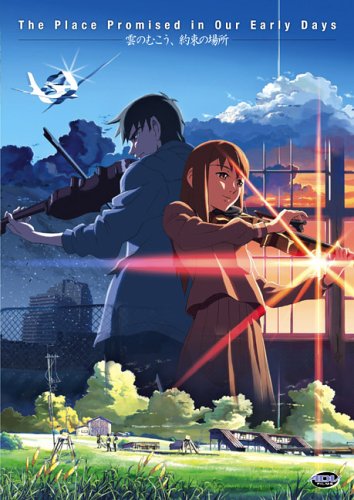
The Place Promised in Our Early Days


(2004) Written and directed by Makoto Shinkai; Starring: Hidetaka Yoshioka, Masato Hagiwara and Yuka Nanri; Available on DVD.

Rating: ***

Does the universe dream?  Writer/director Makoto Shinkai raises this intriguing premise in the beautifully animated, but ultimately hollow exercise, The Place Promised in Our Early Days.  This tale of love, war and parallel universes is better summarized than executed – a near miss that left me on the fence. 


The Place Promised in Our Early Days is set in an alternate Japan divided into two factions: the Union in the north, and the United States-controlled south.  Just within the Union border, in the prefecture of Hokkaido, stands an impossibly tall tower.  The enigmatic structure, whose purpose remains unknown, could be the focal point of a war between both sides, but could also spell the destruction of reality as we know it.  The tower becomes an object of fascination for childhood pals Hiroki Fujisawa and Takuya Shirakawa (voiced by Hidetaka Yoshioka and Masato Hagiwara, respectively), who are building an aircraft with the hope of exploring it close up.  Their dynamic is changed forever when fellow classmate Sayuri Sawatari (voiced by Yuka Nanri) enters the mix.  Hiroki and Sayuri make a promise to visit the tower together – a promise that gets indefinitely sidetracked when she mysteriously disappears. The story shifts ahead three years, as we discover that Sayuri has been in a coma.


Sayuri and her comatose state are somehow linked to the rhythms of the tower, and her awakening could mean disaster for Japan.  The tower, which stretches endlessly to the sky, is the best part of the film.  It represents the great unknown; a vast enigmatic monolith that could be the key to new worlds or the path to our own demise.  We can only deduce that it’s some sort of experiment, weapon, or both, as it opens doors to multiple universes.  Its effects elicit a metaphysical quandary: are these other universes simply the “dreams” of our own universe?  If Shinkai had chosen to linger on this question rather than focus on the more prosaic dramatic elements of the story, we would have been left with an existential meditation on the nature of our existence instead of a film that retreats to familiar territory.


There’s a fine line between maintaining a deliberate pace and just being slow.  The relatively brief running time belies the perception that it’s a much longer film.  While I can appreciate that Shinkai probably wanted to establish a more leisurely pace, it’s hard to dispel the notion that we’re looking at a short film stretched to feature length.  The love story, which is supposed to be the center of the film, is the weakest link, with lead characters that seem somnambulistic. Contributing to this general impression of lifelessness is the virtual absence of humor.


Despite all of my misgivings about The Place Promised in Our Early Days, I didn’t dislike it.  However, I couldn’t shake the feeling that it could have been so much more.  On the surface, the film has all the classic elements that would make it a timeless masterpiece: haunting visuals, universal themes of adolescent love, and a unique science fiction premise.  Unfortunately, none of these pieces quite gel together (Compare to Hayao Miyazaki’s Nausica in the Valley of the Wind or Castle in the Sky, which cover similar ground, but are full of a sense of joie de vivre that’s conspicuously absent in this film).  Shinkai is clearly a talented filmmaker, and if this film is any indication, he has the potential to turn out a truly great film someday, rather than this somewhat underdone, overrated effort.  The Place Promised in Our Early Days is recommended for its stunning visuals and ambitious concept, if you can overlook the bland characterizations and languid pace.