Monday, March 18, 2013

Classics Revisited: The Blob


(1958) Directed by Irvin S. Yeaworth Jr.; Written by Theodore Simonson and Kay Linaker; Starring: Steve McQueen, Aneta Corsaut, Earl Rowe and Stephen Chase; Available on Blu-ray and DVD

Rating: ***½

“We were too stupid to think we could fail, so we succeeded.” – Jack H. Harris (Producer)

The Blob may never be regarded as a classic among stuffier cliques, but it’s notable in its own right as one of the finest teen monster flicks.  The Blob succeeds within its modest goals because it treats its characters with respect and never forgets that the film’s target audience just wants to have a good time.  As with many low-budget independent movies, the road from concept to production was fraught with numerous obstacles.


First-time producer Jack H. Harris aimed to combine the sci-fi and juvenile delinquency genres in one movie.  He hired Theodore Simonson and Kay Linaker to flesh out a script, retaining the original concept of a liquid, cosmic mass that grows as it ingests every human it encounters.  Strapped for funds, Harris took out a second mortgage on his house and cashed the family life insurance policies.  Harris enlisted the aid of Pennsylvania-based Valley Forge Studios to shoot The Blob (its working title was The Molten Meteor). Although the studio had no previous experience with feature-length motion pictures, they had created 3,000 religious short films.  Directorial chores for The Blob were relegated to Irvin S. Yeaworth Jr.,* who had only helmed one other film.  Shooting commenced in 1957,** on location in nearby Chester Springs and Phoenixville, Pennsylvania.    Attempting to complete The Blob on schedule and within budget only proved to be half the battle.  The film was initially turned down by all the major studios, but Paramount eventually picked it up for distribution as part of a double bill with I Married a Monster from Outer Space. 

* The Blob would prove to be the first (and arguably best) of Yeaworth’s three collaborations with producer Harris.

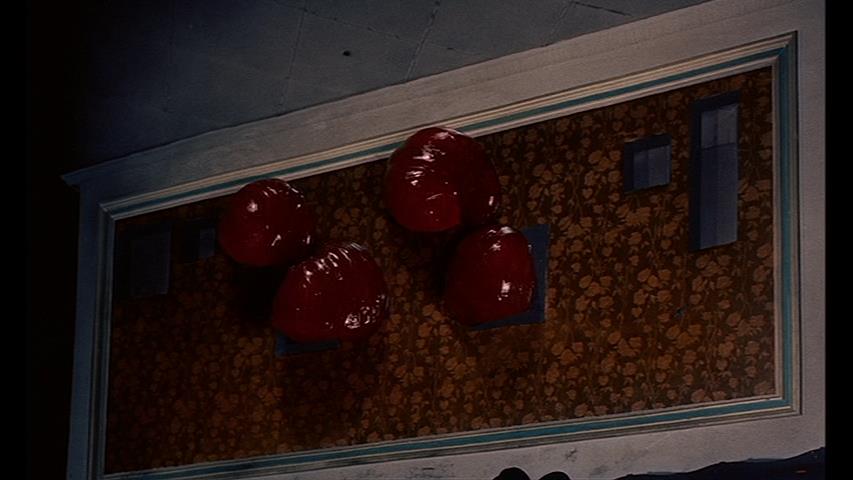
** By the time The Blob reached theaters, it was already 1958, which explained the inconsistency of the 1957 calendar on the wall of the police station set.


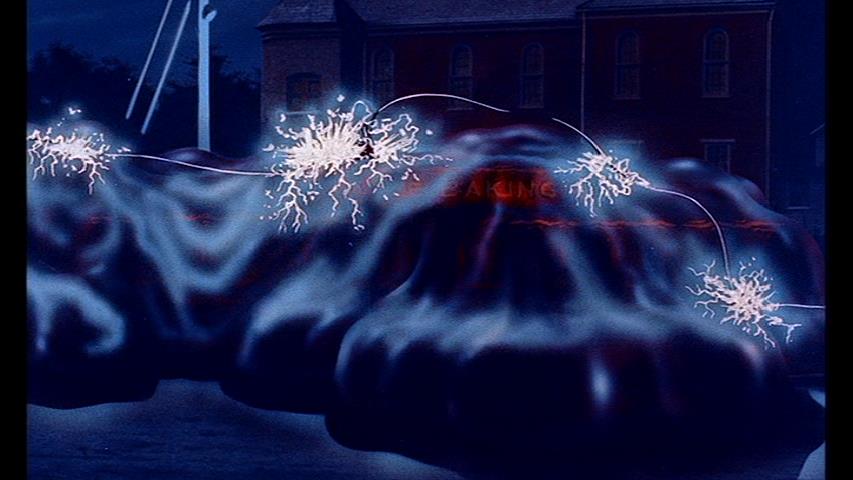
While shooting wrapped in only 30 days, it took six months to create the unique special effects featured in the film.  The filmmakers relied on ingenuity and experimentation to bring the cosmic menace to life.  The Blob itself was fashioned from a weather balloon in the film’s early scenes, and red-colored silicone in the later scenes.  The monster stands apart in The Blob because it’s not the typical man-in-suit variety, but a faceless, amorphous shape with no recognizable link to Earth-bound life.  By virtue of creating a creature whose design was simplicity itself, the effects crew introduced something that was truly frightening and original.

Aside from the titular creature, one of The Blob’s greatest strengths is the performances of the lead performers, Steve McQueen and Aneta Corsaut as teenage protagonists Steve Andrews and Jane Martin, respectively. Although the actors were well into their 20s, they managed to do a credible job of capturing the angst and mischievousness of their youthful characters.  McQueen, who studied acting under Strasberg, was ambivalent about working on a relatively low-profile project such as The Blob, and gained a reputation for being difficult to work with.  Despite any misgivings, however, McQueen turned in an excellent performance, which proved to be a pivotal role for the then-unknown actor, and would lead to bigger and better things as a result.


There are also some nice supporting performances by veteran actors Olin Howlin (in his final film role), as the old hermit who becomes the Blob’s first victim, and Stephen Chase, as Dr. T. Hallen, who futilely attempts to help the old man.  Also noteworthy is Earl Rowe (appearing in his only feature film credit), as the amiable Lieutenant Dave.  Unlike his peers at the police station, he’s willing to give Steve the benefit of the doubt, and entertain the notion that there could be something (other than delinquent teenagers) endangering the town.  His character adds some dimension to a genre where authority figures are generally viewed as the enemy.

The Blob is not a perfect film, but it was never meant to be.  It rises above many other teen monster flicks, thanks to good pacing, smart characters, and a sense of fun, contributing to its much-deserved status as a minor classic.  Subsequent efforts to revive The Blob have met with mixed results.  The original film spawned a belated, unnecessary sequel in 1972 Larry Hagman-directed Beware! The Blob, as well as an excellent 1988 remake (although Jack Harris wasn’t a fan), which was co-written by Frank Darabont and directed by Chuck Russell.  In a Criterion DVD commentary recorded in 2000, Harris mentioned a proposed television project was in the works (we’re probably fortunate that this never saw the light of day).  It probably wouldn’t be too much of a stretch to hypothesize that right now, a studio executive is gauging if the time is ripe for yet another re-imagining.  No matter which form it may take, however, I’ll always hold special affection for the original, warts and all.

Tuesday, March 5, 2013

Holy Motors


(2012) Written and directed by Leos Carax; Starring: Denis Lavant, Edith Scob, Eva Mendes and Kylie Minogue; Available on Blu-ray and DVD

Rating: ***½

“I miss the cameras.  They used to be heavier than us.  Then they became smaller than our heads.  Now you can’t see them at all.” – Mr. Oscar


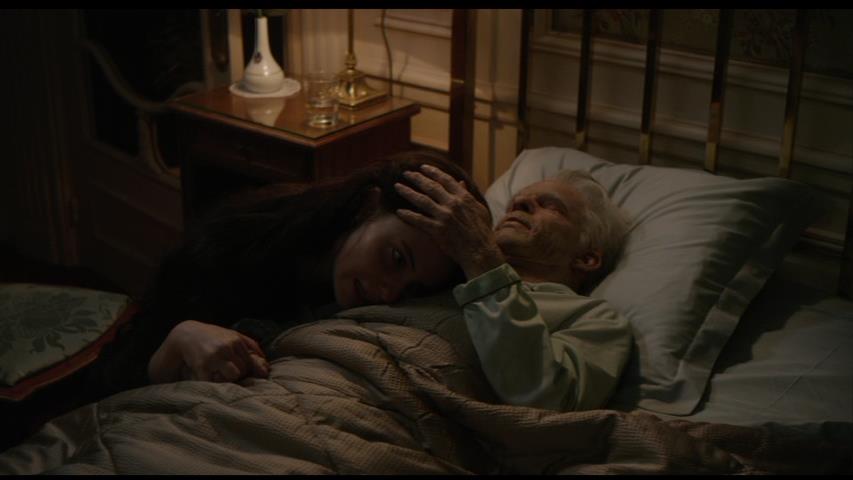
Aside from the knowledge that I was in for a strange viewing experience, I made it a point to avoid learning much about Holy Motors in advance.  In retrospect, it wouldn’t have made much of a difference.  It’s a disorienting film that demands to be watched and re-watched – a puzzle with pieces never intended to fit together perfectly, but somewhat askew.  Writer/director Leos Carax’s first feature-length movie in over a decade follows the chameleon-like Mr. Oscar (Denis Lavant) as he rides around Paris in his chauffeur-driven limousine, adopting one identity after another.  He changes in and out of makeup and various personas while flipping through the dossiers of different individuals.


Holy Motors is full of surprises around every corner, anchored by Lavant’s remarkable, multi-faceted performance.  As the aptly named Merde, a sewer-dwelling troglodyte, he stomps through a graveyard, munching on flowers and pushing aside anyone who gets in his way, accompanied to the strains of Akira Ifukube’s rousing Godzilla score.  In another scene, Lavant appears in a motion capture suit – two bodies engage in an erotic embrace, accompanied by their similarly entwined CGI avatars.  Later, he assumes the identity of a father picking up his teenage daughter from a party.  He punishes her for deceiving him, with the admonishment that she remains herself.  His day begins and ends with very different families, promising that he’s destined to begin the cycle again, only with a whole new set of characters to inhabit.


The peripheral characters in Mr. Oscar’s life provide a few cryptic cues to the bigger picture.  He runs into an old flame, Eva Grace (Kylie Minogue), and they enjoy a brief interlude between appointments.  Eva sings the plaintive song, “Who Were We?” – an ode to their lost past and uncertain future.   The other major player in Holy Motors is Oscar’s laconic chauffeur Céline (Edith Scob).  She clearly cares for her charge, but seems determined to keeping him at arms’ length.  In an affectionate nod to Eyes Without a Face, Scob appears in a mask resembling the one she wore half a century ago, still as graceful and ethereal as ever.


What does it all mean?  The events in Holy Motors were probably never intended to be taken literally.  Shakespeare probably said it best when he wrote, “all the world’s a stage.”  The roles Mr. Oscar occupies are a metaphor for the many faces that each of us wear throughout our day.  We appear differently to our families than to our friends, lovers and business associates.  With many more limos roaming the streets, each presumably with their own Mr. Oscar counterparts, replete with stories of their own, it’s implied we’re only watching the tip of the iceberg.  We’re playing out our respective parts, governed by the cosmic machinery.  Mr. Oscar’s lament about the size of the cameras provides another ambiguous clue to the nature of his world.  Everything is being recorded at all times.  Nothing is intimate. By self-consciously putting on an act for the benefit of others, he’s losing his grip with reality.  His encounters with others like himself beg the question, who are the actors and who is the audience?   He professes his love for “the beauty of the act,” but then poses the question, “what if there’s no beholder?”


Mr. Oscar remains an enigmatic figure, which will likely make Holy Motors a polarizing experience for those who might be looking for solace from easy answers and pat resolutions.  It’s easy to see how the film could be dismissed as pretentious nonsense, but that would be overlooking its many inherent charms.  Carax’s film resides in that sweet spot, somewhere between incoherence and profundity.  You need look no further than the vintage Muybridge clips of bodies in motion, bracketing several scenes, to understand this film is merely a part of a greater legacy.  Like the limousines perpetually roving the city streets, we’re all moving about in the dark, hoping to make a connection, if only for one brief moment.    

Thursday, February 28, 2013

February Quick Picks and Pans


Stingray Sam (2010) This space opera/western/musical hybrid springs from the mind of writer/director Cory McAbee (who also appears as the titular character).  It’s not a feature film in the strictest sense – comprised of a string of episodes which harken back to serials of the 30s and 40s, albeit with a postmodern spin.  Each episode (accompanied by a different song) chronicles the adventures of Stingray Sam (sort of a mash-up between Roy Rogers and Flash Gordon) as he traverses the cosmos with his capricious buddy, The Quasar Kid (Crugie – yep, just Crugie) on a quest to rescue a girl.  It doesn’t make a whole lot of sense, but that’s not really the point.  It’s best to just roll with it, and take in the sights and sounds, accompanied by David Hyde Pierce’s wry narration.  There’s nothing else like it, except maybe McAbee’s similarly themed The American Astronaut. Stingray Sam is a bewildering, but oddly captivating cinematic fever dream that’s worth seeking out.

Rating: ***½.  Available on DVD and Netflix Streaming

 
The Asphyx (1973) This unique little British horror flick feels a bit like a Hammer film, although Peter Cushing and Christopher Lee are conspicuously absent.  Robert Stephens (in a role that would have been perfect for Mr. Cushing) stars as Sir Hugo Cunningham, a man who finds a potential path to immortality by developing a means to capture the spirit (an asphyx) that appears at the moment of death.  His efforts to cheat death predictably backfire, with disastrous results.  While The Asphyx suffers from stagey set design and Stephens’ over-the-top acting, it’s still fun to watch, thanks to a novel premise, along with interesting asphyx effects, which remind me of Ghostbusters.  Check it out.

Rating: ***.  Available on Blu-ray, DVD and Netflix Streaming.


Burke and Hare (2010) Right director, right cast, but wrong direction.  Director John Landis’ Burke and Hare is well-made but unsatisfying.  While I can’t completely dismiss the film, I can’t help but feel Landis missed the perfect opportunity to create a much better movie.  The story about two notorious grave robbers turned murderers (played by Simon Pegg and Andy Serkis) needed to go much darker or much lighter, but ends up somewhere in the middle.  Instead of capitalizing on the more horrific aspects of Burke and Hare’s misdeeds, the film practically paints them as misunderstood folk heroes.  They’re far too sympathetic to be villains, and the comedic elements are far too broad.  What results is a big disappointment.  Sadly, this limp effort doesn’t herald John Landis’ much-deserved comeback.

Rating: **½.  Available on DVD.


Zombie Lake (aka: Le Lac des Morts Vivants) (1981) Depending on your point of view, the prolific director Jean Rollin is an acquired taste or a certifiable hack.  Based on Zombie Lake, which features Nazi zombies rising from the dead, it’s easier to state a case for the latter assertion.  The only conclusion one can make after watching this film is that Rollin was more interested in depicting nubile young women than prompting terror in his audience.  For starters, he apparently didn’t know the basic rules about zombies and their lust for human brains and entrails. Instead, the film’s zombies have a vampire-like thirst for blood (unsurprising, considering Rollin’s fondness for vampires in earlier film efforts).  Zombie Lake features some of the worst zombie makeup ever committed to celluloid, and the underwater shots were obviously done in a pool.  The film sinks to new levels of ineptitude in a “tender” scene between a young girl and her deceased Nazi father, which might only serve to induce uncontrollable fits of laughter.  You have been warned.

Rating: *½.  Available on Blu-ray (really!), DVD and Netflix Streaming

Tuesday, February 19, 2013

Classics Revisited: Harold and Maude


(1971) Directed by Hal Ashby; Written by Colin Higgins; Starring: Ruth Gordon, Bud Cort, Vivian Pickles and Charles Tyner; Available on Blu-ray, DVD and Netflix Streaming

Rating: **** ½

“I haven't lived. I've died a few times.” – Harold

It’s interesting to note a common thread running through several of the films that I have chosen for this column.  Many were not favorites with audiences or critics at the time they were released, but eventually found their audience.  What was considered a misstep became highly regarded after the fact.  Of all the films I’ve covered, Harold and Maude is perhaps the toughest sell on account of its premise – a 20-year-old man falls in love with an 80-year-old woman.  Taken at face value, it’s probably enough to stop most filmgoers dead in their tracks.  That’s unfortunate, since anyone dismissing the film without looking beneath the surface would miss a deliciously witty, dark comedy that’s ironically life-affirming.


Bud Cort shines in his career-defining role as the lugubrious Harold.*  His pallid complexion (which becomes increasingly lifelike as he interacts with Maude), somnambulistic demeanor and wide-eyed expressions stand out in every scene.  He drives an old hearse, attends funerals for recreation and stages several elaborate suicides – all of which is an effort to thwart his long-suffering mother’s (Vivian Pickles) attempts to integrate him into the rest of the world.  His preoccupation with death is a conscious ploy to disengage from society, as he summarily turns away each of the potential mates she has selected for him.  Harold’s tendency to tune out, rather than tune in is at the root of his fascination with death.  It’s easier to play dead than suffer the travails of life. 

* Fun fact: A surprising list of names were considered for the role of Harold.  According to producer Charles B. Mulvehill, Elton John was approached for the film, but he wasn’t interested.  Ultimately, director Hal Ashby auditioned six actors, including Bud Cort, Richard Dreyfuss and Bob Balaban.


If Harold’s mother represents conformity, then Maude (Ruth Gordon) exists as her polar opposite.  The 75-year-old Gordon provides the film’s other standout performance, exhibiting more energy than many actors half her age.  While others (including Harold’s mother) strive to blend in with society, Maude lives to stir the pot.  A brief shot, where a Nazi concentration camp tattoo is revealed on her arm, provides some insight into her motivations and her shadowy European past.  Maude has experienced more pain and tragedy in her life than she can stand, and has since rejected the awful memories and negativity that can only serve to tarnish the present.  She chooses to live life as a free spirit, beyond judgment and conventional morality.*  Maude finds a kindred spirit in Harold, their relationship kindled by their mutual love of funerals.  She facilitates Harold’s emergence into a new identity, as he eschews his false one. 

* Fun fact number two: Despite her character’s penchant for driving off in other peoples’ cars, Gordon herself did not drive.


Cat Stevens’ (aka: Yusuf Islam) lively soundtrack deserves special mention.  His songs are such an integral part of Harold and Maude, that it’s impossible to imagine the film without them.  While he didn’t create a whole soundtrack from the ground up (most of the songs were cobbled together from two of his then recent albums, with a couple of new ones thrown in), the songs are seamlessly woven throughout the scenes.  The infectious “If You Want to Sing Out, Sing Out,” will dwell in your head (in a good way) for days.


So what about the big pink elephant in the room – Harold’s love affair with Maude?  Yes, there’s implied sex (mercifully left to our imagination), but the film isn’t really about that, but two souls enjoying an intense, albeit brief, convergence.  Their relationship is handled discretely and at its core, what they share together is actually quite sweet. 


Ashby originally wanted Harold to kill himself at the end, which would have been the antithesis of everything that led up to that point.  By the film’s conclusion, Harold has established a new, more authentic identity.  He remains a singular presence, rather than a pre-programmed drone.  Harold and Maude’s themes resonate as strongly today as they did when the film debuted.  Through Harold and his bumpy transgression, we’re reminded that facing the inevitability of life is as important as facing the inevitability of death.