Showing posts with label Silents. Show all posts

Saturday, May 3, 2025

The Adventure-a-Thon is Here – Day 2 Recap


Adventure-a-Thon Banner - Prey

We’re back with Day 2 of the Adventure-a-Thon, hosted by Yours Truly and Gill from Realweegiemidget Reviews. We have more wonderful posts in store for you today, but first, a quick reminder, in case you missed it… 

The African Queen

Contest Reminder: As an added “thank you” to those who have contributed posts to the Adventure-a-Thon, I will be hosting a contest in which one lucky blogathon participant will be randomly selected to win a brand-new, all-region Blu-ray copy of the Ray Harryhausen’s timeless adventure classic, The Seventh Voyage of Sinbad (1957). Please read the following contest rules, if you would like to be considered for the giveaway: 

1.     Please email me if you wish to be considered, at: barry_cinematic@yahoo.com, with the following info:

·       Your Name, Blog Name

·       Your answer to the following question: “What’s your favorite Ray Harryhausen movie?” Note: Although an answer is required for eligibility purposes, stating a Harryhausen title different from The Seventh Voyage of Sinbad will not increase or decrease your chances of winning. Responses will be compiled and posted when the winner is announced during Monday’s wrap-up post.

2.     Eligibility is limited to blogathon participants only (you must have submitted a blog post to win).

3.     Sorry, the contest is only open to blogathon participants in the U.S.A, Canada, and Mexico.

4.     Good luck!

Conan the Destroyer

If you’ve signed up, but your post isn’t quite ready, fear not. We’ll post your link on Day Three or the bonus-day “Wrap-up.” Post a comment below, email me at barry_cinematic@yahoo.com, or reach me on BlueSky (@barrycinematic.bsky.social), Instagram (@barry_cinematic), or Twitter/X (@barry_cinematic). You may also contact Gill by commenting on her post, through her blog’s Contact Me page, or on Bluesky (@realweegiemidge.bsky.social).

Jaws

Here are Day 2’s submissions below, and in case you’ve missed yesterday’s post, you can catch up on Day 1 here.

Conquest Poster

Is Lucio Fulci and sword & sorcery a match made in heaven? John Williams from Film Hydra tells us what he thinks of Conquest (1983). 

Dante's Inferno Poster

Lê from Crítica Retrô takes us on a trip to the netherworld, for her review of Inferno (aka: Dante’s Inferno) (1911). 


Stardust

Craig from What the Craggus Saw returns to dazzle us with his review of Stardust (2007).

Edge of Tomorrow Poster

You can read Ryan Ritter’s (at Crittical Analysis) take on Edge of Tomorrow (2014) today. 


The Navigator Poster

Travel through time with Scampy from Spirochaetetrail, as we follow The Navigator:A Medieval Odyssey (1988). 


The Sword of Sherwood Forest Poster

Emma from Nitrate Glow looks at Robin Hood, Hammer style, in The Sword ofSherwood Forest (1960). 


The Lost City of Z

David Ferguson of Movies Reviews from the Dark finds The Lost City of Z (2016). 


See you tomorrow…

Wednesday, October 2, 2024

Silent September Quick Picks and Pans

Within Our Gates Poster

Within Our Gates (1920) Writer/director Oscar Micheaux brought to light racial inequities and concerns that were overlooked by mainstream Hollywood. One prime example, Within Our Gates exposes the myriad ways racism continued to shape and define American society in the early 20th century. Sylvia Landry (Evelyn Preer) a young African American woman, travels from the South (the location is never specified) to Boston in search of funding for a school for disadvantaged black youths. She finds support from an unlikely source. Micheaux strips bare the injustices inherent in a system designed to keep white people on top, but ends his film with hope for a better future. 

Rating: ****. Available on Blu-ray and DVD (in the Pioneers of African-American Cinema box set) and Kanopy


The Kid Brother Poster

The Kid Brother (1927) Harold Lloyd stars as Harold Hickory, the diminutive youngest sibling in a household of lawmen. He discovers a golden opportunity to prove himself when a medicine show rolls into town, and money for a much-needed community project goes missing. While he’s in pursuit of the culprits, he finds the love of his life (Jobyna Ralston), while fending off his mean-spirited archrival (Frank Lanning). The Kid Brother is loaded with gags from start to finish, and features some nifty action sequences (including a confrontation with the crooks on a stranded sailing vessel). 

Rating: ****. Available on Blu-ray and DVD

The Ace of Hearts Poster

The Ace of Hearts (1921) Lon Chaney stars as Farralone, a member of a secret anarchist group, intent on assassinating a prominent industrialist. Chaney plays yet another character who experiences unrequited love (but he does it so well). Farralone almost lets his jealousy get the best of him when Lilith (Leatrice Joy), the object of his affections, falls for another co-conspirator (John Bowers). He must reconcile his conflicted emotions over the woman he loves and his fealty to the group. This low-key thriller/romance stands on the strength of Chaney’s sympathetic performance and a tense restaurant scene. 

Rating: ***½. Available on DVD (included in the Lon Chaney Collection)

The Cameraman Poster

The Cameraman (1928) Buster (Buster Keaton) makes a meager living, selling photos on the street corner. His career aspirations change when he meets Sally (Marceline Day) a young woman who works for a newsreel company. Trading in his portrait equipment for a movie camera, he decides to prove his worth as a reporter. Filled with gags aplenty, The Cameraman showcases Keaton’s gift for physical comedy (especially in a scene where he loses his swimsuit in a public pool). 

Rating: ***½. Available on Blu-ray and DVD


The Star Prince Poster

The Star Prince (1918) In this charming/creepy fantasy film from writer/director Madeline Brandeis (who was only 21 when she directed the film) The Star Prince (Zoe Ray) arrives on Earth, where he’s raised by a poor family. After he callously sends his birth mother away, a fairy turns the once handsome lad into an ugly wretch. He subsequently embarks on a quest to find his mother and make amends. In the midst of his adventure, he encounters a lonely princess (Dorphia Brown) and a hateful dwarf (John Dorland). One of the unique aspects of this production is that all the characters were played by children, lending to the film’s fairytale quality. Location shots and real animals add to the film’s ambitious scope, although I could have done without the “humorous” scenes featuring some baby bears tethered to a rope. 

Rating: ***½. Available on Blu-ray and DVD (included in the Pioneers: First Women Filmmakers box set)

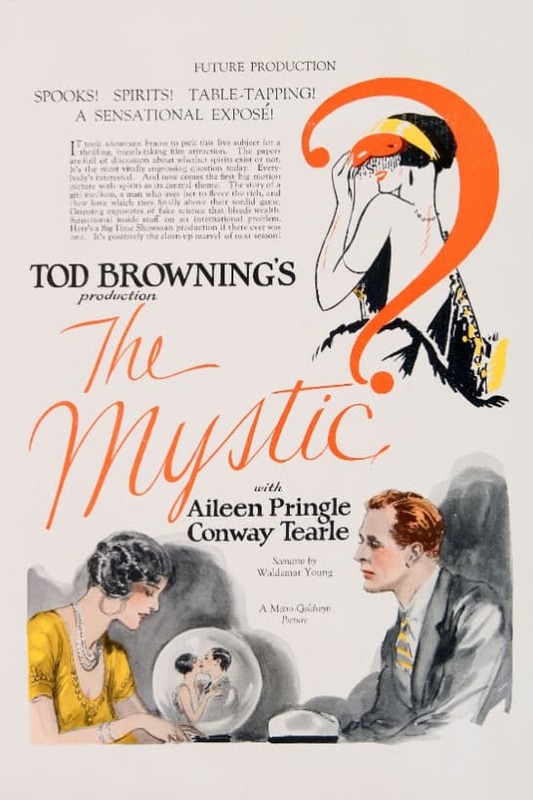
The Mystic Poster

The Mystic (1925) In this little-seen Tod Browning film, an American con-man (Conway Tearle) convinces a Hungarian traveling medium act, led by the lovely Zara (Aileen Pringle) to travel back with him to the United States. He concocts an elaborate scheme, using props and misdirection to hold phony seances to “reunite” wealthy people with their deceased loved ones. Predictably, his plan eventually backfires. An otherwise fascinating movie is only marred by a disingenuous happy ending. 

Rating: ***½. Available on Blu-ray and DVD (part of the Criterion box set, Tod Browning’s Sideshow Shockers)


Saturday, September 28, 2024

The Phantom Carriage


The Phantom Carriage Poster

(1921) Directed by Victor Sjöström; Written by Victor Sjöström; Based on the novel by Selma Lagerlöf; Starring: Victor Sjöström, Hilda Borgström, Tore Svennberg, Astrid Holm and Concordia Selander; Available on Blu ray and DVD 

Rating: ****½ stars 

“No living soul rides in that carriage. By the time I arrive, it’s too late for a doctor. You know full well that I am no longer among the living. But worst of all, you must face the consequences of the evil you have wrought during your lifetime.” – Georges (Tore Svennberg)

The Phantom Carriage

What sort of legacy will we leave behind for our loved ones? Will they think of us with reverence or disdain? We’ve all done things we’re not proud of, but at the end of our lives, when the scales are measured, ideally, the good we’ve accomplished should outweigh the questionable deeds. Director/screenwriter/star Victor Sjöström addresses these questions and more in The Phantom Carriage, based on Selma Lagerlöf’s 1912 novel Körkarlen (aka: Thy Soul Shall Bear Witness!), part of a collaboration between Sjöström and the author that would span five films.

Edit's Deathbed

In the opening scene, Edit (Astrid Holm) lies on her deathbed on New Year’s Eve, asking for David Holm (Victor Sjöström) to visit. In the following scene, Holm drunkenly celebrates with his companions in a graveyard, telling stories to keep warm. He relates the tale that sets the rest of the plot in motion – whoever dies at the stroke of midnight on New Year’s Eve is destined to drive Death’s ghostly carriage, armed with a scythe to reap the souls of the dead, for the following year, with no reprieve or days off. After a scuffle with one of his friends, David perishes at midnight, coming face to face with the legendary carriage and its driver, Georges (Tore Svennberg), who passed away the previous New Year’s Eve. Before Holm takes his place, Georges makes his bewildered replacement re-experience three pivotal moments (told in flashback) when his life took a wrong turn. In the first flashback, we see how Holm turned away from his family and embraced alcoholism.* After being jailed for public drunkenness, he’ released, only to return to an empty house. Instead of reflecting on his wretched behavior, he vows revenge against his wife (Hilda Borgström) for abandoning him. Thus follows Holm’s personal journey, running the gamut of emotion from anger, disgust, guilt, self-loathing, and ultimately redemption. 

* Fun Fact #1: The Phantom Carriage was co-opted by proponents of the temperance movement in several countries, to illustrate the evils of alcohol abuse.

Holm Leaves His Body Behind

At the heart of The Phantom Carriage is Sjöström’s nuanced performance. Seemingly bereft of the capacity for self-reflection, Holm blames his sorrows on his wife. He descends into an abyss of bitterness and hatred, immune to others’ overtures of compassion and charity. In the second flashback, set during the previous New Year’s Eve, he visits a Salvation Army shelter, where he captures the eye of Sister Edit (Astrid Holm). While he sleeps, she thoughtfully repairs his tattered coat, despite warnings from her colleague that it’s covered in germs and filth (a decision that will ultimately cause her death). She cheerfully returns the repaired garment to Holm, only for him to callously render it apart. She later visits him in a bar, where he’s only grown more bitter with time (“Why turn away so carefully? I’m a consumptive, myself, but I cough in people’s faces in hopes of finishing them off. Why should they be better off than us?”). When he discovers the whereabouts of his wife and children, their reunion is less than conciliatory (while she appears ready to pick up where they left off, he fiercely holds on to his wife’s perceived betrayal). When she attempts to lock herself and the children away from Holm, he hacks through the door with an axe* (In an act of spitefulness, he subsequently attempts to infect his own children). Eventually faced with his own mortality, David begs the carriage driver for forgiveness and a second chance. While it’s difficult to excuse his antisocial behavior, our portrait of David Holm is far from one-sided. We also witness his capacity for love and kindness in a flashback with his family, and when he returns as a spirit to comfort Edit in her final moments. 

* Fun Fact #2: Film historian Casper Tybjerg claims this memorable scene (copied years later by Stanley Kubrick in his version of The Shining) may have been influenced by a similar sequence in Broken Blossoms (1919).

Edit and David Holm

If David Holm personifies selfishness, then Sister Edit* represents his polar opposite. Rather than seeing Holm’s rejection of her charity as an irredeemable act, she views him as a challenge. Despite all indications to the contrary, she never gives up faith in his ability to find redemption. While there are indications that her motivations are not completely selfless, her feelings for him give way to seeing that his marriage is repaired. In an act of misguided good intentions, she reunites David with his family, with disastrous results.   

* Her deathbed scenes seem to prefigure Harriet Andersson’s scenes as Agnes in Ingmar Bergman’s Cries and Whispers (1972).

The Phantom Carriage

The ghostly image* of the carriage rolling through the city streets, pulled by a skeletal horse, ranks among some of the most haunting imagery of silent (and talkie) cinema. A particularly indelible sequence depicts the driver retrieving a soul from a drowned sailor on the ocean floor (A possible influence for a scene in Night of the Hunter?). It’s a testament to the skill of the filmmakers** that more than 100 years later, we remain mesmerized by these images. Another factor that contributes heavily to the gloomy atmosphere is that most of the film takes place in the evening. Despite the inherent lighting challenge with film equipment of the time, Sjöström insisted on night-for-night shooting. 

* Fun Fact #3: Although commonly referred to as “double exposure” some of the in-camera effects shots required the film to pass through the camera as many as four times. 

** Fun Fact #4: Writing about the production at the time (specifically Julius Jaenzon’s cinematography) Sjöström commented, “We were proud of the ghosts’ consistency. They were actually not flat and misty. As a result of artful lighting, they had become three-dimensional in their spirituality.”

Holm's Family Discovers Him Passed Out in the Street

Is David Holm beyond redemption? It depends on your point of view. Nothing could undo the damage he inflicted on several lives, but it’s significant that he comes to a realization of his culpability at the moment of his death. Whether he’s virtuous or evil (or somewhere in-between, like most of us), Holm is still doomed to drive the phantom carriage. Perhaps it’s a matter of perspective – to be resigned to one’s fate instead of feeling shackled by it. While The Phantom Carriage received glowing reviews upon its release (Charlie Chaplin and Ingmar Bergman ranked among its many fans) it fell out of favor with critics in the ‘30s, with some accusing the film as being too naïve and moralistic, and its double-exposure shots as passé, time has vindicated Victor Sjöström and his remarkable film. Sjöström used every tool available to tell his story, and it shows. The Phantom Carriage encourages the viewer to turn inward and confront their virtues and failings. If we see a little of ourselves in each of the film’s characters, the resemblance is far from incidental.  


Sources for this article: Criterion Blu-ray commentary by Casper Tybjerg; Victor Sjöström: His Life and His Work, by Bengt Forslund (1988)  


Thursday, September 12, 2024

Short Take: Waxworks


Waxworks Poster

(1924) Directed by Paul Leni; Written by Henrik Galeen; Starring: Emil Jannings, Conrad Veidt, Werner Krauss, William Dieterle and Olga Belajoff; Available on Blu-ray and DVD 

Rating: ***½

“Ivan was a blood-crazed monster on a throne, who turned cities into cemeteries. His crown was a tiara of mouldering bones, his sceptre an axe. His council-room was a torture chamber, with the Devil and Death as chief ministers.” – Intertitle for "Ivan the Terrible" Segment 

Wax figures of Harun Al-Rashid, Ivan the Terrible, Jack the Ripper and Rinaldo Rinaldini

Horror anthologies (and omnibus movies in general) are a special breed of film, providing several complete segments, linked by a branching story. As a result of their episodic nature, they’re often a mixed bag to watch, frequently varying in tone and quality. The beauty of the format, however, is that if you don’t like one story, you usually don’t have to wait too long for the next. Amicus productions arguably perfected the horror portmanteau in the ‘60s and ‘70s, with a string of macabre offerings, starting with Dr. Terror’s House of Horrors (1965), which was directly influenced by Dead of Night (1945). If Dead of Night was the father of the format, then the grandad was 1924’s Waxworks (aka: Das Wachsfigurenkabinett)* from director Paul Leni (The Man Who Laughs, The Cat and the Canary) and writer Henrik Galeen (Nosferatu: A Symphony of Horror). Leni, who worked in many aspects of filmmaking, brought his signature visual flair to the film, before moving to Hollywood for the remainder of his all-too-brief career.*/** 

* Not-So-Fun-Fact #1: The original negative burned in 1925. The reconstructed 82-minute version that exists today is derived mainly from a British print, and is 25 minutes shorter than the version that premiered in Germany. 

** Not-So-Fun-Fact #2: Leni’s career was tragically cut short when he died of blood poisoning in 1929, only a couple of years after moving to Hollywood.

The Writer and His Muse

 In the framing story, a young writer (William Dieterle) visits a carnival sideshow featuring wax figures of some of history’s most notorious individuals: Harun Al-Rashid, Ivan the Terrible, Jack the Ripper and Rinaldo Rinaldini. After catching the eye of the proprietor’s daughter (Olga Belajoff), he’s hired to write their checkered backstories, which follow in a trio of segments. */** 

* Fun Fact #1: Why only three segments? Plans for a fourth story, concerning the Italian gentleman thief Rinaldo Rinaldini, were scuttled when the filmmakers ran out of funds. 

** Fun Fact #2: when the film premiered in its native Germany the order of the stories was completely different, starting with Ivan the Terrible, followed by Jack the Ripper, and concluding with Harun Al-Rashid.

The Streets of Bagdad

The first (and best) story concerns Harun Al-Rashid (Emil Jannings), the capricious Caliph of Bagdad. When Assad, a lowly baker (William Dieterle, in a second role), inadvertently raises the ire of the Caliph, the ruler sends his Grand Vizier (Paul Biensfeldt) to dispatch the offending baker. After hearing a description of the baker’s wife Zarah (Olga Belaioff, also in a second role) from his vizier, the Caliph decides to roam the city incognito to catch a glimpse of her for himself. Meanwhile, in an effort to prove his worth, the baker schemes to steal the Caliph’s “Wishing Ring,” a magical ring that can grant any wish by the turn of its jewel. This segment is a visual delight, featuring a fanciful, expressionistic version of Bagdad that appears almost organic, with no straight lines or right angles.

Ivan the Terrible and His Hourglass

Compared to the lighter tone of the first segment, the second, with Ivan the Terrible (Conrad Veidt), is noticeably darker. The focal point of the story is Ivan’s hourglass, which marks the time a poisoned victim has to live – it’s fittingly ironic that the device becomes the instrument of his eventual comeuppance. Veidt shines as the Russian despot, who keeps the population ensnared in a web of fear. Despite Veidt’s imposing performance and unique set design, the pacing is inconsistent in the second story, making it seem subjectively longer than the preceding (and objectively longer) segment.   

Jack the Ripper

The third segment, by far the shortest,* focuses on Jack the Ripper (or “Spring-Heeled Jack” in the English-language version). It’s not big on story or plot, but a nightmare come to life. The writer falls asleep, dreaming he’s relentlessly pursued through the back streets and alleys by the ignominious killer (played by Werner Krauss, who also appeared as the titular Dr. Caligari).   

* Fun Fact #3: According to Julia Walmüller, who was involved with the film’s restoration, the Jack the Ripper story was always the shortest segment.

Jewel on the Caliph's Ring

Waxworks isn’t easily classified into one genre – not exactly horror, but horror-adjacent.  While largely an exercise in style over substance (the superior Harun Al-Rashid segment notwithstanding), it’s undeniably gorgeous to look at. Although the sum is less than it could have been, Waxworks deserves its place as a revered classic that belongs on anyone’s list of must-see silent films. 


Sources for this article: Flicker Alley Blu-ray commentary by Adrian Martin; “In Search of the Original Version of Paul Leni’s Das Wachsfigurenkabinett: Interview with Julia Walmüller (Deutsche Kinomathek)” (2020)


Monday, October 23, 2023

The Cabinet of Dr. Caligari


The Cabinet of Dr. Caligari Poster

(1920) Directed by: Robert Wiene; Written by Carl Mayer and Hans Janowitz; Starring: Werner Krauss, Conrad Veidt, Friedrich Fehér, Lil Dagover and Hans Heinrich von Twardowski; Available on Blu ray and DVD 

Rating: ****½ 

“Ladies and gentlemen, Cesare the somnambulist will answer all your questions. Cesare knows every secret. Cesare knows the past and sees the future. Judge for yourselves. Don’t hold back, ask away!”      –Dr. Caligari (Werner Krauss)

Dr. Caligari and Cesare

Modern horror films owe a debt of gratitude to The Cabinet of Dr. Caligari, which has been encoded in the DNA of virtually every genre title that followed. Likewise, it’s a safe bet that Tim Burton’s movies wouldn’t have been the same without the influence of this landmark film and its distinctive visuals. I can’t substantiate how it must have also influenced the goth look, but we’ll just chalk it off to the collective unconscious (and dedicated fans of silent horror). Some of the most enduring films stem from Germany’s Weimar Era, a vibrant period for cinema, typified by a new generation of filmmakers who pushed the envelope visually and thematically. Director Robert Wiene’s* The Cabinet of Dr. Caligari ** made a big splash when it debuted in February 1920, with its mind-bending story and dream world made real.    

* Fun Fact #1: Although some dispute the veracity of this claim, many assert that Fritz Lang was originally chosen to direct the film, but was otherwise occupied with the production of The Spiders (1919/1920). 

** Fun Fact #2: In the early ‘30s, while in self-imposed exile from Germany, Wiene planned to direct a sound remake of The Cabinet of Dr. Caligari, starring Jean Cocteau as Cesare. Due to illness and the inability to secure funding for the project, the remake never became a reality.

Alan, Jane, and Franzis

In the opening scene, set in an asylum for the mentally ill, Franzis (Friedrich Fehér) relates to a fellow patient how he came to be in his current predicament. Cut to the sleepy village of Holstenwall, where mesmerist Dr. Caligari petitions the town clerk (who sits in a cartoonishly tall chair) to display his novel attraction at the annual fair. The star of Caligari’s show is Cesare (Conrad Veidt), a somnambulist, who resides in a coffin-like wooden box (forget about the ethics of transporting a person like a piece of luggage). Supposedly gifted with clairvoyance, Cesare awakens only on his master’s command. Franzis convinces his lifelong friend (and rival for the affections of the comely Jane Olsen) Alan to indulge in frivolity and accompany him to the fair, where they stumble upon Caligari’s exhibit. A fun day out turns into a nightmare when Alan asks Cesare how long he’ll live, prompting the reply, “To the break of dawn.” Unfortunately for Alan, the prophecy proves to be true, as he’s later discovered, murdered in his bed. Under the direction of the diabolical Caligari, Cesare is commanded to obey his every whim, which includes eliminating anyone who displeases him. The town falls into a panic as the residents wonder who the next victim will be. Devastated by his friend’s violent death, and fearing for Jane’s (Lil Dagover) life, Franzis tasks himself with tracking down Caligari and bringing the mad doctor to justice. His search leads him to an insane asylum, where Caligari resides as the institution’s director. This discovery sends Franzis into a tailspin, as he (and the audience) questions his grip on reality.

Cesare Carrying Jane

The film’s aesthetic choices (courtesy of production designers Walter Reimann, Walter Röhrig and Hermann Warm), often cited as a prime example of German expressionism, depict a world comprised of impossible landscapes, skewed angles (what would the ‘60s Batman TV show be without this movie?), and ominous shadows. In a conscious effort to stray from realism, there isn’t a rectangular door or right angle in sight. Conrad Veit, as Cesare, with his tall, lanky frame, gaunt appearance, and skin-tight dark clothing, almost seems an extension of the architecture. He’s little more than an automaton, programmed to follow Caligari’s twisted whims.

Cesare Holds Knife While Jane Sleeps

Sigmund Freud opined that dreams were the “royal road to the unconscious.” The film is a waking nightmare, with its uniquely twisted version of reality. But within the artificial world of Caligari, we confront the darker impulses that lie within ourselves. Who, in our darkest moments, hasn’t had an intrusive thought about acting out something that would be otherwise unconscionable? If we had an agent to carry out our unsavory impulses, our hands, if not our conscience, would remain clean. The Cabinet of Dr. Caligari also reflects our collective anxieties about losing our faculties to distinguish reality from fantasy. Who is the puppeteer and who’s the puppet master? Caligari pulls Cesare’s strings, but who manipulates Franzis? It’s revealed that the doctor isn’t the real Caligari, but an ardent student of his research. Amidst his own research he concludes, “You must become Caligari” (which also became the film’s advertising slogan) if he is to understand Caligari.

Cesare and Caligari

Much like the film’s overall visual aesthetic, the story is told in broad strokes, from the perspective of Franzis, an unreliable narrator. The Cabinet of Dr. Caligari keeps us on edge from moment to moment, until we (like the characters in the film) can no longer trust our perceptions. Are we to take Franzis’ account at face value regarding the director of the asylum, or are his recollections merely the elaborate delusions of a disordered mind? Signs point to the latter, but the final shot of Caligari suggests otherwise. Either way, it’s a discombobulating experience, guiding us on the kind of uncanny journey that only horror can take us. Once watched, The Cabinet of Dr. Caligari is never forgotten – leaving an indelible mark after playing in the toybox of our minds.


Sources for this article: Beyond Caligari – The Films of Robert Wiene, by Uli Jung and Walter Schatzberg; The Haunted Screen, by Lotte H. Eisner; “Suggestion, Hypnosis, and Crime,” by Stefan Andriopoulos (from Weimar Cinema, edited by Noah Isenberg); Caligari: How Horror Came to the Cinema (2014 documentary)


Saturday, April 29, 2023

The Futurethon is Now! – Day 2 Recap


Futurethon - Forbidden Planet

Greetings, fellow time travelers, and welcome to Day 2 of the Futurethon! Tonight, we have a trio of astounding posts for your perusal. Thanks to all who have participated, so far, and those who still plan to participate. We can’t wait to check out your posts!

Star Trek II - The Wrath of Khan
 

Here’s a gentle reminder: If you’ve signed up, but your post isn’t quite ready (Hey, I’m always late to my own party), fear not! We’ll feature it on Day Three or the Monday Wrap-up. Latecomers are still welcome (just drop us a line). Post a comment below, email me at barry_cinematic@yahoo.com, or DM me on Twitter (@barry_cinematic). You may also contact Gill by commenting on her post, through her blog’s Contact Me page, or on Twitter (@realweegiemidge).

Outland
 

Here are Day 2’s submissions, and don’t forget to check out all the wonderful posts from Day 1 . We’ll see you tomorrow, for Day 3!

Aelita Queen of Mars Poster

While David Bowie wondered if there was life on the red planet, Lê from Crítica Retrô provides the answer, in her review of Aelita, the Queen of Mars (1924). 


Return to the Planet of the Apes

John from Tales from the Freakboy Zone isn’t monkeying around with his assessment of the short-lived animated TV series, Return to the Planet of the Apes (1975-1976). 


Rollerball Poster

Hey, sports fans, Ruth from Silver Screenings looks at the brutal, future pastime depicted in Rollerball (1975). 


Friday, April 28, 2023

The Futurethon is Now! – Day 1 Recap


Futurethon Banner

The future is closer than you think… Because it’s already upon us. Welcome to Day One of the Futurethon, hosted by Yours Truly and my forward-thinking co-host Gill Jacob of Realweegiemidget Reviews! Over the next three days and perhaps one more (wink, wink, nudge, nudge), we’ll be featuring various visions of tomorrow from the big and small screen.


Silent Running

If today’s crop of exemplary posts is any indication, we’re in for a treat this weekend. If you’ve signed up, but your post isn’t quite ready (present company included), we’ll feature it on Day Two or Day Three. Latecomers are also welcome (just drop us a line). Post a comment below, email me at barry_cinematic@yahoo.com, or DM me on Twitter (@barry_cinematic). You may also contact Gill by commenting on her post, through her blog’s Contact Me page, or on Twitter (@realweegiemidge).

THX-1138

Now, let’s rev up the time machine and journey into Day 1…

Beyond the Time Barrier Poster

The intrepid Brian from Films Beyond the Time Barrier takes us (wait for it)… Beyond the Time Barrier (1960) 


Death Race 2000 Poster

Fasten your seatbelts and hang on for a bumpy ride, as Terence Towles Canote from A Shroud of Thoughts reviews the Roger Corman cult classic, Death Race 2000 (1975) 


Aeon Flux Poster

How does an animated TV show translate to a big-budget film production? Rebecca from Taking Up Room dishes out her opinion of Aeon Flux (2005). 


Dune Poster

Let’s travel to the year 10,191 as Sean from Garden of Memory takes a look at Dune (2021). 

Alien 3 Poster

Is the third time a charm? Let’s find out, as John from UK Film Nerd examines David Fincher’s Alien³ (The Assembly Cut) (1992). 

Moon Poster

But wait, there’s more, as John also explores Duncan Jones’ Moon (2009).  

Robot and Frank Poster

Scampy from The Spirochete Trail takes a few steps into the not-so-distant future with Robot and Frank (2012)  


Soylent Green Poster

What’s eating you? Chris at Angelman’s Place discusses the dystopian nightmare, Soylent Green (1973). 


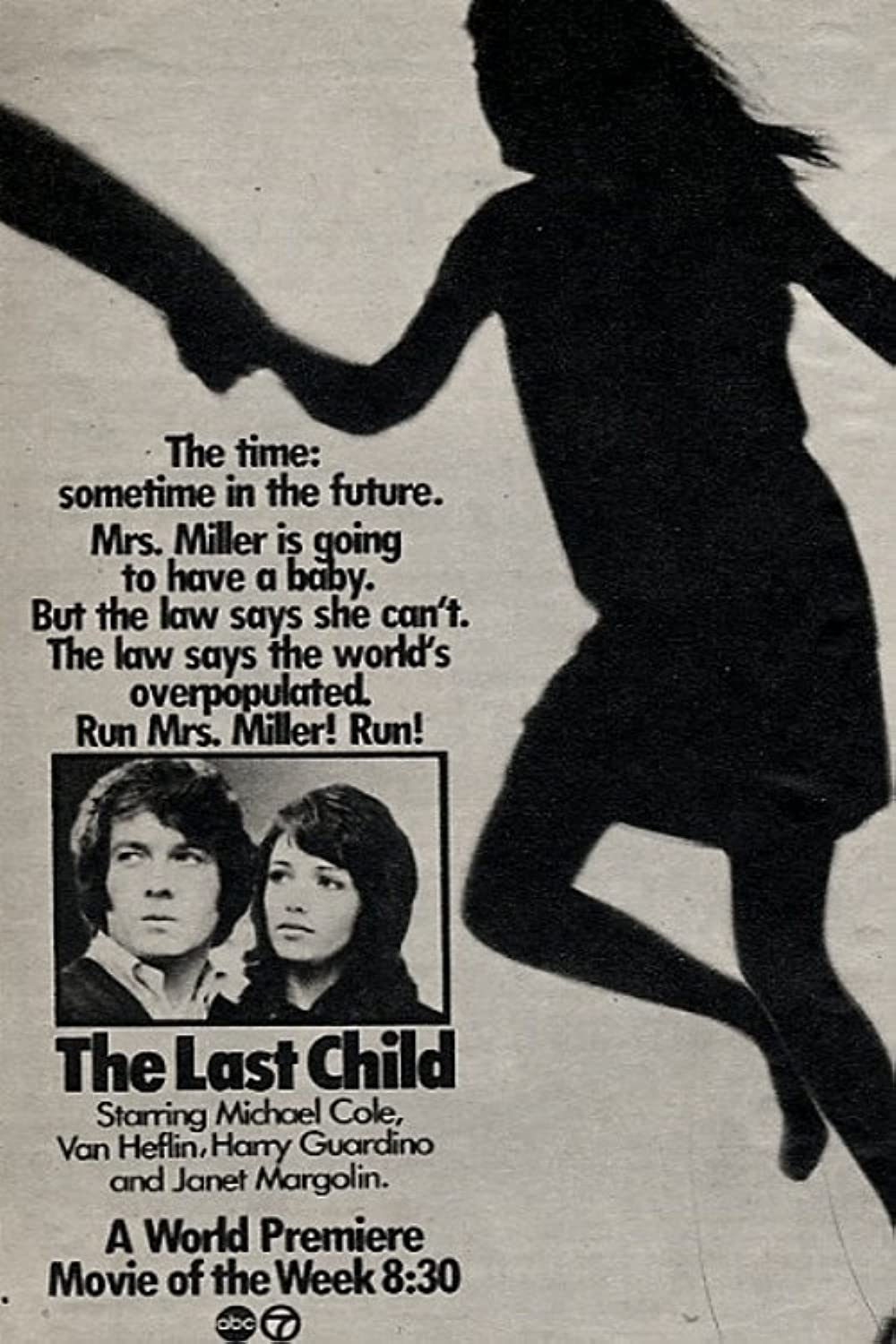
The Last Child Poster

Don’t touch that dial! Sally Silverscreen from 18 Cinema Lane tunes into the TV movie, The Last Child (1971). 


Metropolis Poster

Paul from Silver Screen Classics visits the city of tomorrow, today, with his review of Fritz Lang’s Metropolis (1927).

Buck Rogers in the 25th Century

Let Gill from Realweegiemidget Reviews be your guide to Earth of the future, as she meets Buck Rogers in the 25th Century (1979).