Showing posts with label France. Show all posts

Monday, April 20, 2026

Quest for Fire


Quest for Fire Poster

(1981) Directed by Jean-Jacques Annaud; Written by Gérard Brach; Based on the novel by J.H. Rosny Sr.; Starring: Everett McGill, Rae Dawn Chong, Ron Perlman, Nicholas Kadi, and Naseer El-Kadi; Available on Blu-ray and DVD 

Rating: ****½


Amoukar - Ron Perlman

“I thought I was making this crap caveman movie. I found out that this guy (Jean-Jacques Annaud) had won an Academy Award for ‘Black and White in Color,’ and he was a distinguished filmmaker. By the time I got nervous, I already had the role, so I didn’t trip myself up.” – Ron Perlman, on auditioning for Quest for Fire (Excerpted from 2017 Variety interview)

Sabretooth Cat

It’s no big surprise that most film depictions of early humankind are somewhat lacking in veracity. Whether due to lack of budget, research, or by design, most caveman movies end up looking silly, bordering on self-parody, or straight-out comedies. By default, filmmakers and production companies preferred a more fanciful recreation of primitive people, grunting gibberish, wearing very little, and more often than not, walking amongst dinosaurs (even though the mighty beasts died out many millions of years before our earliest ancestors were on the scene).* Few filmmakers bothered with a “serious” depiction about our early ancestors. One notable exception was Stanley Kubrick’s “Dawn of Man” segment of 2001: A Space Odyssey, which served as a point of reference for French director Jean-Jacques Annaud. Far from the norm, Quest for Fire would reflect the combined efforts of anthropologists, linguists, and many other talented researchers and artists to create a more authentic experience. After three-and-a-half years of development, and an exhaustive search for locations around the world,  filming** commenced in Glencoe, Scotland, Nairobi, Kenya, and Northern Ontario, Canada.*** Budgeted at $12 million, Annaud’s film faced numerous hurdles to overcome, not the least of which were strict Canadian regulations, requiring a certain percentage of Canadian actors, makeup artists and editors. 

* Fun Fact #1: According to Annaud, he purposely wanted to avoid making something like Hammer’s One Million Years B.C. (1966) or Prehistoric Women (1967). 

** Fun Fact #2: In his DVD commentary, Annaud noted that everything was shot live, without post-production trickery. There were very few second takes. 

*** Fun Fact #3: Original plans were to film in Iceland, with its primordial landscape, but shooting was called off due to delays from an ongoing actors’ strike and bad weather.

Trying to Save the Fire

Set 80,000 years in the past, when early humans were just gaining a foothold at the top of the food chain, they endured multiple threats from creatures and hostile tribes, in defense of the one rare commodity that determined who would survive – the possession of fire. When a Neanderthal tribe (the Ulam people) is ambushed by a savage clan of pre-humans (the Wagabou tribe), they set out to make a new home, carrying their precious fire in a crude lantern fashioned from animal skin and bones. In their haste to relocate, their fire is accidentally extinguished. Three are chosen to bring it back to the tribe: Naoh (Everett McGill), Amoukar (Ron Perlman), and Gaw (Nameer El-Kadi).* As our intrepid protagonists set out on their adventure, dangers lurk around every corner, including a pair of hungry sabretooth cats,** who chase our intrepid protagonists up a tree, a stately herd of wooly mammoths,***/**** and a hostile tribe of cannibals (the Kzamm). But all isn’t misery and strife, when they find a new friend with Ika (Rae Dawn Chong)***** a representative from the Ivaka tribe. Over the course of their travels, they will learn to cooperate with each other, and not only gather fire, but learn to create it.******  

* Fun Fact #4: Nameer El-Kadi had a twin brother, Naseer, who played a fellow member of the Ulam tribe in early scenes. Naseer also stood in for Nameer when his brother was unavailable to shoot a scene involving the tribe’s run-in with a bear. 

** Fun Fact #5: Ligers (half-lion/half-tiger), equipped with prosthetic teeth, were utilized for the “sabretooth” cats. 

*** Fun Fact #6: In a scene when the trio of Neanderthals encounter a herd of wooly mammoths, the filmmakers employed children made up to resemble the leads, so the creatures would appear more massive. 

**** Fun Fact #7: The “mammoths” were 14 circus elephants fitted with masks, specially created hairpieces made from knotted yak hair, and enlarged prosthetic tusks. 

***** Fun Fact #8: According to Annaud, Chong wasn’t an actor when he discovered her on the beach in California, but he persuaded her to act in his movie. 

****** Fun Fact #9: For a pivotal scene in which an Ivaka tribesman creates fire…the filmmakers hired a Masai tribesman

Ika - Rae Dawn Chong

While McGill, Perlman, and El-Kadi do an extraordinary job as the three Neanderthal leads, Rae Dawn Chong deserves special mention for one of the film’s most challenging roles as Ika, a Homo Sapiens woman, who spends a large portion of the film clad in nothing but body paint (actually layers of clay and charcoal, inspired by modern tribes). Much to the delight and dismay of her somewhat dim Neanderthal counterparts, she schools them in the ways of making fire, humor (reacting to a rock falling on Amoukar’s head with laughter), and instructing Naoh in the art of lovemaking. The sex and nudity depicted in the movie are presented in a matter-of-fact manner, not intended to be titillating or exploitive, but reminiscent of an anthropological study.

Wooly Mammoths

Quest for Fire invites us to immerse ourselves in the prehistoric world, starting with Annuad’s insistence on no subtitles (despite the urging of a short-sighted film executive). Instead, the filmmakers trust us to infer what’s happening onscreen through the characters’ facial expressions, gesticulations and body language. One of the film’s conceits is that not a single word of modern language is spoken. Instead, author/linguist Anthony Burgess (A Clockwork Orange), devised a language*/** for the Neanderthals, based on Indo-European roots. British zoologist Desmond Morris arranged sessions for the cast to mimic apelike behaviors, and Canadian mime Gary Schwartz (who appears as Rouka, from the Ulam tribe), instructed the actors on movement. Great care also went into the makeup,* to ensure the characters appropriately resembled their parts.   

* Fun Fact #10: The language used by the Ulam tribe included 350 distinct words. 

** Fun Fact #11: Because Burgess was only available for a relatively short time, there was no time to devise a completely different language for Ika’s tribe. Instead, the filmmakers recorded native Inuit speakers for their dialogue. 

*** Fun Fact #12: The elaborate Academy-award-winning makeup (by Sarah Monzani and Michèle Burke) for the principal characters, comprised of five separate pieces, took five hours to apply and two hours to remove. The wigs were designed in three pieces instead of one piece (as in most other caveman films), to make the characters’ hair look more authentic. 

Naoh - Everett McGill and Ika - Rae Dawn Chong

45 years after its release, Quest for Fire remains the gold standard of caveman movies – the touchstone that all other films like it are compared against. While no one alive has ever heard a Neanderthal speak or watched sabretooth cats relentlessly pursue their prey, Quest for Fire’s compelling images are probably the closest thing to a documentarian traveling 80,000 years into the past to observe our ancestors.  


Sources for this article: DVD commentary by Jean-Jacques Annaud; “Quest for Fire – Pretty Department, Dirty Work,” by Suzanna Plowright (Cinema Canada, September 1981); “Final Cut: My First Time in Variety – Ron Perlman” (Variety, Sept. 20, 2017); “Canadian Regulations Under Fire As ‘Quest’ Shoot Continues,” by Gloria Kissin (The Hollywood Reporter, May 5, 1981)


Monday, September 1, 2025

Animated August Quick Picks and Pans


Harvie Krumpet Poster

Harvie Krumpet (2003) Writer/director Adam Elliot’s stop-motion-animated short film introduces us to the bittersweet world of Harvie Krumpet, a Polish immigrant with Tourette’s Syndrome living in Australia (Geoffrey Rush provides the droll narration). Like many of Elliot’s other films, it’s a celebration of the outsider and their uniquely skewed perspective. Despite his struggles connecting with others, Harvie manages to carve his own niche in society. This brief but affecting portrait pushes all the right buttons, and is well worth a look (or two or three). 

Rating: ****. Available on Blu-ray (included in The Adam Elliot Collection), DVD, Kanopy and Tubi


The Tune Poster

The Tune (1992) Bill Plympton’s musical film celebrates the creative process as it intersects and clashes with commercialism. When he experiences the songwriter’s version of writer’s block, Del journeys to the musical town of Flooby Nooby to find inspiration and learn to sing from the heart. Plympton’s unique hand-drawn animation, takes the viewer in unexpected directions, with byzantine gags that build on each other. Will Del find his inspiration in time to please his demanding boss, and win the woman of his dreams? Watch and find out. 

Rating: ****. Available on Blu-ray, DVD and Tubi 

Blood Tea and Red String Poster

Blood Tea and Red String (2006) Christiane Cegavske’s exquisitely detailed stop-motion-animated film plays like a waking dream, skirting the barriers of consciousness. A group of birdlike people clash with mice over a life-size doll, while a frog shaman works his special brand of conjuring. Blood Tea and Red String uses fairy tale tropes to tell its unique story about infatuation, greed and togetherness.   

Rating: ***½. Available on

Phantom Boy Poster

Phantom Boy (2015) Alex, an 11-year-old boy undergoing chemotherapy, becomes an unlikely partner for an injured police detective when he discovers the ability to leave his body. When a super criminal vows to take control of New York City, Alex scours the streets for clues that might break the case. Jean-Loup Felicioli and Alain Gagnol’s French-animated feature is about summoning your inner strength, even when you feel powerless. 

Rating: ***½. Available on Blu-ray, DVD and Kanopy


Hana and Alice Poster

The Murder Case of Hana and Alice (2015) After her parents’ divorce, Tetsuko Arisugawa (“Alice”) moves to a small town with her mother. As the new kid at her middle school, she arrives to a mystery, under the watchful eye of a shut-in former student, Hana. Shunji Iwai’s gentle tale of friendship separates myth from reality, as Alice contends with bullying classmates and reticent locals to learn the truth about a classmate’s alleged death.   

Rating: ***½. Available on Blu-ray, DVD and Tubi 

Bubble Bath Poster

Bubble Bath (aka: Habfürdö) (1980) In this fun, if slight, Hungarian musical oddity, Zsolt gets cold feet over his impending marriage to Klára, taking refuge in his friend Anna’s apartment. Complications ensue when Klára pays Anna a visit, and memories and feelings are brought to the surface. Will Zsolt marry the capricious Klára or run off with amiable Anna? Looking a bit like a lost sequel to Yellow Submarine, Bubble Bath features silly songs and hallucinogenic animation that makes me wonder what kind of substances they were smuggling behind the Iron Curtain during that time.   

Rating: ***. Available on Blu-ray and Tubi


Tuesday, July 1, 2025

The Diabolical Dr. Z


The Diabolical Dr. Z Poster

(1966) Written and directed by Jesús Franco; Adaptation and Dialogue by Jean-Claude Carrière; Starring: Antonio Jiménez Escribano, Estella Blain, Mabel Karr, Howard Vernon, Fernando Montes, Marcelo Arroita-Jáuregui, Cris Huerta, Guy Mairesse and Jesús Franco; Available on Blu-ray and DVD.

Rating: ***½ 

Irma and Dr. Zimmer

“I don’t think I have a definitive film. Such a thing is not possible for me. But if you’re curious about which film I would save from a fire, I should tell you Necronomicon (Succubus), Black Angel (Venus In Furs), and Miss Muerte (The Diabolical Dr. Z). They are the most sincere. They are the most close to my previous idea to do it, you know what I mean? I like the style of black cinema. I like the style of expressionisimo, and they are the most of myself. I don’t say that I love it, though, because I don’t...” – Jesús Franco (from 2009 A.V. Club interview) 

Dr. Zimmer

Jesús (“Jess”) Franco was an incredibly prolific filmmaker, credited with directing more than 200 movies (considering how many titles he directed under a pseudonym, we may never know the true count). Franco was so prolific that it’s easy to see how rumors spread about shooting more than one film at a time.* The Diabolical Dr. Z (aka: Miss Muerte) an unofficial adaptation of Cornell Woolrich’s 1940 novel, The Bride Wore Black, was itself re-made by Franco (sort of) several years later as She Killed in Ecstasy (1971). The French/Spanish co-production was filmed in and around Madrid.   

* Fun Fact #1: Although Tim Lucas perpetuated this rumor in his DVD commentary, Franco himself denied ever directing more than one film at a time, stating in an AV Club interview, “I never made two or three films together. This is impossible! I only have one head. It is impossible for me to think about two films at the same time…”

Irma, preparing to run over a hitchhiker

Set in Austria, the film takes place in the same universe as Franco’s earlier film, The Awful Dr. Orloff (1962). Dr. Zimmer (Antonio Jiménez Escribano),* who’s a disciple of the eponymous mad scientist (sharing his theories about good and evil residing in the nervous system), meets with the International Neurological Congress to present his findings. Unbeknownst to his fellow scientists, Dr. Z has already taken the step from animal to human experimentation. Presumably subscribing to the adage, “Ask for forgiveness, not permission,” Dr. Z requests clearance to use a human subject, which goes about as well as you’d expect. The subsequent shock of rejection by his peers is too much for him to take, but before he dies, he implores his daughter/assistant Irma (Mabel Karr) to continue his work. In Irma’s case, that means using her father’s experiments to take revenge against the men who discredited him. After faking her own death using a hitchhiker (Ana Castor)** as a stooge, Irma sets out to eliminate Dr. Z’s detractors. Using her father’s invention (a cool-looking but impractical device with flimsy mechanical arms), she brainwashes Miss Death (Estella Blain), an unassuming exotic dancer with freakishly long nails, to carry out her bidding.   

* Fun Fact #2: Despite being the title character, Dr. Zimmer only appears in the film’s first 12 minutes. 

** Fun Fact #3: According to film historian Tim Lucas, Castor was Franco’s first pick to play Irma.

Miss Death

Thanks to Alejandro Ulloa’s* gorgeous cinematography, The Diabolical Dr. Z is quite possibly one of the best-looking films Franco has ever made. Although Franco reportedly lamented the fact that many of his earlier films were filmed in black and white, it’s hard to imagine color enhancing the overall experience. Ulloa imbues Dr. Z with a noirish appearance, typified by long shadows, fog-drenched streets, and imposing low-angle shots. One of the film’s highlights is Miss Death’s sexy/creepy dance sequence on a spiderweb, foreshadowing her lethal mind-controlled escapades in future scenes. 

* Fun Fact #4: This film would prove to be Franco’s only collaboration with Ulloa, who would go on to lens Horror Express (1972).

Dr. Z's Lab

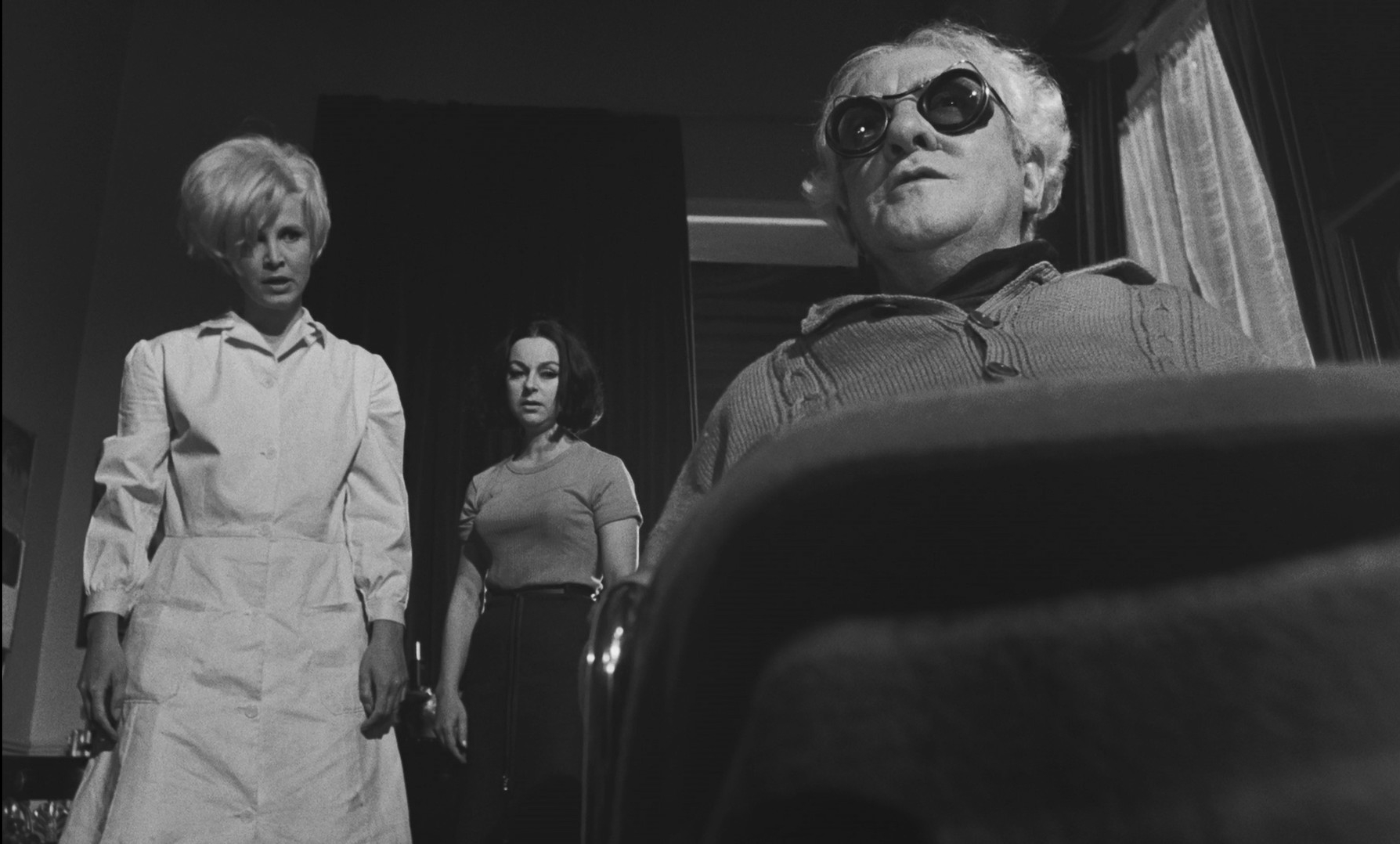
As with many of Jesús Franco’s films, The Diabolical Dr. Z is akin to a waking dream, with logic taking a backseat. But considering the excesses of Franco’s later efforts, Dr. Z shows surprising restraint, most likely enforced by the censors of the time (Miss Death’s revealing costume notwithstanding). Besides the film’s neo-noir leanings, Dr. Z features some excellent performances by Mabel Karr’s as the icy Irma and Estella Blain as the aforementioned Miss Death. Franco himself has a nice semi-comic turn, in the (uncredited) role of the perpetually exhausted Inspector Tanner, who constantly complains about his triplet babies keeping him awake at night. Is The Diabolical Dr. Z proof to the Franco naysayers that he could make a good movie? Well, some naysayers are going to “nay,” no matter what. Those with an open mind (Francophiles and horror fans alike), however, might be pleasantly surprised by this stylish horror thriller.   


Sources for this article: Tim Lucas DVD commentary; JessFranco (interview), by Sean O’Neal, AV Club (2009) 


Monday, April 28, 2025

Cave of Forgotten Dreams


Cave of Forgotten Dreams Poster

(2010) Directed by Werner Herzog; Written by Werner Herzog and Judith Thurman; Starring: Werner Herzog, Jean Clottes, Julien Monney, Jean-Michel Geneste and Michel Philippe; Available on Blu-ray and DVD 

Rating: ***½


Cave Paintings

“There was intense competition to film it, particularly from French directors, all good, serious candidates, and I didn’t think I was in with much of a chance because the French think very territorially when it comes to their patrimoine. All the experts who had explored the cave were French, and my first hurdle was to gain their approval, then that of the regional government of the Ardèche.” – Werner Herzog (from his memoir, Every Man for Himself and God Against All

Cave Bear Skull and Bones

The closest thing we have to a time machine in which we can visit our ancient ancestors is examining the traces they left behind. The Chauvet Cave paintings in southeastern France, dating back approximately 32,000 years, were discovered as recently as 1994, and are among the oldest known examples of cave art.* The Paleolithic Period paintings remain perfectly preserved, due to a rockslide 20,000 years ago, which sealed Chauvet from the outside world. Now managed by the French government, the original entrance has been widened but sealed tight like a bank vault, with a locked metal door. In order to maintain the cave’s pristine appearance, access is restricted to a fortunate few with legitimate scientific interest.**. Facing competition from French filmmakers, Werner Herzog had to convince then French Minister of Culture, Frédéric Mitterrand, that he was the right person for the job. The results (originally presented in 3D) are the closest look most people are likely to get inside Chauvet Cave. Due to strict regulations, director/co-writer Herzog worked with a crew of four (including himself). They were only permitted to film for a maximum of four hours per day for less than a week. Within the confines of the filming window, they were forbidden to touch anything, or venture away from the confines of a two-foot-wide walkway, which ran the length of the 1,300-foot cave. 

* Fun Fact #1: While the paintings at Chauvet Cave are among the oldest known, two locations have them beat by a substantial margin: Maltravieso Cave in Spain (64,000 years) and the caves of Maros-Pangkep, South Sulawesi in Indonesia (51,000 years). 

** Not-So-Fun Fact: In 1963, French authorities closed another archaeological wonder to tourists, Lascaux Cave (featuring 17,000-year-old-artwork), as the accumulated breath of multiple visitors ultimately caused mold to grow on the cave walls. 

*** Fun Fact #2: Herzog’s shoot almost turned to disaster when the battery pack used to power the camera’s memory bank failed. Instead of missing out on four hours of filming, his crew fashioned a new battery from available parts, using only a tiny screwdriver and Swiss Army knife as tools.

Exploring the Cave

Cave of Forgotten Dreams provides insight into the nature of art as a means of human expression, confirming that such concepts as perspective and illusion of motion were employed by ancient artists. We can see what appears to be the birth of animation in the painting of a bison with eight legs, showing the range of motion. The cave paintings are also a document of a world that has come and gone, depicting animals that have long since vanished from the Earth, such as mammoths, wooly rhinos, and cave bears. The mind reels with speculation about who the individuals were who adorned its walls with artwork, and what sort of rituals the cave was used for. We’ll never know the names of the artists, their customs or culture, but for one curious artifact. Several paintings include the handprint of a single individual. Akin to their signature, the handprint uniquely identifies the artist because of a crooked pinkie finger on their right hand. We can also infer that the artist stood about six feet tall, based on the placement of the handprints throughout the cavern.

Julien Monney

We hear from several archeologists and other professionals who share a special affinity for Chauvet cave, and the paintings within. One of the most intriguing individuals interviewed by Herzog is archaeologist Julien Monney, who started out working for a circus as a unicyclist and juggler. Reminiscent of Herzog’s superior documentary, Encounters at the End of the World (2007), the interview underscores the sort of eclectic professionals working toward a common goal. Monney addressed the psychological and spiritual impact of his initial viewing of the paintings, stating that he needed to take several days away from the cave to process the images.

Handprints

Compared to some of his other documentaries, Herzog seems to take more of a backseat approach to the film, letting the cave paintings speak for themselves. Herzog, himself, is not featured as prominently, and his commentaries seem relatively sparse. One of the director’s trademarks, dwelling on shots for a protracted length of time, is present, although an overabundance of these shots (which repeat themselves several times) will likely test the attention spans of many viewers. While it’s a fascinating subject, the material is stretched a bit thin for a 90-minute documentary, which might have been better served by a shorter running time. Herzog goes off track during the last half-hour, discussing another cave in nearby southwestern Germany, as well as a greenhouse project several miles down river from the cave entrance. Regardless of the pacing issues, it’s virtually impossible not to be entranced by the subject matter. At its best, Cave of Forgotten Dreams is an almost metaphysical journey that transcends time, space, and human thought, providing a fascinating glimpse of something few of us will ever experience first-hand. 


Sources for this Article: Every Man for Himself and God Against All, by Werner Herzog, “Narrative Cave Art in Indonesia by 51,200 Years Ago,” Nature (July 3, 2024)

Tuesday, March 29, 2022

Body Horror Month Quick Picks and Pans

Taxidermia Poster

Taxidermia (2006) Director/co-writer György Pálfi’s fascinatingly grotesque film consists of a trio of interwoven stories (based on short stories by Lajos Parti Nagy), covering three generations (1942, 1960s, and presumably the 1980s) of a Hungarian family. In the first segment, a sexually frustrated soldier indulges in his perverse fantasies. The second concerns a fictional Eastern Bloc eating contest, while the third involves a skinny taxidermist (Marc Bischoff) and his beyond-morbidly obese father (Gábor Máté). Pálfi juxtaposes some truly stomach-turning imagery with visual poetry, adding up to an unforgettable viewing experience. It’s a mixture decidedly not for everyone, but if you’re that certain someone who appreciates the repugnant with the sublime, this might just be precisely what you’re looking for. 

Rating: ****. Available on DVD

Titane Poster 

Titane (2021) This audacious, unsettling movie by filmmaker Julia Ducournau makes her one to watch. Alexia (Agathe Rousselle), an exotic dancer with a titanium plate in her skull, has intercourse with a car (No, really!). She subsequently becomes pregnant, but there’s much, much more to the story, full of twists and turns that I wouldn’t dare spoil here. I’m not going to venture an explanation about what it all means, and I can’t exactly say I enjoyed it, but I can’t help but admire Titane’s unflinching commitment to its absurd premise, melding flesh and metal.   

Rating: ***½. Available on Blu-ray, DVD and Hulu

Sssssss Poster

Sssssss (1973) Strother Martin plays, Carl Stoner a herpetologist shunned by the scientific community because of his unorthodox theories. He hires David Blake (Dirk Benedict, of Battlestar Galactica and A Team fame), a naïve young college student as his assistant. Soon, he becomes Stoner’s unwitting pawn in an experiment to transform man into a king cobra. Complications ensue when the mad doctor’s comely daughter Kristina (Heather Menzies-Urich) falls for David. None of the proceedings in this batty flick make a lick of sense (It’s never explained why Stoner keeps the cobra’s mortal enemy, a mongoose, on the premises, except perhaps to justify the climactic battle), but it’s strangely entertaining, thanks to a committed cast and some cool makeup effects. 

Rating: ***. Available on Blu-ray and DVD

The Manster Poster

The Manster (aka: The Split) (1959) Some men could be accused of being led around by their “other” head (amiright?), but I’d wager no one’s expecting to take that literally. Larry Stanford (Peter Dyneley), an American journalist working in Japan, meets mad scientist Dr. Suzuki (Tetsu Nakamura), and soon becomes a test subject. After the doctor injects him with an experimental serum, Larry suddenly sprouts another noggin, and his baser instincts take hold. He forgets his wife Linda (Jane Hylton), starting an affair with the scientist’s lascivious assistant, Tara (Terri Zimmern). By the end of The Manster, the only thing that Dr. Suzuki’s experiment proves is that two heads are certainly not better than one. Don’t be surprised if you find yourself scratching your own coconut over the dubious science and the wacky climax. 

Rating: ***. Available on Blu-ray and DVD

Antiviral Poster

Antiviral (2012) Filmmaker Brandon Cronenberg’s commentary on the cannibalistic nature of celebrity worship brings up some intriguing concepts, and the labyrinthine plot wouldn’t be out of place in a film noir. It’s too bad that it suffers from a wooden lead (Caleb Landry Jones) who mumbles most of his lines and a cast of unrelatable characters. I suppose the art design (where white walls predominate) was intended to convey an austere, clinical look, but without the benefit of contrasts from set to set, the overall impact is numbing. The net effect is an intellectually stimulating, yet emotionally uninvolving experience. 

Rating: ***. Available on Blu-ray and DVD

Exte - Hair Extensions Poster

Exte: Hair Extensions (2007) Director/co-writer Sion Sono dips his foot in the body horror sub-genre, with this fractured fable about human foibles and stolen follicles. A mysterious shipping container yields a bizarre and gruesome discovery when officials find it filled with hair and bodies. A lonely dock guard with a hair fetish (Ren Osugi) takes one of the corpses (which might or might not be alive) home, to harvest its continually sprouting locks. Meanwhile, Yuki (Megumi Satô), a young hair stylist, contends with her irresponsible older sister while she balances her job responsibilities. There are some nice moments, featuring creepy imagery, but Sono’s film is all over the board, tonally (from wacky comedy to a drama about child abuse). I wish Sono had picked a lane and stuck with it, but Exte might be worth a look, for curiosity’s sake. 

Rating: **½. Available on DVD

Tusk Poster

 Tusk (2014) An obnoxious podcaster (Justin Long) travels to Canada to cover an internet meme celebrity, only to find a much bigger story, involving an eccentric retired sea captain (Michael Parks) who’s obsessed with walruses. Little does he suspect (Isn’t that always the case) that he’ll soon become a victim of the warped millionaire’s latest experiment. The story at the movie’s core would make a nice half-hour segment in a horror anthology. Unfortunately, Writer/director Kevin Smith fills the other two thirds of the movie with mostly unfunny gags (imagine every Canadian stereotype thrown into the mix) and scenes that go nowhere (mostly involving an uncredited Johnny Depp as a French-Canadian detective). While I can’t recommend this movie in good conscience, it might be worth checking out, if only for the absurdly horrifying scenes of the walrus-human creation (featuring some excellent makeup effects supervised by Robert Kurtzman of KNB Effects). 

Rating: **½. Available on Blu-ray, DVD and Kanopy

Contracted Poster

Contracted (2013) Writer/director Eric England’s cautionary tale starts with an intriguing premise, but falters after it leaves the starting gate. After being manipulated into an ill-advised one-night stand, a young woman discovers a strange disease spreading rapidly throughout her body. She soon finds herself falling apart, while she gradually alienates herself from everyone. Unfortunately, Contracted is hampered by unconvincing performances and situations. Even when she undergoes some very conspicuous (and icky) changes, no one seems overly concerned. Even her doctor, completely at a loss about her illness, doesn’t seem particularly alarmed (I’m not an MD, but I’d probably contact the CDC or refer her to a hospital). Instead, everyone thinks she’s being annoying, hooked on drugs, or making things up. There was a great opportunity for social commentary, but it’s a hard pill to swallow when it’s so clumsily executed. 

Rating: **. Available on Blu-ray and DVD


Wednesday, December 1, 2021

Rififi


Rififi Poster

(1955) Directed by Jules Dassin; Adapted by Jules Dassin; Based on the novel by Auguste Le Breton; Starring: Jean Servais, Carl Möhner, Robert Manuel, Janine Darcey, Claude Sylvain, Robert Hossein, Marcel Lupovici and Jules Dassin (as Perlo Vita); Available on Blu-ray and DVD 

Rating: ****½  

“There was a passage in the book that had to do with a robbery, which was to finance a greater project, and I seized upon that to build a screenplay around it, and make it a high point in the film. …Many people asked me why silence, because there’s not a word spoken for a long time, and I said these are professional guys who work in silence. Noise is an enemy…” – Jules Dassin

Viviane's Musical Number

Jules Dassin didn’t invent the heist film, but he perfected it with Rififi (aka: Du Rififi Chez les Hommes), which depicts the perfect crime, only to see everything fall apart. The heist is only the beginning of this noir-drenched* tale, which explores the self-destruction and collateral damage caused by a life of crime. The film’s title (also heard as a jaunty nightclub song, performed by Magali Noël as Viviane) is French slang for a tough guy, or perhaps more accurately, the swagger that goes along with the tough guy persona.** American-born director Jules Dassin, a victim of the blacklist, adapted Auguste Le Breton’s novel,*** providing a counterpoint to the characters’ hyper-masculine exploits. 

* Fun Fact #1: In order to create the proper tone, Dassin chose to shoot the film entirely on cloudy days, much to the irritation of the producers. 

** CORRECTION: According to my Twitter pal Jean-Paul Audouy (@jpaudouy): "Rififi means “violent fight” and by extension the damages caused by a fight."

*** Fun Fact #2: After reading Dassin’s adaptation, Le Breton was reportedly displeased, asking the director point-blank, “Where is my book,” while placing a gun on his desk. Dassin managed to smooth things over with the fiery tempered writer (who seemed to fashion himself after the hard-boiled characters in his book), and eventually became friends.

Tony, Mario & Jo

 Middle-aged thief Tony le Stéphanois (Jean Servais) is released from prison after serving five-years of his sentence, taking the rap for Jo (Carl Möhner), a younger man. Jail has left its mark on Tony, as evidenced by his chronic cough. Meanwhile, his girlfriend Mado (Marie Sabouret) has left him for another man, shady nightclub owner/kingpin Pierre (Marcel Lupovici). He reconciles the loss in the worst possible way, by taking her jewelry and beating her (thankfully, this is depicted off-screen). Reluctant at first to plunge back into his former life, he ultimately decides to assist Jo and his scheme to knock off the jewelry store Mappin & Webb.* Along with Jo, he joins Mario (Robert Manuel), a flashy-dressing lock picker, and Cesar le Milanais (played by director Dassin, under the pseudonym Perlo Vita), a womanizing safe-cracker. Prefiguring the longer heist sequence, the scene where Cesar cases the jewelry store is wordless. In the scene that follows the thieves meticulously plan every aspect of the impending robbery, timing the nearby traffic, accessing the location in relation to the other businesses, and rehearsing the operation, down to the slightest detail. 

* Fun Fact #3: Dassin recalled how the filmmakers didn’t expect to receive a positive response, when they asked Mappin & Webb if they would mind being featured in the film. To Dassin’s surprise, they enthusiastically consented.

Opening the Safe

Rififi’s claim to fame is indisputably the 30-minute heist sequence, presented from start to finish without dialogue or music.* It’s the antithesis to what we’ve come to expect from directors who would want to fill the space with superfluous chatter (I’ll refrain from naming any names). Instead, we’re left to observe the well-orchestrated operation,** as Tony and company move in synch with each other like an elaborate dance (as if to underscore this imagery, Cesar wears ballet slippers during the heist). As the scene plays out, it becomes evident how speech would be an extraneous distraction. A thick undercurrent of tension fills the void, allowing the audience to focus on the little details of the team’s precision efforts.   

* Fun Fact #4: According to Dassin, the film’s composer, Georges Auric, created music for the 30-minute sequence (at the insistence of the producers). After playing the film with and without music, Auric agreed with Dassin that it was better to keep things silent. 

** Fun Fact #5: Apparently, Dassin was a little too spot-on with some of the heist’s details, reportedly spawning a series of copycat robberies in multiple cities, where Rififi was shown.

Surveying the Goods

The following scene provides insight into the thieves’ possible futures, as they sit around a table, surveying the goods. For such a sizable haul (worth 240 million francs), their dreams are disproportionately mundane. Mario hopes to spend the money on various hotels, trying out the beds with his wife. In a similar vein, Cesar plans to continue his womanizing lifestyle. Jo, on the other hand, wishes to spend his cut on his young son, Tonio (Dominique Maurin), presumably to shelter him from falling into the same life of crime. Tony, the most seasoned of the bunch, is unsure about what he will do. He’s grown accustomed to a life of crime, which has become his trap. For him, there is no other way of life.

Tony & Jo

The group’s diminutive dreams, prove to be short-lived, when Pierre deduces who perpetrated the theft. Their downfall seems almost pre-ordained, brought on by Cesar’s vanity and Mario’s carelessness. For his part Jo is blinded by thoughts of making a better life for his son, concluding that the means justify the ends. He fails to ponder the consequences that affect his family, when Pierre orders his thugs to kidnap Tonio. Whether he gets his child back or not, he’s lost in the eyes of his wife, who views him as nothing but a common criminal who sold out his family.  

Tonio & Tony

One of Rififi’s most salient themes is the loss of innocence, personified by Jo’s son. Dressed as a cowboy, he waves his toy gun around, in a playful mimicry of the tough guys on both sides who brandish the real thing. To a group of hardened thieves, it’s serious business, but to a five-year-old, it’s all a big game. At its heart, Rififi is a bleak condemnation of criminal culture – a nowhere road of toxic masculinity and misplaced pride, where stereotypical posturing and misogyny is de rigeur. Rather than glorifying career criminals, it teaches us even the best laid plans eventually lead down a destructive path, from which there is no return and no hope of redemption. 

Thursday, September 30, 2021

Silent September V Quick Picks and Pans


Orochi Poster

Orochi (1925) Tsumasaburô Bandô stars as Heisaburo Kuritomi, a disgraced samurai. After being castigated by his master for a fight he didn’t initiate, he’s marked as a troublemaker. His life only continues to take a downward spiral from there, after he’s eventually banished from his village. The now masterless samurai (ronin) moves to a new town, where (due to a series of misadventures and misunderstandings) he becomes the local pariah. Bandô captivates in his tragic role, as a man doomed to live a life of unrequited love and failed aspirations. Orochi reminds us that the outwardly virtuous, as well as the apparently detestable, may not be all that they seem to be. The DVD from Digital Meme’s “Talking Silents” series provides a uniquely engaging viewing experience, featuring Benshi narration, in which a host tells the story, performing the voices for each of the characters.

Rating: ****. Available on DVD

The Dragon Painter Poster

The Dragon Painter (1919) Sessue Hayakawa stars as Tatsu, a mercurial artist living a monastic existence in the mountains. All of his paintings are an interpretation of his long-lost love, a woman who was turned into a dragon 1,000 years ago. After viewing his art, an elderly painter views him as his worthy disciple. In an effort to keep the reluctant artist, he convinces Kano that his daughter Ume-Ko (Tsuru Aoki) is the woman he’s been questing all his life. As embodied by Hayakawa, The Dragon Painter (based on the novel by Mary McNeil Fenollosa) demonstrates how madness and talent frequently reside together. Much like Tatsu’s creations, it’s a simple tale, elegantly told, managing to create a nuanced character study with bold, spare strokes. 

Rating: ****. Available on DVD (Out of Print)


The Blue Bird Poster

The Blue Bird (1918) This visually imaginative fantasy film from director Maurice Tourneur (the father of director Jacques Tourneur), based on a play by Maurice Maeterlinck, is a delightfully weird and wonderful feast for the eyes. Two young children, Mytyl and Tyltyl (Tula Belle and Robin Macdougall) search for the Blue Bird of Happiness, with the aid of a fairy (Lillian Cook). With the help of his magic cap, Tyltyl sees things as they truly are. Along their quest, they experience a series of whimsical (and sometimes downright creepy) adventures, finding a new appreciation for the things they already possess. While the conclusion won’t surprise anyone, it’s a fun voyage, perfect for kids, or adults who never lost touch with the kid inside.   

Rating: ****. Available on DVD (Out of Print)


The Queen of Atlantis Poster

The Queen of Atlantis (aka: Missing Husbands, or L'Atlantide) (1921) French soldiers locate a missing army lieutenant (Georges Melchior) wandering alone and dying of thirst, in the Saharan desert. His companion, Captain Morhange (Jean Angelo) is nowhere to be found. Thus begins the story (told in flashback) of one man’s quest for the lost city of Atlantis. Stacia Napierkowska co-stars as the capricious Queen Antinea, a woman wielding irresistible power over men. The French/Belgian production features some impressive sets and stunning location photography, highlighting Algeria’s stark, merciless desert landscape. Arguably, the film’s nearly three-hour running time could have been cut by a third, but it remains an engrossing tale of obsession driving men to extreme behaviors. 

Rating: ***½. Available on DVD


Siren of the Tropics Poster

Siren of the Tropics (1927) Josephine Baker stars (in her first feature) as Papitou, a free-spirited resident of the French Antilles. You have to wade through some annoying island native stereotypes, but Baker’s charisma shines through. A lecherous businessman (Georges Melchior) with designs on his goddaughter decides to get her fiancé out of the way, by sending him to the Antilles under the auspices of prospecting minerals. He conspires with a shady business associate to ensure that he never makes it back to France. Siren of the Tropics has something for everyone, filled with drama, action, romance, and a dash of screwball comedy (Baker’s chase scene on an ocean liner reminded me of a Buster Keaton routine). But of course, the film’s true raison d’etre is a chance to showcase Baker’s formidable dancing prowess. 

Rating: ***½. Available on DVD (Part of the Josephine Baker Collection)

The Saphead Poster

The Saphead (1920) In Buster Keaton’s first full-length feature, the comic actor plays Bertie Van Alstyne, the scatterbrained son of a tycoon (William H. Crane). Bertie risks being cut off from his inheritance unless he finds a way to become a productive member of society. Can Bertie win the respect of his doubting father, and prove his merit to his sweetheart? Keaton wasn’t a headliner in The Saphead, and it shows, with the film lacking the elaborate pratfalls of his later features. It’s not without its charms, however, especially when Keaton’s singular comic genius is allowed to shine through. Unfortunately, the movie is bogged down by the other peripheral characters, and a plot that focuses on stock trading, so watch accordingly. 

Rating: ***. Available on DVD


The Circus Poster

The Circus (1928) Charlie Chaplin returns for more hijinks with his Little Tramp character. After a misunderstanding with local law enforcement, he stumbles into a circus, mid-performance. His accidental routine becomes a surprise hit with the audience, and he becomes the unwitting star of the show. The film isn’t one of Chaplin’s best, but it has some inspired moments, including one scene where he’s supposed to mimic the gags of a troupe of clowns, only to end up undermining their act. He befriends a young trapeze artist (Merna Kennedy), who lives with her abusive ringmaster stepfather (Al Ernest Garcia). Kennedy and Chaplin’s chemistry seems more perfunctory than genuine, and her character’s dysfunctional relationship with her stepfather never achieves a satisfactory resolution. Nevertheless, there are some nice comic moments peppered throughout, which provide more than enough for me to give The Circus a recommendation. 

Rating: ***. Available on Blu-ray and DVD


Tuesday, March 2, 2021

Beauty and the Beast (aka: La Belle et la Bête)


Beauty and the Beast Poster

(1946) Written and directed by Jean Cocteau; Based on the story by Madame Leprince de Beaumont; Starring: Jean Marais, Josette Day, Mila Parély, Nane Germon, Michel Auclair and Marcel André

Available on Blu-ray and DVD

Rating: *****

“To find trees where there are none, or something where it shouldn’t be, such as a hat off a head in one shot but on again in the next, are, as it were, cracks in the wall through which poetry can penetrate. Those who notice such spelling mistakes are the real illiterates and cannot be moved by fantasy anyhow. Such details have no importance.” – Jean Cocteau (from Diary of a Film, by Jean Cocteau)

Belle and the Beast

Fairy tales stand apart from more conventional stories because of their timeless quality, passed down from generation to generation. They reside on their own plane, a kind of universal language that’s understood and enjoyed by young and old. When or where they take place isn’t relevant, compared to the lessons they teach us about human nature. Beauty and the Beast (aka: La Belle et la Bête) begins, fittingly enough, with “Once upon a time…” In his introduction, writer/director Jean Cocteau invites us to enjoy his film with the innocence and wonderment of a child. Beauty and the Beast, which Cocteau described as “a fairy tale without fairies,” was years in the planning, and filmed from late 1945 through the first half of 1946. He utilized real-life locations for the exteriors (which gave the film a more expansive feel), while the interiors were filmed in sound stages around Paris. An 18th century manor house in Rochecorbon* served as the home for Belle and her family, and the exterior of a sprawling estate in Raray became the Beast’s castle. The production suffered numerous setbacks, including the illnesses of Jean Cocteau** and cast members Jean Marais and Mila Parély, multiple power outages, and budgetary constraints that necessitated the use of several different film stocks. It’s a testament to Cocteau’s vision, chronicled extensively in his Diary of a Film, that he never lost his way.    

* Fun Fact #1: For his location shoot in Rochecorbon, Cocteau was plagued with constant flyovers from a local military airfield – the anachronistic drone of the aircraft (and their presence in the sky) would have undoubtedly taken viewers out of the fairy tale world.

** Not-So-Fun-Fact: Cocteau suffered from numerous ailments throughout the course of filming, including facial rashes, boils, a tooth abscess, and painful sensitivity to the studio lighting. At one point, some of his symptoms became so severe that he was hospitalized for a few days, followed by several days of recovery, bringing production to a temporary halt.

Belle and Family

Belle (Josette Day)* spends her days caring for her merchant father (Marcel André), and being subservient to her two cruel, narcissistic sisters Félicie and Adélaïde (played by Mila Parély and Nane Germon, respectively). While she toils away with the housework, they dress in the finest clothing, acting like royalty, even though the family fortune has been squandered. Her brother Ludovic (Michel Auclair) mocks her sisters for their haughty ways, while he wastes his hours with his friend (and Belle’s potential suitor) Avenant (Jean Marais).** One fateful evening, Belle’s father, too destitute to pay for a room at an inn, is forced to ride through the forest alone at night. He encounters an enchanted castle, where he spends the evening. During a walk in the garden, he picks a single rose for Belle, which incites the sole denizen of the estate, a fearsome Beast. The enraged creature spares his life, in exchange for one of his daughters. Despite her father’s protests, Belle selflessly volunteers to go in his place. Anyone familiar with Madame Leprince de Beaumont’s enduring story, or its many incarnations and permutations, will know the rest.

* Fun Fact #2: According to film historian Arthur Knight, Josette Day was so frightened of the Beast’s horse “Magnificent,” featured prominently in the film, that Cocteau used a double for her riding scenes.

** Fun Fact #3: In de Beaumont’s original story, Belle had three brothers, which was changed simply to Ludovic for the movie. Avenant served as Belle’s sole suitor, in place of multiple (unsuccessful) suitors in the story.

The Beast

Cocteau found a fitting Beast/Avenant/Prince in his lover/muse of several years, Jean Marais. The triple role was especially demanding as the Beast, which required enduring the extensive makeup by Hagop Arakelian.* Despite the limitations imposed by the makeup (which restricted what he could eat, and often placed him into a foul temper), Marais’ passionate performance shines through. With his face obscured, he conveys pathos with his eyes and emotes through body movement. 

* Fun Fact #4: Marais’ Beast makeup required five hours to apply, and his scenes sometimes demanded that he stay in makeup for up to 15 hours at a stretch (a feat that would likely have tested anyone’s patience).

Belle in the Castle

The film’s design required ingenuity from Cocteau’s dedicated team of craftspeople, accomplishing so much with so little. In his film diary, Cocteau lamented that there wasn’t a budget to shoot the film in color. Black and white, however has its own magic. Per his instructions, the castle interiors were based on the works of French illustrator Gustave Doré. The imagery, particularly in the Beast’s castle, resembles pencil sketches or charcoal drawings, effectively mimicking what you’d expect to find in an old storybook. The monochromatic images contribute to the ethereal nature of the subject matter, with the results resembling a waking dream. In one scene, Belle traverses one hallway in slow motion, as if in a somnambulistic trance. In another part of the castle, she glides through a corridor as though she were floating on air. The sets incorporate surreal touches, including candelabras held up by disembodied arms jutting from the walls, food and drink that serves itself, and ghostly caryatids, whose eyes follow Belle’s every movement. Cocteau also employed old-fashioned trick photography (dating back to the films of Georges Méliès) to depict the impossible, as when Belle’s tears become diamonds. With its emphasis on visuals and pantomime, Beauty and the Beast could just as well be a silent film. In many cases, the dialogue (which Cocteau confided was something he didn’t enjoy writing) is almost incidental.  

Beast and Belle

Contrary to what we’re led to believe, it’s not the beast who’s ugly. Rather, it’s others’ distorted perceptions of him, fueled by avarice, envy and ignorance. It takes Belle’s patience and compassion to see the beauty inside (although truth be told, I never thought he looked ugly in the first place. His supposedly dreadful appearance is something we have to accept on faith alone). Similar to the roses the Beast cherishes, the film is a respite from the awful realities of the world. It’s an exquisite work, told with finesse, humor, and above all, the heart of a child. Cocteau understands the conceits of the fairy tale, working within its confines, which requires the complicity of the audience. The more one tries to peek behind the curtains to explain away the machinations of the film or reveal the magic, the further they stray from the mark. Beauty and the Beast is a simple story, wonderfully told, by a master at the top of his craft. It’s a fitting film, if ever there was, to combat the cynicism of an adult in these complex times. 

Sources for this article: Diary of a Film by Jean Cocteau; Criterion DVD commentary by Arthur Knight